
Convert every question’s marks into minutes before you write a single line, scan the whole paper in the first three to five minutes, apply a strict three-minute rule on anything that stalls you, and bank the last ten minutes purely for checking. This single routine, backed by Ofqual’s official exam guidance and the structured practice papers on Mathvault, is what separates students who finish with marks left on the table from those who don’t.
TL;DR:
- Strict pacing routines, including initial question scanning and checkpoint timing, are essential for maximizing exam marks and avoiding time pressure.
- Building automatic pacing requires staged practice over several weeks, starting with untimed work and progressing to faster-than-exam simulations.
- Calculating the minutes-per-mark helps identify slow topics and optimizes time allocation for different question types, including calculator use and method marks.
- In the exam, quick wins should be tackled first, with deliberate skipping and proper note-taking on questions to maximize method marks and efficient checking.
- Regular timed practice, self-marking against official solutions, and replicating exam conditions are crucial for developing reliable exam speed and recovery techniques.
Table of Contents
- Time management for a maths exam: your first-5 and last-10 checklist
- How should you structure practice so pacing becomes automatic?
- What should you actually do while sitting the paper?
- Common timing mistakes and how to fix each one
- Timed drills and a weekly routine that build real speed
- How to recover marks in the final checking minutes
- How Mathvault helps you train exam pacing specifically
- An honest note on why pacing feels impossible until it isn’t
- Start training your exam pacing this week
- Where these recommendations come from
- Sources
- FAQ
Time management for a maths exam: your first-5 and last-10 checklist
Pacing collapses when students freestyle it. A fixed opening and closing routine, rehearsed until it’s automatic, removes the guesswork on the day.
Here’s the sequence to drill until it feels boring:
- Minutes 0 to 3: Scan every question. Mark the ones that look quick with a tick and the long multi-step ones with a star.
- Minute 3: Write your minutes-per-mark figure at the top of the page (more on the calculation below) and jot rough checkpoint times next to major question blocks.
- Minute 4 onwards: Decide your attack order. Quick wins first builds momentum and banks marks before fatigue sets in.
- Throughout: Apply a three-minute stuck rule. If a question hasn’t moved in three minutes, write down whatever method or formula you’ve got, then move on.
- Final 10 minutes: Stop attempting new work. Switch entirely to checking high-mark questions, recovering method marks on abandoned questions, and confirming units and rounding.
Pro Tip: Write your checkpoint times directly onto the question paper, not just in your head. A number in front of you is far harder to ignore than a vague sense that “time’s getting on”.
How should you structure practice so pacing becomes automatic?
Pacing isn’t something you can cram the night before. It’s a trained reflex, and it needs a staged build-up over several weeks.
The progression that works best follows four stages:
- Untimed topic work. Master the maths itself first, with no clock running.
- Generous timing. Attempt past papers with roughly 50% more time than the real exam allows, so you build the habit of checking your pace without panicking.
- Exam-timed papers. Sit full papers under the exact time limit, ideally in exam-like conditions (no phone, no notes).
- Faster-than-exam runs. In the final fortnight, try completing a paper in 10 to 15% less time than allowed. It sounds brutal, but it builds a buffer that a slow question or two can eat into without wrecking your finish.
RevisionDojo’s pacing research recommends starting this staged timing progression eight to twelve weeks before a final exam, and four to six weeks before a smaller unit test.
Here’s the maths behind minutes-per-mark, worked through properly. A typical GCSE Higher paper (Edexcel, AQA or OCR) runs 90 minutes for 80 marks, giving you roughly 1.1 minutes per mark. An A level Pure paper often runs 2 hours for 100 marks, close to one minute per mark. Multiply a question’s mark allocation by that figure and you get a target time. A 6-mark question at 1.1 minutes per mark should take around 6.6 minutes, not the 12 you might lose to it without a target in mind.
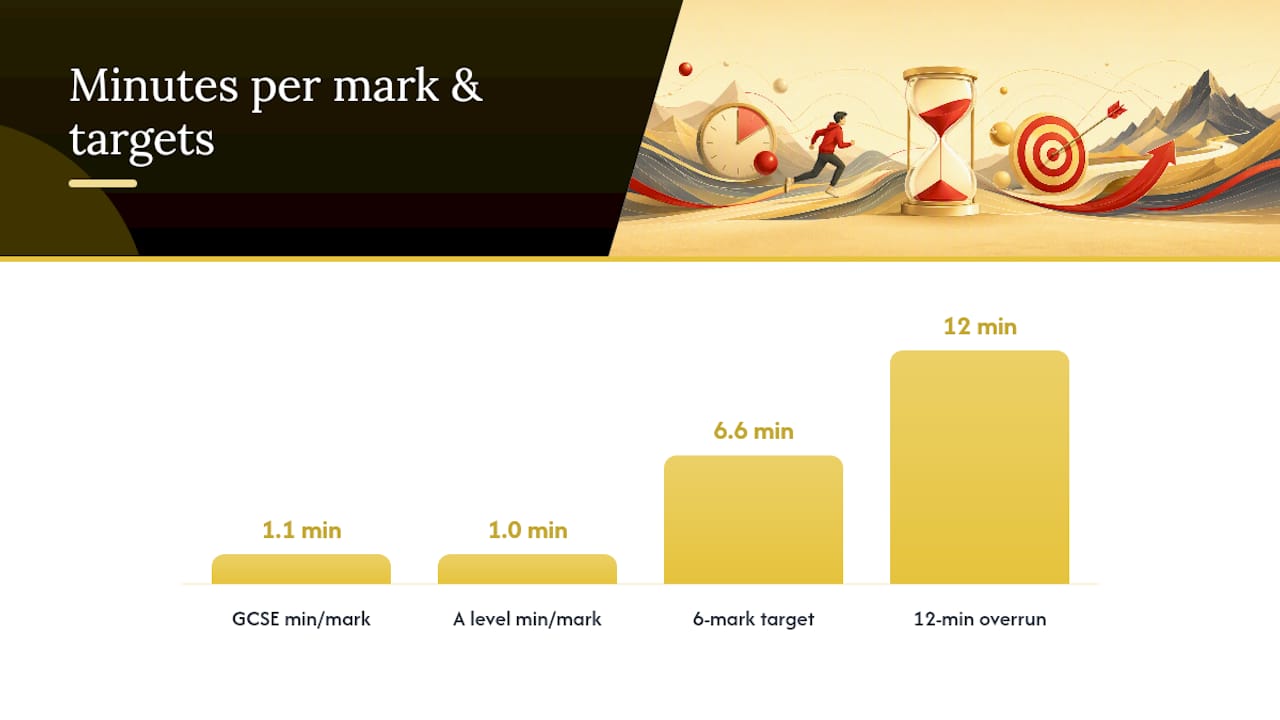
Run this calculation on your own exam board’s timing before you start a timed past paper practice session, and note recurring slow topics in an error journal. If trigonometry consistently eats double its allotted time, that’s where your revision hours belong.
Calculator fluency saves real time too. Practising which steps genuinely need a calculator and which are faster by hand (simplifying fractions, basic arithmetic) stops you fumbling through menus mid-exam.
What should you actually do while sitting the paper?
Getting the theory right matters less than executing it under pressure, when your hands are cold and the invigilator has just announced “you may begin.”
Here’s the sequence, step by step:
- Scan first, write nothing. Spend three to five minutes reading every question, ticking quick wins and starring long ones. This is not wasted time. It’s the single highest-leverage move in exam-specific pacing guides, because it stops you burning your best focus on a question you’ll later realise wasn’t worth it.
- Write checkpoint times. At the top of your paper, note what time you should be at question 10, question 20, and so on, based on your minutes-per-mark figure.
- Run a sanity check at the halfway point. If you’re behind, don’t panic. Speed up on the ticked quick wins you haven’t reached yet, and be ruthless about the three-minute rule from here on.
- Skip and return properly. When you leave a question, write a short note. Not “come back to this” but something concrete: “tried substitution, got x = 3, check if valid” or “need quadratic formula, a=2 b=5 c=-3”. Future you will thank present you.
- Harvest method marks before moving on. Even an abandoned question deserves the formula, the substitution, and the first line of working. Examiners award marks for correct method even when the final answer is wrong or missing, so an empty box is the only guaranteed zero.
- Use substitution to check, not to re-solve. Plugging your answer back into the original equation takes seconds and catches most arithmetic slips. Re-solving a question from scratch to check it wastes minutes you don’t have.
- Final 10 minutes: checking only. No new attempts. Pure recovery and verification.
Pro Tip: If you’re more than two questions behind your checkpoint at the halfway mark, don’t try to solve every remaining question fully. Switch to “method marks only” mode: write the setup and first steps for everything, then circle back to finish the ones you can, in order of marks available.
Common timing mistakes and how to fix each one
Most students lose exam time to a small handful of repeat offenders. Spotting yours is half the fix.
- Calculator menu fumbling. Losing 30 seconds hunting for the right function wastes minutes across a paper. Fix it by practising the exact button sequences for standard deviation, simultaneous equations, and trig ratios until they’re muscle memory.
- Perfectionism on one question. Refusing to move on because “I’m so close” is the single biggest pacing killer. Fix it with the three-minute rule and a quick breathing reset (four seconds in, four seconds out, twice) before moving to the next question.
- Skipping method marks. Leaving a blank box because the final answer eludes you throws away marks you’d have got for free. Always write the formula and first substitution, even mid-panic. Mathvault’s guide to how method marks are awarded shows exactly what examiners look for.
- Misreading command words. “Show that”, “find”, “prove” and “hence” each demand different depth of working. A quick pre-exam habit: underline the command word in every question before you touch your pen.
Pro Tip: Command words are worth a five-second pause. “Show that” needs full working even if you can see the answer; “state” needs one line. Getting this wrong costs marks even when your maths is right.
Timed drills and a weekly routine that build real speed
Speed comes from repetition under realistic pressure, not from reading about pacing.
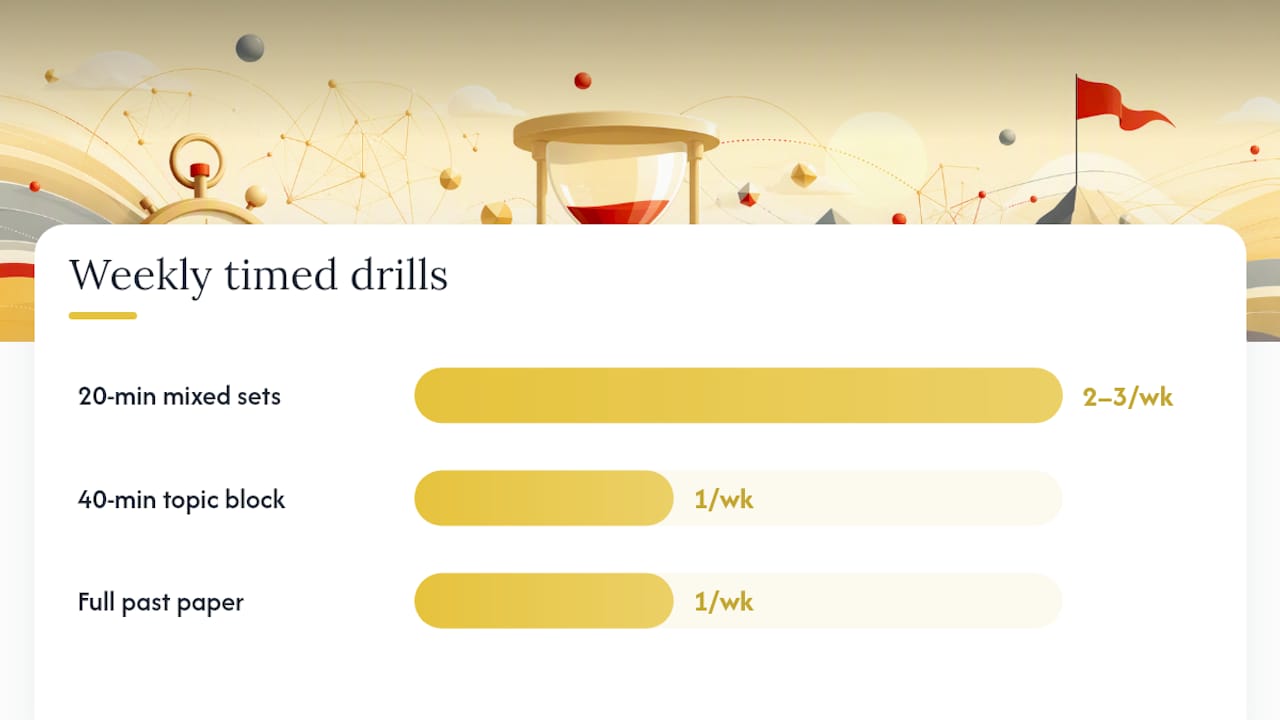
Three drill formats cover most of what you need:
- 20-minute mixed sets. Pull questions from different topics into one short timed block. This trains the topic-switching that full papers demand, and research on interleaved practice shows mixed-topic sets improve retention and problem-solving more than blocked single-topic revision.
- 40-minute topic blocks. Useful when you’ve identified a specific weak area from your error journal and need focused reps.
- Full past paper, once weekly. Under strict exam timing, ideally at the same time of day your real exam will run.
A simple weekly structure:
- Two or three 20-minute mixed sets across the week.
- One 40-minute block on your weakest topic, chosen from your error journal.
- One full timed past paper, self-marked against board-aligned solutions.
Record time-per-question on every timed attempt, not just the final score. In the final two weeks before the real exam, simulate a full exam day once, including start time, break length, and no phone, so the format itself holds no surprises.
How to recover marks in the final checking minutes
The last ten minutes aren’t for finishing new questions. They’re for recovering marks you’ve already half-earned.
Work through this order:
- High-mark questions first. A single error on a 6-mark question costs more than a slip on a 2-mark one, so check the big ones before anything else.
- Skipped subparts next. Questions with (a), (b), © structure often hide a quick, doable part further down that got missed under time pressure.
- Rounding, units, and significant figures last. These are the fastest points to lose and the fastest to catch on a final pass.
Don’t re-solve. Substitute your answer back into the original equation or check it against the question’s context (does a length come out negative? Does a probability exceed 1?). That takes seconds and catches most errors a full re-solve would.
Pro Tip: On any question you abandoned, glance back at your notes and check whether you can now add one more line of working. Half-credit for a correct formula, written in the last two minutes, is still credit.
How Mathvault helps you train exam pacing specifically
Reading about pacing changes nothing until you rehearse it against a real clock, on a real paper, marked against a real scheme.
There are board-aligned past papers, fully worked solutions and video walkthroughs available to practise exactly the routine above:
- Run a full timed past paper, then self-mark it against board-aligned worked solutions to see exactly where minutes went missing.
- Use the GCSE maths revision timetable to schedule your staged progression from untimed to faster-than-exam over 12, 8, or 4 weeks.
- Break the last-minute panic with a structured 48/24/8-hour revision plan that keeps timing practice front and centre right up to the exam.
An honest note on why pacing feels impossible until it isn’t
Pacing feels like guesswork the first few times you try it, because it is: you’re estimating, adjusting, and often still running out of time. That’s normal. It stops being guesswork once the initial scan, the checkpoint numbers, and the three-minute rule become rituals rather than decisions. A ritual doesn’t tax your working memory mid-exam; a decision does, every single time you have to make it fresh. Sit one timed paper a week, track your minutes-per-mark against the real result, and watch the gap close.
— Oloru
Start training your exam pacing this week
There are other ways to build exam speed. Some students rely on generic revision guides, others on tutors who focus on content over timing, and plenty just wing it under real exam pressure and hope. None of these give you what actually fixes pacing: repeated, timed practice on the exact paper format you’ll sit, marked against the exact scheme that will grade you.
The GCSE maths revision guides bring together board-aligned past papers, worked solutions, and downloadable revision timetables in one free place, built specifically for students in England, Wales and Scotland rather than adapted from a generic international syllabus. If you’re further along, the A level maths resources follow a similar structure. Pick one paper this week, time yourself properly using the minutes-per-mark method above, self-mark it against the worked solution, and note your result. Do that once weekly and you’ll have hard evidence of improvement well before results day.
Where these recommendations come from
The pacing strategies in this article draw on official UK exam guidance and published research on effective study methods, not generic advice.
- Ofqual’s student guide to exams and assessments covers exam conduct rules and how to apply for access arrangements or special consideration.
- The NHS guide to preparing for exams offers practical advice on sleep, nutrition and anxiety management that preserves your working speed under pressure.
- Scientific American’s summary of study research explains why spaced and interleaved practice beats cramming for mathematical retention.
Sources
- Ofqual: student guide to exams and assessments in 2026
- NHS: tips on preparing for exams
- Scientific American: Psychologists identify best ways to study
- RevisionDojo: IB math exam time management: 10 smart strategies
FAQ
How is maths used in time management during an exam?
Converting marks to minutes is itself a maths problem: divide total exam time by total marks to get your minutes-per-mark figure, then multiply by each question’s marks to set a target time. It’s the exact skill you’re being tested on, applied to the exam itself.
How much time should I spend on a 40-mark exam?
Divide the total exam duration by 40 to get your minutes-per-mark, then multiply that by each question’s mark allocation. On a typical 90-minute, 80-mark GCSE paper, that works out to roughly 1.1 minutes per mark, so a 40-mark section would need around 44 minutes based on the 1.1 minutes per mark figure.
How can I qualify for extra time in UK exams?
Access arrangements, including extra time, are usually assessed and applied for through your school or college well before the exam, following the process set out in Ofqual’s official exam guidance. Speak to your school’s SENCO or exams officer as early as possible, since evidence gathering takes time.
Is A level maths harder than GCSE maths?
A level maths builds on GCSE content but moves faster, covers more advanced topics like calculus and mechanics, and allows less time relative to the complexity of each question, which is exactly why staged timed practice matters more at A level, not less.
How many past papers should I time myself on before the real exam?
Aim for at least one full timed past paper weekly for several weeks before a final exam, following the staged progression from generous to strict timing recommended by pacing research, then self-mark each one to track improvement.
Leave a Reply