
Learners sit either Foundation or Higher tier papers, corresponding to broad grade ranges, with no coursework or controlled assessment involved. For full technical detail, the official specification PDF and the published sample assessment materials (SAMs) remain the definitive references.
TL;DR:
- The three units differ significantly in content focus, with Unit 1 emphasizing real-world financial contexts and Unit 3 covering measures, statistics, and problem solving.
- Students can be entered for mixed tiers across units, and grade boundaries depend on overall UMS scores, not just raw marks in individual units.
- Calculator use is permitted in Units 1 and 3, but not in Unit 2, requiring students to practice mental and written methods for geometry, ratios, and probability.
- Official resources like sample papers, formula sheets, and detailed specifications help teachers plan focused lessons aligned with the assessment objectives.
- Performance across the entire course depends on consistency, as the final grade reflects combined UMS scores, not isolated strengths or weaknesses.
Table of Contents
- Quick facts: units, weightings, paper lengths and marks
- What each unit covers in practice
- Assessment objectives and how they translate to exam tasks
- Tiering, entries and grading: choosing foundation or higher
- SAMs, formulae and teaching resources
- How MathVault supports WJEC students and teachers with aligned practice
- Grading criteria explained in detail
- How the specification aligns with curriculum standards and progression paths
- Common misconceptions or pitfalls regarding the specification
- Explanation of coursework or controlled assessment if applicable
- Teacher and examiner perspective: pragmatic tips for the new double award course
- MathVault revision packs and where to get WJEC-aligned practice
- FAQ
- Sources
Quick facts: units, weightings, paper lengths and marks
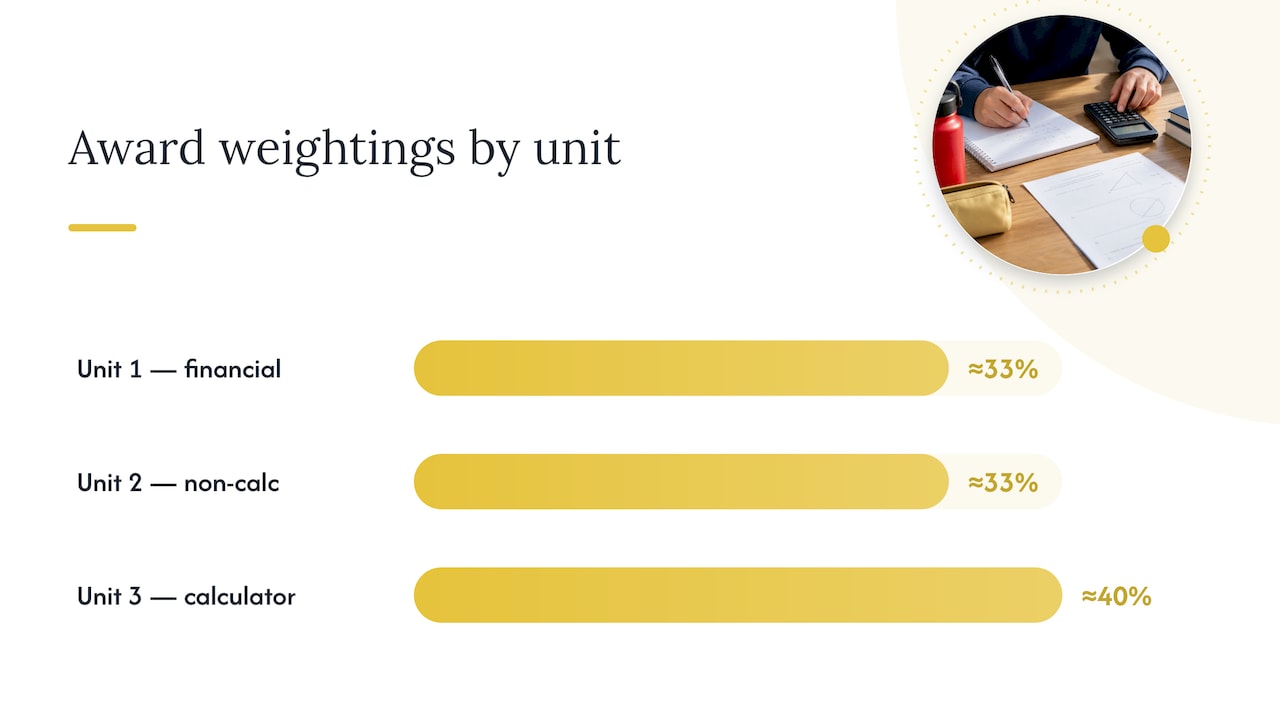
Each unit has a distinct purpose, and knowing the weightings helps you plan revision time sensibly rather than spreading effort evenly across topics that don’t carry equal exam value. Unit 1 covers financial and applied numeracy and accounts for about a third of the award. Unit 2 is non-calculator and also accounts for about a third. Unit 3 allows a calculator and carries the largest share, roughly two-fifths of the award.
Paper durations and raw marks differ by tier, as set out in the GCSE Mathematics and Numeracy qualification outline and the specification itself.
Unit availability is split across the summer and November series, with first assessment and awards confirmed for 2026.
What each unit covers in practice
Unit 1 leans heavily on real-world financial contexts such as budgeting, interest, exchange rates, wages and tax-style calculations that test whether students can apply number skills to situations they’ll actually encounter outside the classroom. Unit 2, being non-calculator, puts more weight on geometry, ratio and probability questions that demand fluent mental and written methods rather than calculator shortcuts. Unit 3 shifts the balance towards measures, statistics and extended problem-solving tasks where a calculator is expected and sometimes essential.
Across all three papers, the specification draws on the same four content domains, just in different proportions depending on the unit’s focus:
- Number: heaviest in Unit 1 and Unit 2, covering fractions, percentages, ratio and standard form.
- Algebra: present in every unit, from basic manipulation in Foundation to functions and graphs at Higher.
- Geometry and measures: concentrated in Unit 2 and Unit 3, including construction, trigonometry and compound measures.
- Statistics and probability: most prominent in Unit 3, with data handling and probability trees appearing regularly.
Diagram booklets and formula sheets accompany relevant papers, and students should get familiar with what’s provided before the exam rather than discovering it on the day.
Assessment objectives and how they translate to exam tasks
The specification marks every question against AO1, AO2 or AO3, and understanding what each one rewards changes how students should show their working. The WJEC specification sets out these roles clearly:
- AO1 tests recall and accurate use of standard techniques, such as solving a routine equation or calculating a percentage.
- AO2 tests the ability to reason, interpret and communicate mathematically, for example explaining why an answer is or isn’t possible.
- AO3 tests strategic competence: solving unfamiliar, multi-step problems that require connecting several topics at once.
Method marks reward a correct approach even when the final answer is wrong, while accuracy marks depend on getting there. AO3 questions, in particular, reward students who set out their reasoning clearly rather than jumping straight to a number, since examiners need to see the logic to award partial credit.
Pro Tip: Set a weekly five-minute “show your working” drill where students solve one AO3-style problem and swap answers to mark each other’s method, not just the final result.
Tiering, entries and grading: choosing foundation or higher
Centres need to decide tier entry carefully because the grade ranges don’t overlap in the way some assume. Higher tier covers grades A* to D, while Foundation covers C to G, and Qualifications Wales confirms that mixed-tier entry across different units is permitted within the same learner’s award.
- Check borderline learners against both tiers: a student capable of a grade C might still benefit from Higher tier if their strengths lie in Units 2 and 3.
- Use mixed-tier entry where it helps: a learner can sit Foundation for one unit and Higher for another if their performance varies across content areas.
- Understand UMS behaviour: raw marks convert on a sliding scale, so a strong performance on one unit can offset a weaker one within the same tier combination.
- Confirm resit and validity rules: unit results carry forward within the specification’s permitted window, so check current guidance before assuming an old result still counts.
SAMs, formulae and teaching resources
The specification PDF, qualification outline and sample assessment materials together give teachers everything needed to plan lessons around the actual question styles students will meet. The WJEC FAQs document confirms SAMs were published on 19 December 2024, with formula lists and diagram booklets included alongside sample papers.
- Specification PDF: the full content domains, AO weightings and assessment arrangements in one document.
- Sample assessment materials: full practice papers with mark schemes, showing exactly how marks are distributed.
- Formula lists and diagram booklets: what students are given in the exam, so lessons can practise using them rather than memorising what’s already supplied.
- Endorsed textbooks and the WJEC Mathematics subject pages: teacher guidance and examiner commentary that reveal how AO2 and AO3 marks get awarded in practice.
How MathVault supports WJEC students and teachers with aligned practice
Our resources are built around the structure this specification follows, so revision time maps directly onto the units and AOs students are actually assessed on.
- Our WJEC past papers and worked solutions let students practise under the same tiering and calculator rules as the real exam.
- Step-by-step solutions on our self-mark past papers page show the method and communication steps that earn AO2 and AO3 marks, not just the final answer.
- Video walkthroughs, including our 2017 WJEC video solution, demonstrate how to set out multi-step problem solving clearly.
- Live Q&A sessions give students a chance to ask about specific mark allocations before exam day.
Grading criteria explained in detail
Grading under this specification depends on raw marks converting to a Uniform Mark Scale (UMS), which then determines the final award across the three units combined.
Grade boundaries shift slightly each series depending on overall paper difficulty, which is standard practice across UK exam boards and not unique to this specification. What matters for planning is the principle, not a fixed number: a student’s final grade reflects their UMS total across all three units, not a simple average of raw percentages. This is why a learner who struggles with non-calculator methods in Unit 2 can still achieve a strong overall grade if Unit 3’s calculator-based statistics and measures work is solid.
For Higher tier, the available range runs from A* down to D, while Foundation runs from C down to G. There’s no grade B available to a Foundation-tier candidate even with a flawless paper, which is why tier choice matters more than many students realise. Teachers assessing borderline candidates should look at a learner’s pattern across all three units before committing to a tier, since a single strong mock result on one unit doesn’t guarantee the same strength across the other two.
How the specification aligns with curriculum standards and progression paths
This specification was developed specifically to work alongside the Curriculum for Wales, and the double award format reflects that design choice directly. According to Qualifications Wales, consolidating mathematics and numeracy into a single double award was intended to reduce total assessment burden while making the qualification’s structure more coherent with the proficiencies the Curriculum for Wales already expects learners to develop before GCSE level.
In practical terms, this means the specification doesn’t sit in isolation from what students have done in earlier years. The numeracy and application focus in Unit 1, for example, builds on real-world mathematical skills that the Curriculum for Wales introduces well before Key Stage 4. Progression beyond this qualification typically leads to AS and A Level Mathematics, where algebra and statistics content builds directly on the foundations set out across all three units here.
For students planning to continue mathematics beyond GCSE, Unit 3’s emphasis on statistics and extended problem solving gives the clearest preview of what A Level demands: multi-step reasoning, data interpretation and the kind of strategic competence that AO3 already rewards at this level. Teachers mapping a five-year scheme of work benefit from treating this specification as a staging point rather than a standalone unit, with AO3 practice in particular functioning as early preparation for the problem-solving demands that increase significantly at A Level.

Common misconceptions or pitfalls regarding the specification
One frequent misunderstanding is treating the three units as equally weighted when they aren’t.
Another common pitfall is assuming calculator papers require less preparation because a calculator “does the work”. In practice, Unit 1 and Unit 3 still test interpretation and multi-step reasoning extensively, and a calculator doesn’t help a student who hasn’t practised setting up the right calculation in the first place.
Some centres also misjudge tier entry by looking only at a learner’s strongest unit result, rather than their consistency across all three. A student who excels at Unit 3’s statistics work but struggles with Unit 2’s non-calculator demands may still be better served by Foundation tier overall, even though their Higher-tier potential looks strong on paper for one unit alone.
Finally, students sometimes assume that because there’s no coursework, written exams are the only thing that matters and classroom practice through the year is less important. In reality, the unitised structure means performance across the year (not just final exam technique) directly shapes the overall grade, since unit results carry forward within the specification’s validity window rather than existing as a single end-of-course snapshot.
Explanation of coursework or controlled assessment if applicable
This specification has no coursework and no controlled assessment component. All three units are assessed entirely through written examinations, each sat under standard exam conditions with no element of teacher-marked or internally assessed work contributing to the final grade.
This is a deliberate design choice reflected throughout the qualification outline, which confirms that every unit is externally assessed. For teachers used to specifications with a coursework element in other subjects, this means planning time differently: there’s no portfolio to build towards across the year, and all preparation should point towards exam technique and content coverage for the three written papers.
The practical upshot is that mock exams and timed practice papers carry more weight in a revision plan than they might for a subject with internal assessment. Since the unitised structure allows unit results to be collected across different series, teachers can use early mock performance on Unit 1 or Unit 2 as a genuine diagnostic tool well before the final exam window, rather than waiting for a single assessment point late in the course.
Teacher and examiner perspective: pragmatic tips for the new double award course
We’d argue the biggest risk with this specification isn’t content coverage, it’s sequencing. Spread the three units across Year 10 and 11 rather than front-loading Unit 2’s non-calculator demands, and build AO3 problem solving into regular short tasks rather than saving it for mock season. Measurement and statistics work in Unit 3 rewards sustained practice far more than last-minute cramming.
— Oloru
MathVault revision packs and where to get WJEC-aligned practice
We offer free access to past papers, worked solutions and video walkthroughs that map directly onto this specification’s unit structure, so revision time goes towards the content that actually appears on each paper rather than guesswork about what to prioritise.
- Our self-mark past papers with live Q&A let students check their working against board-aligned solutions as they go.
- Our GCSE revision guides organise topics so Unit 1, 2 and 3 content can be revised separately or combined.
- Our AO3 working guide shows exactly how to set out multi-step answers for maximum method marks.
| Resource | What it covers | Format |
|---|---|---|
| Self-mark past papers | WJEC-style questions with worked solutions | Free, online |
| GCSE revision guides | Topic-by-topic breakdown across units | Free, downloadable |
| AO3 working guide | Method and communication marks | Free, online |
Students and teachers wanting offline packs for classroom use can find our full GCSE revision collection and start building a plan around the units that matter most for their tier.
FAQ
What is the WJEC GCSE Mathematics and Numeracy specification?
There’s no coursework, and learners are assessed through Foundation or Higher tier papers, as confirmed in the official specification.
How long are the WJEC maths exam papers?
Durations vary by tier and unit: Higher tier papers run 1 hour 45 minutes for Units 1 and 2, and 2 hours for Unit 3, while Foundation tier runs 1 hour 30 minutes for Units 1 and 2 and 1 hour 45 minutes for Unit 3. These figures come directly from the specification outline.
Which WJEC maths papers allow a calculator?
Unit 1 and Unit 3 allow calculators, while Unit 2 is strictly non-calculator. This split is confirmed in the qualification outline and reflects the specification’s focus on testing fluent mental and written methods separately from calculator-based reasoning.
When were the WJEC maths SAMs published and when is first assessment?
Sample assessment materials were published on 19 December 2024, with units becoming available from summer 2026 and Unit 3 noted for the November 2026 series, according to the WJEC FAQs document.
Can a student be entered for mixed tiers across different units?
Yes, mixed-tier entry is permitted, meaning a learner can sit Foundation for one unit and Higher for another. This flexibility is confirmed by Qualifications Wales as part of the double award’s design.
Sources
- WJEC specification for teaching from September 2025
- Integrating mathematics and numeracy: the new double award explained — Qualifications Wales
Leave a Reply