
Unit conversion means expressing the same quantity using different units, and the single best technique for getting it right every time is unit cancellation (dimensional analysis), where you multiply by conversion fractions until the wrong units cancel out. This article covers the metric facts you need to memorise, the imperial approximations examiners actually use, worked examples at both tiers, and the mistakes that quietly cost marks.
TL;DR:
- Converting area and volume units requires squaring or cubing the scale factor to account for two- or three-dimensional measurements.
- Imperial approximations such as 1 inch ≈ 2.5 cm and 1 pint ≈ 568 ml are common in exams but should be used with the ‘≈’ symbol and rounded sensibly.
- Dimensional analysis simplifies multi-step conversions by treating each fact as a fraction equal to one, ensuring proper unit cancellation.
- Proper rounding involves converting first and only rounding at the end to prevent small errors from compounding through calculations.
Table of Contents
- Units and conversions maths: the core metric facts and quick rules
- Area and volume conversions: why you square and cube the factor
- Metric to imperial conversion: approximations you’ll meet in exams
- Dimensional analysis: the method that removes the guesswork
- Worked examples and practice questions: Foundation to Higher
- Common mistakes and exam tips
- How Mathvault helps you practise conversion questions properly
- Significant figures and decimal places in unit conversions
- Converting between Celsius, Fahrenheit, and Kelvin
- Converting derived units: speed, density and other compound quantities
- SI prefixes: kilo, milli, micro and beyond
- What actually separates students who lose marks here from those who don’t
- Practise conversion questions with Mathvault’s past papers
- Sources
Units and conversions maths: the core metric facts and quick rules
Every metric conversion in GCSE maths comes down to multiplying or dividing by a power of ten. Get the base facts fixed in your head and the rest is just deciding which direction to move.
The relationships you need are:
- 1 km = 1,000 m
- 1 m = 100 cm
- 1 cm = 10 mm
- 1 kg = 1,000 g
- 1 litre = 1,000 ml
- 1 m³ = 1,000 litres
These figures form the backbone of metric unit conversions tested at GCSE, and they rarely change from one exam series to the next, so learning them properly is time well spent.
The rule for direction is simple once you say it out loud: converting to a smaller unit means more of them fit into the same quantity, so you multiply. Converting to a larger unit means fewer of them fit, so you divide.
Take 3.4 km converted to metres. A metre is smaller than a kilometre, so you multiply: 3.4 × 1,000 = 3,400 m. Now try 250 g converted to kilograms. A kilogram is larger than a gram, so you divide: 250 ÷ 1,000 = 0.25 kg.
Pro Tip: If you’re ever unsure which way to go, convert a number you already know first, like 1 metre to centimetres. If your method gives 1 m = 0.01 cm, something’s wrong, because a centimetre is smaller than a metre and there should be more of them, not fewer.
For GCSE, prioritise memorising length, mass, and volume conversions above all else. Time and area conversions get built from these, so a shaky grasp of the basics here undermines everything that follows.
Area and volume conversions: why you square and cube the factor
Length conversions use the factor once. Area conversions use it twice. Volume conversions use it three times. That is the entire rule, and it is where a huge number of exam marks disappear each year because students forget to apply the power.
Here is why it works. A square metre is a square with sides of 1 m, which equals 100 cm. Its area is therefore 100 cm × 100 cm, not 100 cm. Squaring the linear factor gives the correct area factor, and cubing it gives the correct volume factor, since area and volume conversions require squaring or cubing the linear scale factor.
- Convert 2.5 m² to cm². The linear factor from metres to centimetres is 100. Square it: 100² = 10,000. Multiply: 2.5 × 10,000 = 25,000 cm².
- Convert 0.4 m³ to cm³. The linear factor is still 100, but for volume you cube it: 100³ = 1,000,000. Multiply: 0.4 × 1,000,000 = 400,000 cm³.
- Convert that answer to litres. Since 1 cm³ = 1 ml and 1,000 ml = 1 litre, divide by 1,000: 400,000 ÷ 1,000 = 400 litres.
Notice the pattern holds even across a two-step conversion. Once you have cm³, moving to litres is just another metric shift using the facts from the section above.
Metric to imperial conversion: approximations you’ll meet in exams
The UK runs on a hybrid system. Metric is the standard taught in schools and used in government and science, but imperial units survive in specific everyday contexts such as road signs measured in miles and pints sold in pubs. GCSE papers reflect this reality by testing a handful of standard approximations rather than exact conversion factors.
The ones worth learning are:
- 1 inch ≈ 2.5 cm
- 5 miles ≈ 8 km
- 1 pint = 568 ml
- 1 gallon = 4.546 litres
These are approximations, not exact values, which is why examiners expect you to write ‘≈’ rather than ‘=’ in your working. If a question gives you an exact conversion factor to use instead (some do, particularly at Higher tier), always use the one supplied in the question rather than the standard approximation you have memorised.
Try this: convert 3 pints to litres. Using 1 pint ≈ 568 ml, multiply: 3 × 568 = 1,704 ml, which is 1.704 litres. Round sensibly and label the answer as approximate.
Recipe conversions are a good real-world reminder of why precision matters here. A UK pint is 568 ml, but a US pint is only 473 ml, so using millilitres or grams instead of “cups” or “pints” avoids ambiguity when following instructions from different sources. The UK’s continued use of miles and pints isn’t an accident of habit. It reflects a longer political and historical resistance to full metrication that means both systems remain part of daily life.
Dimensional analysis: the method that removes the guesswork
Multiply or divide? If you have ever frozen on that question mid-exam, dimensional analysis fixes it permanently. The idea is to treat each conversion fact as a fraction equal to 1, for example writing 1,000 m over 1 km, and multiply your starting value by that fraction so the unwanted unit cancels, leaving only the unit you want. Because each conversion factor is mathematically equal to 1, multiplying by it never changes the actual quantity, only how it’s expressed.
Here’s how it plays out converting 90 km/h to m/s, a classic Higher-tier question:
- Start with 90 km/h, written as 90 km / 1 h.
- Convert km to m: multiply by (1,000 m / 1 km). The km units cancel, leaving 90,000 m / 1 h.
- Convert hours to seconds: multiply by (1 h / 3,600 s). The hours cancel, leaving 90,000 m / 3,600 s.
- Simplify: 90,000 ÷ 3,600 = 25 m/s.
The same method handles mph to m/s conversions, which trip up plenty of students because two different systems collide in one question. Convert miles to km using 5 miles ≈ 8 km, then km to m, then hours to seconds, chaining the fractions exactly as above.
Pro Tip: Before you multiply anything, write out each conversion fraction and check on paper that the unit you don’t want appears once on the top and once on the bottom. If it doesn’t cancel cleanly, you’ve written the fraction upside down.
A quick checklist for setting up the fractions correctly:
- Write the unit you’re starting with as the numerator of your first term.
- Flip each conversion fraction so the unwanted unit sits opposite where it appeared last.
- Cancel units as you go, not just numbers.
- Check your final answer carries only the units the question asked for.
This is the technique examiners expect to see in working for multi-step problems, and it removes the need to memorise separate rules for every possible conversion type.
Worked examples and practice questions: Foundation to Higher
Seeing the method applied a few times makes the pattern click faster than any explanation. Here are three worked examples covering the main categories, followed by practice questions you can attempt yourself.
Example 1 (linear, Foundation): Convert 4.8 km to metres.
Metres are smaller than kilometres, so multiply: 4.8 × 1,000 = 4,800 m.
Example 2 (area, Higher): Convert 3 m² to cm².
Square the linear factor: 100² = 10,000. Multiply: 3 × 10,000 = 30,000 cm².
Example 3 (compound, Higher): A car travels at 72 km/h. Express this in m/s.
Convert km to m (×1,000) and hours to seconds (÷3,600): 72,000 ÷ 3,600 = 20 m/s.
Now try these five practice questions. Method hints follow each one, so cover the hint if you want a genuine test.
- (Foundation) Convert 2.3 kg to grams. Hint: multiply by 1,000. Answer: 2,300 g.
- (Foundation) Convert 650 cm to metres. Hint: divide by 100. Answer: 6.5 m.
- (Higher) Convert 1.2 m³ to litres. Hint: 1 m³ = 1,000 litres, so multiply. Answer: 1,200 litres.
- (Higher) A rectangle measures 0.8 m by 1.5 m. Find the area in cm². Hint: find the area in m² first (1.2 m²), then multiply by 10,000. Answer: 12,000 cm².
- (Higher) Convert 15 miles to kilometres using 5 miles ≈ 8 km. Hint: scale the ratio by 3. Answer: ≈ 24 km.
Marks in these questions are split between method and accuracy, so showing every conversion step separately rather than jumping straight to a final number protects your score even if your final arithmetic slips. Before you commit to an answer, run a rough estimate: does 90 km/h “feeling like” roughly 25 m/s make sense for a fast car? That kind of sanity check catches misplaced decimal points before they cost you the whole question.
Common mistakes and exam tips
Most lost marks in this topic follow a predictable pattern, and they’re avoidable once you know what to watch for.
- Forgetting to square or cube the factor when converting area or volume.
- Mixing units within one calculation, like adding metres to centimetres without converting first.
- Leaving the final answer with no unit at all, which loses accuracy marks even when the number is correct.
- Treating imperial approximations as exact values instead of writing ‘≈’.
Before submitting any exam script, run through this: have I converted everything to the same unit before calculating? Have I squared or cubed where needed? Does my answer have a sensible unit attached? Does the size of my answer roughly match what I’d expect?
How Mathvault helps you practise conversion questions properly
Reading about method only gets you so far. Mathvault’s Edexcel past paper questions organised by topic let you drill unit conversion questions specifically, with fully worked solutions showing exactly how method marks are awarded. Pair that with the WJEC 2022 video walkthroughs to watch dimensional analysis applied step by step on real exam questions, and the live weekly Q&A sessions to ask about anything that still isn’t clicking.
Significant figures and decimal places in unit conversions
Rounding at the wrong moment is one of the sneakiest ways to lose marks in this topic, even when your method is flawless. The rule that matters most: convert first, then round at the end, never partway through a multi-step calculation.
If you round an intermediate value, say rounding 25.6 m/s down to 26 before using it in a follow-on calculation, that small error compounds through every subsequent step and your final answer drifts away from the correct one. Examiners specifically look for this and will penalise premature rounding even when your final method is otherwise sound.
Exam questions usually tell you how to round the final answer, commonly “to 3 significant figures” or “to 1 decimal place.” Read this instruction before you start, not after, so you know whether you’re working towards a precise figure or an approximate one. When a question gives an exact conversion factor rather than an approximation like 1 mile ≈ 1.6 km, your answer can often be given exactly rather than rounded, unless the instruction says otherwise.
A useful habit: carry at least one extra significant figure through your working compared to what the final answer requires, then round only at the very last step. This protects your accuracy mark even across three or four chained conversions, and it’s the same discipline that stops small rounding errors snowballing into a wrong final answer on longer compound-unit questions like density or speed calculations.
Converting between Celsius, Fahrenheit, and Kelvin
Temperature conversions behave differently from every other conversion in this article, because temperature scales don’t share a common zero point. You can’t just multiply by a single factor the way you would for length or mass.
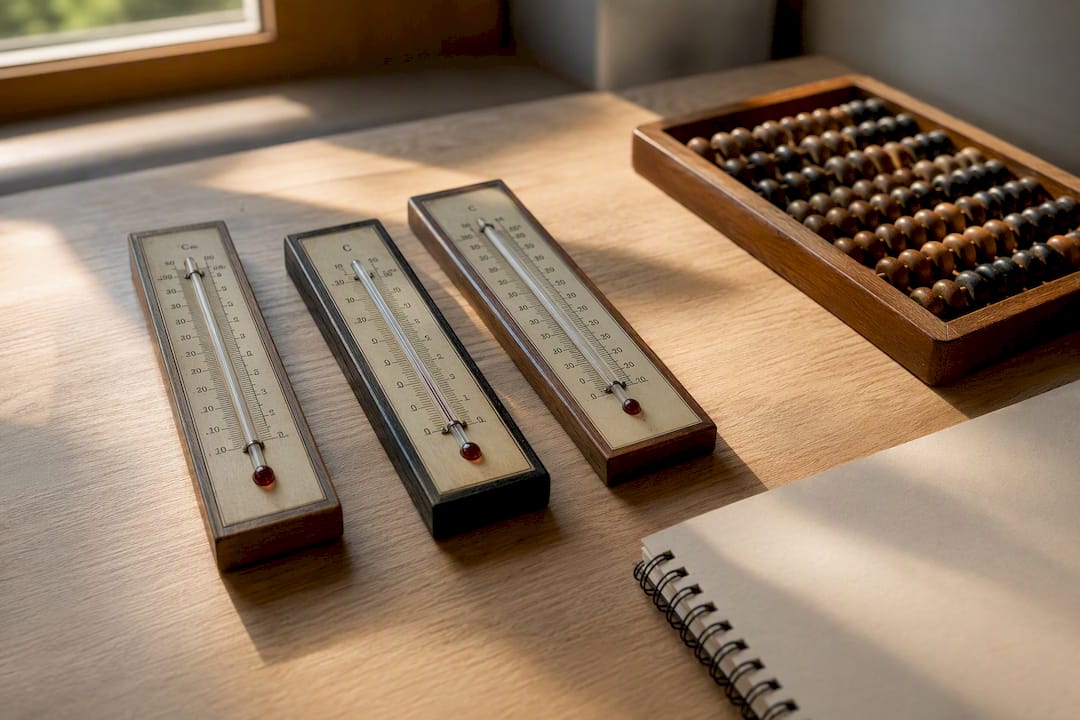
To convert Celsius to Fahrenheit, use F = (C × 9/5) + 32. To convert Fahrenheit to Celsius, rearrange it: C = (F − 32) × 5/9. For example, 20°C converts to (20 × 9/5) + 32 = 68°F.
Kelvin is more straightforward because it shares the same size of degree as Celsius, just shifted so that 0 K sits at absolute zero rather than at the freezing point of water. To convert Celsius to Kelvin, add 273: 20°C becomes 293 K. To go from Kelvin to Celsius, subtract 273.
The key exam trap is treating temperature like any other unit and trying to multiply by a scale factor. That works for Celsius to Kelvin, because the degree size matches, but it never works for Fahrenheit conversions, which need the full formula including the added or subtracted 32. If a question gives you a formula, use exactly that formula rather than a memorised approximation, since temperature conversions appear far less often at GCSE than metric or imperial ones, and examiners tend to supply the formula when they do appear.
Converting derived units: speed, density and other compound quantities
Speed, density, and similar quantities are built from two base units divided by each other, which means converting them properly means converting both parts, not just one.

Speed is distance divided by time, so converting 108 km/h to m/s means converting kilometres to metres and hours to seconds simultaneously, exactly as shown in the dimensional analysis section above: 108,000 ÷ 3,600 = 30 m/s. Skipping either half of that conversion, converting only the distance but leaving the time in hours, is one of the most common ways students lose marks on compound unit questions.
Density is mass divided by volume, typically given in g/cm³ or kg/m³. Converting between this requires remembering that 1 cm³ = 1 ml and that a volume conversion factor gets cubed, not just multiplied. To convert a density from g/cm³ to kg/m³, you multiply by 1,000 (for mass, g to kg) and divide by 1,000,000 (since 1 m³ = 1,000,000 cm³), which simplifies to multiplying by 1,000 overall.
The general principle for any derived unit: identify the two base units it’s built from, convert each independently using the rules already covered for length, mass, time, or volume, then recombine them. This is exactly where dimensional analysis earns its keep, because it forces you to track both units through the calculation rather than converting one and forgetting the other.
SI prefixes: kilo, milli, micro and beyond
Every metric unit you’ve used so far, kilometres, millilitres, centimetres, is built from a base unit plus a prefix that tells you the power of ten involved. Understanding the prefix system means you’re not memorising isolated facts about length, mass, and volume separately. You’re applying one consistent pattern across all of them.
The prefixes most relevant at GCSE and just beyond are: kilo (×1,000), centi (÷100), milli (÷1,000), and, for students moving into A-Level science and further maths, micro (÷1,000,000) and nano (÷1,000,000,000). On the larger end, mega (×1,000,000) and giga (×1,000,000,000) appear occasionally in data and science contexts, such as megabytes or gigahertz.
The pattern is always the same regardless of which base unit the prefix attaches to. A kilogram is 1,000 grams for exactly the same reason a kilometre is 1,000 metres and a kilowatt is 1,000 watts. Once that clicks, you stop needing to memorise “kilo means 1,000” as a fact about length specifically, and start recognising it as a universal rule about the metric system itself.
This matters beyond GCSE too. Micro and nano prefixes turn up regularly in A-Level physics and chemistry, where quantities like wavelength (nanometres) or current (microamps) are standard. Getting comfortable with the full prefix scale now, rather than treating kilo and milli as the only ones that matter, pays off later.
What actually separates students who lose marks here from those who don’t
The conventional advice on unit conversion tends to focus entirely on memorising conversion factors, and that’s not wrong, but it’s incomplete. The students who consistently score well on this topic aren’t the ones who’ve memorised the most facts. They’re the ones who default to dimensional analysis automatically, without pausing to wonder whether a given problem calls for multiplication or division.
That’s the real gap between what most revision guides emphasise and what actually earns marks. Facts like 1 km = 1,000 m matter, but they’re a small fraction of the battle. The bigger issue is process: converting inconsistent units before calculating, squaring or cubing correctly for area and volume, and rounding only at the final step rather than mid-calculation.
If there’s one thing to prioritise above everything else in this article, it’s building the habit of writing out conversion fractions explicitly, every time, even for conversions that feel obvious. That habit is what survives under exam pressure when confidence wavers and simpler mental shortcuts start to feel unreliable.
— Oloru
Practise conversion questions with Mathvault’s past papers
Reading the method is one thing. Applying it under timed conditions against real exam questions is what actually builds the fluency you need on the day. Mathvault’s Edexcel GCSE past paper questions organised by topic give you a dedicated bank of unit conversion problems, each with fully worked, step-by-step solutions that show exactly where method marks come from.

If you’re heading towards Higher tier or further maths, the AQA GCSE Further Maths resources extend the same conversion principles into trickier compound-unit territory. Every resource on Mathvault is free to access, board-aligned, and built specifically for UK students preparing for real exam scripts, not generic practice. Start with the topic-based past papers, work through the worked solutions properly rather than jumping to the answer, and bring anything that still doesn’t click to the weekly live Q&A sessions.
Sources
For extra practice and curriculum alignment, BBC Bitesize’s units of measure guide covers core metric facts clearly, while the NIST unit conversion guidance explains dimensional analysis in more technical depth for students continuing into further maths or science.
- Metrication in the United Kingdom — Wikipedia
- Unit conversion guidance — NIST
- British exceptionalism and the long, strange story of UK metrication — MetricViews
Leave a Reply