
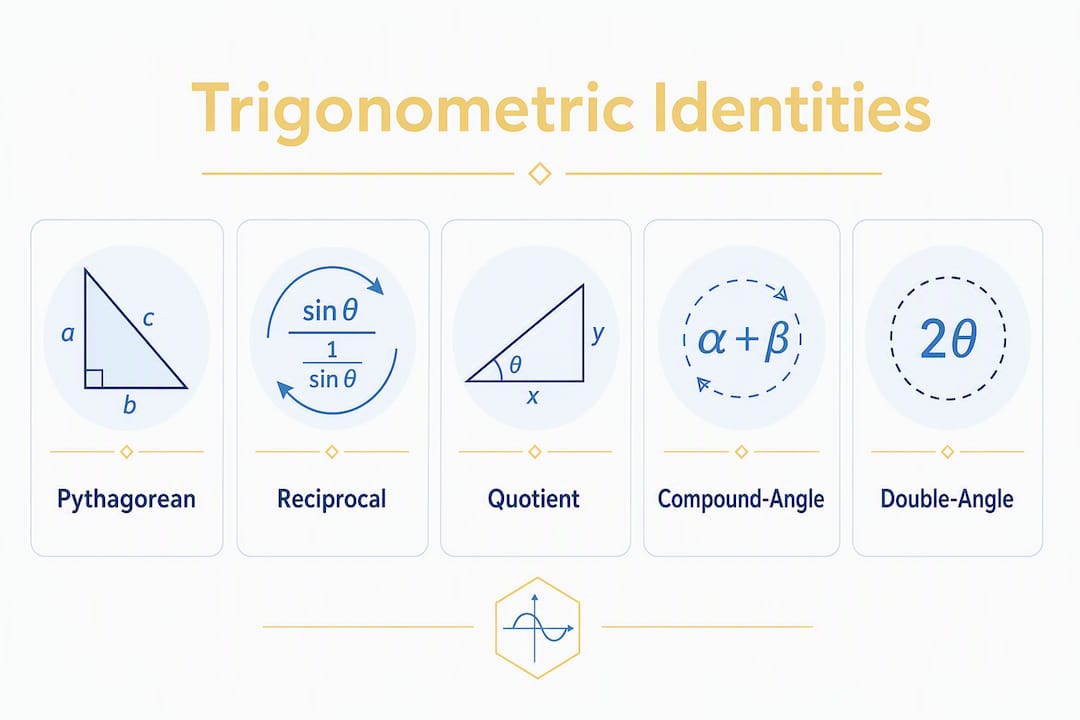
Every A Level maths student needs to know these identities cold before sitting any paper. The non-negotiables are:
-
Pythagorean: sin²θ + cos²θ ≡ 1; 1 + tan²θ ≡ sec²θ; 1 + cot²θ ≡ cosec²θ
-
Reciprocal: sec θ ≡ 1/cos θ; cosec θ ≡ 1/sin θ; cot θ ≡ 1/tan θ
-
Quotient: tan θ ≡ sin θ/cos θ; cot θ ≡ cos θ/sin θ
-
Double-angle: sin 2A ≡ 2 sin A cos A; cos 2A ≡ cos²A − sin²A (and its two rearrangements); tan 2A ≡ 2 tan A / (1 − tan²A)
-
Sum and difference: sin(A ± B) ≡ sin A cos B ± cos A sin B; cos(A ± B) ≡ cos A cos B ∓ sin A sin B
The single fastest exam tactic: convert everything to sin and cos, then simplify. It cuts dead ends on almost every proof or simplification question.
A quick note on formula sheets: AQA, Edexcel, and OCR all supply the compound-angle (sum and difference) formulae and double-angle formulae in the formula booklet. The Pythagorean identities, reciprocal identities, and quotient identities are not given, so you must know those from memory. Check Appendix B of the AQA specification to confirm exactly which formulae your board provides.

Table of Contents
- What are the core trigonometric identity families you need to know?
- How do you prove and simplify trig expressions step by step?
- Worked exam-style examples: simplify, prove, and solve
- What mistakes do students make most often in trig identity questions?
- Where should you practise trig identity questions?
- Key takeaways
- The revision approach that actually works in the final week
- Mathvault has everything you need for A Level trig revision
- Useful sources and further reading
What are the core trigonometric identity families you need to know?
Trigonometric identities are equations involving trig functions that hold true for every angle at which those functions are defined. Grouping them by family makes them far easier to recall and apply.
Pythagorean identities

The root identity comes directly from the unit circle: a point (cos θ, sin θ) on a circle of radius 1 satisfies x² + y² = 1, so:
sin²θ + cos²θ ≡ 1
Dividing through by cos²θ gives 1 + tan²θ ≡ sec²θ. Dividing by sin²θ gives 1 + cot²θ ≡ cosec²θ. Memorise the root; derive the others in ten seconds.
Reciprocal and quotient identities
| Identity | Form |
|---|---|
| sec θ | 1 / cos θ |
| cosec θ | 1 / sin θ |
| cot θ | 1 / tan θ |
| tan θ | sin θ / cos θ |
| cot θ | cos θ / sin θ |
These follow directly from the definitions of the six trigonometric functions. The most common exam error is confusing sec with cosec; remember that sec goes with cos (both contain the letter ‘c’ but not ‘s’).
Double-angle identities
Starting from the compound-angle formula cos(A + B) with B = A:
- sin 2A ≡ 2 sin A cos A
- cos 2A ≡ cos²A − sin²A ≡ 2cos²A − 1 ≡ 1 − 2sin²A
- tan 2A ≡ 2 tan A / (1 − tan²A)
The three forms of cos 2A are all equivalent via sin²A + cos²A ≡ 1. Knowing which form to use is half the skill: choose 2cos²A − 1 when you need to eliminate sin²A, and 1 − 2sin²A when you need to eliminate cos²A.
Sum and difference formulae
- sin(A ± B) ≡ sin A cos B ± cos A sin B
- cos(A ± B) ≡ cos A cos B ∓ sin A sin B
- tan(A ± B) ≡ (tan A ± tan B) / (1 ∓ tan A tan B)
These are provided in the formula booklet, but you still need to recognise them quickly and apply them in reverse (i.e., spot that 2 sin 75° cos 75° is just sin 150°).
Product-to-sum and sum-to-product identities
These appear less frequently in standard A Level questions but are worth knowing for the harder proof questions:
- 2 sin A cos B ≡ sin(A + B) + sin(A − B)
- 2 cos A cos B ≡ cos(A − B) + cos(A + B)
- 2 sin A sin B ≡ cos(A − B) − cos(A + B)
They are derived by adding or subtracting the compound-angle formulae. At A Level, they are most useful when you spot a product of two different trig functions that cannot be simplified any other way.
Exam-board notes
AQA’s specification appendix confirms that the compound-angle and double-angle formulae are provided; the Pythagorean, reciprocal, and quotient identities are not. Edexcel and OCR follow the same convention. A Level teaching typically introduces the basic identities (tan ≡ sin/cos and sin²θ + cos²θ ≡ 1) in Year 12, then builds to the full set of compound and double-angle identities in Year 13.
How do you prove and simplify trig expressions step by step?
A clear, ordered method prevents the most common exam pitfall: starting from both sides simultaneously and ending up with a circular argument.
The five-step procedure
- Start from the more complex side. State clearly which side you are working from at the top of your solution.
- Convert to sin and cos. Replace sec, cosec, cot, and tan with their sin/cos equivalents. Converting to sin and cos early reduces branching paths and keeps the algebra linear.
- Apply Pythagorean identities. Look for sin²θ + cos²θ patterns; substitute to reduce terms.
- Rearrange and factorise. Combine fractions over a common denominator, factorise where possible, and cancel common factors.
- Arrive at the target expression. Write a clear equals or equivalence sign at each step; never skip a line.
When to use double-angle or compound-angle formulae instead
If the expression contains sin 2θ, cos 2θ, or a sum like sin(A + B), expand those first before converting to sin/cos. Trying to convert a double-angle term without expanding it first usually creates more complexity, not less.
Mini worked example: simplifying
Simplify (1 − cos²θ) / sin θ.
- Step 1: Recognise 1 − cos²θ ≡ sin²θ (from the Pythagorean identity).
- Step 2: Substitute: sin²θ / sin θ.
- Step 3: Cancel: sin θ. Done in three lines.
Pro Tip: Before writing anything, spend ten seconds scanning the expression for a Pythagorean pattern (sin²θ + cos²θ, 1 − sin²θ, or 1 − cos²θ). Spotting it early saves you from a longer route.
Worked exam-style examples: simplify, prove, and solve
Example 1: simplifying a compound expression
Simplify sec²θ − tan²θ.
- Rewrite: (1/cos²θ) − (sin²θ/cos²θ)
- Combine over a common denominator: (1 − sin²θ) / cos²θ
- Apply sin²θ + cos²θ ≡ 1, so 1 − sin²θ ≡ cos²θ: cos²θ / cos²θ
- Answer: 1
Mark-scheme note: one method mark for combining fractions, one accuracy mark for the Pythagorean substitution, one for the final answer.
Example 2: proving an identity
Prove that cosec θ − sin θ ≡ cos θ cot θ.
Working from the left-hand side (LHS):
- cosec θ − sin θ ≡ 1/sin θ − sin θ
- ≡ (1 − sin²θ) / sin θ
- ≡ cos²θ / sin θ
- ≡ cos θ · (cos θ / sin θ)
- ≡ cos θ · cot θ ✓
Each line follows from a single substitution or algebraic step. Examiners expect you to show the intermediate equivalence at every stage; a jump from line 2 to line 4 will cost a method mark.
Examiner insight: “Examiners reward clarity of method — showing the side you start from, labelling substitutions, and stating the general solution form gains method marks even when arithmetic slips occur.”
Example 3: solving a trig equation using identities
Solve 2cos²θ − cos θ − 1 = 0 for 0° ≤ θ ≤ 360°.
- Factorise: (2cos θ + 1)(cos θ − 1) = 0
- So cos θ = −1/2 or cos θ = 1
- cos θ = 1 → θ = 0°, 360°
- cos θ = −1/2 → principal value θ = 120°; second solution θ = 240°
- Solutions: θ = 0°, 120°, 240°, 360°
For a general solution (unrestricted interval), produce the general form first: θ = 2nπ or θ = 2π/3 + 2nπ or θ = 4π/3 + 2nπ (n ∈ ℤ), then apply the interval constraint. This structure prevents missed solutions and matches the form most mark schemes expect.
Answer check: substitute θ = 120° back: 2cos²(120°) − cos(120°) − 1 = 2(1/4) − (−1/2) − 1 = 1/2 + 1/2 − 1 = 0. ✓
What mistakes do students make most often in trig identity questions?
Examiner tips
- State your starting side. Write “Working from the LHS:” or “Working from the RHS:” before your first line. Examiners need to see this.
- Show every substitution. Write out the identity you are using (e.g. “using sin²θ + cos²θ ≡ 1”) before applying it, at least in the first few steps.
- Give the final answer in the form requested. If the question asks for exact values, do not leave an inverse trig expression; if it asks for degrees, do not give radians.
- For equations, state all solutions in the given interval. A single solution when two exist loses the accuracy mark.
Common mistakes
- Sign errors in compound-angle formulae. cos(A + B) has a minus sign between its two terms; cos(A − B) has a plus. Students frequently swap these under time pressure.
- Forgetting the general solution. When a question asks for all solutions, writing only the principal value is a very common mark-losing error.
- Misusing reciprocal identities. sec²θ is not the same as 1/sin²θ. Write out the reciprocal definition explicitly if you are unsure.
- Working from both sides simultaneously. This is not a valid proof method and will score zero for the proof marks.
- Ignoring domain restrictions. If the question specifies 0 ≤ θ ≤ 2π, check every solution falls within that range before writing your final answer.
Quick recall checks before handing in
- Substitute θ = 0 or θ = π/2 into both sides of a proved identity to verify they match.
- For an equation, substitute each solution back into the original equation.
- Check that the number of solutions is consistent with the period of the function over the given interval.
Exam-board alignment
AQA questions frequently ask students to prove identities involving sec and cosec, then use the result to solve an equation. Edexcel tends to combine double-angle identities with integration or differentiation in later units. OCR questions often require students to derive exact values using sum and difference formulae. Knowing your board’s style helps you practise the right question types.
Where should you practise trig identity questions?
A focused practice plan matters more than working through random questions. Aim for five to eight past-paper questions on trig identities per week in the six weeks before your exam, timed strictly. Self-mark using the official mark scheme, not just a worked answer, so you learn exactly where method marks are awarded.
Exam-board past papers and topic indexes
| Exam board | Past paper access | Topic index |
|---|---|---|
| AQA | aqa.org.uk | Appendix B lists all required identities |
| Edexcel | Via Pearson’s website | Topic-sorted questions available on Mathvault |
| OCR | Via OCR’s website | Past papers searchable by topic |
Always practise under timed conditions. A question you can solve in twenty minutes with no pressure may take you forty under exam stress; timed repetition closes that gap.
Mathvault curated packs
Mathvault organises Edexcel A Level past questions by topic, so you can drill trig identity questions without wading through full papers. Each question comes with a fully worked solution, and video walkthroughs are available for the harder examples. For AQA students, the AQA A Level maths page gathers board-specific resources in one place.
Topic-sorted past papers and fully worked solutions accelerate exam progress because they let you practise the same question type repeatedly and compare your method step by step against a model answer. Most resources on Mathvault are free; complete downloadable packs for offline revision are available for a small one-off purchase or via a donation through Buy Me a Coffee.
Key takeaways
Mastering A Level trig identities comes down to knowing the Pythagorean, reciprocal, and quotient identities from memory, converting to sin and cos as your default proof strategy, and always producing a general solution before applying interval constraints.
| Point | Details |
|---|---|
| Memorise the non-supplied identities | Pythagorean, reciprocal, and quotient identities are not in the formula booklet; learn them cold. |
| Use the convert-to-sin/cos strategy | Converting every term to sin and cos first reduces dead ends in proofs and simplifications. |
| General solution before interval | Always write the general solution (using n·π or n·2π) before applying the interval constraint to avoid missing solutions. |
| Know your formula booklet | Compound-angle and double-angle formulae are supplied by AQA, Edexcel, and OCR; you still need to apply them quickly. |
| Practise with Mathvault | Mathvault’s topic-sorted past papers and worked solutions let you drill trig identity questions by exam board. |
The revision approach that actually works in the final week
Most students spend too long re-reading notes and not long enough doing questions under pressure. By the time you reach the final week, you should already know the identities; the goal is to make applying them automatic.
Here is a compact micro-plan that works well. On day one, write out every non-supplied identity from memory, check against your notes, and correct any gaps. On day two, do five timed proof questions, mark them strictly, and note every line where you lost a method mark. Day three: solve five trig equations, focusing on producing the general solution correctly before restricting to the interval. Day four: mix question types from past papers, aiming for exam-pace timing. Day five: review your error log from the week and redo only the question types where you dropped marks.
The memory trick that helps most students is to anchor the Pythagorean identities to a single image: a right-angled triangle inscribed in a unit circle. If you can picture sin as the opposite side and cos as the adjacent, the identity sin²θ + cos²θ ≡ 1 is just Pythagoras. The sec and cosec variants follow by dividing, so you only need to remember one root fact.
Switch from learning to practising as soon as you can write out all the non-supplied identities without hesitation. For most students, that point arrives two to three weeks before the exam. After that, every revision hour should involve a timed question, not passive reading.
Mathvault has everything you need for A Level trig revision
Trig identities are one of the highest-yield topics in A Level maths: they appear in proof questions, equation-solving, and calculus problems across all three major exam boards. Mathvault gives you free access to past papers sorted by topic, fully worked step-by-step solutions, and video walkthroughs for the questions that trip students up most.
Whether you are following AQA, Edexcel, or OCR, Mathvault’s board-specific pages mean you practise exactly the question styles your examiners set. The Edexcel A Level topic-sorted pack is the fastest way to drill trig identity questions back-to-back with model answers alongside. AQA students can find their full resource set on the AQA A Level maths page. All core resources are free; complete downloadable bundles for offline revision are available for a small one-off payment. Head to Mathvault now and start your first timed trig identity set today.
Useful sources and further reading
| Source | Best used for |
|---|---|
| AQA A Level Mathematics Specification, Appendix B | Confirming which identities are supplied in the formula booklet and which must be memorised |
| OpenStax Calculus Volume 1 | Formal definitions, derivations, and textbook-style proofs of all core identities |
| GCE AS/A Level Trig Equations Worksheet (PDF) | Exam-style practice on solving trig equations and producing general solutions |
| Mathvault Edexcel A Level topic-sorted papers | Targeted past-paper practice by topic with worked solutions |
| Mathvault AQA A Level maths | AQA-specific resources, formulae, and worked examples |
For formal proofs and derivations, the OpenStax textbook and the AQA specification appendix are the most reliable references. For exam practice, Mathvault’s topic-sorted papers and the GCE worksheet give you the question formats and solution structures that mark schemes reward.
Leave a Reply