
The most reliable way to track past papers is to record the exact paper identity, exam board, specification code, paper or component, and series, alongside your raw mark, time taken, and the specific questions or topics you missed. Use those records to drive targeted retrieval practice rather than simply counting papers completed. Your first step: pick your exam board now and log one past paper attempt, even if it’s an old one you’ve already done.
TL;DR:
- Recording detailed paper information and error classifications enhances targeted retrieval practice and significantly improves exam preparation.
- Official exam board archives are the most reliable source for past papers, with filters needed to find the correct series, specification, and paper version.
- Simple tracking tools like spreadsheets or apps with fields for scores, time, questions missed, and error types help identify patterns and focus revision efforts.
- Tagging each mistake with a specific topic and action enables focused re-testing and reinforces weak areas effectively over time.
- Resources like MathVault offer organised past papers, solutions, and question packs tailored for tracking and fixing errors efficiently.
Table of Contents
- Where to find official UK past papers and mark schemes
- Exact fields a useful tracker must record and why
- Quick tracker options: spreadsheet, apps, or paper
- Turning tracked data into better revision
- How MathVault organises maths past papers to support tracking
- Common tracking mistakes and realistic goals
- Try MathVault for past papers and worked solutions
- Authoritative board and research links to check
- Sources
- FAQ
Where to find official UK past papers and mark schemes
Every major exam board publishes its own archive of past papers and mark schemes, and these should always be your first stop before any third-party site. When searching, use three filters: your qualification family (GCSE or A-Level), your subject, and the exam series (the specific month and year, such as June 2023).
Pearson’s past papers service lets you search by qualification, subject, and series, returning question papers, mark schemes, and examiner reports together. Recent papers can be locked to registered centres. Boards commonly restrict the most recent exam sessions to registered centres, which usually covers roughly the last 9 to 12 months of sittings. If a paper you need shows as padlocked, ask your school’s exams officer, who has centre access and can often retrieve it for you.
When you find a paper, check its full label before you start:
- Confirm the exam board (AQA, Edexcel, OCR, WJEC) matches your syllabus exactly.
- Note the specification code, since boards sometimes run parallel specifications with different content.
- Check the paper or component number, as Paper 1 and Paper 2 often test different skills.
- Confirm the series (for example, June 2022) so you don’t accidentally repeat a paper you’ve already tracked.
Exact fields a useful tracker must record and why
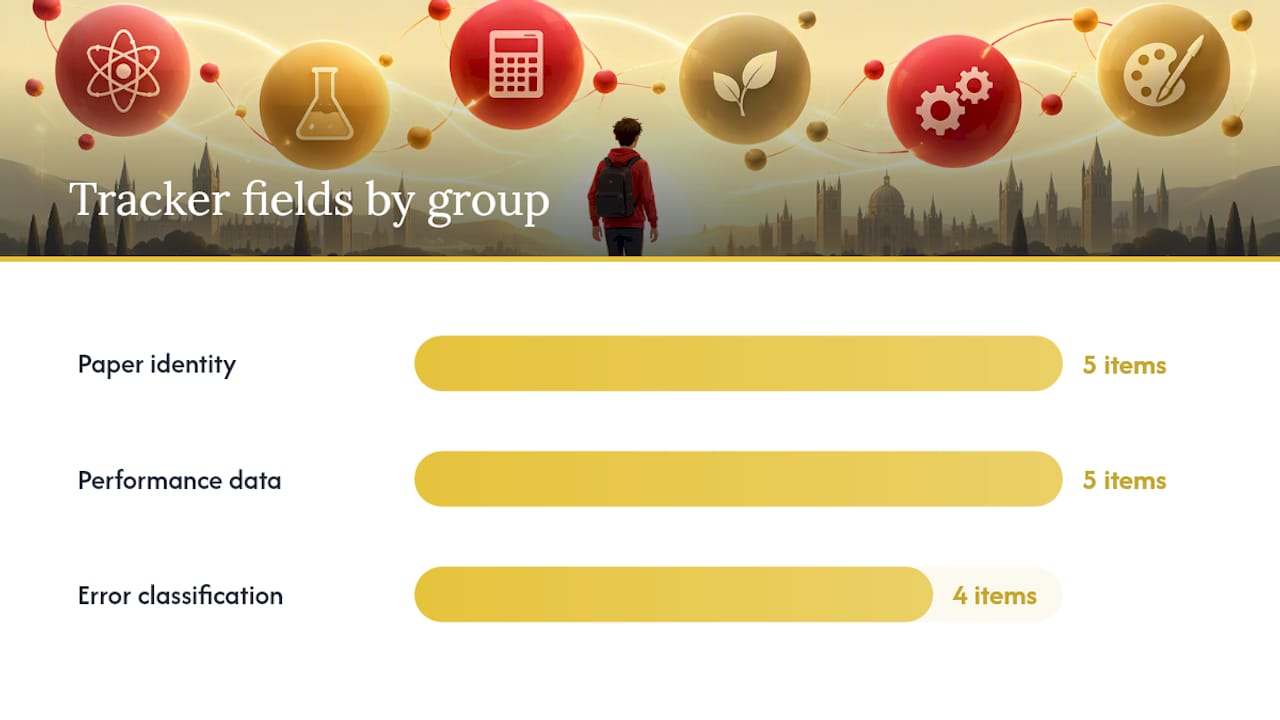
A tracker that only counts finished papers tells you almost nothing useful. What matters is capturing enough detail to spot patterns and act on them. Build your tracker around three groups of fields.
- Paper identity: exam board, qualification, specification code, paper or component number, and series (month and year).
- Performance data: raw mark, maximum mark, percentage, time taken, and a breakdown by question or topic.
- Error classification: which question numbers you missed, the topic tag for each, the type of error (calculation slip, method gap, misread question), and your planned next action.
Recording the paper’s component identity matters more than it sounds. Components within the same subject can carry different timings and mark totals, so lumping Paper 1 and Paper 2 scores together into one average can hide exactly where you’re weak.
This level of detail matters because feedback that’s specific and actionable improves learning far more than a raw score alone. A systematic review commissioned for the Education Endowment Foundation found feedback interventions produce a small positive effect on attainment (pooled estimate g = 0.17), though the effect varied considerably depending on how the feedback was delivered. A tracker that flags precise errors gives you feedback you can actually use.
Pro Tip: Tag each error with a topic and an action, such as “circle theorems, redo worked example,” so every mistake points to a next step rather than just a lost mark.
Quick tracker options: spreadsheet, apps, or paper
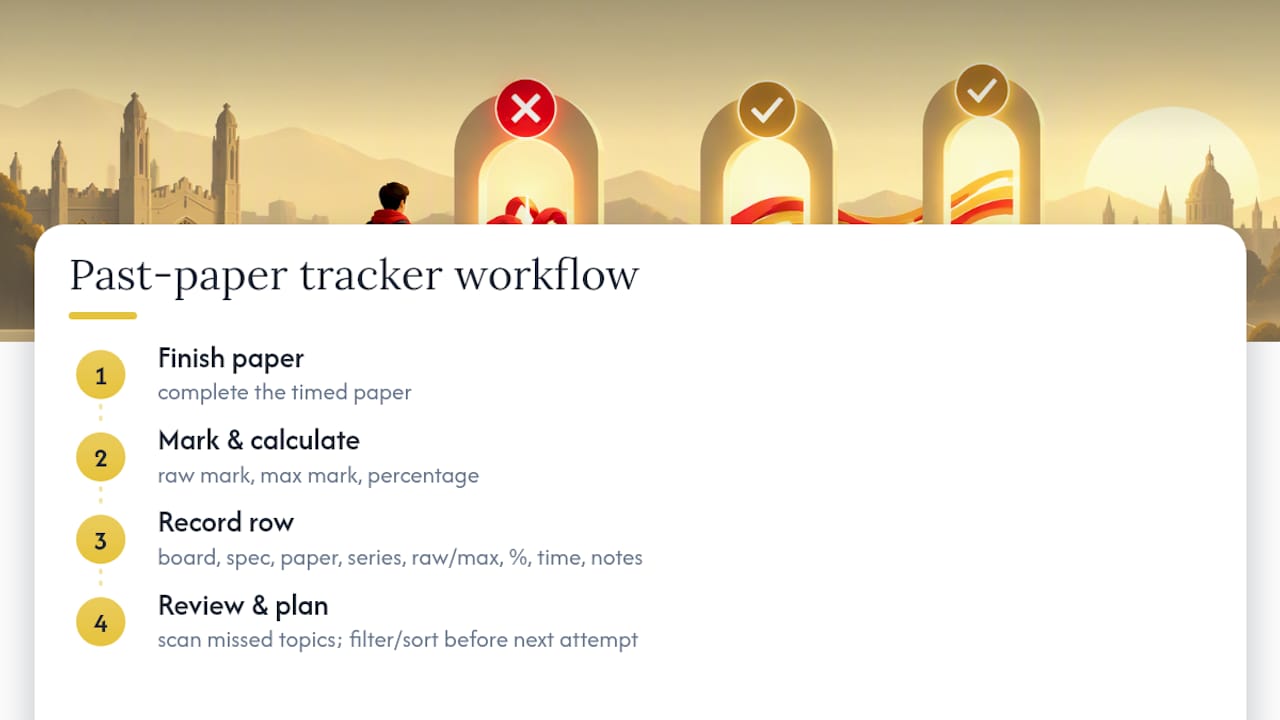
You don’t need anything sophisticated to start. A simple spreadsheet works well, with one row per attempt and columns for board, spec code, paper, series, raw mark, max mark, percentage, time taken, and a notes column for missed questions and topics. Fill in one row every time you finish a paper, and review the sheet before starting your next one.
If you’d rather use an app, look for a few specific features that can help with tracking progress, such as alignment with your exam board and syllabus, per-question or per-topic scoring, and options for offline storage or data export.
Printed logbooks work fine if you’re disciplined about filling them in immediately after marking, but they make it harder to spot topic trends across dozens of papers. Digital trackers win once you’ve done more than ten or so papers, simply because sorting and filtering become useful.
For maths specifically, MathVault organises past papers and worked solutions by exam board and topic, which gives you a ready-made structure for logging attempts without building a system from scratch.
Turning tracked data into better revision
Tracking data is only useful if it changes what you revise next. This is where retrieval practice comes in: testing yourself on material repeatedly, rather than just rereading notes, produces stronger long-term recall. A 2022 study in Memory & Cognition found retrieval practice improved final-test memory compared with restudying, though it also found that negative feedback undermining a student’s confidence can reduce those benefits.
One in six studies in the EPPI review of feedback interventions showed meaningfully larger gains when feedback was specific and actionable rather than a bare score, underlining why your error tags matter more than your percentage. Use your tracker’s topic tags to build short, focused re-tests:
- Pull every question tagged with a weak topic into a single mini-test.
- Re-attempt that mini-test a week later, then again a fortnight after that.
- Log the retest the same way as a full paper, so you can see the topic improve over time.
When you review a mistake, frame it around the fix rather than the failure: “next time, check units before finishing” lands better than “careless error”, and keeps you motivated to keep testing yourself. The EEF’s Science Self-Testing Toolkit pilot offers a useful template for building this kind of retesting routine into a weekly schedule, even though it was designed for science rather than maths.
How MathVault organises maths past papers to support tracking
Some archives are built around a structure that a tracker needs: papers are organised by exam board and topic, with fully worked solutions and video walkthroughs attached to many. When you log a question as a method error, you can go to matching worked solutions to see where your approach broke down.
Topic indexing also allows pulling a set of past questions on a single weak area, such as trigonometric identities or quadratic sequences, without hunting through whole papers. Downloadable packs can provide offline copies to mark and log at your own pace, and live Q&A sessions may offer places to ask about persistent errors.
Common tracking mistakes and realistic goals
The biggest mistake students make is treating past papers as a tally: “I’ve done fifteen papers” says nothing about whether the same topic is failing you every time. Another common error is ignoring time taken, which hides whether a mistake came from rushing or from a genuine gap in understanding.
Set a realistic goal: fixing three recurring error types matters more than completing five more papers. Build the habit of logging your attempt within minutes of marking it, while the mistake is still fresh in your mind.
— Oloru
Try MathVault for past papers and worked solutions
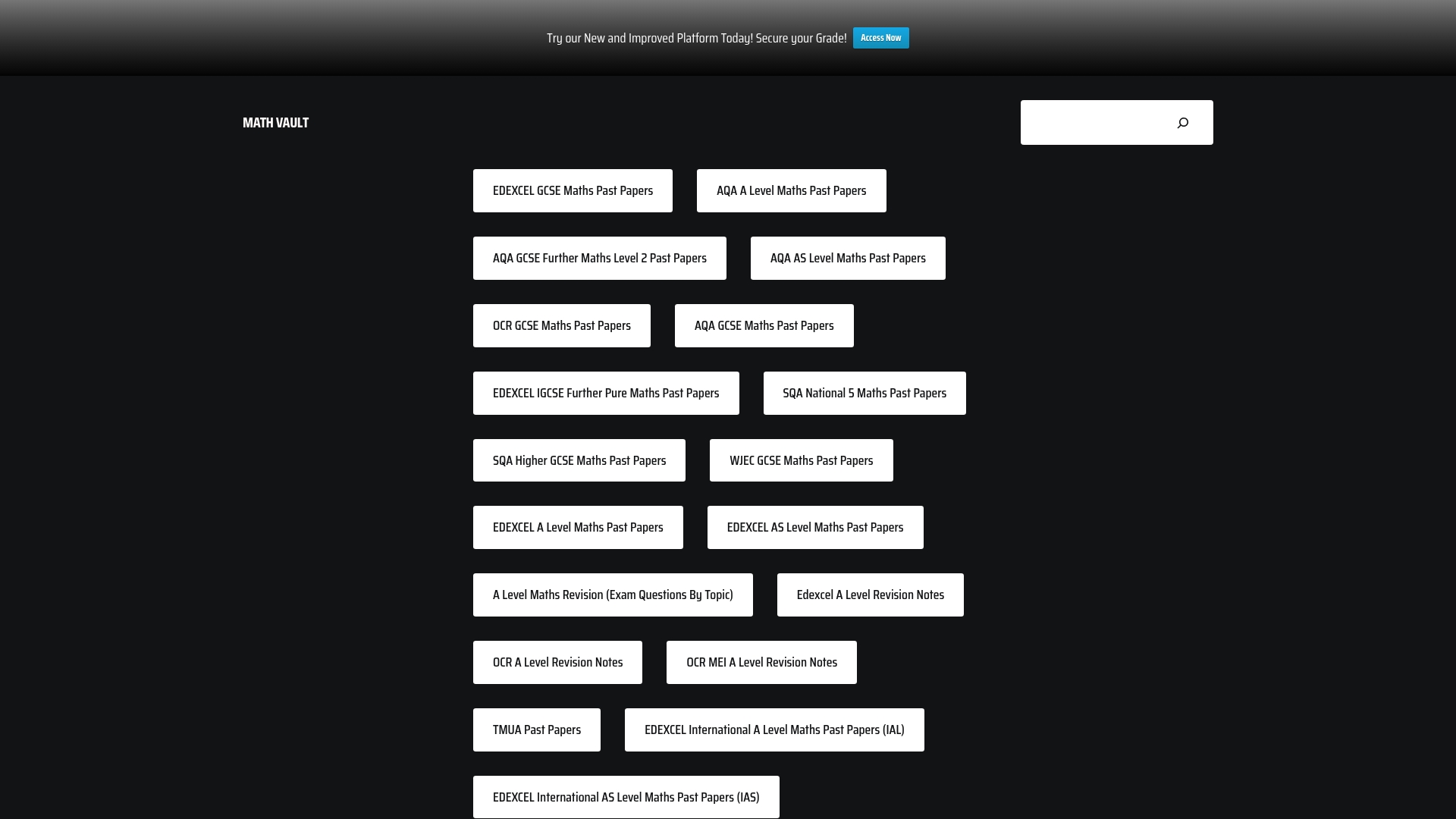
If you’re ready to put this tracking approach into practice, MathVault gives you a direct, UK-focused way to start today without setting up a system from nothing. The site covers GCSE and A-Level maths across the main exam boards, with fully worked solutions attached to every paper so you can fix method errors as you log them.
A few places to start:
- Browse the GCSE maths revision guides for organised past-paper material by topic.
- Use the self-mark past papers with board-aligned solutions to download, mark, and log an attempt in one sitting.
- Build targeted re-tests from the Edexcel topic-based question packs once your tracker flags a weak area.
Most resources on MathVault are free, including papers, solutions, and live Q&A sessions, with optional paid downloadable packs for students who want a complete offline set.
Authoritative board and research links to check
For anything beyond this guide, go straight to the source. Pearson’s past papers support page covers access queries and centre restrictions in more detail, and its past papers by qualification family page explains how older archives remain available even when recent series are locked.
- The EPPI systematic review on feedback underpins the case for actionable, specific feedback over raw scores.
- Independent study-skills coaching research from Educo explores how structured feedback and coaching routines support exam preparation.
Sources
- Past papers information for students | Pearson qualifications
- The impact of feedback on student attainment: a systematic review (EPPI, 2021)
- Exploring the relationship between retrieval practice, self‑efficacy, and memory | Memory & Cognition (2022)
FAQ
Which website is best for past papers?
For official papers and mark schemes, exam board sites such as Pearson remain the primary source, since they’re the only guaranteed accurate archive for your specification. For maths specifically, MathVault organises those same board papers by topic and adds fully worked solutions, which makes tracking and fixing errors considerably faster.
Which website has past papers?
Every UK exam board, including Pearson, AQA, OCR, and WJEC, hosts its own archive of past papers and mark schemes on its qualifications site. For maths, MathVault mirrors this content organised by board and topic, with worked solutions attached to each paper.
Where can I find previous year papers?
Start with your exam board’s own qualifications website, searching by qualification family, subject, and exam series. Recent series from the last 9 to 12 months may be locked to registered centres, so ask your exams officer if a specific paper you need is padlocked.
How to find past papers for GCSE?
Go to your exam board’s qualifications page and filter by GCSE, your subject, and the series you want. If you study maths, MathVault also organises GCSE past papers by topic and exam board, which makes it easier to build a targeted set of questions around a weak area rather than working through whole papers in order.
Leave a Reply