
The routine that works is short and specific: sit a diagnostic paper untimed to find gaps, repair those gaps with focused practice, build up timed section work, sit a full timed mock, then reverse-engineer the mark scheme to write your own model answers before retesting. Every stage feeds the next. The evidence behind this cycle comes from three places: exam boards’ mark schemes, their examiner reports, and worked solutions of the kind Mathvault publishes free for every major specification.
This sequence beats scattergun revision because it forces four things you cannot get from a textbook alone.
- Diagnosis — you find out exactly which topics cost you marks, not which ones you feel shaky on.
- Timing — you learn how many minutes per mark you actually have, then practise working within that limit.
- Examiner expectations — mark schemes show precisely what earns method and accuracy marks, which is often not what students assume.
- Measurable progress — a logged retest cycle proves whether a fix has worked, rather than hoping it has.
Key Takeaways
A disciplined attempt, review, repair, and retest cycle using official mark schemes and examiner reports improves exam performance more reliably than high-volume, unreviewed past-paper practice.
| Point | Details |
|---|---|
| Follow the six-stage cycle | Diagnose, repair, build up timed practice, sit a full mock, reverse-engineer the mark scheme, then retest. |
| Prioritise review over volume | A handful of thoroughly marked papers teaches more than many attempted once and never revisited. |
| Use official sources | Exam board archives supply the only guaranteed match between paper, mark scheme, and current specification. |
| Track lost marks by cause | A spreadsheet logging cause category and retest date turns scattered mistakes into a clear repair plan. |
| Use Mathvault for worked solutions | Mathvault’s free, board-organised papers and step-by-step solutions support diagnostic work and mark-scheme reverse engineering throughout the routine. |
Table of Contents
- Why past papers are the most effective revision tool
- How do you build a practical past-paper strategy?
- Where can you find authentic past papers and mark schemes?
- How many past papers should you do, and when should you start?
- What mistakes waste past-paper practice?
- Build a tracking spreadsheet that turns papers into a plan
- How Mathvault supports every stage of this routine
- Adjusting your strategy when the syllabus or exam difficulty shifts
- Managing stress and staying motivated through the routine
- Fitting past papers around the rest of your revision
- Turning past-paper feedback into targeted revision
- Why disciplined review beats doing more papers
- Start your past-paper routine with Mathvault’s free resources
- Frequently asked questions
- Sources
Why past papers are the most effective revision tool
Past papers train three things that revision notes never touch: exam technique, timing under pressure, and question selection when you are stuck. A textbook teaches you the method for solving simultaneous equations. A past paper teaches you to spot which of six questions is a simultaneous-equations question dressed up as a word problem, and how long you can afford to spend on it.
Mark schemes and examiner reports matter more than most students realise. They do not just confirm right or wrong answers, they show the exact chain of working that earns method marks even when the final answer is incorrect. Examiner reports go further, listing the specific misreadings and wording traps that cost candidates marks year after year.
- Past papers reveal recurring question types you can predict and prepare for.
- Mark schemes show what actually earns marks, not what you assume should.
- Examiner reports flag command-word confusion (
"show that"versus"calculate") that trips up otherwise capable students.
Pro Tip: Read the examiner report before you mark your own paper. It tells you what mistakes to look for in your own working before you have even seen the mark scheme.
How do you build a practical past-paper strategy?
A good paper-ordering strategy for past papers runs on six stages, each with a clear time allowance and a clear output. Skipping stages, especially the review stage, is where most revision time gets wasted.
- Diagnostic pass. Pick one or two topic-heavy sections and attempt them untimed. The goal is locating gaps, not proving speed.
- Targeted repair. Fix the specific conceptual or technique fault the diagnostic revealed, using notes, a topic guide, or worked examples, before touching another paper.
- Timed section practice. Move from single questions to timed sections, then to full papers, gradually increasing time pressure so stamina builds without early burnout.
- Full timed mock. Sit a complete paper under real exam conditions: same time limit, same equipment, phone away, no notes, ideally at the same time of day as your actual exam.
- Mark-scheme reverse engineering. Mark your own paper against the scheme, then rewrite any question you dropped marks on as a full model answer that mirrors the scheme’s structure and wording.
- Scheduled retest. Revisit the same topic area seven to ten days later with fresh questions, to confirm the fix has actually stuck rather than just felt convincing on the day.
Timing deserves its own attention. Work out marks-per-minute for your specification: a paper worth 80 marks over 90 minutes gives you roughly 1.1 minutes per mark, so a six-mark question should take about six or seven minutes, not fifteen. If you are running short on practice time, split a paper into two 45-minute halves across two sessions rather than skipping the timed condition altogether.
Pro Tip: Try a 90-minute session split as 20 minutes diagnostic, 40 minutes timed section work, and 30 minutes mark-scheme write-up. That ratio keeps review time proportional to practice time, which is where most students go wrong.
Where can you find authentic past papers and mark schemes?
Always start with the primary source: the exam board’s own archive. AQA, Edexcel (Pearson), OCR, and the SQA (for National 5 and Higher) all publish free past papers, mark schemes and examiner reports directly, and these are the only guaranteed match to your current specification and tier.
- Exam board archives give you the official paper, mark scheme and examiner report together, which matters because third-party copies sometimes strip out the report.
- Curated collections such as Mathvault’s board-organised revision guides group papers by board and year so you are not hunting across five different sites mid-revision.
- Board-specific pages, including Edexcel GCSE, OCR GCSE and AQA GCSE collections, pair each paper with fully worked solutions rather than a bare mark scheme.
- Before you start any paper, check three things: the specification code matches your syllabus, the tier (Foundation or Higher) is correct, and the paper year is recent enough to reflect your current course content.
How many past papers should you do, and when should you start?
Volume matters less than review quality. A small number of thoroughly reviewed papers tends to teach more than a large stack attempted once and never revisited properly.
- Weeks 8 to 6 before the exam: work through selective questions and short sections tied to your weakest topics, not full papers.
- Weeks 6 to 3: move to full timed sections, then complete timed papers roughly once or twice a week.
- Final 2 to 3 weeks: sit full timed mocks under exam conditions, saving your two or three most recent, unseen papers for last so they genuinely test you rather than test your memory of the mark scheme.
Stop adding new papers once a session stops surfacing new mistakes. That is the real signal you have covered the syllabus, not a fixed number ticked off a list.
What mistakes waste past-paper practice?
The biggest waste is doing a paper and moving straight on without reviewing why marks were lost. That single habit turns a potentially powerful diagnostic tool into a glorified timer exercise.
- Skipping the review-repair-retest gap — marking a paper without fixing the underlying fault means the same error resurfaces in the next attempt.
- Treating mark schemes as scripts — memorising a model answer verbatim instead of understanding the reasoning behind it fails the moment a question is phrased differently.
- Overloading on full papers early — sitting complete timed mocks before you have repaired basic gaps just documents the same weaknesses repeatedly instead of fixing them.
- Not tracking topic frequency — without a record of which topics recur, you cannot tell high-value revision from low-value repetition.
Build a tracking spreadsheet that turns papers into a plan
A simple spreadsheet converts scattered attempts into a genuine improvement log. Each row should record enough detail that a tutor, parent, or you in three weeks’ time can see exactly what happened and what to do about it.

| Column | What it captures |
|---|---|
| Paper ID / board / year | Which exact paper and specification, so results stay comparable |
| Question number | The specific question, not just the topic |
| Marks lost | How many marks dropped on that question |
| Cause category | Knowledge gap, misread command word, timing pressure, or careless slip |
| Fix | The specific action taken to close the gap |
| Retest date | When the topic gets revisited |
| Notes | Anything examiner-report specific, like a common wording trap |
A typical row might read: Paper 2, Edexcel GCSE Higher, 2023 → Question 14 → 3 marks lost → cause: misread “show that” as “calculate” → fix: five practice questions on show-that command words → retest in 10 days. Tracking themes this way across several papers turns individual mistakes into a topic frequency map, so you can prioritise the highest-return areas rather than guessing.
- Sort the log by cause category to see whether most lost marks are knowledge gaps or timing issues, because the fix for each is completely different.
- Recalculate the topic frequency map every two or three papers, since priorities shift as gaps close.
How Mathvault supports every stage of this routine
Mathvault’s board-organised collections map directly onto each stage of the routine described above. The Edexcel A-Level pages and Edexcel AS Level pages give you papers grouped by year, so diagnostic and timed-mock stages use the correct specification without any manual sorting.
- Diagnostic and repair stages: browse by topic and pull questions matched to the specific gap your spreadsheet has flagged.
- Mark-scheme reverse engineering: Mathvault’s fully worked, step-by-step solutions show the exact method examiners reward, which is more instructive than a bare mark scheme when you are building your own model answer.
- Retest cycles: revisit a board’s paper set a fortnight later using different years to confirm the fix has held.
Fully worked solutions also make excellent training material when paired with an official examiner report: read the report first to see where students typically lost marks, then compare that against Mathvault’s worked answer to see exactly how a full-mark response is built. Contributor Oloru has drawn on classroom and tutoring experience in shaping how these resources are organised by board and topic.
Pro Tip: When a question stumps you, look up the worked solution before the mark scheme. Understanding the reasoning first makes the mark scheme’s shorthand much easier to interpret later.
Adjusting your strategy when the syllabus or exam difficulty shifts
Specifications change, and grade boundaries move with them. When a board revises content (adding a topic, dropping another, reweighting the non-calculator paper) your bank of older past papers stops being a perfect mirror of what you will actually sit.
The practical fix is a hybrid approach: always work outward from the two or three most recent papers on your current specification, then use five to seven years of older papers purely to spot long-running patterns in question style and phrasing, not to predict exact content. If your specification recently changed, flag any older paper that covers a topic no longer on your syllabus and set it aside rather than wasting a timed session on content you will never be examined on.
Watch grade boundary movements too. A board tightening or loosening boundaries year on year usually signals a shift in overall paper difficulty, and examiner reports often explain why in plain language (“this year’s paper 2 was found to be more accessible than in previous years”, for instance). If a report notes that a particular topic caused widespread difficulty, that topic deserves a heavier weighting in your repair sessions regardless of how confident you feel about it.
Treat any newly published specimen paper as your most valuable practice resource the moment it appears, since it reflects the board’s current intentions more accurately than any older paper can. If your course has just changed syllabus, prioritise specimen and transition papers over historic ones for your first few timed attempts, then blend in older material once you have a baseline.
Managing stress and staying motivated through the routine
Timed practice is stressful by design, and that is partly the point: staged exposure to time pressure is what builds exam stamina rather than exam anxiety. The mistake is jumping straight into full timed mocks before you are ready, which just replicates panic without building the coping skill that reduces it.
Build up gradually. Untimed diagnostic work first, then timed single questions, then timed sections, then full papers, each stage a little closer to real exam pressure than the last. By the time you sit a full mock, the format and the clock feel familiar rather than threatening.
Motivation tends to fade when progress feels invisible. This is where the error log earns its place: watching a cause category (say, timing pressure on long-answer questions) shrink week by week gives you concrete proof that revision is working, which is far more sustaining than a vague sense of having “done some papers”. Set a realistic weekly target rather than an open-ended one, and treat a paper that goes badly as diagnostic information rather than a verdict on your ability.
Build in short recovery breaks between mock sessions and avoid stacking two full timed papers back to back in a single day. Fatigue erodes concentration long before it erodes knowledge, and a tired attempt at a paper often produces a misleadingly poor result that knocks confidence for no good reason.
Fitting past papers around the rest of your revision
Past papers work best as the testing and diagnostic layer of your revision, not the entire structure. They are extremely good at revealing what you do not know and how fast you can apply it, but they are a poor tool for first teaching a concept you have never properly understood.
A workable balance looks like this: use topic guides, textbooks, or video walkthroughs to learn or relearn a method, then use timed past-paper questions to test whether that learning holds up under pressure. Mathvault’s topic-based revision guides work well for that first learning stage, precisely because they break a syllabus down by topic rather than by paper.
Spaced repetition matters here too. A concept revisited a week after first being taught, then again a fortnight later, sticks far better than one crammed once and left untouched until the exam. Slot past-paper retests into that spacing rather than bunching every paper into the final fortnight, when there is no time left to fix what the papers reveal.
If you are in the final days before an exam, the balance shifts: light, targeted timed practice replaces new content learning almost entirely, alongside quick-reference material such as a formula booklet for last-minute recall rather than full revision sessions.
Turning past-paper feedback into targeted revision
Every past paper you mark generates feedback, but feedback only improves your grade if it changes what you do next. The link between “I got this question wrong” and “here is exactly what I am doing differently this week” is where most students lose the value of the exercise.
Start by categorising each lost mark honestly: was it a genuine knowledge gap, a misread command word, a timing squeeze, or a careless slip that would not recur under calmer conditions? Each category needs a different fix. A knowledge gap needs a return to the topic guide and worked examples. A command-word issue needs deliberate practice reading questions slowly and underlining the instruction verb. A timing squeeze needs more section-timed practice, not more content revision.

Once a cause category appears more than twice in your log, it has moved from “one-off mistake” to “pattern worth a dedicated repair session”. That threshold matters because it stops you overreacting to a single bad question while still catching genuine weak spots early. Schedule the retest for roughly a week to ten days later, long enough for the repair work to consolidate, short enough that you have not forgotten the original context.
The feedback loop closes properly only when you retest and confirm the fix held. If the same cause category reappears at the retest, the original repair did not address the real problem, and it is worth reconsidering the method rather than repeating the same fix and hoping for a different result.
Why disciplined review beats doing more papers
Having worked through this material alongside students and tutors, the pattern that stands out most is how rarely the students who struggle are short on past papers. They are usually short on review. A folder of forty attempted papers with no error log behind it teaches far less than fifteen papers marked properly against the scheme and followed up with a genuine retest.
Staged timing practice does something else worth valuing beyond the marks themselves: it takes the sting out of exam day, because the clock and the format have stopped being novel by the time it matters. Past papers are the testing layer of revision, not the whole of it, so pair every timed session with proper content learning and spaced review, and let the error log, not the pile of papers, tell you when you are actually ready.
Start your past-paper routine with Mathvault’s free resources
Mathvault gives you what a paper-ordering strategy actually needs: papers organised by board and year, fully worked solutions instead of bare mark schemes, and topic packs that slot straight into the diagnostic and repair stages above, all completely free to use.
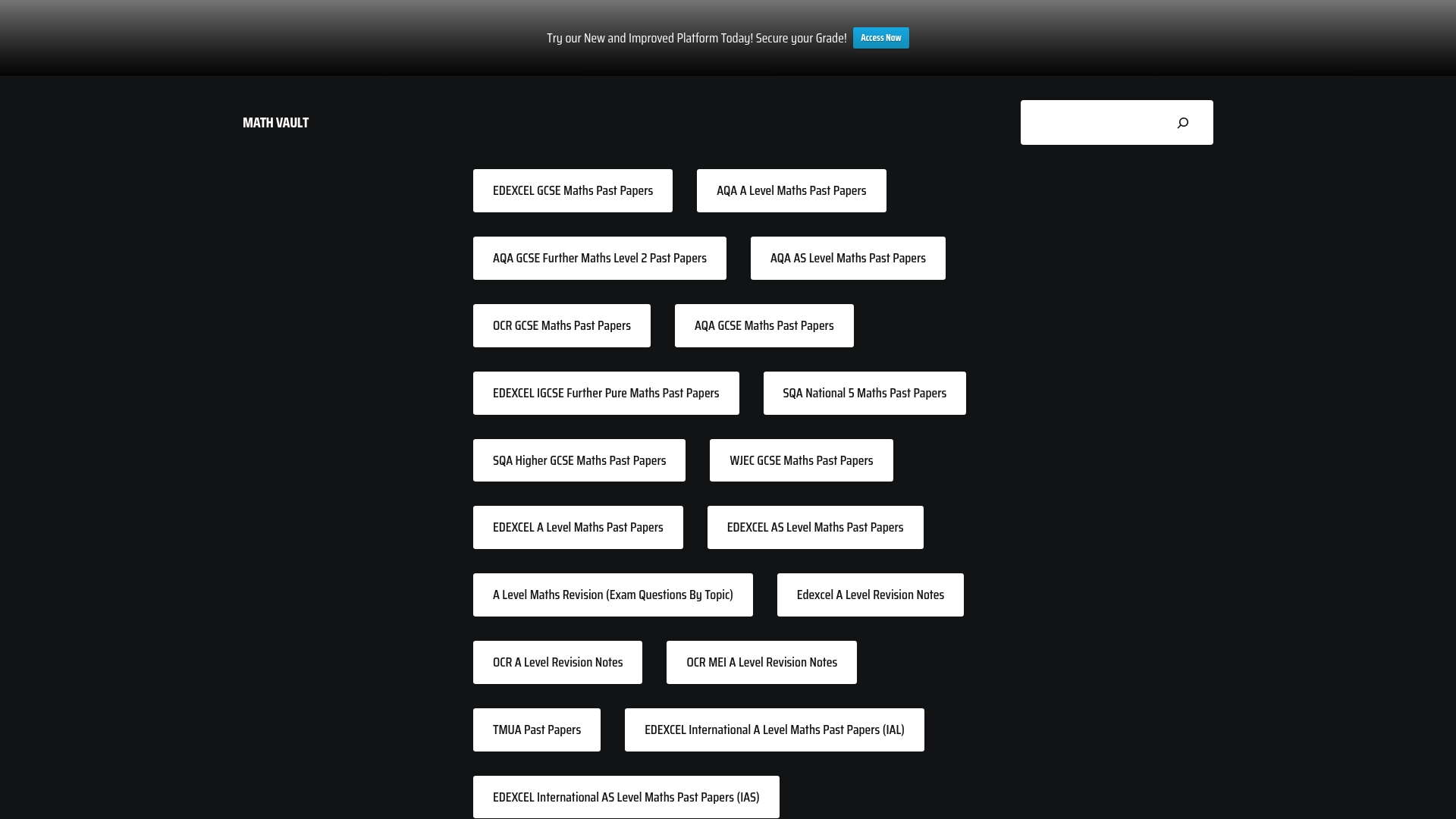
Every board-specific collection, from AQA GCSE to Edexcel A-Level, pairs the original paper with a step-by-step solution, so mark-scheme reverse engineering takes minutes rather than a full evening of guesswork. If you are working through the six-stage routine and need topical practice rather than full papers to start with, the Edexcel GCSE topic-by-topic questions let you target a single weak area without wading through an entire paper first.
Start this week by picking your board’s most recent paper on Mathvault’s GCSE revision hub, run through the diagnostic stage, and use the worked solutions to build your first model answer before your next timed attempt.
Frequently asked questions
How many past papers should I do before my exam?
There is no fixed number that suits everyone. Quality of review matters more than quantity, so aim for consistent attempt-review-repair-retest cycles rather than a target count, and stop adding new papers once a session stops teaching you anything new.
Should I start with the most recent past papers or older ones?
Start with the two or three most recent papers to match your current specification, then use five to seven years of older papers to spot recurring question patterns, adjusting for any syllabus changes along the way.
What is the best way to use a mark scheme?
Mark your attempt against it honestly, then rewrite any question where you lost marks as a full model answer that mirrors the scheme’s structure and wording, rather than just checking whether your final answer matched.
How do I know if I am ready for a full timed mock?
You are ready once untimed and timed-section practice on the relevant topics no longer reveals new gaps. Jumping to a full mock too early usually just repeats mistakes you have not yet repaired.
Where can I find genuine past papers for my exam board?
Go to your exam board’s own archive first for guaranteed accuracy, then use curated, board-organised collections such as Mathvault’s revision guides to find papers paired with fully worked solutions.
Sources
- How to use past exam papers to revise effectively – The Uni Guide
- Get top marks with this effective past paper strategy | Feature
- Past Paper Strategy: How to Use Them Effectively (Not Just Practice Tests)
- Past papers: how many to do, how to review them, and when to stop
- How to use past papers without wasting them – Latimer Tuition
Leave a Reply