
National 5 Mathematics covers three core areas: Expressions and Formulae, Relationships, and Applications. The exam is two papers totalling 90 marks — Paper 1 is non-calculator (40 marks) and Paper 2 uses a calculator (50 marks). Your best first step is to download an SQA specimen paper and attempt it under timed conditions, then check your answers against the official marking instructions or Mathvault’s worked solutions.
Start here:
- Download the SQA course specification and a specimen paper from the SQA National 5 resource page.
- Attempt one full paper under exam conditions before you revise anything else — it tells you exactly where your gaps are.
- Use Mathvault’s National 5 past papers and solutions to check your working step by step.
- Note every question you dropped marks on; that list becomes your revision priority order.
Table of Contents
- What are the National 5 maths topics you need to revise?
- How is National 5 assessed, and what does each paper test?
- How to use past papers effectively
- Your 6-week National 5 revision plan
- Where to find specimen papers, marking schemes and revision resources
- Answer presentation and time management in the exam
- Adapting the revision timetable to your situation
- Which calculator is permitted in Paper 2?
- Key takeaways
- Why syllabus mapping matters more than you might think
- Free Mathvault resources for your National 5 revision
What are the National 5 maths topics you need to revise?
The National 5 mathematics curriculum organises all assessed content into three core areas. Here is a full breakdown of the topics and the specific skills tested under each.
Expressions and formulae
- Indices and surds: simplify expressions using laws of indices; identify and simplify surds; rationalise denominators.
- Algebraic manipulation: expand brackets, factorise expressions (including difference of two squares and trinomials), simplify algebraic fractions.
- Completing the square: rewrite a quadratic in the form $(x + a)^2 + b$ to identify the turning point.
- Formula rearrangement: change the subject of a formula involving squares, square roots, and fractions.
- Volumes: calculate volumes of standard 3D solids (sphere, cone, cylinder, prism) and solve reverse-volume problems.
Relationships
- Linear equations and inequalities: solve equations and inequalities; interpret solutions in context.
- Quadratic equations: solve by factorising, using the quadratic formula, or reading from a graph; interpret the discriminant to determine the nature of roots.
- Simultaneous equations: solve algebraically (substitution and elimination) and graphically.
- Graphs: sketch and interpret graphs of linear, quadratic, and trigonometric functions; identify features such as turning points, intercepts, and period.
- Pythagoras’ theorem: apply in two and three dimensions; identify right-angled triangles within composite shapes.
- Trigonometry: use SOH-CAH-TOA in right-angled triangles; apply the sine rule and cosine rule to find sides and angles in non-right-angled triangles; use trig identities.
- Geometry: apply properties of circles, arcs, sectors, and angles in polygons.
Applications
- Vectors: add and subtract vectors; calculate the magnitude of a vector; work with 2D and 3D components.
- Statistics: calculate mean, median, mode, and standard deviation; interpret box plots, dot plots, and scatter graphs; evaluate data sets critically.
- Bearings and compound measures: solve problems involving bearings, speed, distance, time, and percentage change.
- Percentage problems: calculate percentage increase/decrease, reverse percentages, and compound interest.
Topics commonly interlink: a trigonometry question will often require algebraic manipulation, and a statistics question may involve formula rearrangement. Revise across areas, not in isolation.
Pro Tip: Use the Leckie National 5 checklist to tick off micro-skills as you master them — for example, “rationalise the denominator” or “use the discriminant”. This converts vague topic revision into mark-scorable steps.

How is National 5 assessed, and what does each paper test?
Understanding the exam structure is half the battle. The two papers test different skill sets, and your revision must reflect that split.
| Paper | Calculator? | Marks | Duration | Skills Assessed |
|---|---|---|---|---|
| Paper 1 | No | 40 | 1 hr 15 min | Mental arithmetic, algebraic manipulation, reasoning, geometry |
| Paper 2 | Yes | 50 | 1 hr 50 min | Applied modelling, extended problems, calculator methods |
| Total | 90 |
Paper 1 is frequently underestimated. The SQA course specification is explicit: the non-calculator paper tests fundamental understanding, not complex computation. Mental arithmetic and clean algebraic working without digital aids are what earn marks here.
Paper 2 rewards students who can apply methods across topics — expect multi-step problems where you select the right strategy, not just recall a formula. The SQA specimen papers and marking instructions are the authoritative benchmark for both format and marking expectations; use them before any other resource.
How to use past papers effectively
A structured approach to past papers produces far better results than simply working through questions. Follow this method.
- Set exam conditions. Remove notes, silence your phone, and use only the permitted equipment. Paper 1: no calculator. Paper 2: approved calculator only.
- Time yourself accurately. Use the actual exam duration for each paper rather than working at your own pace.
- Attempt every question. Even partial working earns method marks; leaving a question blank earns nothing.
- Mark with official instructions. Use SQA marking instructions to understand exactly which steps award marks — not just whether your final answer is correct.
- Complete an error log. For every dropped mark, record: question reference, skill tested, mistake type (concept gap, arithmetic slip, or misread question), the correct method, and a follow-up resource.
- Reattempt similar questions. Find a past-paper question on the same skill and attempt it a week later. Reattempting similar questions is more effective than moving straight to new textbook exercises.
- Track improvement. Keep a running mark total per paper so you can see progress over weeks, not just individual sessions.
Pro Tip: Pay close attention to command words. When a question says “show that,” the SQA expects a chain of reasoning with annotated working — a bare numeric answer scores zero. Mathvault’s worked solutions demonstrate exactly how to lay out this reasoning to match marking instructions.
Your 6-week National 5 revision plan
| Week | Topic Focus | Practice Type | Goal |
|---|---|---|---|
| 1 | Expressions and Formulae (indices, surds, algebra) | Timed topic questions — Paper 1 style | Identify weak micro-skills; start error log |
| 2 | Relationships (equations, quadratics, simultaneous) | Timed topic questions — mixed P1 and P2 | Fluency with solving methods |
| 3 | Relationships (trigonometry, graphs, geometry) | Timed topic questions — P2 style | Sine/cosine rule accuracy; graph sketching |
| 4 | Applications (vectors, statistics, percentages) | Timed topic questions — P2 style | Multi-step problem confidence |
| 5 | Weak topics from error log | Full Paper 1 mock (40 marks, 1 hr 15 min) | Non-calculator stamina; mark against instructions |
| 6 | Full mock papers (both papers) | Full Paper 2 mock (50 marks, 1 hr 50 min) | Exam-condition practice; final error review |
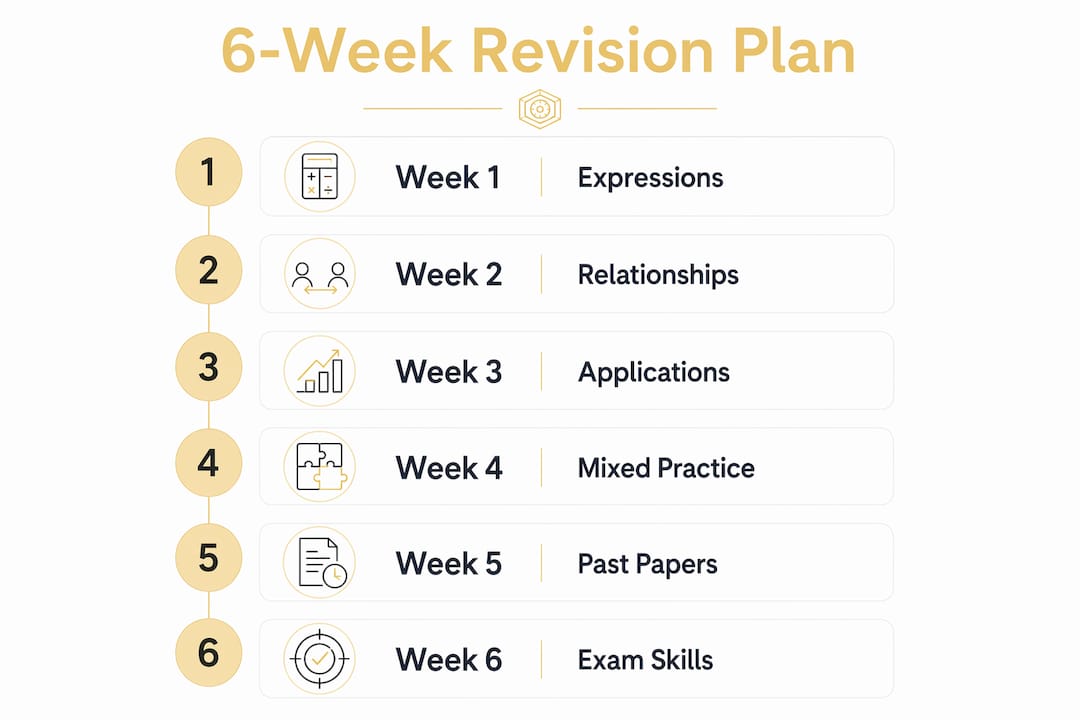
In weeks 1–4, practise individual topic questions in timed bursts of 10–15 minutes rather than attempting full papers. This trains pacing and quickly reveals which topics take disproportionate time. Move to full mock papers only in weeks 5 and 6, when you have addressed the main gaps from your error log.
Where to find specimen papers, marking schemes and revision resources
Official SQA materials — always start here.
- SQA National 5 course specification: the definitive list of assessed topics, command words, and assessment criteria.
- SQA specimen papers and marking instructions: available on the SQA National 5 resource page; use these to calibrate your marking and understand examiner expectations.
- SQA formulae list: provided in the exam — download it now and practise knowing when to apply each formula.
Mathvault resources — free and exam-focused.
- National 5 past papers and worked solutions: fully worked step-by-step solutions that show the reasoning behind each mark, not just the answer.
- Video walkthroughs: watch a worked solution before attempting a similar question to see how to structure your response.
- Live weekly Q&A sessions: ask questions in real time when a topic is not clicking from written solutions alone.
- Complete student guide to National 5 Mathematics: a platform-specific overview linking syllabus areas to curated resources.
The most effective combination: attempt a specimen paper question, mark it with SQA instructions, then watch the Mathvault video walkthrough for any question where your method differed — even if you got the right answer.
Answer presentation and time management in the exam
Clear working earns marks even when your final answer is wrong. Write every step on a new line, label your method (e.g., “using the cosine rule”), and never erase working — cross it out neatly if you change approach. Examiners award method marks for correct process, so a visible, logical chain of working protects you when arithmetic slips occur.
For time management, divide your available minutes by the total marks to find your per-mark pace: roughly 1.5 minutes per mark across both papers. If a question is taking far longer than its mark allocation suggests, move on and return to it. Spending eight minutes on a two-mark question is one of the most common ways students lose marks they could have earned elsewhere.
Adapting the revision timetable to your situation
The six-week plan above assumes you are starting revision with six weeks to go. If you have more time, extend weeks 1–4 by adding a second pass through each topic area before moving to mock papers. If you have fewer than four weeks, compress by focusing exclusively on your error-log topics and completing at least two full mock papers under exam conditions.
The key principle is that your timetable should respond to your error log, not follow a fixed script. After each mock paper, reorder your remaining revision days to weight the topics where you dropped the most marks. A timetable that never changes is not a revision plan — it is a schedule.
Which calculator is permitted in Paper 2?
The SQA permits a scientific calculator in Paper 2. Graphical calculators and calculators with symbolic algebra (CAS) functions are not permitted. Check the SQA’s current list of approved models before your exam, as permitted models are reviewed periodically.
Knowing your calculator is permitted is one thing; using it efficiently is another. Practise these functions specifically for Paper 2:
- Trigonometric functions and their inverses (sin, cos, tan, sin⁻¹, cos⁻¹, tan⁻¹): essential for sine and cosine rule questions.
- Standard deviation: many scientific calculators compute this directly in statistics mode — know your model’s key sequence before the exam.
- Powers and roots: use the $x^y$ and $sqrt[n]{x}$ keys for volume and index questions rather than repeated multiplication.
- Memory functions: store intermediate values to avoid rounding errors in multi-step calculations.
Never round intermediate answers mid-calculation. Store the full value in your calculator’s memory and round only at the final step, to the precision the question requests.
Key takeaways
The most reliable path through National 5 Mathematics is to map the SQA syllabus to your personal error log, practise both papers under timed conditions, and use official marking instructions to understand exactly how marks are awarded.
| Point | Details |
|---|---|
| Three core areas | The syllabus covers Expressions and Formulae, Relationships, and Applications — revise all three. |
| 40/50 marks split | Paper 1 (non-calculator, 40 marks) tests reasoning and algebra; Paper 2 (calculator, 50 marks) tests applied methods. |
| Non-calculator fluency | Mental arithmetic and clean algebraic working are crucial for Paper 1 — practise without a calculator daily. |
| Error log discipline | Log every dropped mark by skill and mistake type; reattempt similar questions one week later to confirm understanding. |
| Mathvault resources | Use Mathvault’s National 5 hub for past papers, fully worked solutions, and video walkthroughs alongside official SQA specimen papers. |
Why syllabus mapping matters more than you might think
Most students approach National 5 revision by working through topics they already find comfortable. It feels productive, but it rarely moves the grade. The students who improve most are those who treat the SQA course specification as a checklist, identify the specific micro-skills they cannot yet demonstrate reliably, and then practise those skills against real past-paper questions with marking instructions open beside them.
The SQA’s assessment framework is built around mathematical reasoning and strategy selection, not rote procedures. That means the exam rewards students who can explain their method, not just produce a number. Annotating your working to match what marking instructions expect is a learnable skill — and Mathvault’s worked solutions are designed to model exactly that approach, step by step.
If you are working through this syllabus and feel uncertain about where to start, the live Q&A sessions are there precisely for that moment. Free, weekly, and open to all — no question is too basic.
Free Mathvault resources for your National 5 revision
Every National 5 past paper, fully worked solution, and video walkthrough on Mathvault is free. You get step-by-step solutions that show the reasoning behind each mark, video walkthroughs that model correct working presentation, and downloadable revision packs you can use offline. Live weekly Q&A sessions mean you can get a real answer to a specific question, not just a generic explanation.
Head to the Mathvault National 5 hub to access past papers and worked solutions, or visit mathvault.io to browse the full range of SQA resources. Download a revision pack, attempt a specimen paper this week, and bring your questions to the next live Q&A.
Leave a Reply