
The fastest route to a better GCSE maths grade is a diagnostic past paper followed by a focused practice plan built on spaced repetition and interleaving, not endless textbook reading. Sit one paper under timed conditions, mark it against a topic list, then let the results decide your priorities. Choose a 12 week timetable if your exam is months away, 8 or 4 weeks if you’re starting later, and the 48/24/8 plan if you’re down to the final days. You can find past papers and worked solutions online to run every stage of this plan without paying for materials.
TL;DR:
- Focusing on diagnostic past papers can quickly identify actual gaps, making targeted revision more effective than endless textbook reading.
- Using a RAG system to log mistakes by topic ensures priority topics receive regular practice and review, improving retention over time.
- Past-paper practice should be timed, self-marked against official mark schemes, and followed by specific targeted tasks to maximize exam readiness.
- Short daily practice sessions of 15 to 20 minutes with retrieval, focused drills, and error review outperform infrequent, longer study blocks.
- When persistent gaps remain after three focused sessions, seeking help from teachers, tutors, or videos is preferable to repeated self-study without progress.
Table of Contents
- Which revision timetable suits your starting point?
- How do you build a personalised plan from a diagnostic paper?
- How should you mark and drill past papers for maximum gain?
- What does an effective daily study session look like?
- When should you get extra help or switch tiers?
- Which topics carry the most marks in the GCSE maths exam?
- How do you manage exam stress without losing motivation?
- Which resources are worth using for GCSE maths revision?
- How do you balance maths revision with your other subjects?
- Why a diagnostic-led plan beats generic revision advice
- Run this plan with MathVault.io’s free resources
- Sources
- FAQ
Which revision timetable suits your starting point?
The timetable you choose depends entirely on how much runway you have left, not on how you feel about maths. A student six months out needs a different rhythm from one staring down a Friday exam.
- 12 week plan. Weeks 1 to 3 rebuild foundations in number, algebra and ratio. Weeks 4 to 7 move into topic mastery, working through geometry, statistics and trigonometry one block at a time. Weeks 8 to 10 shift to exam technique and full mock papers under timed conditions, which builds stamina and technique more than extra topic hours. Weeks 11 and 12 return to final practice, drilling whatever the mocks exposed.
- 8 week plan. Compress the foundations phase to a single week, run topic mastery over four weeks instead of four to seven, and start mocks from week 6 rather than week 8. Drop any topic where a diagnostic paper shows solid marks already.
- 4 week plan. Suited to students with reasonably solid foundations who need sharpening, not rebuilding. Each week pairs two topic areas with one timed paper, and non-calculator practice runs daily rather than weekly. Structured past-paper practice over a compressed window can move a student a grade boundary or two even inside 30 days.
- 48/24/8 last-minute plan. With 48 hours left, revise your three weakest topics only and sit one mixed past paper. At 24 hours, stop learning new content entirely and review your error log instead. In the final 8 hours, sleep properly, check your equipment, and skim formula sheets rather than attempting new questions.
Whichever timetable you follow, aim for 30 to 40 minutes on weekdays and a longer session at weekends, with one full timed mock per week from week 8 onwards in the longer plans. A 12, 8 or 4 week revision timetable template is available to provide a printable structure to adapt.
How do you build a personalised plan from a diagnostic paper?
Start by sitting one complete past paper under genuine exam conditions: timed, no notes, phone away. Choose a paper from the last two or three years so the question style matches what you’ll actually face, and mark it strictly against the official scheme rather than guessing at partial credit.
Once marked, log every mistake by topic, not just by mark lost. This error log becomes the engine of the whole plan.
- Sort each topic into red, amber or green based on your diagnostic score. This RAG system forces attention onto genuine gaps rather than comfortable topics you’d rather keep practising.
- Give red topics the first slot in every session for at least a week.
- Mix topics within sessions rather than blocking one at a time. Practising algebra, number and geometry side by side mirrors the exam paper and improves long-term retention, even though it feels harder at first.
- Schedule spaced review: revisit a red topic after two days, then five, then ten, stretching the gap each time it holds.
- Retest a topic after three focused sessions. If it’s still red, that’s your signal to change approach.
Pro Tip: Don’t discard your first diagnostic paper. Keep it, retest with a fresh paper four weeks later, and compare your RAG map side by side. Watching amber turn green is the clearest motivation you’ll get.
If a topic stays red after three genuine attempts, the three-session rule says it’s time to change tactics, whether that means a worked solution, a video walkthrough, or asking a teacher directly.
How should you mark and drill past papers for maximum gain?
Past papers only work if you treat them as a diagnostic tool, not a confidence exercise. Sitting one comfortably under no time pressure tells you almost nothing about exam performance.
- Simulate real conditions separately for calculator and non-calculator papers, using the exact time allowance and no reference materials.
- Mark against the official mark scheme line by line, noting where you lost method marks versus accuracy marks.
- Build a topic miss-list straight from the marking, ranking each miss by how many marks it cost across the paper.
- Chunk future practice into mixed blocks, working every third question from a different topic area. This mirrors exam-style transitions and stops false confidence building from solving only easy runs of questions.
- Convert every miss into a specific task: not “revise trigonometry” but “practise sine rule questions involving obtuse angles.”
Track your miss-count across three or four successive papers. A shrinking list is the only evidence that matters, more useful than how a paper “felt” while you sat it. Our self-mark past paper packs with board-aligned solutions speed up exactly this cycle.
What does an effective daily study session look like?
A session under 30 minutes rarely achieves much; a session over an hour usually loses focus halfway through. The middle ground works best.
- Open with a 3 to 5 minute retrieval warm-up: three quick questions from topics you studied last week, done from memory.
- Spend 15 to 20 minutes on focused practice on your current red or amber topic.
- Close with 5 minutes reviewing what went wrong and updating your error log.
Short, daily sessions of 15 to 20 minutes outperform occasional long ones for building lasting recall, with a longer weekend session reserved for full papers or mocks.
Calculator fluency deserves its own slot: practise with the exact model you’ll use in the exam hall, not a phone app, and learn its statistics and fraction functions properly. Non-calculator work needs separate daily drilling. A concentrated two-week run of 20 minutes a day on mental arithmetic and estimation checks can lift non-calculator paper scores noticeably, since this skill tends to lag behind calculator confidence. Pack spare pens, a protractor, compasses and a spare calculator battery the night before, not the morning of.
When should you get extra help or switch tiers?
If a red topic survives three genuine practice sessions with no improvement, that’s your cue to escalate rather than repeat the same approach. A teacher, tutor, or a worked video walkthrough can unstick a topic that self-marking alone hasn’t shifted.
- No improvement after three focused sessions on the same topic.
- Mock scores stuck well below the target grade with weeks still remaining.
- Persistent gaps in an entire topic area, not just isolated question types.
Deciding between Foundation and Higher tier should rest on mock evidence, not hope. If Higher mocks stay incomplete or consistently low with little time left, Foundation is often the safer route to secure a solid grade 4 or 5.
Pro Tip: Parents get more from calm consistency than from reacting to a bad mock score. Treat early mocks as a map of gaps, not a verdict, and use school feedback to adjust the plan, not to raise the temperature at home.
Which topics carry the most marks in the GCSE maths exam?
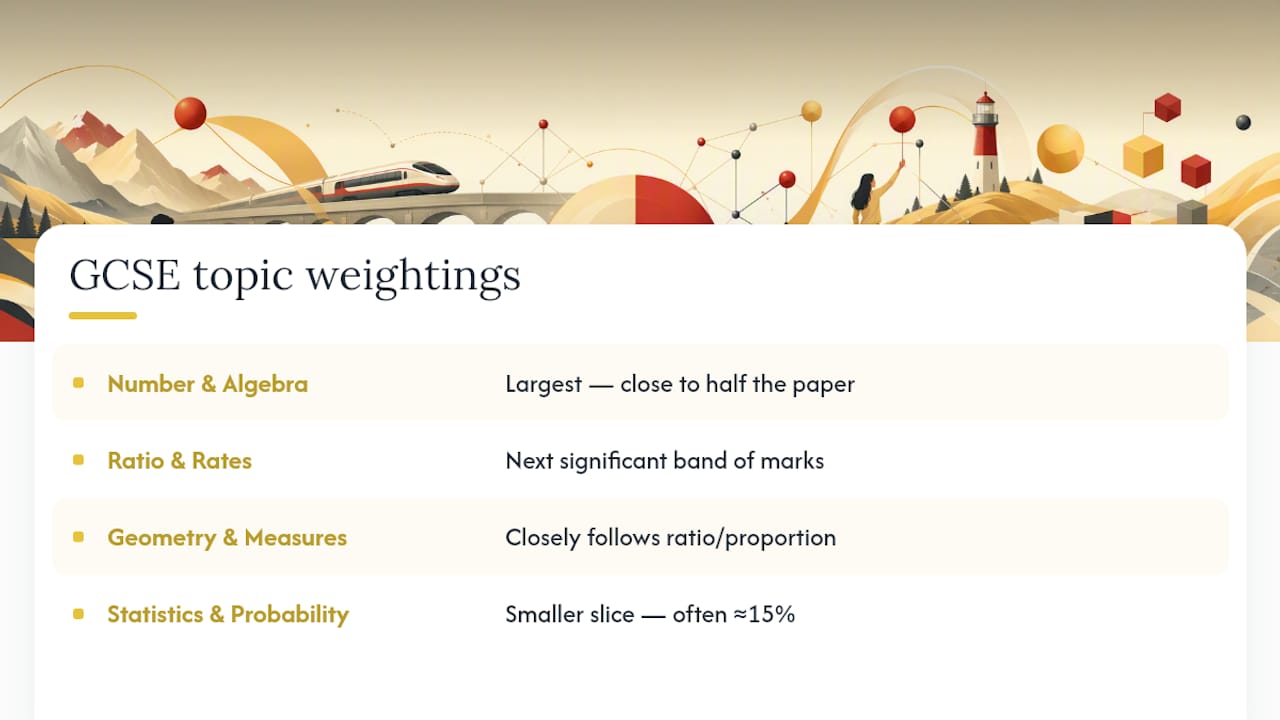
Not every topic deserves equal revision time, and the exam’s own weighting tells you exactly where to put the hours. Number and algebra together typically account for the largest single chunk of marks across most GCSE specifications, often close to half the paper between them. Ratio, proportion and rates of change form the next significant band, closely followed by geometry and measures.
Statistics and probability usually make up a smaller but consistent slice, often around 15% of available marks, which means it’s rarely worth neglecting even though it feels lower stakes than algebra.
The exact weighting differs slightly between exam boards, so check your board’s own assessment objectives rather than assuming AQA, Edexcel and OCR split marks identically. Our complete revision guide to National 5 maths topics breaks the syllabus down by area so you can weight your timetable against what the exam actually rewards, not against which topics feel most comfortable.
Algebra deserves particular attention because it resurfaces inside geometry and statistics questions too. A student weak on solving equations loses marks well beyond the algebra section alone, which is exactly why interleaved practice across topics matters more than isolated topic revision.
How do you manage exam stress without losing motivation?
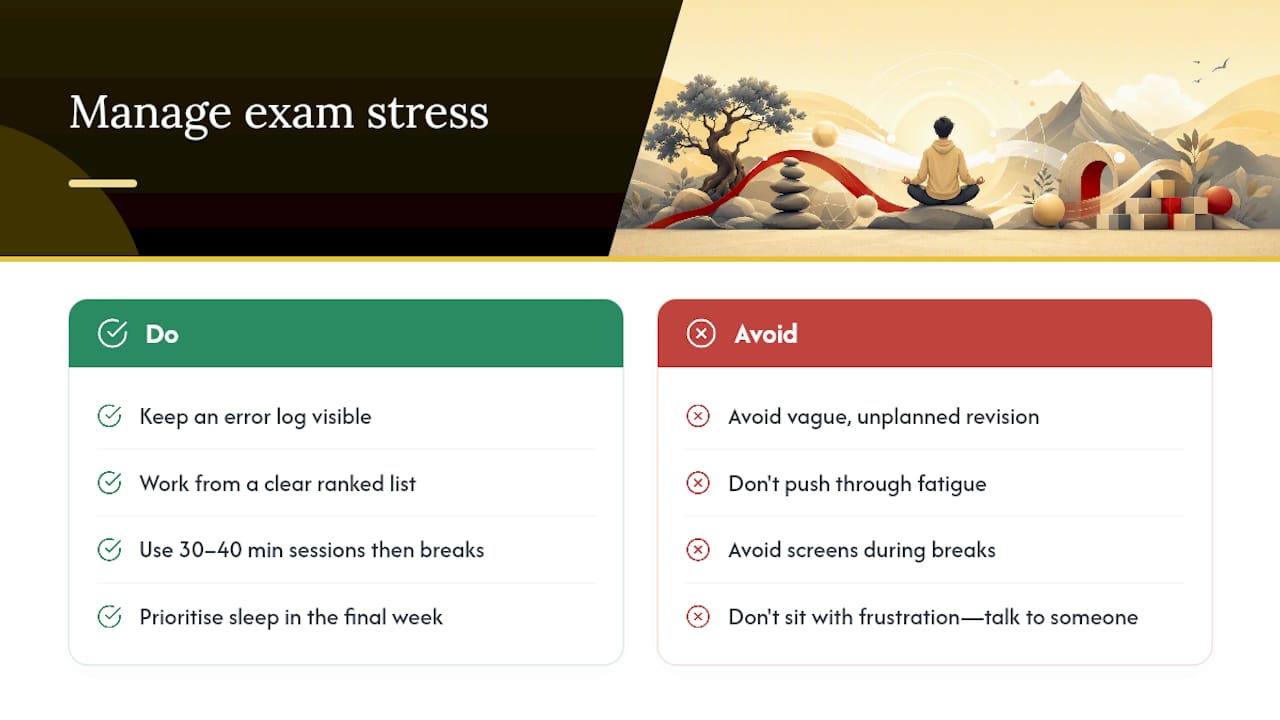
Stress during revision usually comes from vagueness, not difficulty. A student who doesn’t know what to revise next feels far more anxious than one working through a clear, ranked list.
Keeping your error log visible and updating it after every session turns a vague fear of “not being ready” into a concrete, shrinking list of red topics. That shift alone reduces a good deal of exam anxiety, because progress becomes visible rather than imagined.
Build in deliberate breaks. A 30 to 40 minute session followed by a proper break, away from screens, protects concentration for the next one far better than pushing through fatigue. Sleep, particularly in the final week, matters more than one extra hour of cramming; a tired brain retrieves information poorly regardless of how much content it holds.
Talk to someone, whether a parent, teacher or friend, when a topic feels stuck rather than sitting with the frustration alone. Our guide to managing maths anxiety before GCSEs covers practical techniques for calming exam-day nerves specifically. Motivation dips are normal around the midpoint of any long revision plan; treat that slump as expected rather than as a sign the plan isn’t working, and let small wins, a shrinking miss-list, a green topic, carry you through it.
Which resources are worth using for GCSE maths revision?
The right resource depends on what stage of the plan you’re at, not on which one has the flashiest branding. For structured topic teaching, a board-specific textbook remains genuinely useful, particularly for working through worked examples before attempting past-paper questions cold.
For past papers themselves, Edexcel GCSE past paper questions sorted by topic let you target red topics directly rather than working through a whole paper when you only need practice on circle theorems or simultaneous equations. BBC Bitesize offers solid, free revision notes and quizzes organised by specification, useful for a quick refresher before a topic-focused session.
Where self-marking breaks down, worked solutions and step-by-step videos speed up correction considerably compared with guessing at a mark scheme alone. Live Q&A sessions add a further layer for topics that survive repeated independent attempts. Our GCSE maths revision guides organised by topic and board pair notes with the papers you need for each timetable phase, all free to access.
Apps have a place too, mainly for short retrieval warm-ups and flashcard style number facts, but they rarely substitute for full past-paper practice under timed conditions.
How do you balance maths revision with your other subjects?
Maths rarely sits alone in a revision timetable, and treating it as the only priority usually backfires on your other grades. The daily rhythm that works for maths, short focused sessions with a clear red topic target, transfers directly to other subjects, so build a weekly grid rather than a maths-only one.
A practical approach: rotate two or three subjects per day rather than dedicating whole days to single subjects. Interleaving across subjects, not just within maths, keeps your brain switching contexts the way exam week actually demands. If maths mocks reveal several red topics, it’s reasonable to weight that week more heavily toward maths, but don’t let it swallow the entire week at the expense of subjects with equally pressing gaps.
Use weekends for the longer sessions, mock papers or extended essay practice, that don’t fit into a 30 to 40 minute weekday slot, and keep weekday sessions short and specific across every subject. A step-by-step exam preparation structure built around daily short blocks, though written for a different exam system, illustrates the same underlying principle: consistency across subjects beats occasional marathon sessions in any one of them.
Why a diagnostic-led plan beats generic revision advice
Most revision advice tells students to “practise more” without saying what to practise or when to stop. That vagueness is why so many students revise for weeks and still walk into the exam hall uncertain. A diagnostic paper removes the guesswork on day one, and a RAG-tracked error log keeps removing it every week after.
The interleaving research is genuinely counterintuitive here: mixing topics feels slower and less satisfying than blocking one topic until it feels mastered, yet it produces better retention by exam day. Trust the harder-feeling method over the comfortable one.
MathVault.io’s role in this plan is straightforward. Use the topic-sorted past papers for your diagnostic and for red-topic drilling, lean on worked solutions when self-marking stalls, and bring genuinely stuck topics to live Q&A rather than letting them sit red for weeks. The workflow depends on resources being freely accessible for repeated use.
— Oloru
Run this plan with MathVault.io’s free resources
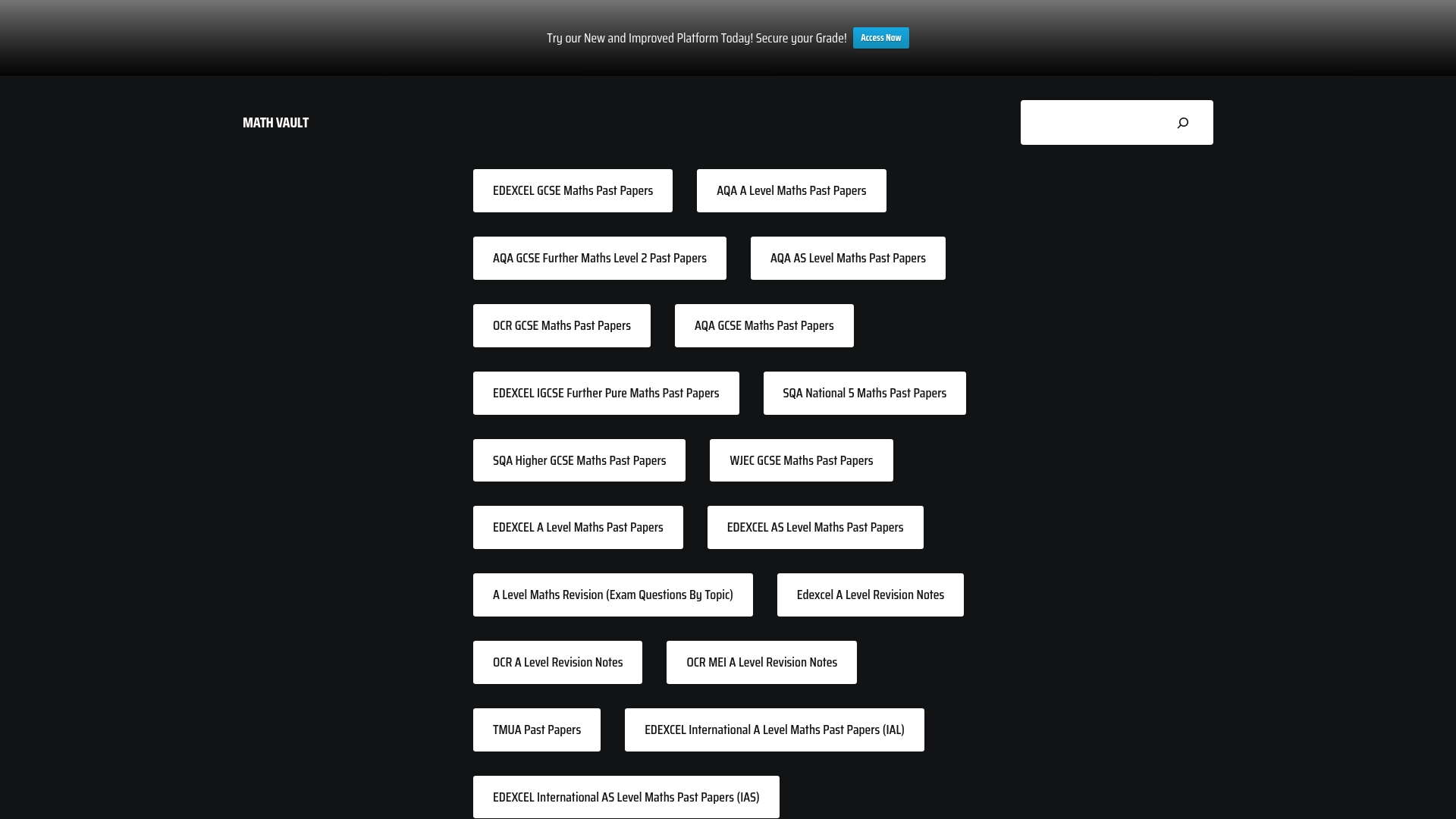
This plan can be run using available free resources without the cost of buying separate revision packs or tutoring hours for each topic. Use the Edexcel GCSE past papers sorted by topic for your week-one diagnostic and for drilling red topics through weeks 4 to 7 of a 12 week plan.
For the exam-technique phase from week 8 onwards, run full timed mocks and self-mark them against board-aligned solutions using the self-mark past paper packs. When a topic survives three attempts and stays red, consider bringing it to a live Q&A session, where a worked explanation can help clear the sticking point more effectively. If your exam is under a week away, a 48/24/8 last-minute revision plan offers a compressed version of this structure. Begin with one diagnostic paper and let your error log build the rest of your timetable from there.
Sources
- Five tips and tricks to help with GCSE Maths revision – BBC Bitesize
- GCSE Maths Revision Plan: 12 Weeks to Exam Day | EduBoost
- Closing the revision gap — Century Tech
- Blocking or interleaving? — InnerDrive
FAQ
What is a revision plan for maths?
A revision plan for maths is a scheduled sequence of diagnostic testing, targeted topic practice and mock exams, structured over weeks and built around your actual weaknesses rather than a generic topic list.
How long before my GCSE maths exam should I start revising?
Twelve weeks gives the most reliable window for meaningful grade improvement, though structured 8 or 4 week plans still produce real gains for students starting later.
How many past papers should I complete before my exam?
There’s no fixed number, but sitting one paper roughly every one to two weeks from week 8 onwards, each timed and self-marked, gives enough data to track a shrinking miss-list reliably.
Is interleaving really better than revising one topic at a time?
Yes. Mixing topics within a session produces stronger long-term retention than blocking, even though it feels harder and slower in the moment.
Where can I find free past papers and worked solutions for GCSE maths?
Mathvault provides free past papers sorted by exam board and topic, alongside worked solutions, video walkthroughs and live Q&A sessions for students who need extra correction.
Leave a Reply