
Quick links to get started:
- Edexcel A level maths page — module notes and exam practice
- AQA AS level maths page — AQA-aligned mechanics notes and practice
- Official exam board specification pages (AQA, Edexcel, OCR) for mark schemes and specimen papers
Pro Tip: Print your one-page formula sheet, set a 12-minute timer, and attempt a single past-paper question without looking at it. Only check the sheet if you are genuinely stuck. This trains you to recall under pressure, not just recognise.
Key takeaways
Fluency with SUVAT equations and resolving forces, combined with timed past-paper practice and mark-scheme-aligned worked solutions, is the most direct route to a higher mechanics grade.
| Point | Details |
|---|---|
| Start with SUVAT fluency | Practise selecting the correct equation from three known variables before attempting full papers. |
| Use board-aligned resources | Match your notes, past papers and worked solutions to AQA, Edexcel, OCR or OCR MEI specifically. |
| Diagnose with past papers | Categorise every lost mark by topic and rework that topic before attempting another question on it. |
| Watch worked solutions actively | Pause, attempt each step yourself, then redo the full question without the video. |
| Mathvault for free access | Mathvault provides free topic-tagged past papers, worked solutions and live Q&A sessions for all major UK boards. |
Table of Contents
- What AQA mechanics resources do you actually need?
- How do you revise Edexcel mechanics effectively?
- What resources cover OCR and OCR MEI mechanics?
- Core mechanics topics you must revise before the exam
- How should you use past papers to improve your mechanics score?
- How do video walkthroughs help you learn methods, not just answers?
- Sample 2-week and 4-week mechanics revision plans
- Which resources should you prioritise as the exam approaches?
- Where to find concise one-page mechanics revision notes
- Why board-aligned resources raise your mechanics score
- Mathvault’s free mechanics revision resources
- Useful sources and links
What AQA mechanics resources do you actually need?
AQA embeds mechanics within its A level Maths paper, so there is no separate mechanics module — every mechanics topic can appear alongside pure content. That makes board-aligned one-page summaries especially useful, because you need to switch between topic areas quickly in the exam.
Where to find AQA mechanics materials:
- One-page summary notes covering kinematics, Newton’s laws, moments, projectiles and friction — available via the AQA AS level maths page on Mathvault
- AQA specimen and past papers from the official AQA website, filtered for mechanics-heavy questions
- Printable formula sheets listing SUVAT equations, friction inequalities and moment formulae
Which topics appear most in AQA mechanics assessments:
- Kinematics with constant acceleration (SUVAT equations A level)
- Resolving forces on inclined planes and in two dimensions
- Moments and equilibrium, including non-uniform rods
- Projectile motion under gravity
- Connected particles and Newton’s third law
Pro Tip: When checking your work against an AQA mark scheme, read the method mark descriptors carefully. AQA often awards an M1 mark for a correct equation of motion even if the arithmetic is wrong. Mirror that language in your own working — write “applying Newton’s second law along the slope” before your equation, not just the equation alone.
AQA mark schemes reward clear, structured working. Sketching a force diagram and labelling every known variable before selecting an equation is half the battle in mechanics questions.
How do you revise Edexcel mechanics effectively?
Edexcel A level Maths includes mechanics content in its Year 1 and Year 2 papers. Students following the legacy specification will recognise the M1 and M2 module structure; the current linear specification integrates those topics across the two years. Either way, the core mechanics content is consistent.
Edexcel mechanics notes and module alignment:
- Year 1 mechanics covers kinematics, forces, Newton’s laws, moments and variable acceleration
- Year 2 extends to projectiles, friction on inclined planes and more complex connected-particle problems
- Mathvault’s Edexcel A level maths page provides module-aligned notes and an index of topic-tagged practice questions
Using Mathvault’s Edexcel topic-tagged papers:
Mathvault hosts Edexcel A level past paper questions by topic with fully worked solutions, so you can drill a single topic — say, projectiles A level maths — without sitting a full paper. This is far more efficient when you have identified a specific weak area.
Edexcel mechanics exam checklist:
- Confirm whether your paper is calculator-allowed (both Edexcel A level mechanics papers permit a calculator).
- Watch for command words: “find” expects a numerical answer; “show that” requires a complete, justified derivation.
- Check that your answer includes correct units — Edexcel mark schemes deduct accuracy marks for missing or wrong units on final answers.
- For connected-particle questions, draw separate free-body diagrams for each object before writing any equations.
For students who prefer a structured printed supplement alongside free online notes, the Edexcel AS Mechanics 1 revision guide offers a compact, worked-example-led format that pairs well with Mathvault’s topic papers.
What resources cover OCR and OCR MEI mechanics?
OCR A level Maths and OCR MEI both include a mechanics component, though the MEI specification tends to place greater emphasis on mathematical modelling and interpretation. The distinction matters when you are selecting practice questions.
OCR and OCR MEI mechanics topics:
- Kinematics in one and two dimensions, including SUVAT and variable acceleration
- Forces, friction and Newton’s laws on horizontal and inclined surfaces
- Moments, equilibrium and centres of mass
- Projectile motion and resolving forces A level style into horizontal and vertical components
- Probability and statistical modelling (MEI only, separate from mechanics strand)
How OCR mark schemes award marks:
- Method marks (M marks) are given for a correct method even with an arithmetic slip
- Accuracy marks (A marks) depend on a correct preceding method mark
- For multi-part questions, OCR often carries forward an incorrect answer from part (a) into part (b), awarding marks if the method in (b) is correct given that wrong value
Pro Tip: On OCR and OCR MEI multi-part questions, treat each subpart as a checkpoint. If you cannot complete part (b), write down the equation you would use and substitute your part (a) answer — even an incorrect one — to secure the method mark. Examiners follow the “follow through” rule explicitly.
Core mechanics topics you must revise before the exam
This checklist applies across AQA, Edexcel, OCR and OCR MEI. Tick each topic only when you can complete a timed question without referring to notes.
Topic checklist:
- Kinematics (SUVAT equations A level): practise selecting the correct equation from the five SUVAT equations given three known variables; apply to vertical motion under gravity
- Resolving forces A level: decompose forces into perpendicular components; apply F = ma independently in each direction on inclined planes
- Newton’s laws: write equations of motion for single particles and connected particles; identify action-reaction pairs
- Friction: apply F ≤ μR for static cases and F = μR for limiting equilibrium; know when to use the inequality
- Moments and equilibrium: take moments about a chosen point to eliminate unknown forces; check both force and moment equilibrium
- Projectiles A level maths: treat horizontal and vertical motion independently; derive time of flight, range and maximum height
- Variable acceleration: differentiate displacement to get velocity, differentiate again for acceleration; integrate in reverse
- Modelling assumptions: state when a particle, light rod, smooth surface or inextensible string is assumed — examiners award marks for these explicitly
What to practise for each topic:
- SUVAT: derive each equation from the definitions of acceleration and velocity, not just memorise them
- Resolving forces: sketch the force diagram first, then resolve — drawing diagrams and listing known variables before selecting equations is the technique that consistently reduces errors
- Projectiles: practise finding the angle of projection from given range and height simultaneously
Fluency with SUVAT and vector resolution accounts for a large share of accessible marks in mechanics papers. Prioritise these two areas if your revision time is short.
Pro Tip: Convert this checklist into a weekly rotation. Assign two topics per day, spend 20 minutes on notes and 25 minutes on past-paper questions for those topics. After seven days, repeat the rotation but use questions you have not seen before.
How should you use past papers to improve your mechanics score?
Past papers are most effective when used as a diagnostic tool, not just a rehearsal. The process below turns each paper into a targeted improvement cycle.
- Timed attempt: sit the paper under exam conditions — no notes, correct timing, calculator if permitted.
- Self-mark against the mark scheme: award marks strictly; do not give yourself benefit of the doubt on unclear working.
- Categorise every lost mark by topic (e.g. “projectiles — wrong sign for vertical component”).
- Targeted rework: return to your notes and a worked solution for that specific topic before attempting another question on it.
- Repeat with a fresh question on the same topic within 48 hours to confirm the fix has held.
Choosing which papers to use:
- Use older papers (pre-2017 legacy modules) for technique practice on individual topics — the question style is often more straightforward and builds confidence
- Use recent papers (2018 onwards) to practise the current question style, command words and multi-step problems
- Mathvault’s topic-tagged Edexcel past papers let you drill one topic across multiple years without sitting full papers
Pro Tip: Keep a simple error log — a notebook or spreadsheet with three columns: topic, error type (method or arithmetic), and the corrected approach. Reviewing this log the evening before the exam is more productive than attempting another full paper.
How do video walkthroughs help you learn methods, not just answers?
Watching a worked solution passively is one of the least effective revision strategies. The method below converts a video walkthrough into active learning.
How to watch actively:
- Pause the video after the question is read and attempt the first step yourself before watching the solution
- Recreate each step on paper as the video progresses — do not just follow along visually
- After watching, close the video and redo the entire question from scratch; check only where you diverge
Worked solutions that explicitly reference marking notes — distinguishing method marks from accuracy marks — are superior for exam preparation. Mathvault’s worked solutions are structured to mirror mark-scheme language, so you learn not just the mathematics but the presentation style that earns marks.
What to look for in a good worked solution:
- Clear labelling of diagrams with all forces and directions shown
- Explicit statement of the equation or law being applied before substitution
- Units carried through every line, not just the final answer
- A note where a method mark is secured, separate from where the accuracy mark is earned
Pro Tip: Use the rewind function as a checkpoint system. If you cannot reproduce a step without rewinding, that step is a gap in your method knowledge. Note it, find a past-paper question that isolates that step, and practise it separately before returning to the full solution.
Sample 2-week and 4-week mechanics revision plans
Intensive 2-week plan
- Days 1–2: SUVAT and kinematics — notes review, 15 practice questions, one timed paper section
- Days 3–4: Forces, Newton’s laws and resolving — force diagrams, inclined plane questions
- Days 5–6: Projectiles and friction — topic-tagged past questions, worked solution review
- Days 7–8: Moments, equilibrium and connected particles — method practice
- Days 9–10: Variable acceleration — differentiation and integration applications
- Days 11–12: Two full timed past papers, strict marking, error log review
- Days 13–14: Weak-topic consolidation only; formula sheet review; no new methods
Steady 4-week plan
| Week | Focus | Daily structure |
|---|---|---|
| 1 | Kinematics and forces | 20 min notes, 25 min topic questions, 15 min worked solution review |
| 2 | Projectiles, friction and moments | 20 min notes, 20 min topic questions, 10 min error log |
| 3 | Connected particles, variable acceleration | 15 min notes, 25 min mixed questions, 10 min mark-scheme check |
| 4 | Full papers and consolidation | Timed paper, marking, and weak-topic rework intervals vary depending on progress |
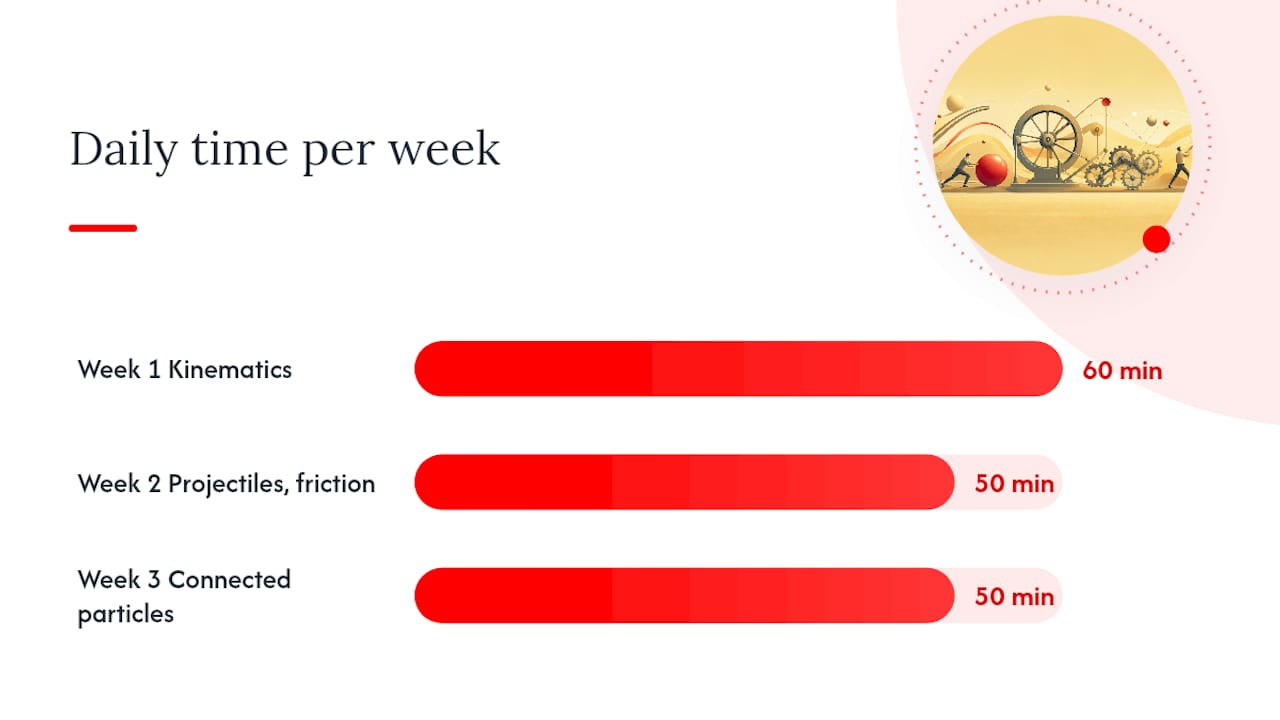
Consolidation of strengths rarely moves your grade; targeted work on weaknesses does.*
Which resources should you prioritise as the exam approaches?
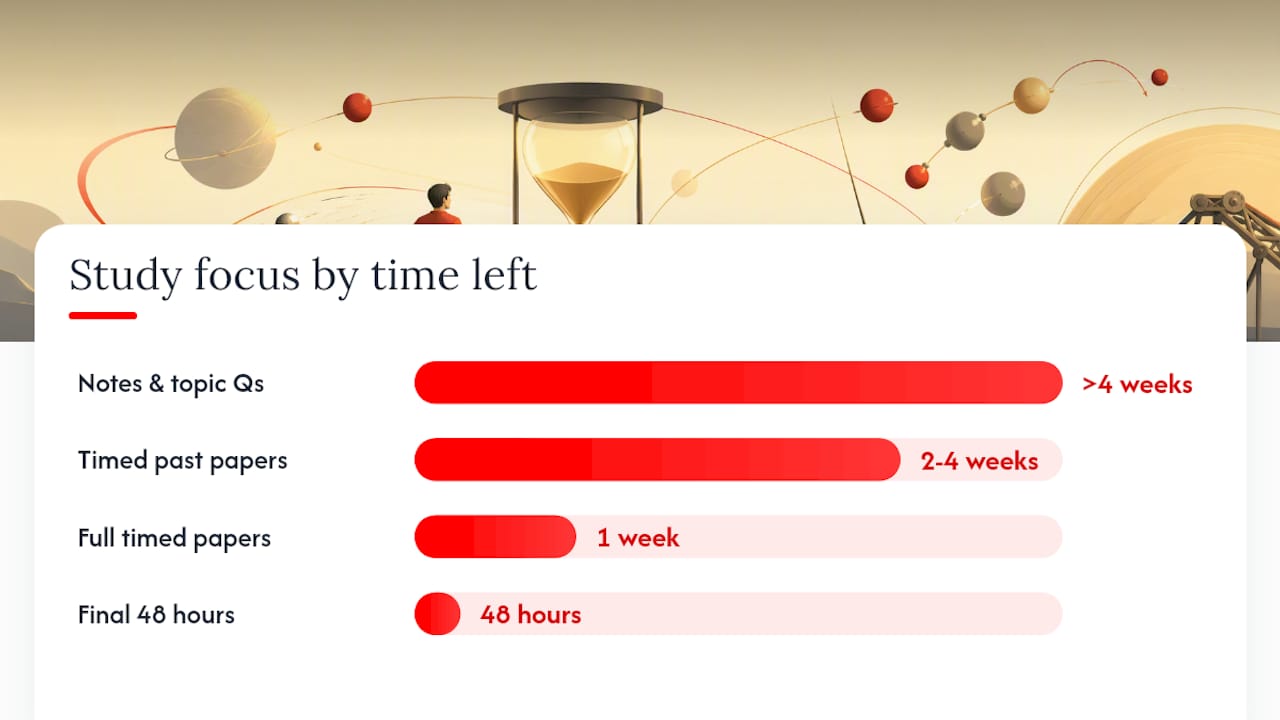
The right resource mix depends on how much time you have left.
Prioritisation rules:
- More than four weeks out: focus on notes and topic-tagged questions; build method fluency before attempting full papers
- Two to four weeks out: shift to timed past papers; use worked solutions only to diagnose errors, not as primary learning
- One week out: full timed papers, strict marking, error log review, and formula sheet memorisation only
- Final 48 hours: no new methods; review your error log, practise two or three weak-topic questions, and confirm your formula sheet is memorised
Resource quality checklist:
- Board-aligned to your specific specification (AQA, Edexcel, OCR or OCR MEI)
- Includes fully worked solutions with method and accuracy marks distinguished
- Questions tagged by topic so you can drill specific areas
- Downloadable as a PDF for offline or printed use
Pro Tip: Stop learning new methods 72 hours before the exam. At that point, exam technique and timing matter more than additional content. Practise writing clear, structured working under timed conditions — that is where most marks are recovered in the final days.
A final checklist for resource quality:
- Does the worked solution show the force diagram, not just the algebra?
- Does the mark scheme distinguish M marks from A marks?
- Are questions sorted by topic so you can target weak areas?
- Is the material free to access, or is a paid download available for offline use?
Where to find concise one-page mechanics revision notes
One-page summaries are among the most practical revision tools for mechanics because they force the key formulae, conditions and modelling assumptions onto a single printable sheet. A good summary for mechanics should include the five SUVAT equations, the friction inequality (F ≤ μR), the moment formula (moment = force × perpendicular distance), the projectile motion equations for horizontal and vertical components, and the standard modelling assumptions (particle, smooth surface, light inextensible string).
The most useful summaries go one step further: they note the conditions under which each formula applies. For SUVAT, that means constant acceleration only. For friction, it means the surface must be rough and the object either stationary or in limiting equilibrium. Printing one of these sheets and annotating it with your own worked examples from past papers is a more active revision method than reading notes passively.
Mathvault’s board-aligned revision materials include downloadable summary sheets structured around the AQA, Edexcel and OCR specifications, so the formulae and conditions you see on the sheet match exactly what appears in your exam.
Why board-aligned resources raise your mechanics score
Most students revise mechanics with generic notes that do not reflect the specific phrasing, command words or mark-scheme structure of their exam board. The gap between a correct mathematical answer and a fully marked answer is often just presentation: writing “applying Newton’s second law” before the equation, or stating the modelling assumption before using it. Board-aligned worked solutions teach that presentation layer explicitly, which generic textbooks rarely do.
Mathvault’s approach is built around this principle. Every worked solution is written to mirror the mark-scheme language of the relevant board, so students learn the method and the presentation simultaneously. The weekly live Q&A sessions add a further layer: you can bring a specific question you could not solve and work through it in real time, which is qualitatively different from re-reading a static solution.
The combination of free topic-tagged past papers, step-by-step worked solutions and live support means you are not just practising mechanics — you are practising the version of mechanics your examiner will mark.
Mathvault’s free mechanics revision resources
Every resource described in this article is available free on Mathvault: past papers, fully worked solutions, video walkthroughs and live weekly Q&A sessions, all organised by exam board. There are no paywalls on the core materials.
For students who want everything in one offline-ready file, Mathvault offers downloadable revision packs — including the Edexcel A level topic-tagged past paper collection with fully worked solutions — available as a one-off purchase. Purchasing a pack or leaving a small donation via Buy Me a Coffee directly supports the production of new worked solutions and keeps the free resources running for every student who needs them.
Start with the free hub, work through the topic-tagged papers for your board, and download a pack when you want everything consolidated in one place. Join a live Q&A session when you hit a question you cannot crack alone.
Useful sources and links
Mathvault resources:
- Edexcel A level maths page — module notes and exam practice
- AQA AS level maths page — AQA-aligned mechanics notes and practice
- Edexcel AS level maths page — AS mechanics module materials
Official exam board resources:
Supplementary materials:
- Edexcel AS Mechanics 1 revision guide — a compact printed supplement for structured notes alongside free online resources
- SUVAT topic summary and resources — overview of kinematics and constant acceleration techniques
- Resolving forces and Newton’s second law — technique guide for inclined plane and 2D force problems
Leave a Reply