
Maths anxiety is a common, measurable reaction to numbers and timed problem solving, and it can be reduced by practising targeted study skills alongside a short in-exam routine. It is not a character flaw or proof that you are “bad at maths” — it is a learned response that shrinks your working memory exactly when you need it most.
The single most effective immediate action is this: pair short, frequent self-testing on past papers with a 60 second breathing or writing routine you rehearse before every practice session. UK government exam guidance recommends structured revision and realistic reframing as core tools, and a peer-reviewed intervention study found that study-skills training lifted grades for highly anxious students more than emotion-focused techniques alone.
Start today with these two habits:
- Set a 15 minute timer and complete one past-paper question under exam conditions, then mark it immediately.
- Practise a 60 second breathing routine before you begin, so it becomes automatic by the time you sit the real exam.
Key Takeaways
Reducing maths anxiety for GCSEs works best when targeted study skills and a rehearsed in-exam routine are combined, not treated as separate fixes.
| Point | Details |
|---|---|
| Study skills come first | Self-testing and spaced practice raised grades for anxious students more than calming techniques alone, per npj Science of Learning. |
| Anxiety is common | A substantial portion of adults report feeling anxious about maths, so the worry is widely shared, not a personal failing, per OCR. |
| Break the avoidance cycle | Deliberately practise the topic you avoid, since skipping hard problems only weakens skills further. |
| Rehearse your exam routine | Practise a 60 to 90 second breathing or writing reset before every timed past paper, not just on exam day. |
| Escalate when needed | Speak to your teacher first, then a mentor, counsellor, or educational psychologist if symptoms persist. |
Table of Contents
- What is maths anxiety, and is it different from being bad at maths?
- What causes maths anxiety and what keeps it going?
- How does maths anxiety actually affect your GCSE performance?
- Do you have maths anxiety? A quick self-check
- Which study strategies before the exam actually reduce anxiety?
- What can you do in the exam room to calm maths anxiety?
- When should you ask a teacher, counsellor, or specialist for help?
- How does Mathvault support these techniques?
- How should you manage your time during GCSE revision to keep anxiety low?
- How do you build maths confidence through progressively harder problems?
- Can study groups and peer support actually reduce maths anxiety?
- Do sleep, diet, and exercise affect maths anxiety around exam time?
- Bring the right past-paper practice to your revision plan
- A GCSE-first way to actually reduce maths anxiety
- Frequently asked questions about maths anxiety and GCSEs
- Sources
What is maths anxiety, and is it different from being bad at maths?
Maths anxiety is a negative emotional reaction to mathematics that ranges from mild tension to a genuinely debilitating fear, according to the Centre for Neuroscience in Education. It is not the same thing as low mathematical ability. Plenty of capable students freeze on a calculus question they could solve calmly at home, because the anxious response itself, not a lack of knowledge, is what derails them.
The mechanism is well documented: anticipating a maths task triggers threat-related activity in the brain, which competes for the same working memory you need to hold numbers, methods, and steps in mind. When that competition happens mid-exam, correct methods you have practised for months can suddenly feel unreachable.
This is far more common than most students assume:
- A National Numeracy survey reported by OCR found that 35% of adults say maths makes them feel anxious.
- Maths anxiety frequently coexists with normal-to-high attainment, so strong students are not immune.
- The anxiety itself, not the underlying skill level, is usually the more fixable part of the problem.
Knowing this changes the target. You are not trying to become “naturally better” at maths overnight. You are training your response to it.
What causes maths anxiety and what keeps it going?
Most maths anxiety traces back to a handful of familiar triggers: a harsh comment from a teacher or parent, a public mistake at the board, or a string of low marks that got labelled as a character trait rather than a skills gap. A fixed mindset, the belief that maths ability is something you either have or do not, makes these moments stick. Carol Dweck’s research on growth mindset suggests the opposite belief, that skill grows with effort and practice, tends to protect students from exactly this kind of spiral.
The pattern that keeps anxiety alive is an avoidance cycle, and it is worth naming because most students do not realise they are in it:
- Anxiety makes hard problems feel threatening, so you skip them.
- Skipping hard problems means you never build the skill to solve them.
- Weaker skills produce more failure, which deepens the anxiety.
- The cycle repeats, usually accelerating in the months before GCSEs.
A substantial portion of adults report feeling anxious about maths, according to OCR’s survey findings, which means you are revising alongside a huge number of people carrying the same worry, not an unusual minority.
Breaking the cycle means doing the opposite of what anxiety tells you: deliberately seeking out the topic you have been avoiding, rather than polishing the ones you already find comfortable.
How does maths anxiety actually affect your GCSE performance?
The damage is not abstract. Working memory interference from anxiety shows up in exam halls as specific, predictable errors: going completely blank on a question you could answer easily in a calm moment, misreading a command word under time pressure, or spending eight minutes on a three-mark question because panic narrows your focus onto one method and blocks you from trying another.
Time misallocation is one of the most common and most fixable symptoms. A student who panics on question four often has no time left for questions fifteen to twenty, even when those later questions are ones they know well.
“Anticipation of math tasks activates brain regions tied to threat detection and pain in highly math-anxious people,” reports the APA Monitor, which explains why anxiety can block access to skills a student has clearly practised and knows.
The encouraging finding is that this is reversible through practice, not just through calming techniques. The npj Science of Learning study found that a study-skills intervention, built around self-testing and spaced practice, raised grades for highly anxious students more than an emotion-regulation approach did on its own. Skill exposure beats calming alone.
Do you have maths anxiety? A quick self-check
Run through this checklist honestly. You do not need every item to apply, but the more you recognise, the more targeted your next steps should be.
- Cognitive: your mind goes blank on questions you have solved before, or you reread the same line of a question repeatedly without absorbing it.
- Emotional: you feel dread, embarrassment, or a spike of panic specifically when maths homework or revision is mentioned.
- Physical: your heart races, your hands feel clammy, or you get a tight chest before a maths lesson or test.
- Behavioural: you delay starting maths revision, reach for easier subjects first, or avoid past papers altogether.
Ask yourself two direct prompts: “Do I often go blank under time pressure?” and “Do I avoid attempting past papers because I am scared of getting them wrong?” A yes to either is a strong signal.
Pro Tip: Keep a one-week log of your revision sessions, noting which topics you opened and which you scrolled past. The pattern of avoidance is often more revealing than how you feel in the moment.
Which study strategies before the exam actually reduce anxiety?
Study skills, not relaxation alone, are what the evidence points to first. The npj Science of Learning trial found self-testing and spaced practice outperformed an emotion-focused intervention for raising grades among anxious students, and government exam guidance backs structured revision and self-testing as core tools for managing pressure generally.
Build your revision around these four principles:
- Spaced practice: revisit each topic several times across weeks rather than cramming it once.
- Interleaving: mix topics within a session (algebra, then geometry, then ratio) instead of blocking one topic for hours.
- Self-testing: attempt past-paper questions from memory before checking notes, not the reverse.
- Deliberate difficulty: spend more time on the topic you are avoiding than the one you already find easy.
Re-reading notes feels productive but rarely is. It creates familiarity with the page, not retrieval under pressure, which is what the exam actually demands.
A simple weekly structure:
- Monday and Wednesday: one topic each, self-tested with a past-paper extract.
- Friday: mixed interleaved practice across three topics.
- Sunday: a full timed paper section, marked against the Edexcel topic-by-topic question bank.
In the final stretch, use a 48/24/8 hour checklist: at 48 hours out, finish your last full past paper; at 24 hours, review only your error log from that paper; at 8 hours, do light retrieval practice and stop, rather than starting new topics. Mathvault’s GCSE maths revision guides are organised by topic and exam board specifically to support this kind of structured, spaced schedule.
Pro Tip: Keep a running “error log” of every mistake from past papers, sorted by cause (silly slip, method gap, ran out of time). Reviewing that log in the last week is more useful than attempting fresh, unfamiliar questions.
What can you do in the exam room to calm maths anxiety?
The exam itself needs its own rehearsed routine, because a technique you have never practised will not work under pressure for the first time.
- Use your reading time deliberately. Scan the whole paper first and plan your order, tackling questions you feel confident about before the ones that make you nervous.
- Run a 60 to 90 second reset before you start writing. A structured breathing exercise, following NHS guidance on breathing for stress, or a brief burst of expressive writing about your worries can offload some of that intrusive noise and free up working memory for the actual problem.
- Use reappraisal phrases when you feel stuck. Silently telling yourself “this is a hard question, not a sign I am failing” restores some of the working memory that panic otherwise consumes.
- Set time checkpoints. If you are three minutes into a question with no progress, move on and return later rather than losing ten minutes you cannot afford.
Evidence on expressive writing and reappraisal is genuinely mixed when used as a single, one-off fix. The APA Monitor notes that lasting benefit comes more reliably from repeated exposure and stronger study technique than from a single calming exercise on the day, which is exactly why rehearsing your routine matters more than the routine itself.
When should you ask a teacher, counsellor, or specialist for help?
Self-help strategies solve most cases, but not all of them. If anxiety is stopping you attending lessons, causing panic attacks, or persisting despite consistent revision and practice, it is time to escalate beyond what you can manage alone.
A sensible path to follow:
- Start with your maths teacher, who can suggest classroom adjustments such as reduced cold-calling or breaking tasks into smaller steps, both recommended in OCR’s guidance for supporting anxious students.
- If it persists, speak to a school mentor or tutor, who can review your revision pattern with you.
- A school counsellor can help if the anxiety is affecting your wider wellbeing, not just maths lessons.
- For severe or long-standing cases, ask about referral to CBT or an educational psychologist.
Bring concrete evidence to that conversation: a marked mock paper showing where marks were lost, and brief notes on when the physical or cognitive symptoms appear.
How does Mathvault support these techniques?
Mathvault.io was built specifically to close the gap between knowing a topic and performing under exam pressure. Its worked solutions and video walkthroughs give you repeated, low-pressure exposure to exactly the kind of questions that trigger anxiety when they appear unfamiliar.
- Full past papers with fully worked, step-by-step solutions, organised by exam board and topic, so self-testing and error-log review are genuinely fast to run.
- Video walkthroughs that let you see a method applied before you attempt it cold, reducing the shock of an unfamiliar question type.
- Live weekly Q&A sessions where you can ask about a specific sticking point rather than guessing at where you went wrong.
- Resources organised by board and syllabus, so your GCSE revision guides match the exam you are actually sitting.
Combine these with the weekly plan above: use the topic-based guides for spaced practice, the past papers for self-testing, and the Q&A sessions when your error log reveals a genuine method gap rather than an anxiety-driven slip.
How should you manage your time during GCSE revision to keep anxiety low?
Poor time management is one of the biggest hidden drivers of maths anxiety, because an unstructured revision plan leaves too much room for panic to fill the gaps. If you do not know what “enough revision” looks like, anxiety will always tell you it is not enough.
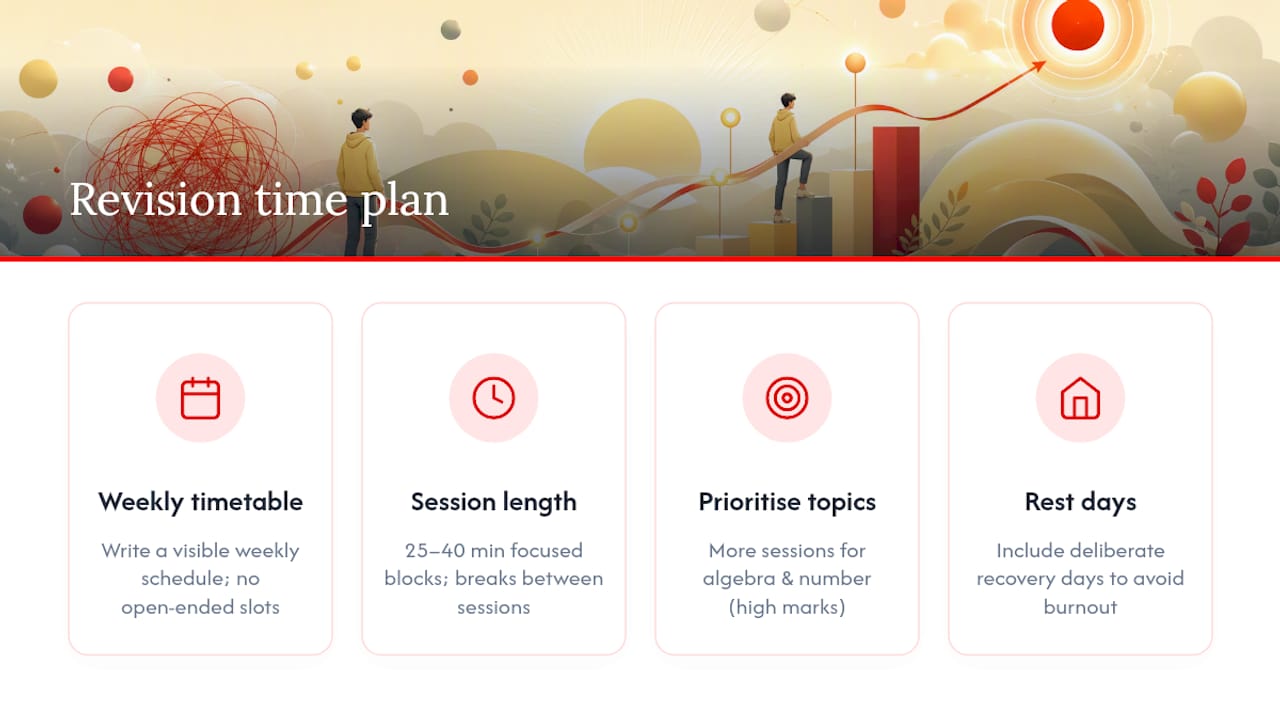
Build a visible schedule rather than a mental one. A written weekly timetable, even a rough one, gives your brain a concrete boundary: revision happens here, and it stops here. Open-ended “I’ll do maths until I feel ready” sessions tend to run long, feel exhausting, and reinforce the idea that maths revision is endless and unmanageable.
Break each topic into sessions of 25 to 40 minutes with a short break between them, rather than marathon two-hour blocks. Concentration drops sharply after around 40 minutes on one subject, and pushing past that point mostly produces frustration rather than learning.
Prioritise by marks, not comfort. Look at where GCSE papers allocate the most marks (algebra and number typically carry heavy weighting across boards) and schedule more sessions there, rather than defaulting to whichever topic feels least stressful to open.
Finally, build in deliberate rest days. A revision plan with zero recovery time is a plan that will eventually be abandoned mid-way through, which then triggers guilt and a fresh wave of anxiety about lost time.
How do you build maths confidence through progressively harder problems?
Confidence in maths is built the same way physical strength is: through small, manageable increases in difficulty, not by jumping straight to the hardest past-paper questions and feeling crushed when they go badly.
Start each topic at a level slightly below where you think your GCSE grade should sit, and get three or four questions right in a row before moving up. This “easy win first” approach matters more than it sounds. A string of early successes calms the nervous system before it faces genuine challenge, which is precisely the opposite of jumping into a grade 9 question when you are still shaky on grade 5 fundamentals.
Once you are consistently solving one level correctly, move up by one grade boundary at a time rather than several. Skipping straight from grade 4 questions to grade 8 questions almost guarantees a run of failures that will feed the avoidance cycle described earlier in this article.
Track your progress visibly. A simple grid marking which grade level you have “cleared” for each topic, ratio, algebra, geometry, and so on, turns an abstract feeling of “I’m not good at maths” into a concrete, updatable record of what you have already mastered.
Mixed-difficulty practice sessions help too. Once a topic feels solid at a higher grade level, drop an easier question back in occasionally. It reminds you how far you have come and prevents the creeping belief that everything is now equally hard.
Can study groups and peer support actually reduce maths anxiety?
Talking to other students about maths anxiety tends to reduce it, largely because it breaks the isolating belief that you are the only one struggling. Given that A substantial portion of adults report feeling anxious about maths, it is statistically near-certain that several people in your class share the same worry, even if nobody says so out loud.
Study groups work best with structure rather than as an open-ended chat. A group that meets to compare answers on a specific past paper, discuss where each person lost marks, and explain methods to each other tends to outperform a group that simply revises “together” without a shared task.
Explaining a method to a peer is itself a powerful form of self-testing. If you can teach a topic clearly, you have demonstrated genuine understanding, not just recognition. If you struggle to explain it, that gap tells you exactly where to focus next.
Peer support also normalises mistakes. Watching a classmate work through a wrong answer and correct it, without drama, teaches you that errors during practice are a normal part of learning, not evidence that you are falling behind. Choose your study partners carefully, though: a group that spirals into shared panic before an exam can amplify anxiety rather than ease it.
Do sleep, diet, and exercise affect maths anxiety around exam time?
Physical wellbeing is not a side issue to exam stress, it is one of the more direct levers you have over it. Anxiety is partly a physiological state, and sleep, food, and movement all shift that state measurably.

Sleep deprivation hits working memory hardest, which is precisely the resource maths anxiety already depletes. Aim for consistent sleep in the weeks before your GCSEs rather than a single “good night” the evening before, since the cumulative effect of several rested nights matters more than one.
Blood sugar swings from skipped meals or heavy sugar intake can mimic or worsen anxiety symptoms, a racing heart or shaky concentration are hard to distinguish from nerves once they start. Regular meals with slow-releasing energy, rather than a rushed breakfast or exam-morning energy drink, keep your body from adding physical noise on top of psychological pressure.
Exercise, even a brisk 20 minute walk, lowers baseline stress hormones and tends to improve sleep quality that night. It does not need to be intense or lengthy to help; consistency across the revision period matters more than any single session.
None of this replaces study-skills practice as the main lever, but a well-rested, reasonably fed student gets noticeably more value out of every hour of revision than one running on four hours of sleep and no breakfast.
Bring the right past-paper practice to your revision plan
If there is one habit worth committing to this week, it is timed self-testing on real past papers rather than passive review. Mathvault’s Edexcel GCSE past paper questions organised by topic let you target the exact skill gaps your error log reveals, with fully worked solutions to check your method, not just your final answer.
Pair that with the GCSE maths revision guides to structure your weekly schedule around spaced, interleaved practice, and use the live weekly Q&A sessions when a genuine method gap needs explaining rather than another attempt at the same question type.
A GCSE-first way to actually reduce maths anxiety
The conventional advice on maths anxiety leans heavily on calming techniques: breathe deeply, think positive, relax before the exam. None of that is wrong, but the evidence points somewhere more specific. The npj Science of Learning trial found that study-skills training beat emotion-regulation training for raising grades among the most anxious students. That is a genuinely uncomfortable finding for anyone who wants a quick calming fix, because it says the deeper problem is exposure, not mood.
What gets overlooked is the order these techniques should come in. Breathing exercises and reappraisal phrases matter, but they work best as a finishing layer on top of solid, repeated practice, not as a replacement for it. A student who has done twenty past papers and still feels nervous will calm down faster with a 60 second breathing routine than a student who has done two papers and is hoping calmness alone will carry them through unfamiliar questions.
Prioritise the practice first. Rehearse the calm second. Do both consistently, and the anxiety loses most of its grip well before results day.
Frequently asked questions about maths anxiety and GCSEs
Is maths anxiety a recognised condition?
It is a recognised psychological phenomenon studied in educational and neuroscience research, though it is not classed as a clinical diagnosis. The Centre for Neuroscience in Education describes it as a negative emotional reaction to maths that can range from mild tension to significant impairment.
Can maths anxiety affect students who are good at maths?
Yes. OCR’s research notes that maths anxiety frequently coexists with normal-to-high attainment, meaning strong students can still lose marks to anxiety-driven blanking or time mismanagement.
How long before my GCSE should I start working on maths anxiety?
Start as early in your revision timetable as possible, since the evidence favours repeated exposure over quick fixes. That said, the breathing and reappraisal routines in this guide can still help meaningfully even in the final 48 hours before an exam.
Does maths anxiety ever go away completely?
Many students see it fade substantially through consistent practice and exposure to harder problems, even if a small flicker of nerves remains normal before any exam. The goal is management, not total elimination.
Should I tell my teacher I have maths anxiety?
Yes. Teachers can adjust classroom approaches, such as reducing cold-calling or breaking tasks into smaller steps, based on strategies outlined in OCR’s guidance, and knowing early gives them more time to help before the exam.
Sources
- Coping with exam pressure – a guide for students
- Preventing math anxiety — APA Monitor
- Breathing exercises for stress — NHS
Leave a Reply