
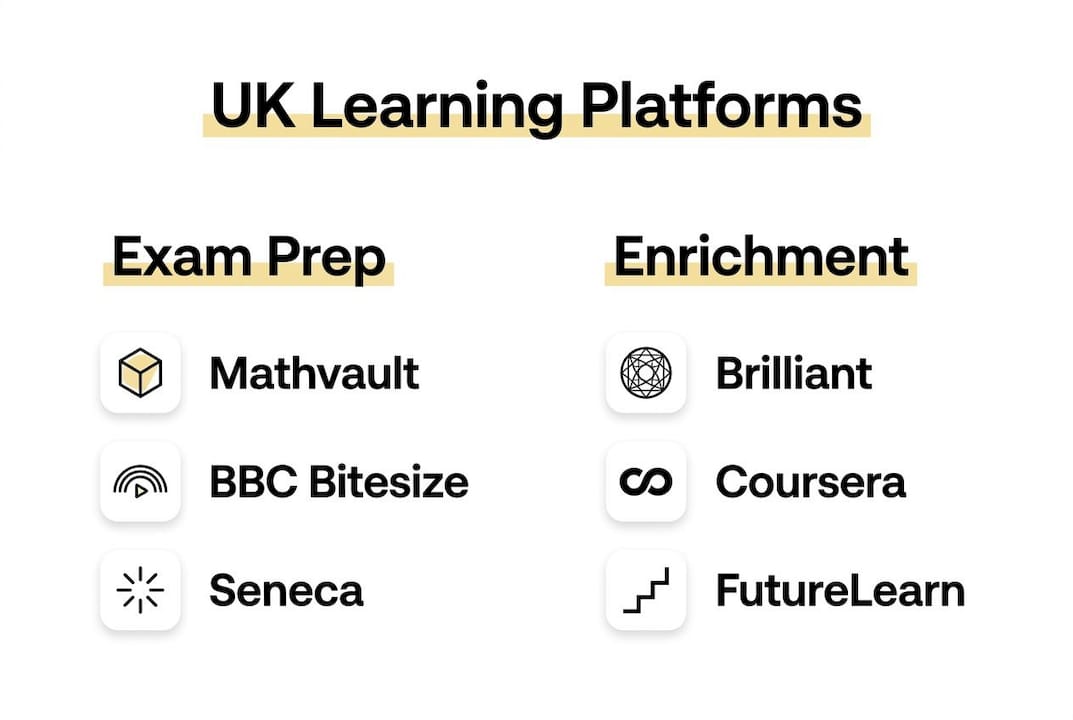
For UK students focused on exam results, the strongest alternatives to Khan Academy are Mathvault (GCSE and A-Level past papers with worked solutions), BBC Bitesize (free curriculum-mapped revision), Seneca Learning (adaptive recall practice), Brilliant (interactive STEM problem solving), Coursera and edX (university-level depth with certificates), and FutureLearn (UK-university-backed short courses).
- Mathvault is the recommended pick for GCSE and A-Level maths exam practice: past papers organised by exam board, fully worked step-by-step solutions, video walkthroughs, and live weekly Q&A sessions, all free.
- BBC Bitesize and Seneca Learning suit KS3–GCSE students who need syllabus-mapped content and quick recall practice at no cost.
- Brilliant, Coursera, and edX work best for learners who want deeper conceptual understanding or a verifiable certificate beyond the national curriculum.
Table of Contents
- How do these platforms compare at a glance?
- How do these alternatives actually differ from Khan Academy?
- How do you choose the right alternative for your goal?
- What should you expect from each platform?
- What does each platform actually cost in the UK?
- How to pair Khan Academy with an AI study layer for active revision
- What is the final recommendation by goal?
- Key takeaways
- Why these picks reflect what UK students actually need
- Mathvault: free GCSE and A-Level maths revision, built for UK exams
- Useful sources and further reading
How do these platforms compare at a glance?
| Platform | Best for | UK exam / curriculum fit | Cost model | Interactivity & practice | Certificates | Device / offline | Depth / level | Tutor support |
|---|---|---|---|---|---|---|---|---|
| Mathvault | GCSE & A-Level maths exam prep | High (GCSE, A-Level, WJEC, Edexcel, AQA) | Free (freemium) | Past papers, worked solutions, video walkthroughs | No formal cert | Web; PDFs downloadable | GCSE to A-Level | Live weekly Q&A |
| BBC Bitesize | KS2–GCSE revision across subjects | High (KS2, KS3, GCSE) | Free | Quizzes, short videos | None | Web; limited offline | KS2 to GCSE | None |
| Seneca Learning | Adaptive recall, GCSE & A-Level | High (GCSE, A-Level, many boards) | Free / freemium | Adaptive quizzes, spaced repetition | None | Web / app | GCSE to A-Level | None |
| Brilliant | Interactive STEM problem solving | Low (not syllabus-mapped) | Subscription (paid tier) | Guided problem sets, interactive lessons | None | App; some offline | GCSE to undergraduate | None |
| Coursera | University-level courses, credentials | Low–medium (HE aligned) | Freemium / per-course | Video, quizzes, peer review | Yes (paid) | App; some offline | Undergraduate to postgraduate | Peer forums |
| FutureLearn | UK-university short courses | Medium (A-Level to HE) | Freemium / subscription | Video, quizzes, discussion | Yes (paid) | App; limited offline | GCSE to postgraduate | Discussion boards |
| edX | University courses, verified certs | Low–medium (HE aligned) | Free audit / paid cert | Video, graded assignments (paid) | Yes (paid) | Web / app | Undergraduate to postgraduate | Forums |
| IXL | Adaptive K-12 maths and English | Medium (aligned to UK curriculum) | Subscription | Adaptive questions, diagnostic reports | None | Web / app | KS1 to A-Level | None |
| Crash Course (YouTube) | Engaging subject overviews | Low (not exam-board specific) | Free | Passive video | None | Offline via YouTube Premium | KS3 to A-Level | None |
| OpenStax | Free university-level textbooks | Low (US curriculum base) | Free | Textbook reading, some practice | None | Web; PDF download | Undergraduate | None |
| Udemy | Skill-specific courses, coding | Low (not syllabus-mapped) | Per-course (frequent sales) | Video, quizzes, projects | Completion cert | App; offline download | All levels | Q&A forums |
How do these alternatives actually differ from Khan Academy?
Khan Academy’s core strength is breadth: it covers subjects from primary arithmetic to university calculus in a single, free, well-structured platform. What it does not do particularly well is align its content to UK exam boards. A GCSE student studying Edexcel or AQA will find Khan Academy’s maths content broadly useful but not mapped to the specific mark schemes, question styles, or assessment objectives they will face in the exam hall.
The alternatives above fill that gap in different ways:
- Syllabus specificity: Mathvault, BBC Bitesize, and Seneca Learning are built around UK national curricula. Mathvault organises past papers and worked solutions by exam board and year, so you are practising the exact question formats that examiners set.
- Active recall and adaptive practice: Seneca Learning uses spaced repetition and error-driven question selection, which research consistently links to stronger long-term retention than passive video watching.
- Credentialing: Coursera, edX, and FutureLearn offer verified certificates from universities. Khan Academy does not issue credentials recognised by employers or universities.
- Live tutor support: Khan Academy offers no live help. Mathvault’s weekly Q&A sessions give students a direct line to worked explanations in real time, which is particularly useful in the weeks before exams.
- Problem-first learning: Brilliant and CS50-style courses force you to solve problems before explaining theory, a method that MIT OpenCourseWare and similar university platforms have long championed for STEM subjects.
- Cost of certificates: Khan Academy is entirely free. Most alternatives that offer certificates charge for them, sometimes significantly.
Where Khan Academy still leads: its sheer breadth and the quality of its explanatory videos for foundational topics are hard to match for free. If you are building conceptual understanding from scratch in a subject, Khan Academy remains a strong starting point. The alternatives above are best used to supplement it, not always to replace it.
Pro Tip: If you are a GCSE or A-Level maths student, use Khan Academy to fill conceptual gaps, then switch to Mathvault’s past papers and worked solutions to practise exam-style questions under timed conditions. The combination covers both understanding and exam technique.
How do you choose the right alternative for your goal?

Start with the question that matters most: what outcome do you actually need? Passing a specific exam, earning a university certificate, building coding skills, and developing deep conceptual understanding each point to a different platform.
Questions to ask before you commit
- Does it map to my exam board? If you are sitting AQA, Edexcel, WJEC, or OCR, check whether the platform labels content by board and year, not just by topic.
- Do I need a certificate? If yes, check whether the certificate is free or requires a paid upgrade before you invest time in the course.
- What devices do I use? Some platforms restrict offline access or have weak mobile apps. Check before you start.
- How much does it cost? Free tiers often exclude graded assignments, certificates, or tutor feedback. Know what the free tier actually includes.
- How much practice does it offer? Video-heavy platforms build understanding but rarely replicate exam conditions. Look for worked solutions, past papers, or adaptive question banks.
- Is there any teacher or tutor support? Forums, Q&A sessions, and instructor feedback vary widely. If you get stuck easily, this matters.
Red flags to watch for
- Certificates advertised prominently but locked behind a paywall that is only revealed after you complete the course.
- No worked solutions or mark-scheme explanations, only answer keys.
- Content described as “curriculum-aligned” with no mention of specific UK exam boards.
- No mobile app or offline access for a platform you plan to use on the go.
- A free trial that requires a credit card before you can access any content.
A quick three-step test drive
Run these three checks during any free tier or trial before committing:
- Find a topic you already know and check whether the platform’s explanation matches your exam board’s approach.
- Attempt a practice problem and look at the solution: does it show method marks and working, or just the final answer?
- Search for a past paper question from your specific board and year. If the platform cannot surface one, it is not exam-board specific.
What should you expect from each platform?

Mathvault
Mathvault is built specifically for GCSE and A-Level maths students in England, Wales, and Scotland. Every resource is organised by exam board (Edexcel, AQA, WJEC, OCR) and by year, so you can work through WJEC past papers and worked solutions in the same session as video walkthroughs of the trickiest questions.
- Past papers and fully worked step-by-step solutions, free.
- Video walkthroughs of exam questions, not just topic explanations.
- Live weekly Q&A sessions for real-time help.
- Downloadable revision packs available for a small one-off payment.
- Covers GCSE, A-Level, Further Maths, and international variants.
UK suitability: Excellent. Content is mapped to UK exam boards and national syllabuses. The last-minute GCSE maths revision plan is a practical resource for students in the final weeks before exams.
BBC Bitesize
BBC Bitesize is the UK’s most widely used free revision site, covering subjects from KS2 through to GCSE across all major boards. Its content is written and reviewed by teachers, and it is genuinely free with no registration required.
- Short video clips, written summaries, and quizzes for each topic.
- Organised by subject, key stage, and exam board.
- No certificates, no adaptive practice, no live support.
- Works well on mobile; no offline mode.
UK suitability: High for KS2–GCSE. Less useful at A-Level, where content depth thins out.
Seneca Learning
Seneca Learning uses an adaptive algorithm that identifies weak areas and serves more questions on topics you get wrong, a method grounded in spaced repetition principles. It is widely used in UK secondary schools and covers GCSE and A-Level content across many subjects.
- Free for students; school licences available for teachers.
- Covers GCSE and A-Level across multiple exam boards.
- No live tutor support, but the adaptive question engine is genuinely useful.
- Available on web and app; some offline functionality.
UK suitability: Strong. Many UK schools use Seneca as a homework and revision tool, which means content is regularly updated to reflect exam board changes.
Brilliant
Brilliant takes a problem-first approach: you work through interactive puzzles and guided challenges before theory is introduced. This suits students who find passive video frustrating and want to build genuine mathematical intuition.
- Subscription-based (pricing not publicly listed as a fixed UK rate; check the site for current offers).
- Covers maths, science, computer science, and data.
- Not mapped to UK exam boards or syllabuses.
- Strong mobile app with some offline access.
UK suitability: Good for STEM enrichment and deeper understanding, but not a substitute for exam-board-specific revision.
Coursera
Coursera partners with universities including Imperial College London and the University of London to offer courses ranging from introductory to postgraduate level. Most courses can be audited for free; certificates require payment.
- Thousands of courses across all subjects.
- Verified certificates from real universities, recognised by some employers.
- Auditing is free; graded assignments and certificates are paid.
- Strong mobile app with offline video download.
UK suitability: Good for A-Level students looking ahead to university or adults seeking credentials. Not suitable as a GCSE revision tool.
FutureLearn
FutureLearn is a UK-founded platform backed by the Open University and partners with dozens of UK universities. Its short courses run over several weeks and include discussion boards and peer interaction.
- Free to join; certificates and unlimited access require a paid upgrade.
- Strong UK university partnerships (Open University, King’s College London, and others).
- Discussion-based learning suits students who want community alongside content.
- Available on web and app.
UK suitability: Good for A-Level to undergraduate level. The Open University connection gives it genuine credibility for UK learners.
edX
edX offers university courses from MIT, Harvard, and many others. Like Coursera, it allows free auditing of most content but restricts graded assignments and certificates to paid verified tracks.
- Free audit access to lectures and most materials.
- Certificates require payment; prices vary by course and institution.
- MicroMasters and Professional Certificate programmes available for deeper credentials.
- Web and app access; some offline video.
UK suitability: Strong for undergraduate and postgraduate level study. Not exam-board specific.
IXL
IXL is a subscription-based adaptive learning platform covering maths and English from KS1 through to A-Level. It provides diagnostic reports that show exactly which skills need work, which makes it popular with parents and tutors.
- Subscription required; no meaningful free tier beyond a daily question limit.
- Adaptive question engine with detailed skill-level reporting.
- Covers UK curriculum topics, though not always mapped to specific exam boards.
- Web and app; no offline mode.
UK suitability: Good for KS1–GCSE, particularly for parents tracking progress. Less useful for A-Level exam technique.
Crash Course (YouTube)
Crash Course produces fast-paced, well-animated videos covering history, science, maths, literature, and more. The content is engaging and free, but it is not mapped to UK exam boards and offers no practice or assessment.
- Entirely free on YouTube.
- No interactivity, no practice questions, no certificates.
- Works best as a supplement to other resources, not as a primary revision tool.
- Offline access via YouTube Premium.
UK suitability: Useful for building background knowledge and motivation. Not a substitute for syllabus-specific revision.
OpenStax
OpenStax publishes free, peer-reviewed university-level textbooks across maths, science, and the humanities. The content is rigorous and genuinely free, but it is written primarily for the US curriculum.
- Free PDF and web access; print copies available at cost.
- No interactive practice, no certificates, no live support.
- Useful as a reference text for A-Level and first-year undergraduate study.
UK suitability: Moderate. Useful as a reference for A-Level and university students, but not aligned to UK exam boards.
Udemy
Udemy is a marketplace of instructor-created courses covering everything from GCSE maths to professional coding skills. Courses are sold individually, though frequent sales bring prices down considerably.
- Per-course pricing; no subscription required.
- Quality varies significantly between instructors.
- Completion certificates issued, though not university-accredited.
- Strong offline access via the app.
UK suitability: Good for skill-specific learning (coding, data analysis) and adult learners. Less reliable for GCSE or A-Level exam prep due to variable quality.
Pro Tip: Before purchasing a Udemy course, check the instructor’s credentials and read recent reviews. Course quality varies more on Udemy than on any other platform in this list.
What does each platform actually cost in the UK?
Many of the best-known online learning platforms advertise free access prominently, but the free tier often covers only a fraction of what you actually need. Understanding the cost model before you start saves time and avoids disappointment.
- Fully free: Mathvault, BBC Bitesize, Crash Course, OpenStax. No registration required for core content; no hidden fees.
- Freemium (free content, paid certificates or full access): Coursera, edX, FutureLearn, Seneca Learning. You can learn without paying, but graded assignments and certificates sit behind a paywall.
- Subscription: Brilliant and IXL charge monthly or annual fees. Brilliant’s pricing is not publicly listed as a fixed UK rate; IXL’s pricing varies by plan and is best checked directly on the site.
- Per-course: Udemy sells courses individually. Prices vary, but sales are frequent and courses often drop to under £15.
Hidden costs to watch for
The most common hidden cost across platforms is the certificate upgrade. edX, for example, lets learners audit courses for free, but certificates and graded assignments require a paid verified enrolment. Coursera operates similarly. FutureLearn’s free tier gives access to course content for a limited period after the course ends; unlimited access and certificates require a paid upgrade.
School licences are worth knowing about if you are a teacher or parent. Seneca Learning offers free school accounts with additional teacher tools. IXL sells school and family licences that reduce the per-student cost significantly.
Worth knowing: Mathvault’s core resources, including past papers, worked solutions, and video walkthroughs, are free. Downloadable revision packs and direct live support are available for a small one-off payment, making it one of the most cost-effective options for UK exam preparation.
How to pair Khan Academy with an AI study layer for active revision
Passive video watching is half the battle at best. Research consistently supports spaced repetition and active recall as more effective for long-term retention than re-reading notes or re-watching lessons. The practical implication: use Khan Academy (or any video-based platform) to build understanding, then convert that content into active practice.
AI-integrated study workflows are increasingly popular for exactly this reason. Students upload their own notes, lecture slides, or PDFs and use AI tools to generate flashcards, practice quizzes, and topic summaries automatically.
A four-step method for active revision
- Watch or read the topic once on Khan Academy, BBC Bitesize, or whichever platform covers it clearly. Take brief notes on key formulas, methods, and worked examples.
- Convert your notes into flashcards using a spaced repetition tool such as Anki. Focus on definitions, formulas, and the steps in each method, not just the final answers.
- Generate practice questions from your notes using an AI study tool, or work through past paper questions on Mathvault that target the same topic.
- Schedule spaced reviews over the following days and weeks. Anki’s algorithm handles the timing automatically; the key is to review before you feel you need to, not after you have forgotten.
Pro Tip: The biggest gain from this workflow comes from converting your weakest topics into Anki decks immediately after you study them. Students who wait until they feel confident before making flashcards tend to skip the topics they most need to practise.
Active learning in practice: Education research and practitioners consistently recommend spaced repetition systems and active problem practice as significantly more effective for retention than passive video consumption alone. Platforms that force you to retrieve information, not just watch it, produce stronger results over time.
What is the final recommendation by goal?
The right platform depends on what you are trying to achieve. For most UK students, the answer is not one platform but a combination of two.
- GCSE maths exam preparation: Mathvault for past papers, worked solutions, and video walkthroughs. BBC Bitesize for quick topic summaries across all subjects.
- A-Level maths extension and deeper understanding: Mathvault for exam-board-specific past papers and worked solutions. Brilliant for building mathematical intuition beyond the syllabus.
- University-level credentials: Coursera or edX for verified certificates from real universities. FutureLearn for UK-university-backed short courses.
- Interactive STEM practice: Brilliant for problem-first learning. Seneca Learning for adaptive recall across GCSE and A-Level subjects.
- Free textbook reference: OpenStax for undergraduate-level reading. MIT OpenCourseWare for lecture notes and assignments at university depth.
A three-step test plan for this week
- Step 1: Pick one topic you find difficult. Find it on Mathvault and work through the past paper questions and worked solutions for that topic.
- Step 2: Map that topic to a past paper question from your specific exam board and year. Check whether your method matches the mark scheme.
- Step 3: Run a one-week revision sprint: one topic per day, past paper question first, worked solution second, Anki flashcard third.
Key takeaways
The strongest Khan Academy alternatives for UK students are those that align to specific exam boards, offer worked solutions, and force active practice rather than passive watching.
| Point | Details |
|---|---|
| Match platform to goal | Exam prep needs syllabus-specific tools; credentials need Coursera or edX; STEM depth needs Brilliant. |
| Free does not always mean complete | Freemium platforms often lock certificates and graded assignments behind paid upgrades. |
| Active practice beats passive video | Spaced repetition and past-paper practice produce stronger retention than re-watching lessons. |
| UK exam alignment is the key filter | Only Mathvault, BBC Bitesize, and Seneca Learning are reliably mapped to GCSE and A-Level exam boards. |
| Mathvault for UK exam prep | Free past papers, worked solutions, video walkthroughs, and live Q&A, organised by exam board and year. |
Why these picks reflect what UK students actually need
The selection in this article is deliberate. Most roundups of online learning alternatives are written for a global audience, and treat syllabus alignment as a secondary concern. For a student sitting GCSE or A-Level maths in England, Wales, or Scotland, it is the primary concern. A platform that covers calculus beautifully but does not reflect the specific question styles, mark schemes, and assessment objectives of AQA, Edexcel, WJEC, or OCR is only partially useful.
That is why Mathvault sits at the top of this list for exam preparation. Its resources are built around the actual papers students will face, with fully worked solutions that show method marks and accuracy marks, not just final answers. The live Q&A sessions add something most platforms simply do not offer: a real opportunity to ask about the specific question you got wrong last Tuesday.
The broader platforms, Coursera, edX, FutureLearn, and Brilliant, earn their place for students who are looking beyond the immediate exam. They are genuinely strong for university preparation, credential building, and STEM enrichment. But for the student whose priority is passing their maths GCSE or A-Level, the combination of Mathvault and BBC Bitesize covers the ground that matters most, at no cost.
Mathvault: free GCSE and A-Level maths revision, built for UK exams
If your goal is GCSE or A-Level maths, Mathvault gives you everything you need without a subscription. Every past paper is organised by exam board and year, every solution is fully worked with method and accuracy marks shown, and every video walkthrough explains the reasoning behind each step, not just the answer.
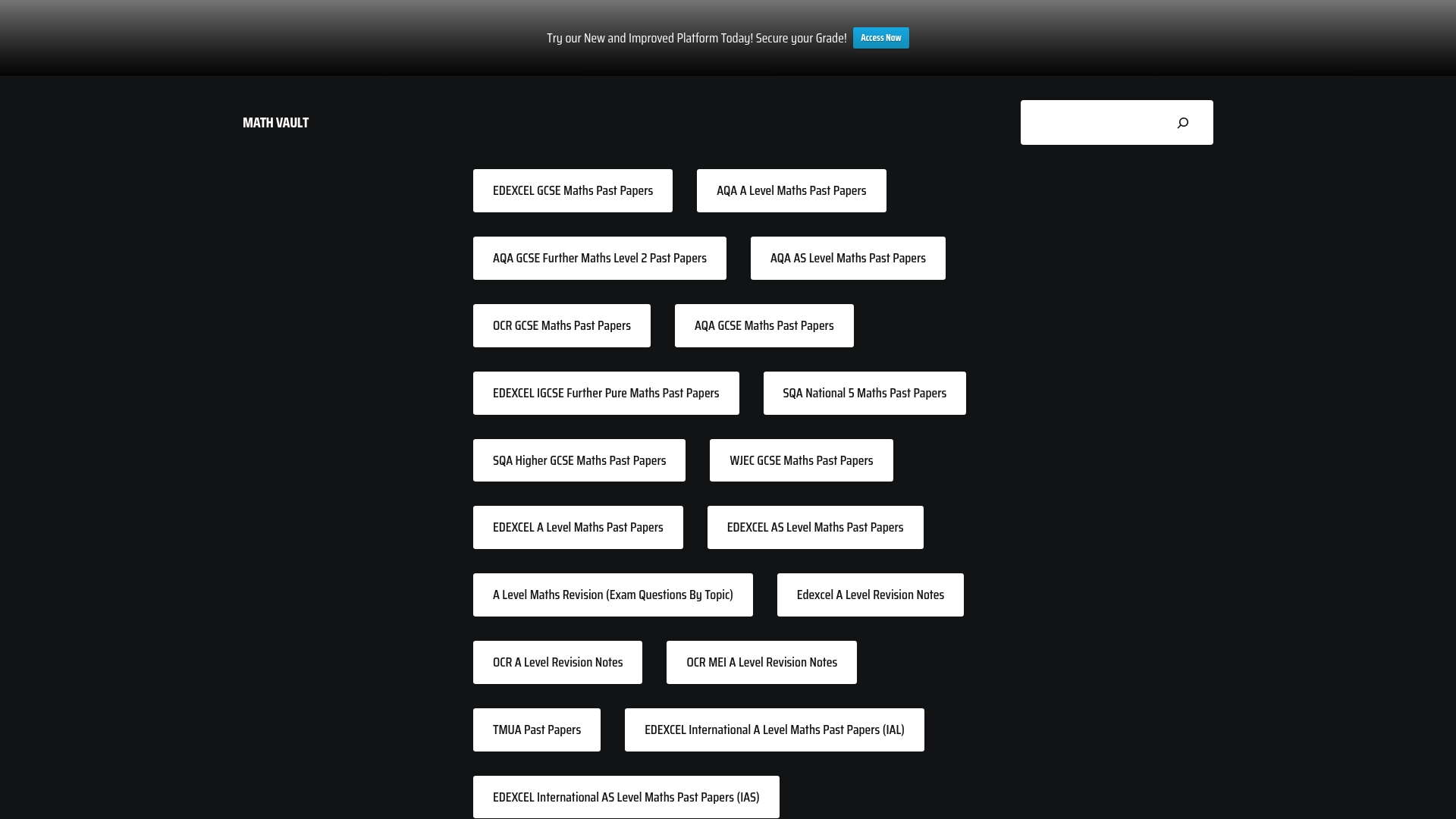
- Past papers for Edexcel, AQA, WJEC, OCR, and international variants, free.
- Fully worked step-by-step solutions that match the mark scheme.
- Video walkthroughs of exam questions, not just topic summaries.
- Live weekly Q&A sessions for real-time support.
- Downloadable revision packs available for a small one-off payment.
Start with the GCSE maths revision guides to find the right starting point for your exam board, or go straight to Edexcel A-Level past papers by topic if you are preparing for A-Level. Both are free to access now.
Useful sources and further reading
- MIT OpenCourseWare — Free lecture notes, assignments, and course materials from MIT across maths, science, and engineering. Useful for A-Level extension and undergraduate study.
- OpenLearn by the Open University — Over 900 free short courses from the Open University, covering a wide range of subjects at varying levels.
- edX free online courses — Overview of edX’s free audit model and what is included without payment. Check here before enrolling to understand certificate costs.
- CS50’s Introduction to Programming with Python — Harvard’s free coding course, a strong example of project-based learning that forces active practice.
This article is for general information only. Pricing, course availability, and exam board alignment change regularly. Always check each platform’s current terms directly before enrolling or purchasing.
Leave a Reply