
Yes, homeschooled pupils can sit GCSE maths in the UK, and they do it as private candidates at an approved exam centre. There’s no legal requirement to take GCSEs at all when home educating, but most families choose to, because GCSE maths underpins sixth form, A-level maths, and most university applications. The national curriculum sets expectations for schools, not for home educators, so you’re free to build a revision plan around your child’s pace.
Your first practical move is searching the JCQ private candidates list for centres near you that accept external entries. A few things to expect straight away:
- Not every centre accepts private candidates, and fewer still accept every specification or tier.
- Fees are set by the centre, not the exam board, and typically run into the hundreds of pounds per subject.
- You’ll need to book months ahead of the exam series, not weeks.
Key Takeaways
Homeschool GCSE maths success depends on securing a private candidate place early and building revision around genuine board-specific past papers and mark schemes.
| Point | Details |
|---|---|
| Register early | Contact JCQ-listed centres 12 to 18 months ahead, since acceptance is discretionary and fills up. |
| Match tier to ambition | Choose foundation or higher based on target grades needed for A-level maths or sixth form. |
| Use official past papers | Practise topic-by-topic, then move to full timed papers marked against real schemes. |
| Budget realistically | Expect roughly £150 to £300 per exam entry, set individually by each centre. |
| Arrange accommodations early | Apply for access arrangements through the centre, not the exam board, well before deadlines. |
Table of Contents
- How does homeschool GCSE maths registration actually work?
- Which GCSE maths qualification and tier should your child take?
- What are the best resources for homeschool GCSE maths revision?
- What do private candidate entries for GCSE maths cost?
- Your homeschool GCSE maths checklist
- How Mathvault supports homeschool GCSE maths revision
- Can homeschooled students get exam accommodations or special consideration?
- What should you expect on GCSE maths exam day?
- Why official guidance alone isn’t enough for homeschool GCSE maths
- Frequently asked questions
- Sources
How does homeschool GCSE maths registration actually work?
A private candidate (sometimes called an external candidate) is someone sitting an exam without being enrolled at that centre as a full-time pupil. This is the standard route for GCSE maths at home, and every major awarding body, AQA, Pearson, and OCR, works this way for home-educated learners.
AQA is explicit that private candidates need an approved centre willing to enter them, and that not all specifications are open to external entries. Pearson goes further, stating plainly that a centre is under no obligation to accept a private candidate, even one willing in principle. Some may decline simply because they lack capacity or don’t run coursework-based assessments for external pupils.
Work through registration in this order:
- Decide the specification and tier your child will sit (more on this below) before contacting anyone.
- Contact several centres, not just one, since acceptance is discretionary and varies year to year.
- Confirm fees, deadlines, and any non-exam assessment (NEA) arrangements, particularly for GCSE maths components that involve controlled conditions.
- Complete the entry once a centre confirms a place, and get the confirmation in writing.
You’ll typically need photo ID (a passport is standard), proof of address, and sometimes a parent or guardian declaration confirming home-education status. Approved distance-learning providers can also act as the entering centre and often handle these logistics for you, which is worth exploring if local schools say no.
Pro Tip: Start your centre search a full academic year before the intended exam series. Centres often set their own internal deadlines for private candidates well ahead of the JCQ’s own entry dates, and the good ones fill up.
Which GCSE maths qualification and tier should your child take?
GCSE maths is offered at two tiers: foundation, which caps grades between 1 and 5, and higher, which covers grades 4 to 9. A learner sitting foundation cannot achieve above a grade 5, so this decision has real consequences for sixth form and A-level maths eligibility.

Some families also consider the International GCSE (iGCSE), run by boards such as Cambridge International, which structures assessment slightly differently from the UK GCSE. Not every centre accepts iGCSE entries from private candidates, and not every sixth form treats it identically to a standard GCSE, so check with your target sixth form or college before committing.
Points to weigh before booking:
- Grade ceiling versus confidence: higher tier opens grade 9, but a learner sitting it underprepared risks a poor outcome versus a comfortable foundation pass.
- Future pathway: A-level maths generally expects at least a grade 6 or 7 at GCSE, so ambitions to move into A-level maths should shape tier choice early.
- Board and centre availability: private candidates cannot assume every board’s specification is offered locally; the entry codes and subjects guide that AQA and Pearson publish lists what’s actually available.
- Comparing boards: specifications differ enough in style and topic emphasis that it’s worth reading a detailed comparison before settling on one.
Always confirm current guidance with the exam board directly rather than assuming last year’s rules still apply.
What are the best resources for homeschool GCSE maths revision?
Past papers and their mark schemes are the single most useful revision tool available, because they show exactly how marks are awarded, not just what the right answer looks like. Practising by topic first, then moving to full timed papers, mirrors how most successful candidates actually prepare, whether homeschooled or in a classroom.
A sensible revision structure looks like this:
- Topic-by-topic practice using past exam questions grouped by subject area, working through mark schemes line by line.
- Worked solutions and video walkthroughs to unpick any method you or your child can’t reconstruct from the mark scheme alone. MathVault’s GCSE revision guides organise this by board, and BBC Bitesize offers board-aligned explanations that work well for Year 10 and Year 11 revision.
- Full timed papers under exam conditions, ideally once every fortnight in the final term before the exam series.
- Review against examiner reports, which flag the mistakes that cost the most marks year after year, often on questions that look simple.
Board-aligned past papers paired with worked solutions and timed practice under exam conditions is the combination most likely to translate into exam-day performance, because it trains both the maths and the exam technique simultaneously.
Pro Tip: Method marks matter as much as the final answer. GCSE maths mark schemes award marks for correct working even when the final figure is wrong, so train your child to show every step, not just the answer.
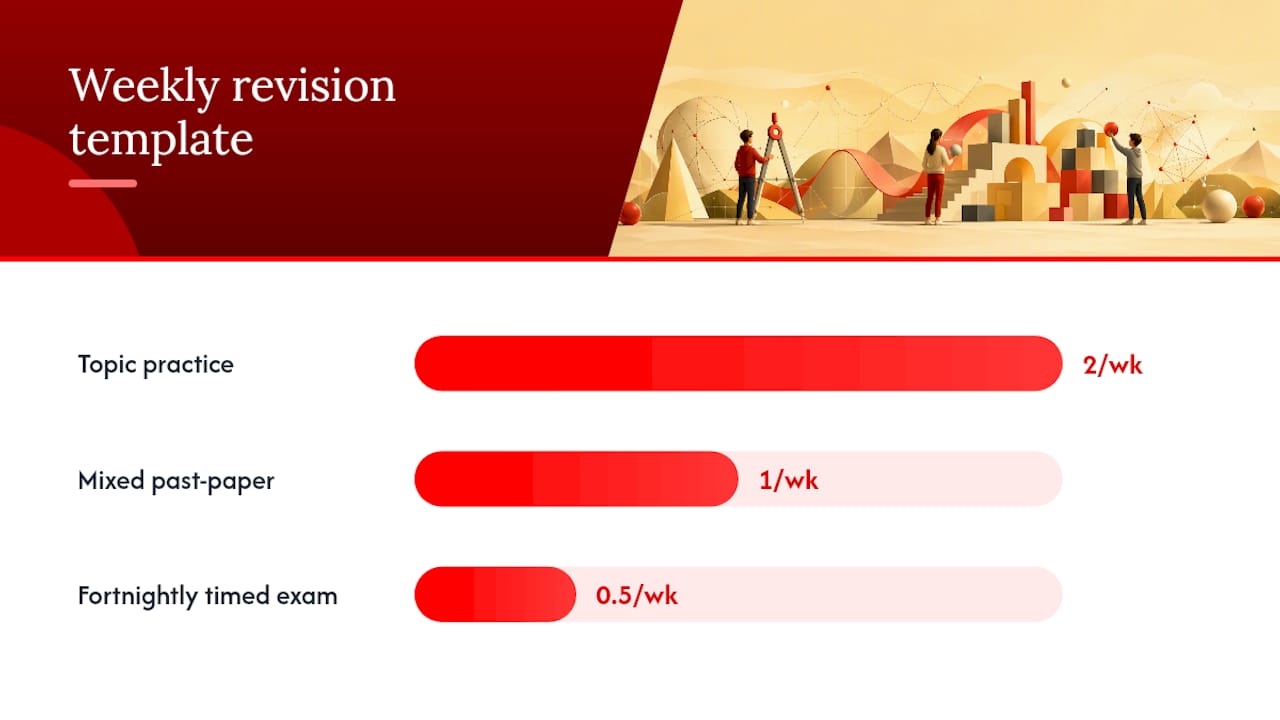
A weekly template that works for most families: two sessions on new or weak topics, one session of mixed past-paper questions, and one full timed paper every second week, followed immediately by marking against the official scheme. Pearson also runs free on-demand GCSE maths lessons that suit independent learners working without a classroom teacher, and specimen papers are particularly useful in the months right after choosing a specification, since they reveal question style before real past papers exist for a newer syllabus.
What do private candidate entries for GCSE maths cost?
Centres set their own charges for private candidates, and fees commonly range somewhere between roughly £150 and £300 per exam entry, though this varies significantly by centre and region. There’s no national fixed fee, so always get written confirmation of the exact amount before committing.
- The main exam series runs in summer, with some boards offering limited November resits for certain subjects.
- Entry deadlines are typically set well before the exam window, often in the term before summer entries close.
- Missing a centre’s internal deadline usually means waiting for the next series, sometimes a full year away.
A workable timeline: start contacting centres 12 to 18 months before the intended exam series, confirm a place and fee within a couple of months, then use the remaining time purely for revision rather than logistics.
Your homeschool GCSE maths checklist
Getting from “we’re homeschooling” to “exam booked” is mostly about sequencing. Follow these steps in order:
- Decide the tier, specification, and pathway (A-level maths, sixth form, or straight into work or further study).
- Search the JCQ private candidates list and contact at least three centres, or investigate an approved distance-learning provider.
- Confirm fees, ID requirements, and firm exam dates in writing.
- Complete and pay for the entry once a centre agrees to take your child.
- Build a revision plan around past papers and worked solutions, and arrange tutoring or extra support for any persistently weak topics.
Each step depends on the one before it, so resist the temptation to start revising seriously before the entry itself is locked in.
How Mathvault supports homeschool GCSE maths revision
Mathvault gives home educators free access to board-aligned past papers, fully worked step-by-step solutions, video walkthroughs, and weekly live Q&A sessions, all organised by exam board so you’re not guessing which resources match your child’s specification.
- Start at the GCSE maths revision guides hub to find materials sorted by board and topic.
- Pair Mathvault’s worked solutions with the official mark scheme for each paper to check method marks, not just final answers.
- Use board-specific pages, such as Edexcel GCSE maths, when your child sits a particular specification.
Can homeschooled students get exam accommodations or special consideration?
Homeschooled candidates are entitled to the same access arrangements as school-based pupils, but the process works differently because there’s no school SENCO managing it on their behalf. Access arrangements, such as extra time, a reader, or a scribe, must be applied for through the entering centre, not directly with the exam board, since JCQ rules require centres to hold the supporting evidence and submit requests on the candidate’s behalf.
This means the conversation about accommodations needs to happen early, ideally at the same time you’re confirming whether a centre will accept your child as a private candidate at all. Ask directly whether the centre has experience processing access arrangements for external candidates, because not all do.
You’ll typically need documented evidence of need, such as an educational psychologist’s report or medical evidence, showing a history of support consistent with the request. If your child has never been assessed because they’ve never sat formal exams before, get an assessment done well ahead of the entry deadline, since evidence gathered close to the exam date is unlikely to be accepted in time.
Special consideration, distinct from access arrangements, covers unexpected circumstances close to or during the exam itself, such as illness or a bereavement. This is also applied for through the centre after the exam, so keep the centre’s exams officer contact details to hand throughout the exam series, not just on the day.
What should you expect on GCSE maths exam day?
Exam day logistics matter more for private candidates than for school pupils, because you won’t have a familiar building, timetable, or teacher managing the process for you. Confirm the exact start time, room, and arrival window with the centre at least a week beforehand, and ask whether your child needs to arrive earlier than school-based candidates for identification checks.
Bring photo ID every time, even if the centre has met your child before. Most GCSE maths papers require a scientific calculator, pens, pencils, a ruler, and a protractor and compass for the geometry-heavy questions, so check the specific equipment list for your board rather than assuming last year’s requirements still apply.
GCSE maths is typically split across three papers, often one non-calculator and two calculator papers, each roughly 90 minutes long, though exact timings vary by board and specification. Confirm the sequence and dates in writing, since private candidates sometimes sit papers on a slightly different schedule from the main cohort at that centre.
Arrive with time to settle, not just to arrive. A candidate who’s been driving to an unfamiliar building loses composure faster than one on home turf, and that matters most in the first ten minutes of a maths paper, when nerves cost the easiest marks.
Why official guidance alone isn’t enough for homeschool GCSE maths
The official guidance from JCQ, AQA, and Pearson answers the process questions well: where to look, what centres expect, and what private candidate status actually means. What it doesn’t do is tell you how to actually get a child from “can do the maths” to “performs under exam pressure”, and that gap is where most homeschool GCSE maths advice online falls short.
The conventional wisdom treats revision as a separate problem from registration, tackled after the paperwork is sorted. In practice, the two should run in parallel from month one, because tier choice, specification, and revision resources all depend on each other. A family that books higher tier without checking whether the target centre even offers it is now revising for an exam they might not sit.
If there’s one thing to prioritise, it’s board-aligned past-paper practice under real timed conditions, marked against the actual scheme, not a generic workbook’s approximation of one. Everything else, the centre search, the ID checks, the calculator rules, matters, but none of it replaces the discipline of sitting a genuine past paper against the clock.
Frequently asked questions
Do homeschooled children legally have to take GCSEs?
No. Home educators are legally responsible for providing a suitable education, but there’s no statutory requirement to sit GCSEs. Most families choose to anyway, since GCSE maths is a near-universal requirement for A-levels, apprenticeships, and university entry.
Can any exam centre refuse to take a private candidate?
Yes. Pearson and AQA both confirm that centres aren’t obliged to accept private candidates, for reasons ranging from capacity to how they manage non-exam assessment for external pupils.
Is iGCSE maths a good alternative to GCSE for homeschoolers?
It can be, particularly where a local centre offers iGCSE more readily than standard GCSE, but check with your target sixth form first, since not every one treats Cambridge iGCSE identically to a UK GCSE for entry purposes.
How early should we start looking for an exam centre?
Start at least a year before the intended exam series. Centres set their own internal deadlines for private candidates that typically fall well ahead of the exam board’s own entry dates.
What if our local centres won’t accept a private candidate?
Approved distance-learning providers are often a workable alternative, since some are approved centres in their own right and can manage entries and NEA arrangements for home-educated candidates.
Sources
- Private candidates – Joint Council for Qualifications
- AQA | Student & parent support | Private candidates
- Private candidates – Pearson qualifications
- GCSE Maths – BBC Bitesize
Leave a Reply