
The GCSE maths topics that most often stand between students and a grade 7 or above are algebraic proof, algebraic fractions, quadratic simultaneous equations, non-right-angled trigonometry, vectors, circle theorems and conditional probability. Every one of these sits in the Higher tier, and every one rewards multi-step reasoning rather than a memorised procedure, which is exactly why they trip so many capable students. If you take one thing from this article, take this: pick one topic from that list today, complete a single past paper question on that topic, and write down the exact step where you lost marks.
That last habit, the error note, matters more than another hour of passive revision. According to Ofqual’s own explanation of grade boundaries, a handful of marks either side of a boundary can shift your final grade, so the topics that quietly cost two or three marks per paper are worth disproportionate attention.
Here’s where to start, depending on your target grade:
- Aiming for a grade 5: shore up algebraic fractions and ratio-in-context before anything else.
- Aiming for grades 7 to 9: prioritise algebraic proof, vectors, and non-right-angled trigonometry.
- Foundation tier throughout: bounds, standard form, and conditional probability tend to cause the most avoidable slips.
- Pick one topic from the list above.
- Complete one past paper question on it, timed.
- Write one sentence describing exactly where you went wrong.
Key Takeaways
Targeted, error-logged practice on a small set of Higher-tier topics, algebraic proof, vectors, trigonometry, and conditional probability among them, produces bigger grade gains than broad, unfocused revision.
| Point | Details |
|---|---|
| Focus on reasoning topics | Algebraic proof, vectors, and non-right-angled trigonometry demand multi-step reasoning, not just calculation. |
| Fix prerequisites first | Weak fraction, algebra, or angle skills from earlier years make later topics feel harder than they are. |
| Log every error type | Record the topic, the exact step, and the mistake type after each timed practice question. |
| Ask for help after three repeats | Bring a marked past paper and specific questions if the same error recurs three times. |
| Practise with MathVault | Use MathVault’s topic-sorted past papers and worked solutions by AQA, Edexcel, and OCR to drill weak topics directly. |
Table of Contents
- Why do some GCSE maths topics feel so much harder?
- Which GCSE maths topics cause the most trouble, and how do you fix each one?
- What study methods actually move the needle on hard topics?
- How much time should you give the hardest topics, and when should you ask for help?
- How do MathVault’s resources map onto these hard topics?
- A teacher’s honest view on hard topics
- Start practising the topics that actually move your grade
- Where to find authoritative past-paper practice
- Frequently asked questions
- Sources
Why do some GCSE maths topics feel so much harder?
Some topics ask you to apply a rule you already know. Others ask you to work out which rule applies, in what order, and then justify your reasoning in writing. That second category, often labelled AO2 and AO3 in exam board specifications, is where most Higher-tier marks are lost. AO1 questions test whether you can execute a known method; AO2 and AO3 questions test whether you can select, combine, and reason with methods you’ve never seen arranged in quite that way before.
Tutorioo’s analysis of hardest topics backs this up directly: the jump that catches students out isn’t from easy calculation to hard calculation, it’s from calculation to algebraic reasoning, and a large share of high-value errors turn out to be sign errors or labelling mistakes rather than genuine conceptual gaps.
Missing prerequisites make this worse. A topic rarely fails because the new idea is impossible; it fails because an earlier skill was never solid. Before tackling any topic on the hard list, check you can confidently handle:
- Fraction and negative number arithmetic without a calculator.
- Rearranging simple linear equations and expanding brackets.
- Angle facts (angles on a straight line, in a triangle, around a point).
Exam wording causes its own avoidable damage. Diagrams that aren’t drawn to scale, questions that round too early, or phrasing that hides which quantity is which, all of these catch students who understand the maths but misread the question.
Pro Tip: Before you write a single calculation, label every given value on the diagram itself. Tutors who mark hundreds of Higher-tier scripts consistently see one early labelling slip cascade into three or four lost marks on multi-step geometry and trigonometry questions.
Which GCSE maths topics cause the most trouble, and how do you fix each one?
This is the ranked list. Each entry explains the conceptual leap involved, the mistakes examiners see repeatedly, and a three-step plan you can run this week.
1. Algebraic proof
The leap here is from “show your working” to “construct a logical argument using algebraic expressions for odd, even, or consecutive numbers.” There’s no single calculation to check against, which unsettles students used to getting a numerical answer.

Common mistakes: using a specific number instead of a general expression; forgetting to define variables clearly at the start; stopping before the conclusion is explicitly stated.
Three-step plan: drill the standard expressions (2n for even, 2n+1 for odd, n, n+1, n+2 for consecutive integers); attempt five mixed proof questions without a mark scheme in front of you; finish with a genuine past-paper proof question from AQA or Edexcel and mark it against the full method.
2. Algebraic fractions
Adding, subtracting, or simplifying algebraic fractions demands fluency with factorising alongside fraction rules, and most students have only practised each skill in isolation.
Common mistakes: cancelling terms instead of factors; forgetting to find a common denominator before adding; mishandling negative signs when subtracting.
Three-step plan: re-drill factorising quadratics until it’s automatic; practise ten algebraic fraction simplifications in isolation; move to a combined question that requires factorising and simplifying in the same step, as found in Edexcel’s higher-tier papers.
3. Quadratic simultaneous equations
Solving one linear and one quadratic equation together requires substitution skill plus the confidence to solve the resulting quadratic, often by factorising or using the formula.
Common mistakes: substituting incorrectly and losing a sign; forgetting that two solutions usually exist; failing to substitute back to find both corresponding values.
Three-step plan: practise substitution alone with simple pairs; solve five full quadratic simultaneous pairs, checking both solution sets; attempt a past exam question and check your answer pairs against the mark scheme exactly.
4. Non-right-angled trigonometry
The sine rule, cosine rule, and area-of-triangle formula only apply once you’ve correctly identified which rule fits the given information, and that selection step is where most marks disappear.
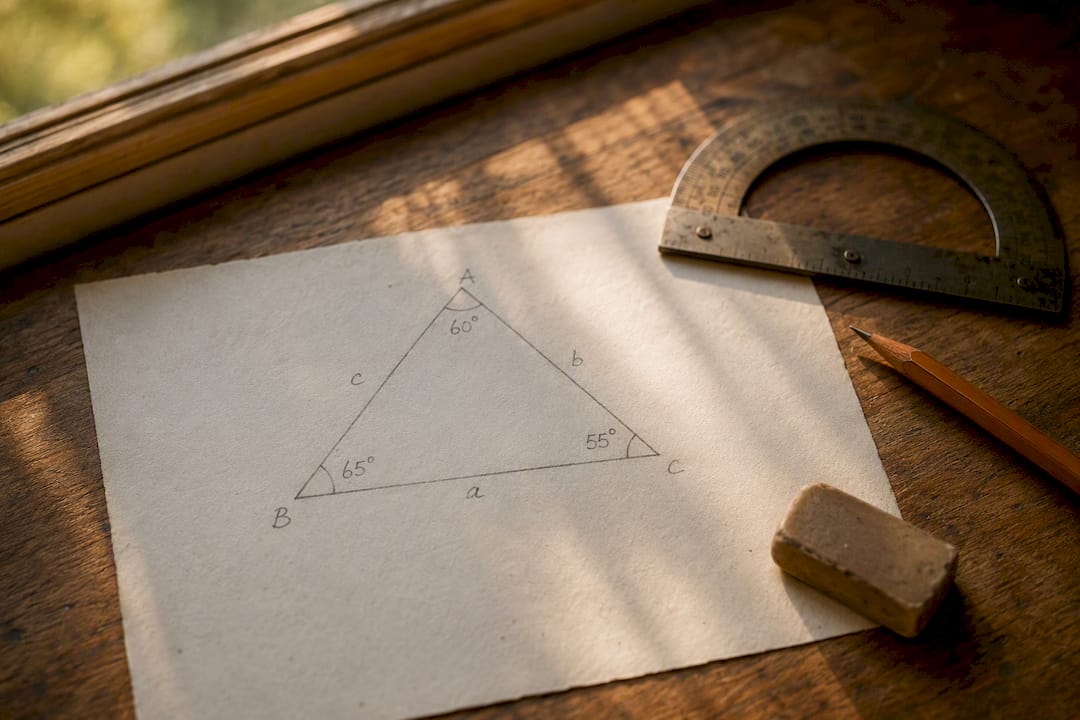
Common mistakes: applying the sine rule when the cosine rule is needed; mislabelling sides and angles on the diagram; rounding intermediate answers too early, which throws off the final figure.
Three-step plan: memorise the decision rule (two angles and a side, or two sides and an angle, use sine rule; three sides, or two sides and the included angle, use cosine rule); label a blank triangle diagram correctly five times before calculating anything; work through a genuine Edexcel or OCR past-paper trigonometry question and compare your labelling to the model answer.
5. Vectors
Vector questions demand spatial reasoning about direction and magnitude at the same time as algebraic manipulation, which is an unusual combination for most GCSE students.
Common mistakes: confusing vector direction (AB versus BA); adding vectors without checking they represent the same journey; failing to spot when a question wants a ratio rather than a full vector.
Three-step plan: practise basic vector addition and subtraction with column vectors; work through five diagram-based vector problems focusing on direction; attempt a full past-paper vectors question, ideally one flagged in examiner reports for low average marks.
6. Circle theorems
There are eight circle theorems to recall, and questions frequently require chaining two or three of them together in a single proof or calculation.
Common mistakes: misremembering which theorem applies to which diagram configuration; assuming a triangle is isosceles without justification; giving the answer without stating which theorem was used, which loses reasoning marks even with a correct numerical answer.
Three-step plan: create a one-page reference sheet of all eight theorems with a small diagram for each; practise identifying (not solving) which theorem applies across ten different diagrams; complete a multi-theorem past-paper question and state each theorem by name in your working.
7. Conditional probability
Tree diagrams and “without replacement” scenarios require you to track how probabilities change after each event, which breaks the instinct to treat every draw as independent.
Common mistakes: using the same denominator for every branch of a tree diagram; forgetting to multiply along branches and add across them; misreading “at least one” as “exactly one.”
Three-step plan: draw five tree diagrams from scratch for without-replacement scenarios; practise “at least one” questions separately, since they trip up otherwise strong students; finish with a past-paper conditional probability question from your exam board and check every branch label against the mark scheme.
Past-paper signposting matters here. ThinkStudent’s roundup of historically difficult questions flags vectors and circle theorems as recurring end-of-paper items across multiple years, and GCSE Online Tutoring’s breakdown notes that the hardest questions rarely test one topic alone; they blend two or three, often in an unfamiliar real-world context, which is exactly why isolated topic drills need to be followed by mixed past-paper practice.
What study methods actually move the needle on hard topics?
Passive revision, rereading notes or rewatching videos without producing your own working, barely touches these topics. What works is deliberate, structured practice built around four habits.
Worked examples first, blank practice second. Study a fully worked solution before attempting a similar question cold. This lets you absorb the structure of a correct answer, including how marks are allocated for method versus final accuracy, before you’re under pressure to produce it yourself.
Space and interleave your practice. Revisiting algebraic proof once a week over a month beats one three-hour cram session. Mixing topics within a session, rather than drilling one topic for an hour, also forces you to identify which method a question needs, which is the actual skill Higher-tier papers test.
Build an error log. Every time you lose a mark, write down the topic, the exact step, and the type of mistake (calculation, labelling, misreading, or method choice). After two weeks you’ll see a pattern, and that pattern tells you exactly where to focus next.
Run timed sessions properly. A focused 25 to 40 minute block on past-paper questions, followed by a 10 to 15 minute review against the mark scheme, teaches you more than an unstructured hour. During the review, don’t just check whether the final answer is right; check whether you would have earned method marks even if the final figure was wrong.
- Choose one topic and one past-paper question.
- Attempt it fully within a timed block.
- Mark it against the official scheme, noting every method mark separately from accuracy marks.
- Log the specific error type.
- Repeat with a mixed-topic paper once the single-topic error rate drops.
Pro Tip: When marking your own timed practice, use a different coloured pen for method marks versus accuracy marks. It forces you to see, in colour, whether your maths was right but your presentation lost you credit, which is one of the most common and most fixable problems on Higher-tier papers.
How much time should you give the hardest topics, and when should you ask for help?
A realistic run-up to exams splits naturally into three phases, and where each hard topic lands depends on your target grade.
12 weeks to 6 weeks out: work through every topic on the hard list once, in isolation, using the three-step plans above. If you’re targeting a grade 5, spend the bulk of this phase on algebraic fractions and ratio in context. If you’re targeting grades 7 to 9, add algebraic proof, vectors, and non-right-angled trigonometry.
6 weeks to 2 weeks out: shift to mixed past papers that combine topics, since this is how the real exam presents them. Keep the error log running and revisit only the topics still generating mistakes.
Final 2 weeks: consolidate. Redo your weakest three topics from the error log, attempt one full past paper per exam board style you’re sitting, and stop introducing new content.
Three attempts is a useful rule of thumb for knowing when to get help. If you’ve made the same type of error on the same topic across three separate timed attempts, independent practice alone probably won’t fix it, and it’s time to bring in a teacher, tutor, or knowledgeable peer.
Before any help session, bring:
- A marked past paper with the specific questions you got wrong.
- A written note of exactly which step went wrong each time.
- Two or three precise questions, not “explain vectors to me” but “why did I choose the wrong vector direction here.”
How do MathVault’s resources map onto these hard topics?
MathVault organises exactly the resources this revision plan calls for, sorted by exam board and topic, so you’re never guessing where to practise next. For each hard topic above, the workflow is the same: pick the topic, run a short skill drill, attempt the matching past-paper question by board and year, then mark it against a fully worked solution.
- Algebra-heavy topics (proof, fractions, quadratic simultaneous equations): start with the AQA GCSE maths topics guide for structured drills before moving to past papers.
- Trigonometry and vectors: use the Edexcel GCSE maths topics guide for board-specific worked examples and diagram conventions.
- Stretch and Further Maths crossover topics (advanced vectors, circle theorems): the GCSE Further Maths topics guide extends practice for students targeting the top grades.
Higher-tier students should start with the topic guides above; Foundation-tier students get more value starting directly with topic-sorted past papers and building up. Video walkthroughs and live Q&A sessions slot into the 6-to-2-week phase, once you know precisely which questions to bring.
A teacher’s honest view on hard topics
Every year, the students who jump a grade aren’t the ones who revise everything equally. They’re the ones who ruthlessly target three or four topics that consistently cost them marks and drill those until the mistakes stop repeating. “Hard” doesn’t mean impossible; it means it needs deliberate, specific practice rather than general revision. Pick your worst topic from the list above and do one question today. That’s the whole trick.
Start practising the topics that actually move your grade
MathVault gives you free access to past exam papers, fully worked step-by-step solutions, video walkthroughs, and weekly live Q&A sessions, all organised by topic and exam board so you spend your revision time on the questions that matter, not searching for them.
Getting started takes three steps. First, visit the GCSE maths revision guides landing page and find the topic you scored lowest on last time. Second, pick that topic and work through the linked skill drills. Third, attempt the recommended past-paper question and mark it immediately against the worked solution, rather than waiting until you’ve forgotten your own reasoning. All materials map to AQA, Edexcel, and OCR, and higher-tier past papers with full solutions are linked directly from each topic-based Edexcel past-paper page, so there’s no guessing which paper matches which board.
Where to find authoritative past-paper practice
For grade boundary context, see Ofqual’s explainer and Pearson’s grade statistics, which show where cohorts typically lose marks.
Frequently asked questions
What is the single hardest topic on the GCSE maths Higher tier?
Algebraic proof and vectors are the two topics teachers and examiners flag most consistently, largely because both demand structured reasoning rather than a fixed calculation method.
Is trigonometry harder than algebra at GCSE?
Non-right-angled trigonometry (sine rule, cosine rule) tends to cause more errors than basic algebra because it requires correctly selecting a method before any calculation begins, whereas algebraic errors are usually calculation slips rather than method-selection failures.
How many hours should I spend on a single hard topic?
There’s no fixed number, but a productive pattern is a 25 to 40 minute focused session followed by a 10 to 15 minute review, repeated two or three times across a week rather than crammed into one sitting.
Do Foundation-tier students need to worry about these topics?
Most of the topics ranked hardest here, algebraic proof, vectors, circle theorems, sit on the Higher tier only. Foundation students should prioritise bounds, standard form, ratio in context, and basic conditional probability instead.
Where can I find real past-paper questions sorted by topic?
MathVault organises Edexcel past-paper questions by topic, with matching worked solutions for AQA, Edexcel, and OCR boards.
Sources
- GCSE maths grade boundaries explained — Ofqual blog
- Grade statistics — Pearson
- Hardest GCSE Maths Questions: How to Spot, Approach and Solve
Leave a Reply