
Yes, you can resit GCSE maths, and if you narrowly missed a grade 4, November is often your fastest route back. Maths and English are the only two GCSEs offered in the autumn resit series; almost every other subject waits until the following summer.
Your first move should happen this week, not next month. Check which exam board your centre uses, confirm whether your school or college will enter you, and start a diagnostic past paper to see exactly where you stand.
- Check your exam board (AQA, Edexcel, OCR or WJEC) and confirm entry deadlines with your centre
- Ask your school or college directly whether they run a November entry, or identify a private-candidate centre nearby
- Sit one full past paper under timed conditions this week to establish your genuine starting point
Key Takeaways
Passing a GCSE maths resit depends on entering the right series for your circumstances, confirming your entry early, and prioritising number fundamentals before advanced topics.
| Point | Details |
|---|---|
| Confirm your series | Maths can be resat in November, but most other GCSEs must wait for the following summer. |
| Check eligibility early | 16–19 students without a grade 4 must continue studying maths as a funding condition, though entry timing is the centre’s call. |
| Book through the right route | Ask your current centre first, then consider an FE college or a private-candidate centre like Nottingham College. |
| Diagnose before you revise | Start with one timed past paper to find real gaps before building a study plan. |
| Use board-matched resources | Mathvault’s board-specific past papers and worked solutions help you practise exactly what your exam will ask. |
Table of Contents
- Who has to resit GCSE maths at 16–19?
- When can you sit a maths resit: November or summer?
- How do you actually book a GCSE maths retake?
- Do you have to pay for a GCSE maths resit?
- Building a study plan that actually closes the gap
- Getting extra time or support arranged for a resit
- Is Functional Skills a better option than a GCSE resit?
- What happens after results: reviews and appeals
- Frequently asked questions
- Sources
Who has to resit GCSE maths at 16–19?
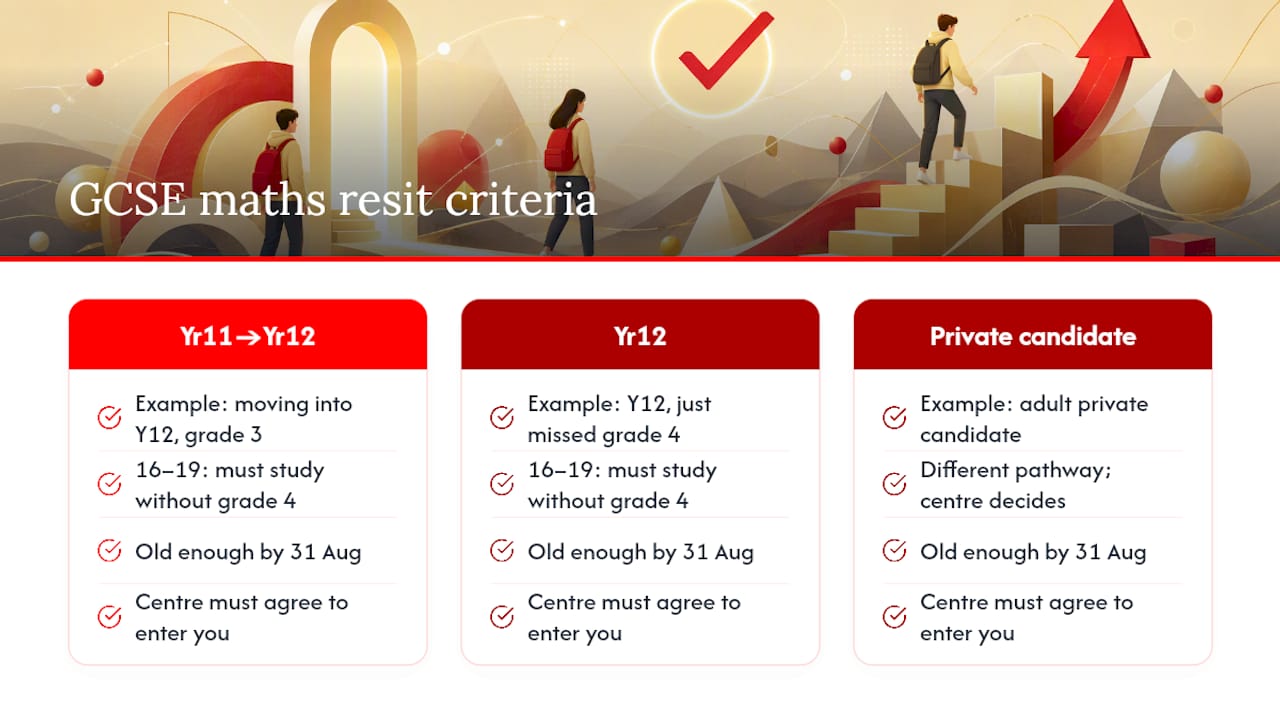
If you’re on a 16–19 study programme and don’t hold a grade 4 in maths, continuing to study towards it is a condition of your funding, not optional extra work. That’s a study requirement, though, not an instruction to sit an exam the moment results land. Your college decides, based on your grade and readiness, whether November is the right series or whether you need a longer run at it before summer.
Entry rules for November also hinge on age (you typically need to be old enough by 31 August of that academic year) and on your centre judging you genuinely close to the grade. A Year 11 student moving into Year 12 with a grade 3, a Year 12 student who just missed a 4, and an adult private candidate all face slightly different pathways, but the underlying rule is the same: your centre has to be willing to put your name down.
Pro Tip: Ask your centre directly what evidence they use to decide who sits November. Some will look purely at your summer grade; others want to see a strong mock or diagnostic result first.
When can you sit a maths resit: November or summer?
Maths and English sit apart from the rest of the GCSE calendar. Everything else waits for the May/June series the following year.
| Series | Subjects | Typical results | Best suited to |
|---|---|---|---|
| November | Maths, English only | Mid to late January | Students who narrowly missed grade 4 |
| Summer (May/June) | Maths, English, and all other GCSEs | Mid to late August | Students needing a longer rebuild |
The gap between summer results day (mid-August) and November papers is tight, often under three months. Entry deadlines for that window can fall within weeks of results day, so waiting to “decide later” frequently means missing it entirely.
- Confirm your exact paper dates with your specific board once entered; they vary by tier and paper number
- Don’t assume November suits you just because it’s sooner. A rushed entry with weak fundamentals rarely beats a properly prepared summer attempt
How do you actually book a GCSE maths retake?
Three routes exist, and which one applies to you depends mostly on whether you’re still in full-time education.
- Ask your current school or college first. If you’re already enrolled on a 16–19 study programme, this is usually the simplest and often free route. Your centre handles entry, candidate numbers, and paperwork.
- Enrol at a local FE college. If your own centre won’t run a November entry, many further education colleges accept external students specifically for maths and English resits.
- Enter as a private candidate. Colleges such as Nottingham College run dedicated private exam entry services for people no longer attached to a school, including adult learners returning to maths.
Whichever route you take, your centre will need your exam board, your previous candidate number if you have one, your intended tier (foundation or higher), any access arrangements, photo ID, and confirmation you’ve met their internal deadline, which is often earlier than the board’s own cut-off.
Pro Tip: Start calling centres on results day itself, not the week after. Private-candidate slots for November fill quickly, and some centres cap numbers by mid-September.
Do you have to pay for a GCSE maths resit?
If you’re on a 16–19 study programme without a grade 4, your resit is usually funded as part of your statutory study requirement. You shouldn’t be asked to pay for that entry.
Fees typically apply if you’ve already left full-time education, you’re an adult learner, or you’re sitting the exam purely to improve a grade you don’t strictly need to retake. Private-candidate fees vary by centre, since each awarding body sets an administrative charge that the centre passes on, plus its own booking fee.
- If a fee is quoted, ask your college whether a bursary, hardship fund, or free adult provision applies before you pay privately
- Compare at least two nearby centres if you are entering privately; charges are not standardised nationally
Building a study plan that actually closes the gap
Most resit failures come down to shaky number fundamentals, not an inability to grasp harder topics. Tutors working with resit students consistently see the same pattern: a student can follow a trigonometry explanation perfectly well but loses marks on a simple percentage change three questions later. Fix the foundations first, and the rest tends to follow faster than expected.

Your plan looks different depending on your timeframe. If you narrowly missed a 4 and you’re eyeing November, you’re working with an intensive 8 to 12 week window. If your gap is bigger, a staged rebuild running through to summer is the more realistic route, and trying to rush it usually backfires.
For the intensive route, structure your weeks like this:
- Week 1: diagnostic. Sit a full past paper cold, under timed conditions, and mark it properly to see your genuine gaps rather than guessing at them.
- Weeks 2 to 4: rebuild number skills. Times tables, fractions, decimals, percentages, and the order of operations (BIDMAS) underpin almost everything else on the paper.
- Weeks 5 to 8: focused topic repair. Work through your board’s topic-indexed past questions to target exactly the areas your diagnostic flagged.
- Weeks 9 to 11: timed full papers. Aim to complete several complete past papers under exam conditions, marking each one against the official scheme.
- Final week: exam-day strategy. Review your formula sheet, plan your time allocation per question, and stop learning new content.
- Master times tables, fraction operations, percentage change, decimal manipulation, and BIDMAS before touching algebra or geometry in depth
- Balance your practice: topic questions first, marked feedback second, full timed papers third
- Aim for several complete past paper sittings before your resit date, not just isolated topic drills
Mathvault’s Edexcel-specific past papers and AQA resources let you match practice directly to your board rather than working from generic questions that might not reflect your exam’s style or mark scheme.
Pro Tip: A score alone tells you almost nothing useful. Get feedback that explains what the examiner actually wanted to see for each method mark, not just whether your final answer was right.
Getting extra time or support arranged for a resit
If you have a diagnosed learning difficulty or additional need, access arrangements such as extra time, rest breaks, a reader, or a scribe don’t carry over automatically between exam series. They must be applied for fresh through your exam centre.
Speak to your school’s SENCO or your college’s learning support team as early as possible. Centres typically need existing assessment evidence or a specialist report to support the request, and JCQ paperwork can take time to process.
- Extra time (commonly 25%) for processing or reading difficulties
- Rest breaks for medical or concentration-related needs
- Readers or scribes for specific literacy or physical access needs
- Separate rooming for anxiety or sensory sensitivities
Start this conversation the moment you decide to resit, not once your entry deadline is looming.
Is Functional Skills a better option than a GCSE resit?
Functional Skills Level 2 is a recognised alternative to GCSE maths, usually assessed on-demand rather than tied to a fixed exam series. That flexibility suits some students far better than the GCSE resit calendar.
It tends to make sense if your grade gap is large, if you’re an adult learner returning to study, or if your intended course only requires Functional Skills for entry. A GCSE resit remains the better choice if your target university, college course, or apprenticeship specifically asks for a GCSE grade rather than an equivalent.
- Check exactly what your next step (course, apprenticeship, university) actually requires before choosing
- Weigh your current grade and confidence against the timescale you have available
- Confirm your intended provider explicitly accepts Functional Skills as equivalent before ruling out a resit
What happens after results: reviews and appeals
November results typically land in mid to late January; summer results follow the usual mid-August pattern. Either way, results come through your centre, not directly from the exam board.
If a result looks wrong, your centre can request a clerical check or a full review of marking on your behalf, though this usually carries a fee that you or your centre pays unless the entry was mandatory funded provision.
- Speak to your centre immediately if a grade looks lower than your papers and predicted grade suggested
- Check your board’s published deadline for review requests, since these windows are short and strict
- Keep a note of every deadline and fee your centre quotes, in case you need to escalate further
- A review of marking checks whether the mark scheme was applied correctly; it won’t change a result simply because you disagree with the grade boundary
A tutor’s honest view on resit timing
Diagnose before you plan. Students who skip the diagnostic paper waste weeks revising topics they’d already mastered. November suits a near-miss with solid foundations; a bigger gap deserves the fuller run to summer.
Where to start your GCSE maths retake preparation on Mathvault
Whichever route you’ve chosen, the hardest part of a resit is usually knowing where to start. Mathvault gives you free past papers, fully worked solutions, and topic-by-topic guides organised by exam board, so you’re never practising the wrong material or guessing at what the mark scheme actually rewards.
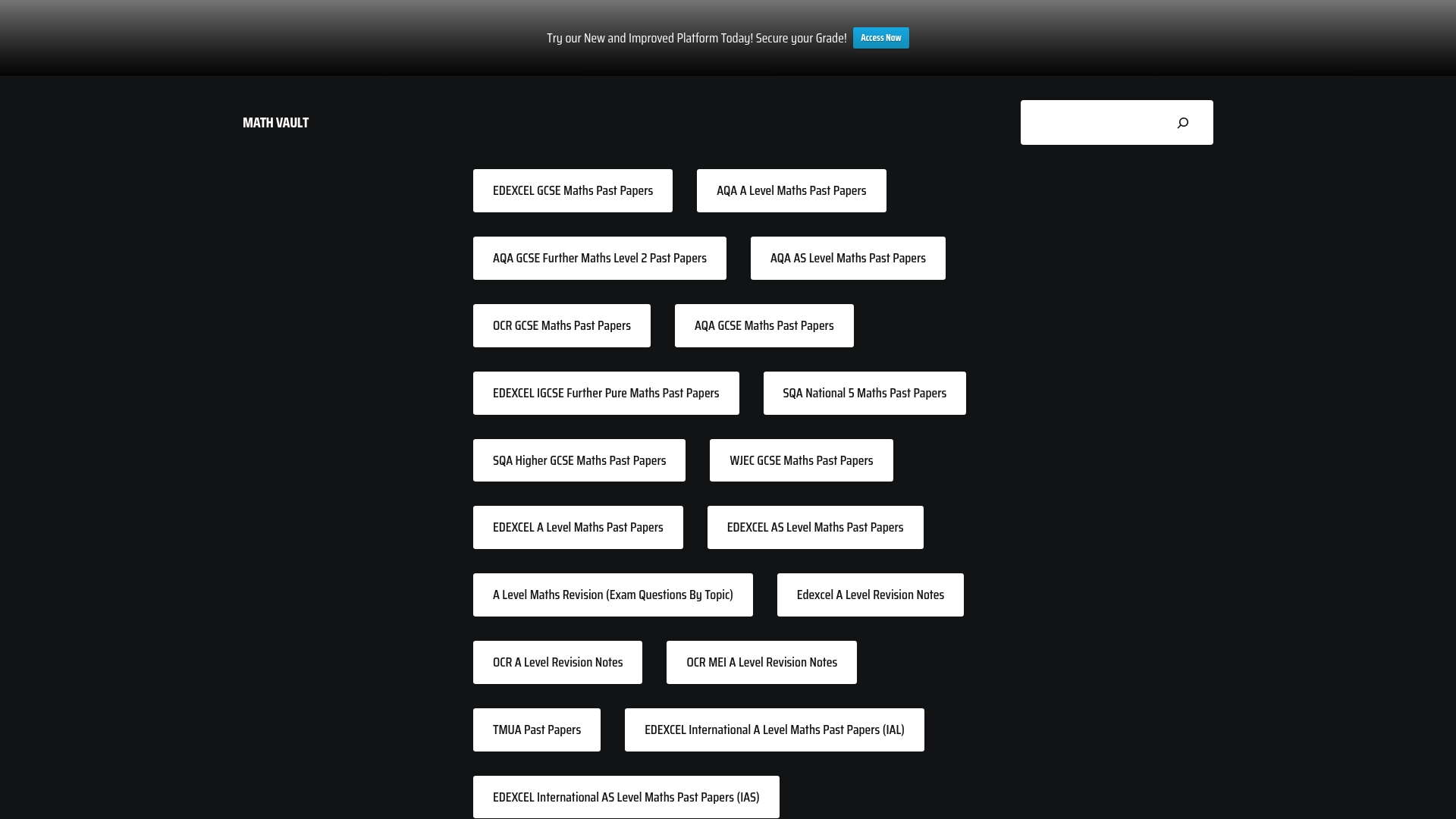
If you’re not sure where to begin, open the GCSE maths revision guides page first. It pulls together structured study plans and formula references in one place, so your first session focuses on real gaps rather than a random topic. From there, follow through to board-specific papers, whether that’s Edexcel’s topic-indexed questions or the OCR paper archive, and start building the timed-practice habit your resit plan depends on.
Frequently asked questions
Can you resit GCSE maths more than once?
Yes. There’s no cap on how many times you can resit GCSE maths, though each attempt needs a fresh entry through a centre and, in some cases, a fee if you’re no longer in funded 16–19 education.
What grade do you need to avoid resitting maths?
You need a grade 4 or above to meet the standard pass threshold and satisfy the 16–19 funding condition on continued study.
Can you resit GCSE maths without going through a school?
Yes, as a private candidate through an approved exam centre such as a local FE college, though you’ll need to arrange this yourself and there’s often a fee involved.
Does a GCSE maths resit affect university applications?
Most universities accept a resit grade the same as a first attempt, though some competitive courses may prefer to see the improved grade achieved by a specific point before you apply.
Is November or summer better for a GCSE maths resit?
November suits students who narrowly missed a grade 4 and have strong underlying skills; a bigger gap usually calls for the longer run to the summer series.
Sources
Check GOV.UK’s 16–19 funding guidance for eligibility rules, and the National Careers Service for a plain-English overview of resit options. For exact paper dates and entry deadlines, go directly to your board: AQA, Edexcel/Pearson, OCR, or WJEC. Northern Ireland students should also check nidirect for local guidance.
- Exam resits | National Careers Service
- Gov
- GCSE resits 2026: dates and key information | Tes
- Private exam entry service — Nottingham College
Leave a Reply