The summer 2026 GCSE maths exams have been and gone. The three AQA papers ran on 14 May, 3 June and 10 June 2026, and the next sitting is the November 2026 series, with papers on 4, 6 and 9 November. This guide gives you both timetables, explains the contingency day and how clashes are handled, and shows how to use the dates to plan revision, whether you are resitting this month or preparing for next summer.
TL;DR
- The summer 2026 GCSE exam window ran from 7 May to 23 June 2026, with 24 June held as the contingency day.
- AQA GCSE maths Paper 1 was on 14 May, Paper 2 on 3 June and Paper 3 on 10 June 2026, all in the morning.
- The November 2026 Edexcel GCSE maths papers are on 4, 6 and 9 November, and you must have been 16 or over on 31 August 2026 to sit them.
- A formulae sheet is provided with GCSE maths papers in 2025, 2026 and 2027, so you do not need to memorise every formula.
- Always confirm your own start time and room with your exam centre, because centres can set times within the published session.
Table of Contents
- When were the GCSE maths exams in 2026?
- The summer 2026 paper dates for AQA
- Do the dates differ by exam board?
- The contingency day and why it matters
- What if two exams clash?
- The November 2026 resit series
- Is there a formula sheet in 2026?
- Turning the dates into a revision plan
- What we can offer you
- Our perspective
- FAQ
- Sources
When were the GCSE maths exams in 2026?
GCSE exams in summer 2026 were held between 7 May and 23 June 2026, according to Ofqual’s student guide. Maths sits inside that window as three papers, taken on three separate days, spread across about four weeks. That spacing is deliberate: it gives you time to review between papers rather than cramming all three into one week.
If you took GCSE maths in summer 2026, your results are already with you. If you are reading this because you need to resit, or because you are in Year 10 or Year 11 and want to know what next year’s pattern looks like, the 2026 timetable is a reliable guide to how the series is structured. Exact dates move every year, so treat the 2026 pattern as a template and check the current timetable for your own sitting.
The summer 2026 paper dates for AQA
For AQA GCSE mathematics, the published timetable placed the three papers as follows, per AQA’s May to June 2026 timetable as published by an exam centre:
| Paper | Calculator | Date in 2026 | Session |
|---|---|---|---|
| Paper 1 | Non-calculator | Thursday 14 May | Morning |
| Paper 2 | Calculator | Wednesday 3 June | Morning |
| Paper 3 | Calculator | Wednesday 10 June | Morning |
The same timetable notes that published start times for AQA exams are either 9:00 am or 1:30 pm. All three maths papers fell in the morning session. The calculator rules are a feature of the specification: the first paper is non-calculator and the second and third allow one.
A few practical points from the pattern:
- The gap between Paper 1 and Paper 2 was almost three weeks. That is long enough to forget how you handled the non-calculator paper, so many students plan a short refresher on mental methods, fractions, surds and algebraic manipulation before Paper 2.
- Papers 2 and 3 were exactly one week apart. This is the tight stretch. Use the week for targeted topic work, not for sitting full papers every day.
- Maths ran mid-window. Early May to mid-June also carries science, English and other subjects, so your maths revision always competes with other deadlines.
Every paper in a tier is taken by the same students. Foundation tier students can be awarded grades 5 to 1, and Higher tier students grades 9 to 4, so the tier decision matters well before exam day. Your teacher will have made the entry decision with you, and it affects which paper you sit on each date.
Do the dates differ by exam board?
In practice, very little. The Joint Council for Qualifications (JCQ) facilitates a common timetable agreement so that members align exam dates and reduce clashes across awarding bodies. JCQ members develop and agree common timetables for the GCSE November series and the GCSE and GCE June series. That is why AQA, Edexcel and OCR maths papers sit on shared dates in the main series, and why you will see the same three days quoted across different guides.
What differs between boards is the paper content, the question style and the marks, not the calendar. Ofqual’s student guide covers exams in England, so if you are in Wales or Scotland your qualifications and timetables may follow a different pattern. WJEC and the Scottish Qualifications Authority publish their own dates, and you should take those from the board directly.
The quickest way to check which board you are on is your exam entry confirmation or your teacher. Once you know, revise from that board’s papers. Our past papers for AQA GCSE maths are organised by board and year, so you can match the style you will sit.
The contingency day and why it matters
The contingency day for summer 2026 was 24 June 2026. Ofqual’s guide says students must be available then in case an exam has to be moved nationally because it could not take place when planned. That covers rare events such as a serious disruption affecting a paper across the country.
Two things are worth knowing:
- It is a national safety net, not a second chance. The same guidance states that the contingency session cannot be used to reschedule an exam that a student has missed. If you miss a paper, speak to your exam centre straight away about what options exist.
- You should keep it free. The practical advice for any summer series is to avoid booking holidays, trips or work on the contingency day until results are out, even though it is very rarely used.
What if two exams clash?
Because timetables are shared across boards, most students never meet a clash. Clashes happen when you take subjects from different boards, or optional subjects that sit in the same slot. In that case your centre handles it, not you.
One rule worth knowing: JCQ regulations allow an exam to be moved to a different session on the same day if the total combined duration of all exams in a session exceeds three hours. The JCQ page also points to sections 7 and 8 of its Instructions for Conducting Examinations for the full detail. If you think you have a clash, tell your exams officer early. They are the person who applies the rules and arranges supervision between sessions.
The November 2026 resit series
The November series is the main route if you are resitting GCSE maths this autumn. The official position is that GCSE mathematics is available in November to students who were aged 16 or above on 31 August 2026.
For Pearson Edexcel, the final November 2026 timetable schedules GCSE mathematics on 4, 6 and 9 November 2026:
| Paper | Calculator | Date |
|---|---|---|
| Paper 1 | Non-calculator | Wednesday 4 November 2026 |
| Paper 2 | Calculator | Friday 6 November 2026 |
| Paper 3 | Calculator | Monday 9 November 2026 |
The same Pearson document explains that UK centres may start an exam earlier or later than the published time without Pearson’s prior approval, within the stated session time limits. So your own start time can differ from the one printed on a general timetable. Ask your centre for your personal timetable and read it twice.
If you are resitting in November
The window is short, so be realistic about what you can change in the time left:
- Prioritise the topics that carry the most marks. Number, algebra, ratio and proportion, geometry and probability and statistics all appear across all three papers. Find which you lost marks on last time and start there.
- Practise the non-calculator paper separately. Paper 1 is the first sitting and sets the tone. Give it its own timed practice.
- Work from mark schemes, not only answers. Method marks and accuracy marks are awarded separately, so a wrong final answer can still earn most of the marks if the working is clear.
- Sit one full paper under timed conditions each week, then spend twice as long reviewing it as you did sitting it.
Is there a formula sheet in 2026?
Yes. The Department for Education and Ofqual confirmed in 2024 that formulae and equation sheets would be provided for GCSE mathematics, physics and combined science exams in 2025, 2026 and 2027. OCR’s guidance adds that students are given a formulae sheet alongside each maths question paper in both the June and November series, with separate sheets for Foundation and Higher tier. The Higher tier sheet includes additional formulae.
That does not mean you can skip the learning. Formulae you have always had to remember, such as the quadratic formula in many cases, may still be your job to recall, and knowing where each formula applies matters more than seeing it on paper. Check the sheet for your own board and tier before you rely on it. Our GCSE maths exam checklist covers the five topics students most often drop marks on, the formula sheets and the tier rules, in one page.
Turning the dates into a revision plan
A timetable is only useful if it shapes your weeks. Here is a simple way to use it, whether you have days or months.
Work backwards from Paper 1
Count the weeks from today to the first paper. Divide them into three blocks:
- Content gaps. Use the early weeks to close topic gaps, using topic-based revision guides that break each area into manageable steps.
- Past papers. Move to full papers once your topic coverage is reasonable, marking each one yourself against the mark scheme.
- Targeted repair. In the final fortnight, rework only the question types where you keep dropping marks.
Use the gap between papers
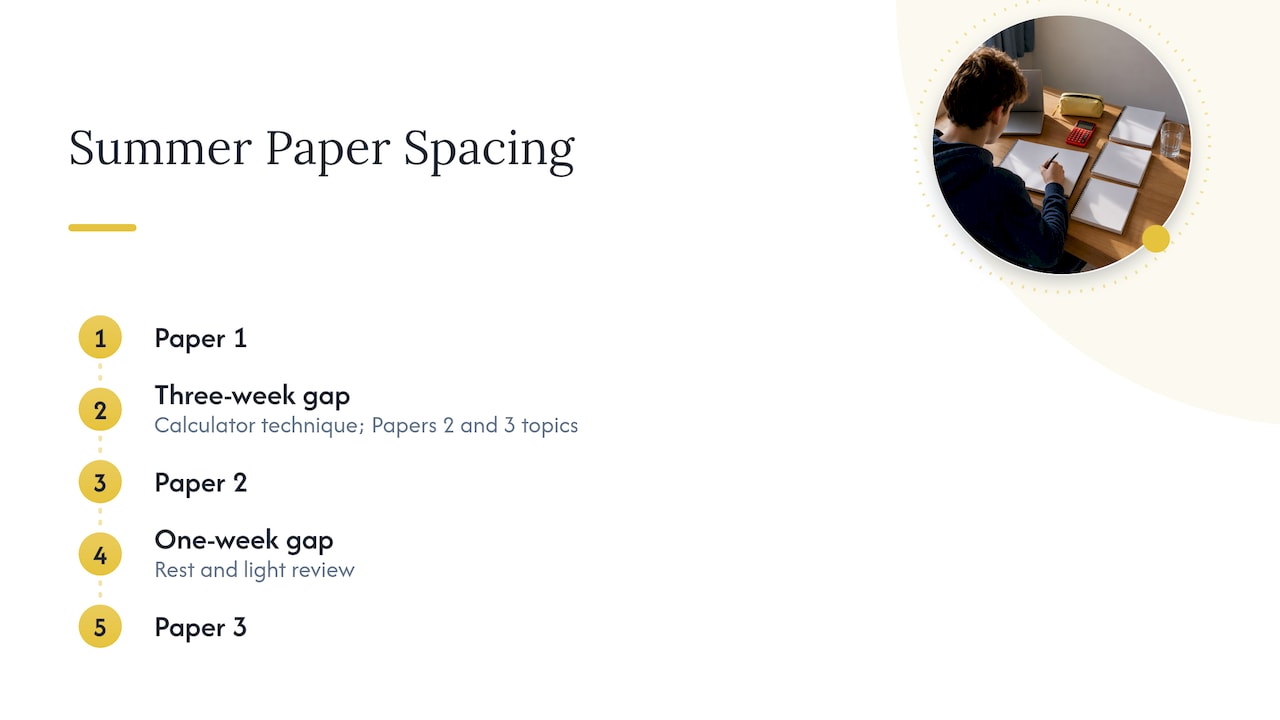
In the summer pattern, the three-week gap after Paper 1 is for calculator technique and for topics that appear more heavily on Papers 2 and 3. The one-week gap between Papers 2 and 3 is for rest and light review. Plan the rest as seriously as the revision.
Check your grade targets
Knowing what a grade requires helps you decide where to push. We publish GCSE maths grade boundaries from 2018 to 2025 so you can see how raw marks have translated to grades in past series. Boundaries change each year, so treat them as a guide to the typical range, never a promise. Our companion post on grade boundaries and exam timetables pairs the two.
What we can offer you
MathVault is built for exactly this stage of preparation. Past papers are organised by exam board and year, solutions are fully worked step by step, and there are video walkthroughs and live weekly Q&A sessions. Everything revision-related is free to use, and a small share of advanced resources and downloadable packs is paid for by those who want offline copies.
If you want to mark your own work as the examiner would, start with our self-marking past papers with board-aligned solutions, where you can also join the live Q&A.
If you prefer to learn by watching a method before trying it, the 4 to 6 week plan using video walkthroughs fits neatly into the weeks before a November sitting.
Our perspective
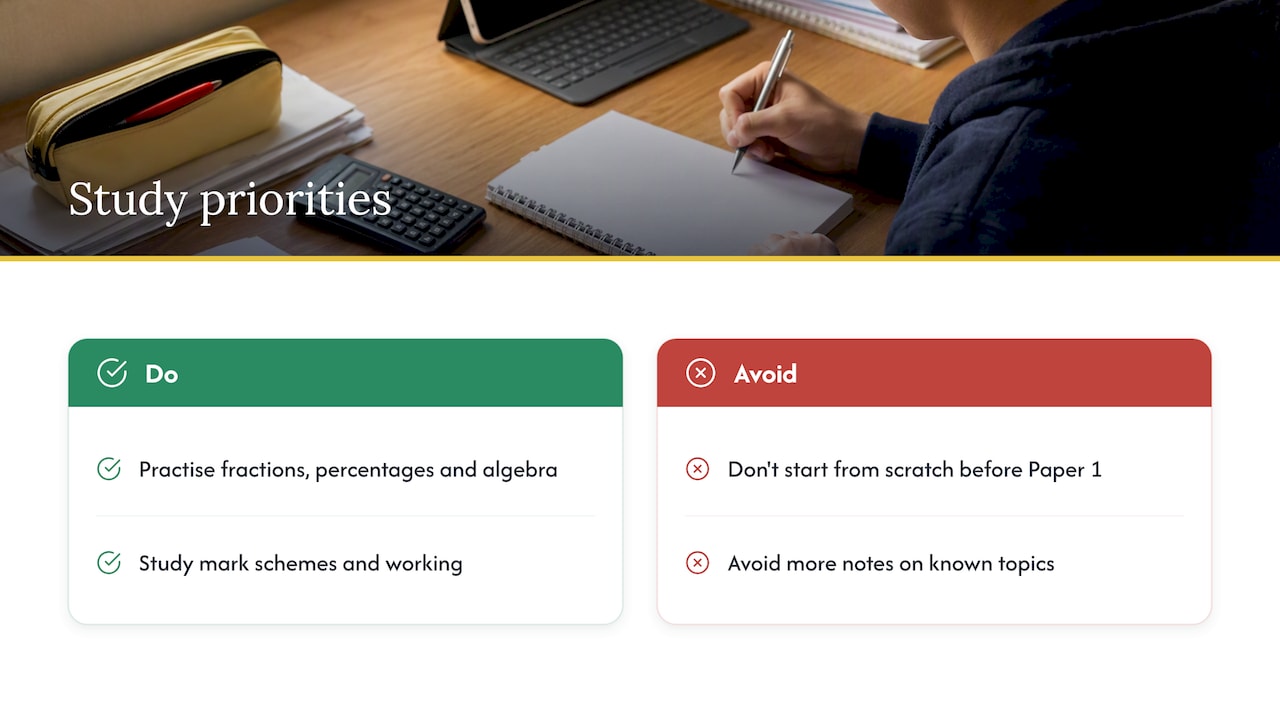
We see the same pattern every year: students who know the dates early do better than students who only learn them from a teacher’s reminder. A timetable gives you a fixed point, and fixed points make a plan believable. The weeks before Paper 1 are not the time to start from the beginning, they are the time to decide which marks are the cheapest to win.
Our view is that the first paper deserves more respect than it usually gets. It is non-calculator, it comes first, and students who panic on it carry that feeling into the next two. We would rather you spent a week building fluency on fractions, percentages, simplifying algebra and arithmetic without a calculator than add a fourth set of notes on a topic you already know.
We also think resitting is more common and more worthwhile than people admit. The November series exists because a grade is not final until you decide it is. If you are resitting, work from the mark scheme and the working, not just the final answers, because that is where the recoverable marks are. Method marks reward a clear approach even when the arithmetic slips.
The dates are fixed, but how you use the weeks before them is yours to decide.
— Oloru
FAQ
When is GCSE maths in 2026?
The summer 2026 series ran from 7 May to 23 June, and AQA’s three maths papers were on 14 May, 3 June and 10 June. The November 2026 series follows, with Edexcel’s maths papers on 4, 6 and 9 November. Check your own centre’s timetable for exact start times.
How many GCSE maths papers are there?
There are three papers in each series. Paper 1 is non-calculator and Papers 2 and 3 allow a calculator. You sit the same three papers whichever tier you are entered for, with Foundation and Higher tier papers differing in difficulty.
Can I resit GCSE maths in November 2026?
Yes, provided you were aged 16 or above on 31 August 2026, according to Ofqual’s student guide. Entries are made through your school, college or an exam centre. Ask your centre well ahead, because they set their own internal deadlines.
Do I get a formula sheet in the exam?
Formulae sheets are provided alongside GCSE maths papers in 2025, 2026 and 2027, with a separate sheet for each tier. Some formulae still need to be learned, so check the sheet for your board and tier before the exam.
What is the contingency day?
It is a spare day, 24 June in the summer 2026 series, kept free in case an exam has to be moved nationally. It cannot be used to reschedule an exam you have missed. Keep it free until results are out.
Sources
- What you need to know before your exams, GOV.UK (Ofqual)
- GCSE November 2026 Final Timetable, Pearson Edexcel
- AQA GCSE May to June 2026 exam timetable
- Shared services, Joint Council for Qualifications
- Managing timetable clashes, Joint Council for Qualifications
- Formulae and equation sheets for assessments in 2026, OCR
Leave a Reply