
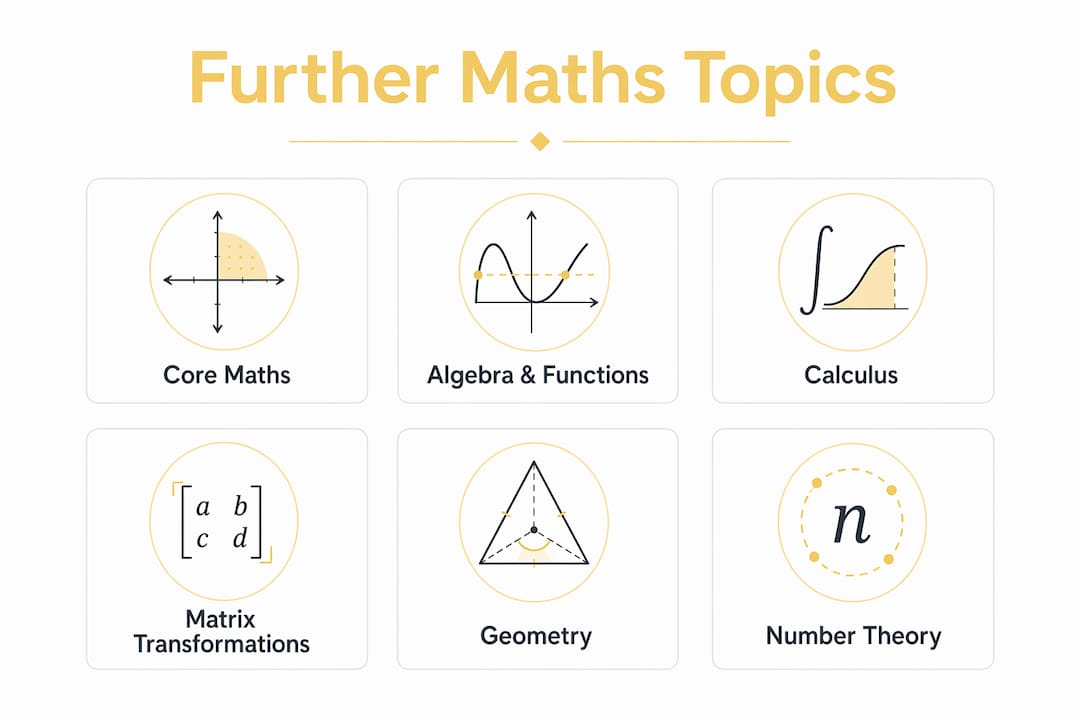
The AQA Level 2 Certificate in Further Mathematics (specification 8365) covers six core topic areas. If you are preparing for this qualification, these are the domains you need to master:
- Number — advanced number theory, surds, fractions, and numerical methods
- Algebra and Functions — factor theorem, functions, inequalities, polynomial manipulation, simultaneous equations
- Coordinate Geometry (2D) — lines, circles, tangents, distance and midpoint calculations
- Calculus — differentiation, gradient functions, and an introduction to integration
- Matrix Transformations — 2×2 matrices and geometric transformations
- Geometry — circle theorems, trigonometry in 2D and 3D, Pythagoras’ theorem, geometric proofs
This is a Level 2 linear qualification, untiered and graded on the 9–1 scale. It targets students who already have, or are expected to achieve, top GCSE grades in GCSE Mathematics. The course does not replace standard GCSE Maths. It extends it, building the algebraic reasoning and problem-solving depth that A-Level Mathematics demands.
What do the GCSE further maths topics actually cover?
Each of the six topic areas carries distinct content, and understanding what sits within each one is half the battle when planning your revision.
Number
Number in Further Maths goes beyond standard GCSE arithmetic. You will work with surds and rationalising denominators using more complex expressions, apply the product rule for counting, and handle numerical methods. The content assumes confident fluency with fractions, percentages, ratio, and order of operations from Key Stage 4.
Algebra and functions
Algebra is the backbone of the entire qualification. Key subtopics include:
- Defining, composing, and inverting functions using f(x) notation
- Domain and range of functions
- Expanding brackets using Pascal’s triangle and the binomial theorem
- Factorising polynomials and applying the factor theorem
- Manipulating rational algebraic expressions
- Solving linear, quadratic, and simultaneous equations, including one linear and one second-order pair
- Solving triple simultaneous equations (three unknowns)
- Sketching exponential and other function graphs
Composite and inverse functions, domain and range analysis, and polynomial expansions beyond standard GCSE level are central to this section. These underpin the higher-order problem solving the exams reward.
Coordinate geometry (2D)
This section extends GCSE coordinate work into more demanding territory. You need to know:
- Gradient relationships for parallel and perpendicular lines
- Equations of circles with centre (a, b) and radius r, in the form (x − a)² + (y − b)² = r²
- Properties of tangents, including the fact that a tangent is perpendicular to the radius at the point of contact
- Distance between two points and midpoint calculations
Calculus
Calculus is genuinely new content for most students at this stage. The focus is on differentiation: understanding the gradient function, finding the gradient of a curve at a given point, and applying differentiation to tangents, normals, and simple optimisation problems. Basic integration as the inverse of differentiation also appears, along with finding areas under curves.

Matrix transformations
Matrices are another topic that feels entirely new. You will multiply 2×2 matrices by 2×2 or 2×1 matrices, use scalar multiplication, and apply matrices to represent geometric transformations such as rotation, reflection, and enlargement. The identity matrix and combinations of transformations are also assessed.
Geometry
The geometry section draws together circle theorems, trigonometry, and proof:
- Circle theorems: angle at the centre is twice the angle at the circumference; angles in the same segment are equal; opposite angles in a cyclic quadrilateral sum to 180°; the alternate segment theorem
- Sine and cosine rules in scalene triangles
- Pythagoras’ theorem in both 2D and 3D, including common Pythagorean triples such as 3-4-5 and others
- Trigonometric graphs for sin x, cos x, and tan x for angles of any size
- Trigonometric identities and solving equations within a given interval
- Formal geometric proofs using established theorems
| Topic area | Key concepts | Builds on GCSE? |
|---|---|---|
| Number | Surds, product rule for counting, numerical methods | Mostly extension |
| Algebra and Functions | Factor theorem, functions, binomial expansion, triple simultaneous equations | Significant extension |
| Coordinate Geometry | Circle equations, tangents, perpendicular lines | Moderate extension |
| Calculus | Differentiation, integration, optimisation | Entirely new |
| Matrix Transformations | 2×2 matrix operations, geometric transformations | Entirely new |
| Geometry | Circle theorems, 3D trig, proofs | Moderate extension |
Which topics do students find hardest, and how should you prepare?
The most challenging areas for Further Maths students are consistently the factor theorem, solving simultaneous equations with multiple unknowns, and introductory calculus. These topics share a common difficulty: they require abstract reasoning and multi-step working rather than a single technique applied once.
Here is what makes each one demanding, and what you can do about it:
- Factor theorem — students often know the rule but struggle to apply it efficiently when factorising cubics. Practise substituting rational values systematically and linking the result to polynomial division.
- Triple simultaneous equations — the algebra is manageable, but the volume of working creates opportunities for arithmetic errors. Write each elimination step clearly and check your solution by substituting back into all three equations.
- Calculus — differentiation feels abstract at first because it describes change rather than a fixed value. Sketch the curve alongside the gradient function to build intuition before moving to formal problems.
- Matrix transformations — the mechanics of multiplication are straightforward once practised, but combining two transformations and interpreting the result geometrically trips many students up.
Pro Tip: When tackling multi-part questions worth 5–8 marks, read the whole question before writing anything. The final part often signals what form your earlier answers should take, which saves you from working in an unhelpful direction.
Extended multi-part problems are the standard format in Further Maths exams. There are no multiple-choice questions. Every mark requires demonstrated working and reasoning, so a correct answer with no method shown will not receive full credit.
Effective preparation comes down to three habits: regular timed practice, working through past papers under exam conditions, and reviewing mark schemes critically. Understanding why a method earns marks is more useful than simply checking whether your answer matches.
AQA Level 2 Further Maths: what the specification tells you
The AQA 8365 specification sets out a linear, untiered assessment structure. Both papers assess all six topic areas. There is no split syllabus by paper, so you cannot predict which topics will appear where.
| Feature | Detail |
|---|---|
| Specification code | AQA 8365 |
| Qualification level | Level 2 (untiered, linear) |
| Grading scale | 9–1 |
| Number of papers | Two: Paper 1 (non-calculator), Paper 2 (calculator) |
| Question format | Multi-part extended response; no multiple choice |
| Target students | Predicted top GCSE grades in GCSE Maths |
| Progression route | A-Level Mathematics and Further Mathematics |
| Topic areas assessed | All six areas on both papers |
The qualification is designed to be taught either alongside GCSE Mathematics or after it. Most schools run it in parallel with Year 11 GCSE Maths, treating the matrices and calculus sections as genuinely new content and the remaining topics as structured extension work. Students who complete this course typically find the transition to A-Level Maths considerably less steep, particularly in algebra and calculus.
Where to find the best revision resources for Further Maths
Knowing the syllabus is one thing. Having the right materials to practise it is another.
Official past papers and mark schemes are the single most effective revision tool. AQA publishes past papers, mark schemes, and examiners’ reports for specification 8365 on its website. Search for “8365 past papers” in the assessment resources section. Examiners’ reports are particularly valuable: they show exactly where students lost marks and why.
Pro Tip: Work through a past paper under timed conditions, then mark it using the mark scheme. For every question where you lost marks, write out the correct method in full before moving on. This active correction process builds understanding far faster than passive re-reading.
| Resource type | Best use | Where to find it |
|---|---|---|
| Past papers and mark schemes | Exam practice and question familiarity | AQA website (specification 8365) |
| Video walkthroughs | Understanding worked solutions step by step | Mathvault, YouTube |
| Textbooks | Structured topic-by-topic learning | School library, online retailers |
| Live tuition | Targeted support on weak areas | UK tutoring providers |
| Revision notes by topic | Quick reference before exams | Mathvault, school resources |
Mathvault offers free access to GCSE and A-Level past exam papers, fully worked step-by-step solutions, video walkthroughs, and live weekly Q&A sessions. Resources are organised by UK exam board and cover all major syllabus variants, including Further Maths. The fully worked solutions are particularly useful for checking not just whether your answer is correct, but whether your method would earn method marks in an exam setting.
For students who want structured, expert-led support, small-group GCSE masterclasses that follow cognitive science principles and provide real-time feedback can accelerate progress, especially on the harder algebraic and calculus topics.
A practical revision timetable should allocate time by topic area rather than by paper. Spend more sessions on calculus and matrix transformations if these are new to you, and use the Mathvault blog for guidance on structuring your study across the weeks before your exams.
Key takeaways
The AQA Level 2 Further Maths qualification covers six distinct topic areas, with calculus and matrix transformations representing entirely new content for most students.
| Point | Details |
|---|---|
| Six core topic areas | Number, Algebra and Functions, Coordinate Geometry, Calculus, Matrix Transformations, and Geometry. |
| Hardest topics | Factor theorem, triple simultaneous equations, and introductory calculus require the most focused practice. |
| Exam format | Two papers (calculator and non-calculator), both assessing all six topics with multi-part extended response questions. |
| No multiple choice | Every mark requires demonstrated working; correct answers without method shown will not receive full credit. |
| Best revision approach | Past papers under timed conditions, followed by active mark-scheme review and fully worked solution study. |
Leave a Reply