
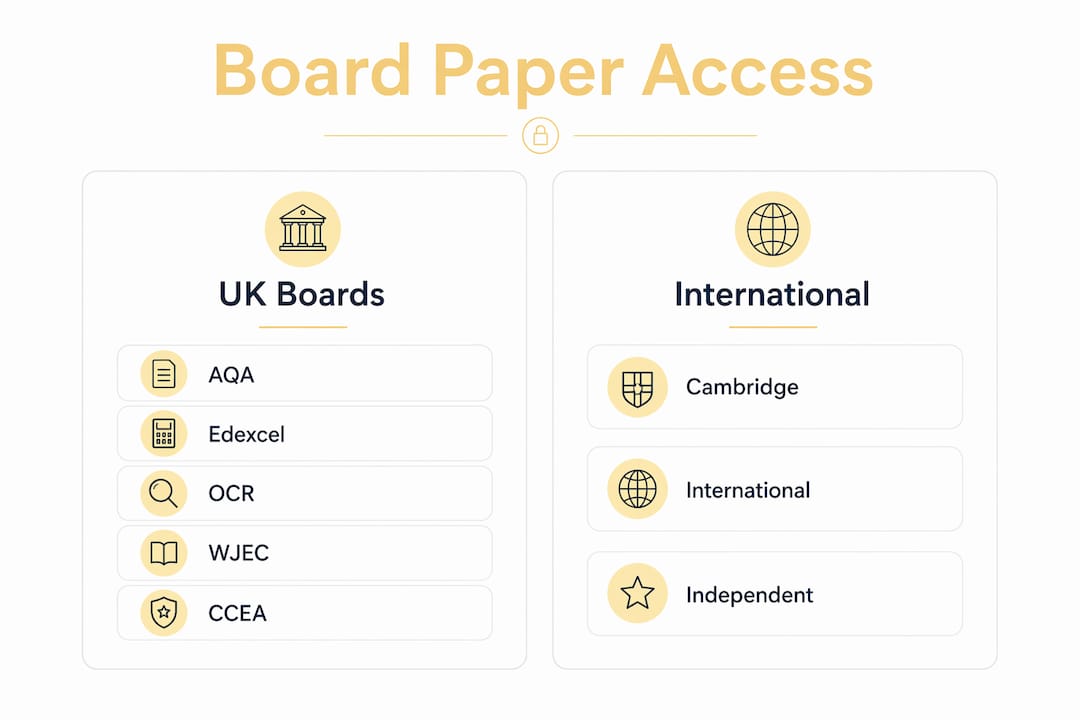
The fastest way to find UK Further Maths past papers is to go directly to your exam board’s website. AQA, Edexcel (Pearson), OCR, WJEC/Eduqas, CCEA, and Cambridge International (CAIE) all publish free question papers and mark schemes on their specification pages. Mathvault also collects and organises these materials by board and year, so you can find papers, worked solutions, and video walkthroughs in one place without hunting across multiple sites.
Your first step is simple: identify your exam board and paper code, download the most recent available paper, and sit it under timed conditions. Then mark it against the official mark scheme and read the examiner report for that series. That three-step loop, repeated consistently, is half the battle in Further Maths preparation.
- AQA — past papers and mark schemes via the A-Level Further Mathematics specification page
- Edexcel (Pearson) — papers and mark schemes via the Pearson Qualifications website, organised by component
- OCR — past papers and examiner reports via the OCR Mathematics qualification pages
- WJEC/Eduqas — papers via the WJEC website; Mathvault also hosts WJEC resources with worked solutions
- CCEA — past papers via the CCEA qualification pages for Further Mathematics
- Cambridge International (CAIE) — syllabus 9231 past papers including examiner reports and specimen papers
Pro Tip: Always download both the question paper and the mark scheme for the same series. A mark scheme from a different year will not match the paper you are sitting, and mismatched documents are one of the most common revision mistakes.
Table of Contents
- Where to download A-level and AS further maths papers by board
- Which boards offer GCSE further maths and where to find the papers
- What official board listings include and how each document helps you
- How to practise effectively with past exam papers
- What Mathvault provides alongside official papers
- Key takeaways
- The jump to Further Maths is real — here is what actually helps
- Mathvault’s organised packs and worked solutions for every board
- Official sources and further reading
Where to download A-level and AS further maths papers by board
Every major UK exam board publishes its A-Level and AS Further Maths papers on its own website, organised by year and component. The DfE subject criteria set the prescribed core content that all boards must follow, which means the compulsory topics overlap significantly across boards — but optional components differ, so matching the right paper to your syllabus matters.

AQA (7367) publishes papers for Further Pure, Further Statistics, Further Mechanics, and Further Discrete Mathematics. Papers are listed by year and component on the AQA specification page, alongside examiner reports and example student answers.
Edexcel (9FM0) splits its A-Level Further Maths into a compulsory Core Pure paper and optional papers covering Further Pure, Further Mechanics, Further Statistics, and Decision Mathematics. The Pearson Qualifications site lists papers by component code, which you will need to match against your school’s chosen options.
OCR (H245) and OCR MEI (H645) both offer A-Level Further Maths with slightly different optional paper structures. OCR’s past-paper archive is searchable by qualification code, making it straightforward to filter by year.
WJEC/Eduqas serves students in Wales and some English centres. Papers are available via the WJEC website, and Mathvault’s WJEC section provides additional worked solutions alongside the official downloads.
CCEA serves Northern Ireland and publishes its own Further Mathematics papers and mark schemes via the CCEA qualification catalogue.
Cambridge International (CAIE 9231) is used in independent schools and international centres. Its A-Level Further Mathematics syllabus comprises four components: Further Pure 1, Further Pure 2, Further Mechanics, and Further Probability & Statistics.
| Board | Component examples | Typical paper duration | Marks |
|---|---|---|---|
| AQA | Further Pure 1, Further Statistics 1 | Paper durations vary | Marks vary |
| Edexcel | Core Pure 1, Further Mechanics 1 | Paper durations vary | Marks vary |
| OCR | Pure Core, Further Pure A | Paper durations vary | Marks vary |
| CAIE | Further Pure 1 (Paper 1) | Paper durations vary | Marks vary |
| CAIE | Further Mechanics (Paper 3) | Paper durations vary | Marks vary |
CAIE paper durations and mark allocations as noted in the published 9231 syllabus.
Which boards offer GCSE further maths and where to find the papers
GCSE Further Maths is a distinct, optional qualification that sits above the standard GCSE Mathematics course. Not every board offers it, so checking your specific syllabus code before downloading anything is worth doing.
- AQA Level 2 Certificate in Further Mathematics (8365) is the most widely sat version in England. AQA publishes past papers and mark schemes on its qualification page; specimen papers are also available for the current specification.
- OCR Level 2 Further Mathematics (J560 extension / standalone) — OCR offers a Level 2 Further Mathematics qualification; check the OCR site for the correct qualification code and available series.
- WJEC/Eduqas offers a GCSE Further Mathematics qualification for centres in Wales; papers are available via the WJEC website, and Mathvault’s WJEC resources page includes worked solutions for several series.
- CCEA does not currently offer a separate GCSE Further Mathematics qualification; students in Northern Ireland typically progress directly to A-Level Further Maths.
- Cambridge International (CAIE) does not offer a GCSE-equivalent Further Mathematics qualification; its Further Mathematics provision begins at AS/A-Level (9231).
Specimen papers are published by boards when a qualification is new or re-specified. They differ from live past papers in one important way: they are written to demonstrate the format and style of questions rather than to reflect a real sitting, so the difficulty distribution can feel slightly different. When a new specification launches and only one or two live series exist, specimen papers fill the gap. Boards publish specimen papers alongside sample mark schemes, and you should treat them as compulsory practice material, not optional extras.
What official board listings include and how each document helps you
Exam board past-paper pages typically publish four types of document for each series: the question paper, the mark scheme, the examiner report, and grade boundaries (sometimes called grade thresholds). Each serves a different purpose in revision.
The question paper is the exam itself. The mark scheme tells you which answers earn marks and, crucially, distinguishes between method marks (M marks), accuracy marks (A marks), and follow-through marks. Reading mark distributions carefully shows you that a wrong final answer can still earn partial credit if your method is correct.
Examiner reports are the most underused resource in Further Maths revision. They describe, question by question, what candidates did well and where marks were lost. Pairing examiner report comments with the mark scheme reveals the precise level of working expected for each mark band — something the mark scheme alone cannot show you. A report might note, for instance, that candidates who wrote the correct formula but failed to define their variables lost the final mark; that is the kind of detail that changes how you write your solutions.
Grade boundaries tell you the raw mark required for each grade in a given series. They vary year to year depending on paper difficulty, so checking the boundaries for the specific series you are practising against gives you a realistic target rather than a generic percentage.
Pro Tip: Read the examiner report before you look at the mark scheme for any question you got wrong. The report tells you why students lost marks; the mark scheme tells you what the correct answer is. Together, they give you a complete picture of the examiner’s expectations.
How to practise effectively with past exam papers
Timed past-paper practice is the most reliable way to build the stamina and sustained reasoning that A-Level Further Maths demands. The following sequence turns a single paper into a full revision cycle.
- Choose the right paper. Match the paper code to your board and specification year. Avoid papers from before a major specification change, as the topic coverage may differ.
- Sit it under timed, exam conditions. No notes, no calculator unless the paper permits one, and no pausing. Treat the time limit as non-negotiable.
- Mark your work against the official mark scheme. Award method marks honestly, even where your final answer is wrong. Note every question where you lost marks.
- Read the examiner report for that series. Focus on the questions you dropped marks on. The report will often identify the exact misconception or missing step.
- Rework every question you lost marks on. Do not just read the solution; write it out from scratch. For proof-based questions, this step is where the real learning happens.
- Revisit the relevant topic notes. If you lost marks on a whole topic area (e.g. complex numbers or matrix transformations), go back to your topic notes or a Mathvault topic pack before attempting another full paper.
A practical weekly rhythm is one timed paper per week, with two shorter topic-focused sessions in between. If you find yourself repeatedly losing marks on the same technique or proof structure, a session with a personalised maths tutor can resolve the block faster than repeated solo attempts.
Pro Tip: Use grade boundaries to convert your raw mark into a realistic grade estimate for that series. If you are consistently hitting the grade B boundary but targeting an A, the examiner report will usually tell you exactly which question types are costing you those final marks.
What Mathvault provides alongside official papers
Mathvault’s resources are designed to sit alongside official board papers, not replace them. The distinction matters: official papers give you the authentic exam experience; Mathvault’s worked solutions and walkthroughs give you the teaching layer that a mark scheme alone cannot provide.
Step-by-step worked solutions show every intermediate step, including the reasoning behind method choices. Where a mark scheme might show a single line of working, a Mathvault solution explains why that approach was taken, which is particularly useful for proof and reasoning questions.

Video walkthroughs walk through full papers or individual questions with spoken explanation. For students who find written solutions harder to follow, video is often the faster route to understanding where their logic went wrong.
Topic packs let you practise a specific weakness rather than sitting another full paper. Mathvault’s Edexcel A-Level topic question bank organises past-paper questions by topic, so if complex numbers or differential equations are your weak point, you can target those directly.
Live Q&A sessions run weekly and are free to attend. If a worked solution still leaves you uncertain, the live session is the place to ask.
Mathvault covers multiple boards and qualifications. The SQA Higher section includes question papers from recent years alongside worked solutions, and the WJEC section includes papers from several series with accompanying solutions.
Key takeaways
Consistent timed practice paired with examiner reports and worked solutions is the most effective preparation method for Further Maths exams at both GCSE and A-Level.
| Point | Details |
|---|---|
| Match paper to your syllabus | Download papers using your board’s specific qualification code to avoid mismatched content. |
| Use all four document types | Question paper, mark scheme, examiner report, and grade boundaries each serve a distinct revision purpose. |
| Timed practice builds stamina | Sitting papers under real conditions prepares you for the sustained reasoning A-Level Further Maths requires. |
| Examiner reports decode marking | Reading reports before the mark scheme reveals the exact working level examiners expect. |
| Mathvault adds the teaching layer | Worked solutions and topic packs on Mathvault help you understand why answers are correct, not just what they are. |
The jump to Further Maths is real — here is what actually helps
Students often underestimate how different A-Level Further Maths feels compared to standard A-Level Maths. The shift is not just more content; it is a change in the type of thinking required. Proof and sustained multi-step reasoning appear far more frequently, and the margin for vague or incomplete working is much smaller. A correct answer with insufficient justification can lose marks in ways that feel unfair until you understand the marking logic.
The honest advice is this: do not wait until you have “revised everything” before sitting a timed paper. Sitting papers early, even when you expect to struggle, shows you exactly where the gaps are. One or two timed papers per week, combined with targeted topic work on your weak areas, will do more for your grade than reading through notes repeatedly.
Mathvault and the official board resources are here to support that process at every stage. You are not expected to get it right immediately — you are expected to keep working at it.
Mathvault’s organised packs and worked solutions for every board
If you want everything in one place, Mathvault organises past papers, worked solutions, and video walkthroughs by board and paper code, so you spend your time practising rather than searching.
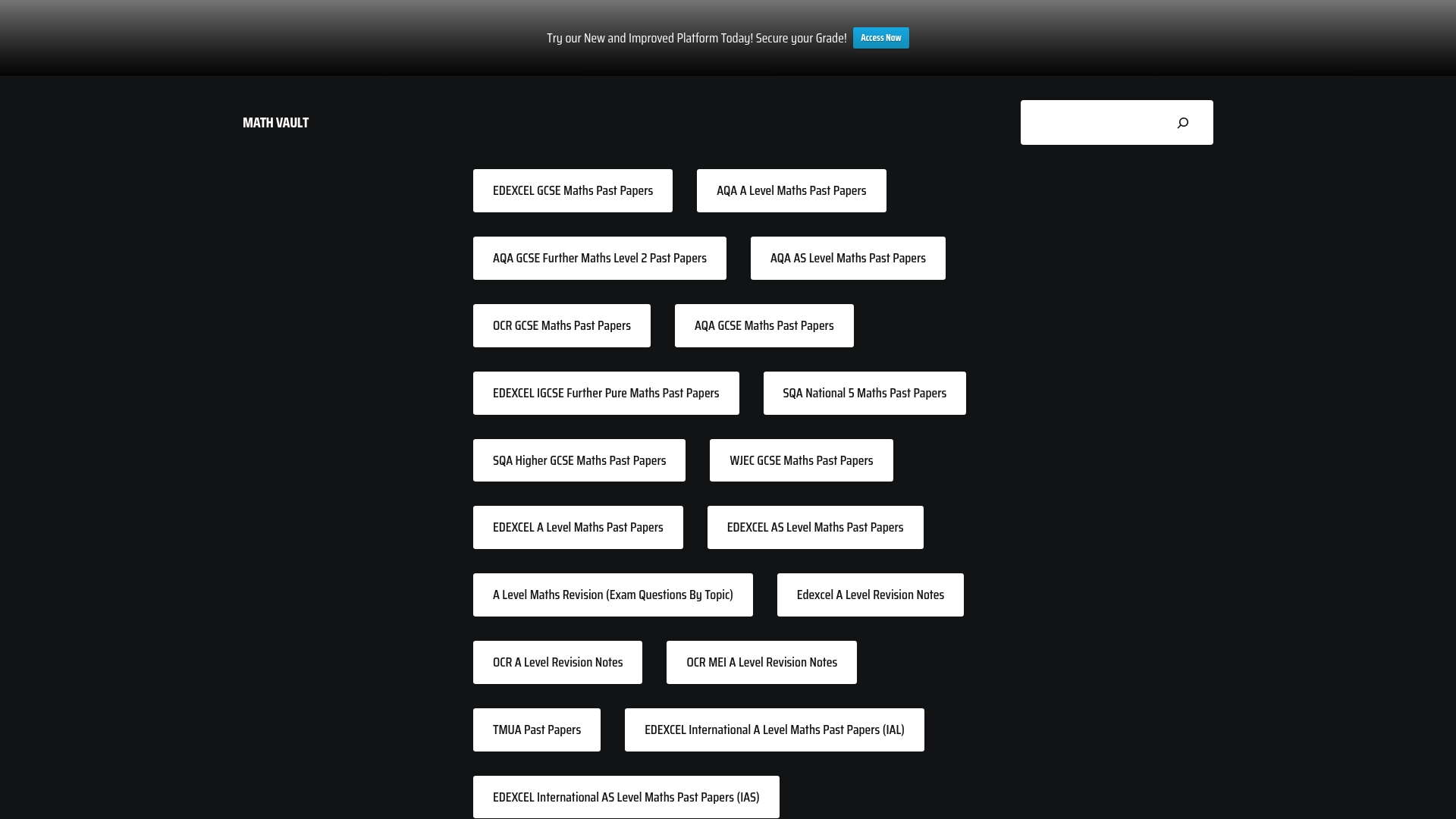
All core resources on Mathvault are free, including the worked solutions and live weekly Q&A sessions. For students who want a complete offline revision pack, downloadable packs are available for a small one-off cost. Whether you are preparing for AQA, Edexcel, WJEC, or another board, you can start practising on Mathvault today without signing up or paying anything. For Edexcel students who want focused topic-by-topic practice, the Edexcel topic question bank is a particularly efficient way to target weak areas before your next timed sitting.
Official sources and further reading
Confirm your syllabus code and the years relevant to your cohort before relying on older papers. Specification changes affect which topics are assessed, and a paper from a previous specification may include content no longer examined or omit content that now is.
- AQA Further Mathematics — specification and past papers including examiner reports and grade boundaries by series
- Cambridge International (CAIE 9231) — past papers, examiner reports and specimen papers for A-Level Further Mathematics
- DfE subject criteria — the GCE AS and A-Level subject content for Further Mathematics defines the prescribed core topics all boards must cover
- Edexcel (Pearson) — Pearson Qualifications website, searchable by qualification code (9FM0 for A-Level Further Maths)
- OCR — OCR Mathematics qualification pages, filterable by H245 or H645
- WJEC/Eduqas — WJEC website for Wales-based qualifications; Mathvault’s WJEC page for worked solutions
- CCEA — CCEA qualification catalogue for Northern Ireland Further Mathematics papers
Always pair any paper you practise with the examiner report and grade boundaries for that specific series. The report and boundaries together tell you not just what the correct answers were, but what standard of performance each grade required in that sitting.
Leave a Reply