
A good further maths paper strategy has three parts: knowing exactly how your board awards marks, rehearsing the paper under real conditions, and turning every mistake into a short list of fixes. Content knowledge gets you to the starting line. Strategy decides how many of the marks you actually collect in the room.
This guide is for A-level Further Mathematics students in England, Wales and Scotland, plus the teachers, tutors and parents supporting them. It covers how to plan your past-paper supply, how to spend the time inside a paper, how mark schemes really work, and how to review a paper so the next one goes better.
TL;DR
- Read your board’s specification and assessment page first: paper lengths, mark totals and calculator rules differ by board, so build your timings from the official figures.
- Show full working on every multi-mark question. Method marks can only be awarded for steps the examiner can see.
- Ration your past papers: practise topics by question first, then save whole papers for timed, exam-condition sittings.
- After each paper, sort lost marks into knowledge gaps, method slips and timing problems, and fix them in that order.
- Use fully worked solutions and live Q&A to close gaps quickly rather than repeating the same error.
Table of Contents
- Start with the paper, not the content list
- Understand the marks you are chasing
- Build a past-paper supply plan
- How to spend your time inside the paper
- What examiners say about where marks go
- Review every paper with a three-column audit
- Our perspective: what we see students get wrong
- Put it into practice with free resources
- A sample eight-week plan before the exams
- FAQ
- Sources
Start with the paper, not the content list
Students often revise Further Maths as a pile of topics: matrices, complex numbers, further calculus, differential equations, and so on. Then they meet the paper and discover that it is a different animal. Questions mix techniques, proof questions appear in unfamiliar clothes, and the clock runs faster than in a classroom.
So before you plan anything, find out what your papers look like. Further Maths is a separate qualification from A-level Maths, and boards structure it differently. Core pure content is compulsory, and options such as further statistics, mechanics or decision maths vary by board and by the combination your school chose. The official assessment pages are the place to confirm paper count, duration, marks and weighting: for example, OCR’s assessment page for Further Mathematics A (H235, H245) includes student revision checklists listing the content you need to cover for each unit, and AQA’s scheme of assessment explains that its A-level is linear, with all assessments sat at the end of the course in the same series.
Write down, for each paper you will sit:
- Duration and total marks.
- Whether a calculator is allowed (and which features your board’s rules require).
- Which topics it can examine, including any options you take.
- Where you are on each topic: confident, patchy or unseen.
That one page becomes the backbone of your plan.
Work out your minutes per mark
Divide the paper’s minutes by its marks. A paper with roughly one minute per mark leaves very little slack, so a four-mark question deserves about four minutes, and a ten-mark proof deserves about ten. Keep a small buffer, since you will want time at the end to check, and note it on your timings. This is simple arithmetic, but it stops the classic trap: spending twelve minutes on a five-mark question because you were certain you were nearly there.
Understand the marks you are chasing
The single most useful piece of strategy is understanding the mark scheme. Examiners work to a defined system, and once you know it, you can write answers that are easy to reward.
| Mark type | What it rewards | What it means for you |
|---|---|---|
| M (method) | Attempting a valid process | Write the setup, even if arithmetic later goes wrong |
| A (accuracy) | A correct result, dependent on the method mark | Slow down on the final line, but never skip the method |
| B (independent) | A correct statement or value, not tied to a method | Quote standard results and facts cleanly |
This M, A and B system is used across the major boards. Pearson’s general marking guidance in its Further Mathematics sample assessment materials states that mark schemes should be applied positively and candidates rewarded for what they have shown they can do. OCR’s updated Further Maths B (MEI) sample mark schemes show the same convention in practice, with earlier E1 and G1 marks replaced by M1, A1 or B1 marks.
The practical consequences:
- Never leave a multi-mark question blank. An incomplete attempt with a valid first step can still bank method marks.
- Show every step on questions worth more than one mark. If the answer is wrong and no working is visible, there is nothing to reward.
- Do not cross out working unless you have replaced it. A crossed-out but valid attempt can earn marks when nothing else is there.
- Use the question’s command word. “Show that” means every step must be justified, because the answer is already given and the marks are for the route.
Know what the assessment objectives ask for
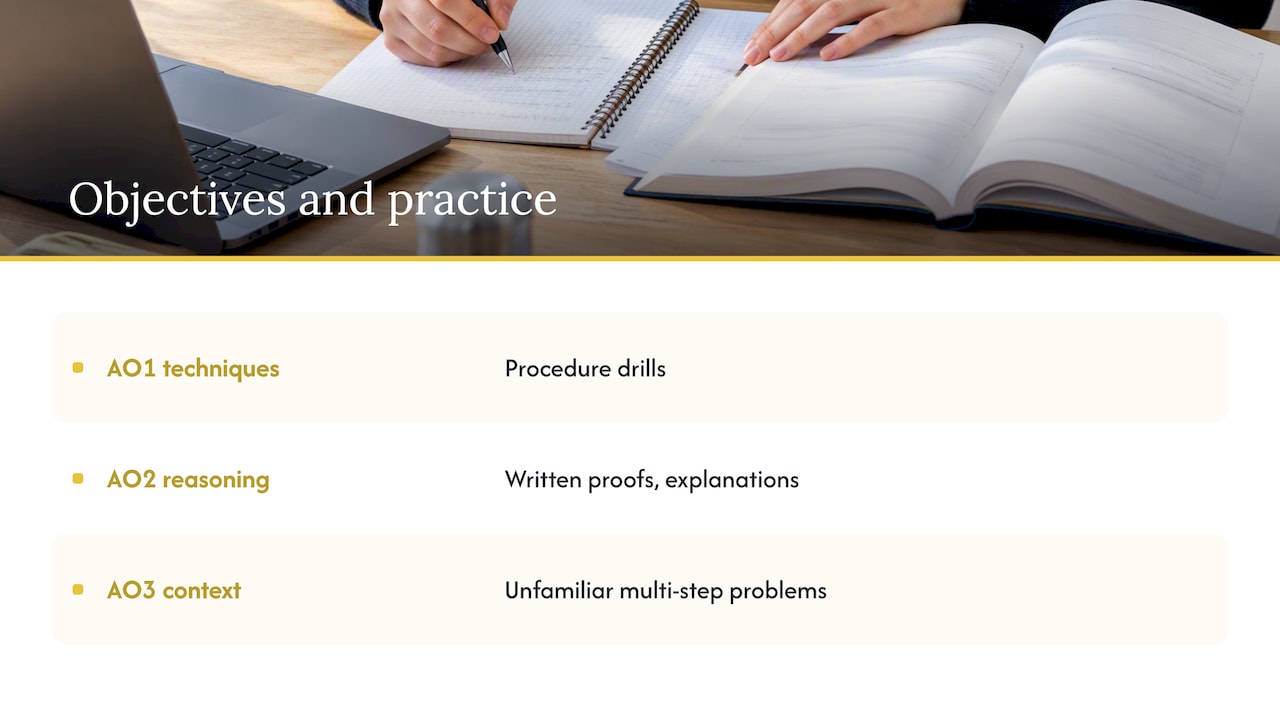
Further Maths papers do not only test technique. The assessment objectives cover using standard techniques, reasoning and communicating, and solving problems in context. The weightings are laid out in the specification: AQA’s published scheme gives AO1 as the largest share, with AO2 and AO3 making up the rest. In practice, that means a student who can only run procedures leaves marks behind on proof, interpretation and modelling questions. Train all three: procedure drills for AO1, written proofs and explanations for AO2, and unfamiliar multi-step problems for AO3.
Build a past-paper supply plan
A very common worry, even among confident students, is running out of past papers before the exams. It is a real constraint: each board only has so many papers per specification, and older papers from previous specifications may not match your content. The answer is to stretch your supply by using it in stages.
Stage 1: question-level practice (autumn to early spring)
Do not sit full papers yet. Work through past questions by topic, straight after you have learned that topic in class. This is where most learning happens, and it uses up no whole papers. Our A-level past-paper questions are organised so you can pick a topic and work through exam-style questions with the mark scheme beside you.
For Edexcel students, the topic revision pages split content into manageable blocks, such as calculus, vectors and sequences and series. These pages cover the A-level Maths pure content that Further Maths builds on, so use them to shore up foundations before you push into the further topics.
Stage 2: half-papers and section drills (spring)
Set a timer for half the paper’s length and attempt the matching half of the marks. This builds pacing without spending a full paper. It also exposes whether your problem is knowledge or speed.
Stage 3: full papers under exam conditions (final six to eight weeks)
Save your best, most representative papers for this stage. Treat them as rehearsals: phone away, only permitted equipment, strict timings, no looking up a formula halfway through. If you can, schedule them at the same time of day as your real exams.
A sensible allocation for a student with, say, ten usable papers per specification:
- Hold back four to six for timed sittings.
- Use the rest to rehearse specific sections or as half-papers.
- Keep one for the last fortnight, as a final confidence check.
If you really have run out, redo your earlier papers cold after a long gap. Seen papers are still valuable if you wait several weeks and attempt them without your old working in front of you.
How to spend your time inside the paper
There is no single correct order for everyone, but a few habits work for most students.
Do a two-minute scan
Spend the first minutes reading through the paper. Mark the questions that look immediately doable, and those that look long. You are not solving anything yet, just deciding where to start so your first twenty minutes are productive and your confidence builds.
Work in passes
- First pass: answer everything you can do cleanly. Skip anything that stalls you for more than a minute or so after reading it twice.
- Second pass: return to the skipped questions and attempt at least the first step of each. Method marks are cheap.
- Final pass: check. Use the last ten minutes or so to verify the questions that carry the most marks.
Many papers are ordered so that questions get harder towards the end, but this is a tendency, not a rule. Do not assume a late question is beyond you without reading it.
Know when to abandon an approach
If you have used about twice the expected time on a question and you are not close, stop. Draw a line, write “return” in the margin and move on. The sunk-cost feeling is strong in maths, because you have already invested so much. Resist it.
Check smartly, not blindly
Rereading your own working rarely catches errors, because you see what you meant to write. Better checks include:
- Substituting your answer back into the original equation.
- Testing a simple case, such as setting n = 1 in a general formula.
- Checking dimensions and signs in mechanics and statistics.
- Confirming that a matrix, complex number or vector answer is in the form requested.
- Re-reading the question to see whether it asked for an exact value, a given number of decimal places or a specific form.
Handle proof and “show that” questions carefully
Proof questions are where students lose the most marks through vagueness. Write each line so a reader could follow it without you there. For proof by induction, state the base case, the assumption, the inductive step and a concluding sentence in words. For “show that” questions, do not work backwards from the answer unless you can justify each step reversibly.
What examiners say about where marks go
Principal examiner reports are an underused revision tool. They are free, written by the people who led the marking, and they describe in plain language what candidates did well and badly. In Pearson’s Summer 2022 report for the International A Level Further Pure 1 paper, the examiners note that most candidates attempted some or all of every question, but that many did not attempt question 9 (b), and they could not tell whether this was down to time or knowledge. That ambiguity is exactly why you should log the reason behind every blank you leave in practice.
When you read a report for your own board, look for repeating patterns:
- Questions where candidates lost marks through poor notation or missing justification.
- Topics where the average performance was weak (these tend to recur).
- Specific advice, such as stating a theorem or giving an answer in an exact form.
It is worth ten minutes per paper, and it shows you the examiner traps before you step into them.
Review every paper with a three-column audit
Marking a paper and recording the score is not a review. The improvement comes from the audit afterwards. Mark your paper in a different colour, then go through every lost mark and write it in one of three columns.
| Column | Typical cause | Fix |
|---|---|---|
| Knowledge gap | You did not know the method or result | Relearn the topic, then do three more questions on it |
| Method slip | You knew it, but made an algebra, sign or notation error | Slow down on that step, and write a one-line reminder |
| Timing | You ran out of time or rushed | Adjust your pass strategy and practise half-papers |
Next, rank the columns by marks lost. If most of your lost marks are method slips, doing more content revision will not help; you need accuracy habits. If most are knowledge gaps, go back to topic-level work. Keep a single page, your error log, and reread it before each new paper.
A fully worked solution is the best companion for this. Try each question first, and only then check the solution, a habit we explore in our guide to written versus video solutions. The point is to compare your method with the examiner’s line by line and see where the marks were available.
Our perspective: what we see students get wrong
We built Mathvault around one idea: past papers are only as useful as the feedback attached to them. A paper that you sit and never properly mark teaches you very little. A paper that you mark against a full solution, with the method and accuracy marks visible, teaches you what the examiner wanted to see.
The pattern we notice most is this. Students who are strong at the maths still drop marks because they treat the paper as a place to display answers rather than collect marks. They skip working because the answer is “obvious”, abandon a question after a small slip when the method marks were still available, or save every paper for the final week and then find they cannot absorb the feedback in time.
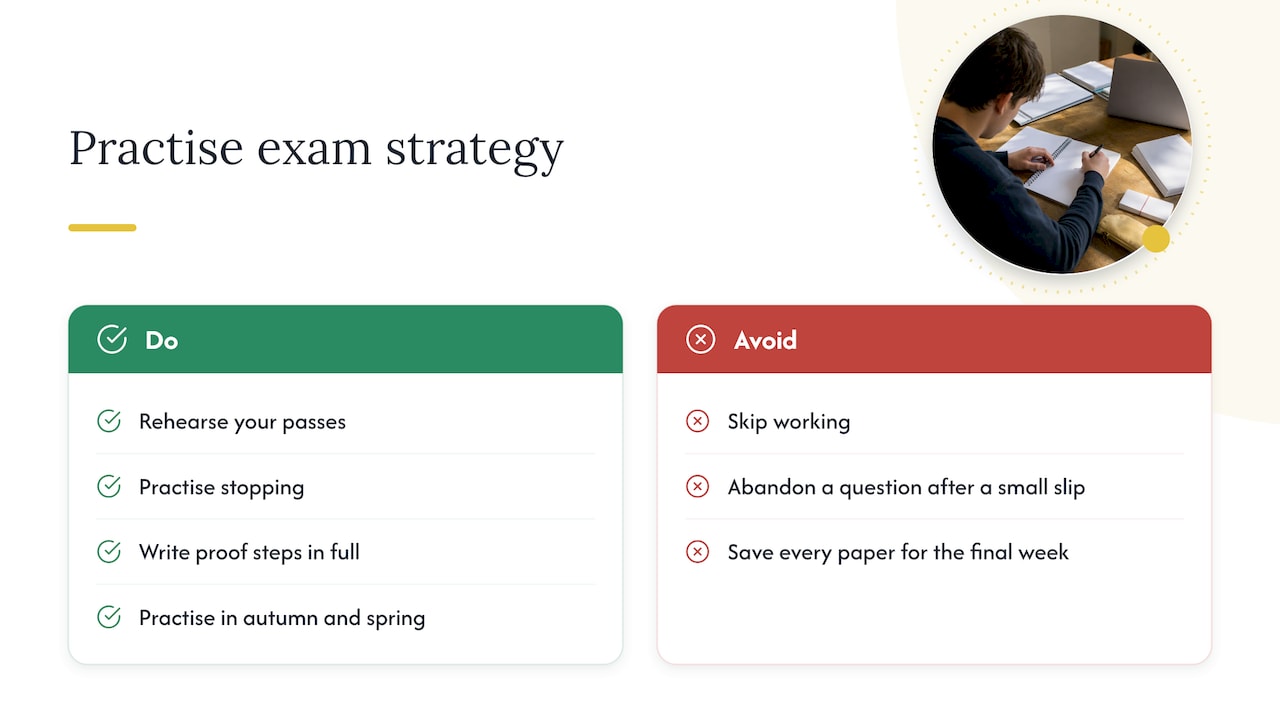
Our advice is to treat strategy as a skill you practise, not a mood you bring on the day. Rehearse your passes. Practise stopping. Practise writing the awkward line of a proof in full. Do it in autumn and spring, when mistakes are cheap, so they are rare in June.
And be kind to yourself. Further Maths is hard. Feeling stuck on a question is a normal part of studying it, not evidence that you are falling behind.
— Oloru
Put it into practice with free resources
If you want a ready-made routine, our A-level past-paper questions give you topic-based practice with worked solutions, free to use. Pair them with the Edexcel A-level revision roadmap if you want a phased plan to follow, and use our live Q&A sessions when a solution leaves you with a “but why?”. Most of what we offer is free; downloadable packs and donations help us keep the archive growing, but you never need to pay to practise.
A sample eight-week plan before the exams
Here is one way to arrange the final stretch. Adapt it to your timetable and board.
| Weeks | Focus | Output |
|---|---|---|
| 8 to 7 | Topic questions on your weakest two or three areas | Error log started |
| 6 to 5 | Half-papers, timed, mixed topics | Minutes-per-mark habit set |
| 4 to 3 | First full papers under exam conditions | Three-column audits completed |
| 2 | Targeted fixes from the audits, proof writing | Short formula and method sheet |
| 1 | One final full paper, light review, rest | Calm, rehearsed routine |
Two cautions. Do not add new content in the last week; consolidate. And do not skip rest. Tired students make arithmetic slips that no strategy can fix.
FAQ
Should I do Further Maths past papers in order or by topic?
Start by topic, straight after you learn each area, because it gives focused feedback and uses no whole papers. Move to mixed questions, then half-papers, then full timed papers as the exams approach. Mixed practice matters because the real paper does not tell you which topic is coming.
What if I have run out of past papers for my board?
Redo earlier papers after a gap of several weeks without looking at your old working, and use topic-level questions to practise specific skills. Papers from other boards can help with pure content, but check your own specification first, since options and notation differ. Examiners’ reports are another free source of exam-style insight.
How many marks can I get for method if my answer is wrong?
Often a good share. Method marks are awarded for a valid process, and Pearson’s marking guidance says mark schemes should be applied positively. But the marks must be visible: with no working shown on a multi-mark question, there is nothing for the examiner to credit.
What should I do if I freeze on a question in the exam?
Write down what the question gives you and what it asks for, then try the first obvious step, such as differentiating, substituting or drawing a diagram. If nothing moves after a minute or two, mark it and return later. Coming back with fresh eyes after finishing other questions often unlocks it.
Is a live Q&A session useful for Further Maths?
Yes, if you arrive with specific questions from papers you have already attempted. Bring the question, your working and the point where you got stuck. Our guide to using live Q&A well explains how to turn one session into weeks of progress.
Sources
- OCR: AS and A Level Further Mathematics A (H235, H245) assessment
- AQA: A-level Mathematics 7367 scheme of assessment
- Pearson: A level Further Mathematics sample assessment materials
- OCR: Updated sample assessment material for Further Mathematics B (MEI)
- Pearson: Examiners’ Report, Principal Examiner Feedback Summer 2022
Leave a Reply