
How do Edexcel and AQA GCSE maths actually differ?
Both Edexcel and AQA are fully regulated by Ofqual, which means a grade 7 from either board carries identical weight with universities, sixth forms, and employers. The difference is not in the value of the qualification. It is in how each board asks you to demonstrate your knowledge.

The core distinction comes down to question style. AQA questions use a structured, scaffolded approach where sub-parts build on each other, guiding you step by step toward the answer. Edexcel questions are more open-ended, often presenting real-world scenarios that require you to identify the correct method without any prompting from sub-parts. Neither approach is harder in absolute terms. They reward different strengths.
Here is a quick summary of the key differences:
- Question style: AQA uses structured, multi-part questions; Edexcel favours unstructured, application-based problems.
- Formula sheets: Neither board provides a formula sheet within the exam. You must memorise all required formulae, though any additional ones needed will be given within the question itself.
- Paper structure: Both boards run three 90-minute papers totalling 240 marks, with Paper 1 as the non-calculator paper for both.
- Syllabus content: Both boards cover the same nationally mandated content: Number, Algebra, Geometry and Measures, Statistics, and Probability.
- Grade equivalence: Grades hold equal value regardless of board. Universities do not distinguish between them.
- School context: AQA is widely used in many schools in England and is dominant in state schools; Edexcel is common in London private schools and international settings.
| Feature | AQA GCSE Maths | Edexcel GCSE Maths |
|---|---|---|
| Question style | Structured, scaffolded, multi-part | Open-ended, application-focused |
| Paper count | 3 papers, each 90 minutes | 3 papers, each 90 minutes |
| Total marks | 240 | 240 |
| Non-calculator paper | Paper 1 | Paper 1 |
| Formula sheet | Not provided | Not provided |
| Multiple choice questions | Yes, at the start of each paper | No |
| Specification layout | Clear tables | Listed format |
| Working space | Lined answer space | Open space |
| School prevalence | dominant in state schools | ~30% of English schools |
| International use | Primarily UK state schools | Common in international and private schools |
Table of Contents
- What are the real differences in exam format and question style?
- How does each board’s syllabus shape what you actually learn?
- How should you revise and choose between the two boards?
- What do experts say about difficulty, grading, and board choice?
- Start revising smarter with Mathvault
- Key takeaways
What are the real differences in exam format and question style?
Paper structure and timing
Both AQA and Edexcel run three 90-minute papers, each worth 80 marks, giving a total of 240 marks. Paper 1 is the non-calculator paper for both boards, followed by two calculator papers. This shared structure means switching between the two boards mid-course is straightforward in terms of timing, though the question style shift would require deliberate adjustment.
One notable structural difference is that AQA starts each paper with around five multiple-choice questions worth one mark each. These are designed to be accessible to all students and give you an early foothold in the exam. Edexcel does not use multiple-choice questions. Instead, every question requires a written response, often with working shown in an open space rather than on provided lines.

Scaffolded versus unstructured questions
AQA’s multi-part questions are built so that part (a) leads naturally into part (b), and so on. If you understand the method, the structure carries you through. Edexcel’s reasoning papers include a higher proportion of single-step, unstructured questions where you must recognise what mathematical approach is needed without any sub-part scaffolding. This is the most practically significant difference for students sitting the exam.
Specification layout and working space
AQA presents its specification content in clear, user-friendly tables, making it straightforward to track which topics fall under which tier. Edexcel writes its specification as a list, with Higher-tier-only content identified in bold font. Neither format is superior, but AQA’s table layout tends to be easier to use as a revision checklist. On the papers themselves, AQA provides lined space for working, while Edexcel gives an open blank space unless a written sentence is expected.
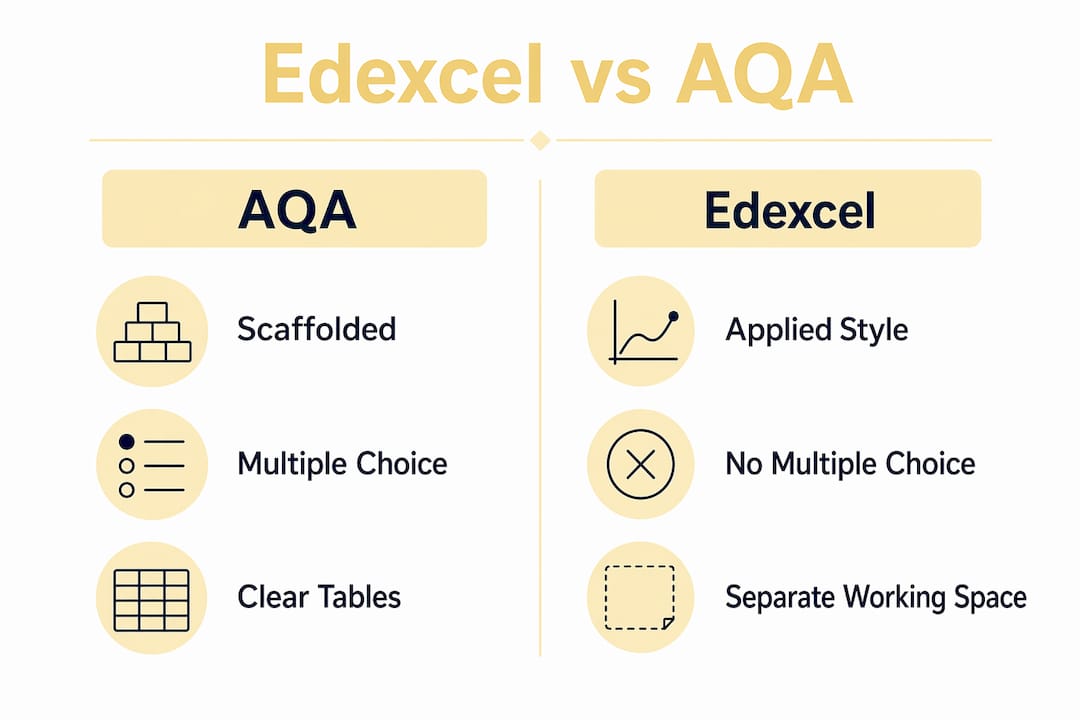
| Aspect | AQA | Edexcel |
|---|---|---|
| Multiple choice questions | Yes (approx. 5 per paper) | No |
| Working space | Lined | Open/blank |
| Specification format | Tables | Listed, Higher content in bold |
| Reasoning paper style | Structured multi-part | Unstructured single-step |
| Mark scheme clarity | Explicit, step-by-step | Clear, but broader in places |
| Tiering labels | Basic foundation / Additional foundation / Higher | Foundation / Higher (bold for Higher-only) |
How does each board’s syllabus shape what you actually learn?
Core content is the same
Both boards cover the same core content mandated by the national curriculum: Number, Algebra, Geometry and Measures, Statistics, and Probability. You will not encounter a topic on one board’s paper that the other board ignores entirely. The national curriculum sets the floor, and both boards build from it.
Where genuine content differences exist, they tend to be specific and technical. Edexcel’s specification explicitly includes stem and leaf diagrams and frequency polygons at both Foundation and Higher tier, and the Peterson capture-recapture method at Higher tier. AQA does not explicitly list these in its specification. Conversely, AQA requires knowledge of all eight compass point bearings, while Edexcel expects only four. AQA also expects students to describe correlation as “weak” or “strong” on scatter graphs; Edexcel requires only “positive” or “negative.”
These are not dramatic differences, but they matter if you are revising from the wrong board’s specification. A student preparing for Edexcel who revises from AQA materials might spend time on eight-point compass bearings that will not appear in their exam, and might miss stem and leaf diagrams that will.
Assessment objectives and skills
Ofqual sets the same three assessment objectives for all boards: using and applying standard techniques, reasoning and interpreting, and solving problems in mathematical contexts. The weighting across these objectives is consistent across boards. What differs is how each board tests them. AQA rewards methodical, logical progression through clearly structured questions. Edexcel rewards the ability to identify the right approach independently and apply it to an unfamiliar context.
Neither board includes coursework or controlled assessment components in GCSE Maths. The qualification is entirely exam-based across all three papers.
Calculator and non-calculator rules
Both boards follow the same rule: Paper 1 is non-calculator, Papers 2 and 3 allow a calculator. There is no difference in which calculators are permitted; standard scientific calculators such as the Casio fx-83 or fx-85 series are acceptable for both. The non-calculator paper tests arithmetic fluency, algebraic manipulation, and geometric reasoning without technological support, and this is consistent across both boards.
Pro Tip: Check the specific year’s specification document on your board’s website before revising. Minor content updates do occur between cohorts, and the specification document is the definitive source for what is and is not assessed.
How should you revise and choose between the two boards?
Revision strategies by board
The single most important revision principle is to use past papers and mark schemes from your specific board. A student preparing for AQA who practises exclusively on Edexcel papers will develop fluency in unstructured problem-solving but may underperform on the structured, methodical questions AQA rewards. The reverse is equally true.
For AQA, focus your revision on demonstrating clear working at every stage. The mark scheme rewards method marks explicitly, so a correct final answer with no working shown can cost you marks. Practise reading multi-part questions carefully and using earlier parts to inform later ones. AQA’s multiple-choice questions at the start of each paper are worth practising too; they require confident, informed decisions rather than guesswork.
For Edexcel, the priority is building flexibility in problem identification. When you encounter an unfamiliar scenario in a past paper, resist the urge to look at the mark scheme immediately. Spend time working out what type of problem it is and which mathematical tools apply. Edexcel’s gold, silver, and bronze practice papers, which are tiered by level of scaffolding, are particularly useful for building this skill progressively.
- AQA revision priorities: Clear working, step-by-step method marks, structured multi-part practice, multiple-choice confidence.
- Edexcel revision priorities: Problem identification, applying knowledge to unfamiliar contexts, unstructured question practice.
- Both boards: Memorise all required formulae; no formula sheet is provided in the exam.
- Timing: Both exams are 90 minutes per paper. Practise pacing so you do not spend disproportionate time on early questions.
Choosing the right board
In most cases, the choice of board is made by your school, not by you. Schools commit to a board for all students in a cohort, and switching mid-course is rarely feasible. If you are a teacher or school leader making this decision, the key factors are your student cohort’s learning profile and the resources your department already uses.
Edexcel is particularly prevalent in London private schools and international settings, partly because it also offers IGCSEs, which matter for students studying outside the UK. AQA’s dominance in state schools reflects its clear specification structure and the depth of freely available teaching resources it provides. Neither board is a better choice in the abstract.
For students on the borderline between grade 5 and grade 6, the board choice and the quality of board-specific preparation can make a measurable difference to the final grade. For students targeting grade 7 and above, both boards are equally accessible with thorough preparation. The board matters most when preparation is tailored precisely to its question style.
Pro Tip: If your school uses Edexcel, Mathvault’s Edexcel past paper questions by topic give you targeted practice organised by mathematical topic, so you can focus your revision where it counts most.
What do experts say about difficulty, grading, and board choice?
The difficulty question
The most persistent myth about Edexcel and AQA is that one is harder than the other. No exam board is inherently harder; the assessments reflect different mathematical strengths. AQA rewards methodical logical progress; Edexcel rewards independent problem identification. Students who prefer predictability and clear frameworks often find AQA more comfortable. Students who have been trained to think flexibly about application sometimes find Edexcel plays more to their strengths.
Students perceive AQA as more straightforward due to its structured questions, while Edexcel is considered more applied and context-heavy. But perceived difficulty is entirely subjective and depends on how you have been taught. A student who has spent two years practising Edexcel-style problem-solving will find Edexcel questions far more manageable than an equally able student who has only ever seen AQA papers.
Grade boundaries and equivalence
Grade boundaries differ year to year and between boards to ensure comparable national outcomes. If one board sets a harder paper in a given year, the grade boundary is adjusted downward to compensate. This is how Ofqual maintains equivalence across boards. A raw score of 65 out of 100 might achieve a grade 7 at AQA in one year and only a grade 6 at Edexcel in the same year, depending on how the cohort performed nationally. The grade you receive reflects your performance relative to the national cohort on that specific paper, not an absolute score.
A grade 7 in GCSE Maths is a grade 7 regardless of whether it is AQA or Edexcel. Universities and sixth forms do not differentiate. For preparation purposes, however, the board matters significantly. A tutor who teaches from the wrong board’s specification may cover content that is not tested on your actual papers, or miss content that is.
This is why board-specific preparation is not just good practice. It is the foundation of effective revision.
Where the board choice matters most
Students aiming for grade 7 and above generally succeed equally with either board when suitably prepared. The board choice becomes most consequential for students on grade boundaries, where targeted preparation for the specific board’s question style can shift a grade 5 to a grade 6. For Foundation tier students, the structural differences between the two boards are less pronounced, and the content overlap is substantial.
For teachers, the practical implication is clear: use past papers, mark schemes, and teaching resources from the board your students are actually sitting. Mixing resources from different boards during revision is one of the most common and avoidable preparation errors. Mathvault organises its free revision resources by exam board precisely to prevent this, giving students and teachers confidence that every practice question, worked solution, and video walkthrough is matched to the right specification.
Start revising smarter with Mathvault
Mathvault provides free access to past papers, fully worked step-by-step solutions, video walkthroughs, and live weekly Q&A sessions, all organised by UK exam board. Whether you are preparing for AQA or Edexcel, every resource on Mathvault is matched to the correct specification so you practise exactly what your exam will test. No guesswork, no wasted revision time.
Key takeaways
Both Edexcel and AQA GCSE Maths cover identical national curriculum content and award grades of equal value, but their question styles, specification layouts, and paper structures differ in ways that make board-specific preparation essential.
| Point | Details |
|---|---|
| Grades are equivalent | A grade 7 from AQA and a grade 7 from Edexcel carry identical weight with universities and employers. |
| Question style is the key difference | AQA uses structured, scaffolded multi-part questions; Edexcel uses open-ended, unstructured problem-solving questions. |
| No formula sheet for either board | Both AQA and Edexcel require students to memorise all formulae; additional ones needed are given within the question. |
| Board choice matters most at grade boundaries | Students targeting grade 7 and above succeed equally with either board; borderline students benefit most from board-specific preparation. |
| Revise using your board’s past papers | Using past papers and mark schemes from the wrong board is one of the most common and avoidable revision errors. |
Leave a Reply