
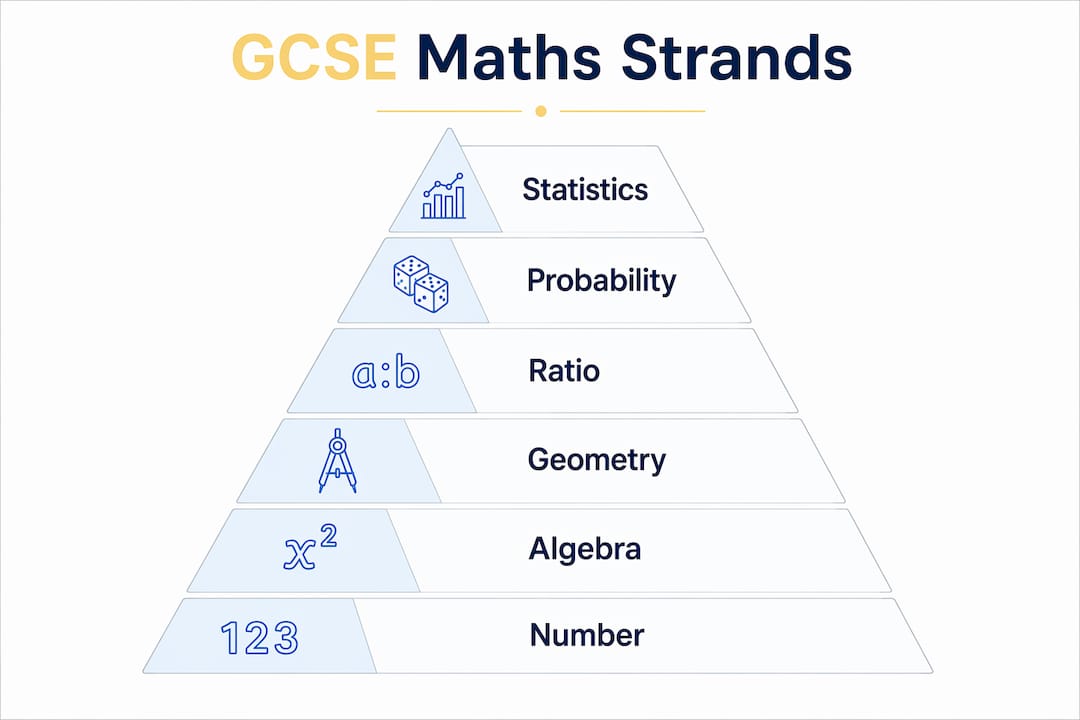
The Edexcel GCSE maths specification organises the entire curriculum into six core content strands. Every topic you will encounter across Foundation and Higher tiers falls within one of these categories:
- Number — calculation, fractions, decimals, indices, surds, standard form, and accuracy
- Algebra — expressions, equations, graphs, sequences, functions, and proof
- Ratio, Proportion and Rates of Change — percentages, direct and inverse proportion, compound units, and scaling
- Geometry and Measures — properties, constructions, mensuration, circle theorems, transformations, and vectors
- Probability — outcomes, events, tree diagrams, and combined probability
- Statistics — data handling, representation, averages, correlation, and sampling
These six strands underpin both the Foundation and Higher tiers and have remained stable since the reformed 9–1 specification launched in 2015. Knowing this structure is half the battle: once you understand which strand a question belongs to, you can target your revision precisely rather than working through content at random.
Table of Contents
- What does each Edexcel GCSE maths topic actually cover?
- How do Foundation and Higher tiers differ?
- What is the Edexcel GCSE maths assessment structure?
- How to revise effectively for Edexcel GCSE maths
- How topic weighting differs between Foundation and Higher tier
- Where to find the best revision resources for Edexcel GCSE maths
- What question types appear most often in Edexcel GCSE maths exams?
- Key takeaways
What does each Edexcel GCSE maths topic actually cover?
Each of the six strands contains a defined set of subtopics. The depth and complexity of those subtopics varies by tier, but the strand structure itself is identical for all students.
1. Number
Number underpins everything else in the GCSE maths syllabus. At Foundation level, the focus is on building numerical fluency: ordering integers, fractions, decimals, and percentages; applying the four operations; working with factors, multiples, and primes; and understanding place value. Higher tier students extend this into fractional and negative indices, manipulation of surds, rationalising denominators, and converting between recurring decimals and exact fractions.
Key subtopics across both tiers include:
- Ordering and comparing integers, decimals, fractions, and percentages
- Prime factorisation, HCF, and LCM
- Index notation, index laws, and powers of 10
- Calculating with surds and multiples of π (Higher)
- Standard form: converting, adding, subtracting, multiplying, and dividing
- Rounding to decimal places and significant figures
- Error intervals and bounds of accuracy
Real-life contexts appear frequently here. Exam questions often ask students to estimate the cost of materials, calculate compound interest, or interpret very large and very small quantities in scientific scenarios.
2. Algebra

Algebra carries significant weight in the Edexcel maths curriculum, particularly at Higher tier. The strand covers notation and manipulation, graphs, solving equations and inequalities, and sequences.
Notation, vocabulary, and manipulation:
- Simplifying expressions by collecting like terms and using index laws
- Expanding single and double brackets; expanding products of more than two binomials (Higher)
- Factorising quadratics of the form x² + bx + c, and ax² + bx + c (Higher)
- Completing the square and rearranging formulae
- Simplifying algebraic fractions (Higher)
- Constructing algebraic proofs and arguments
Graphs:
- Plotting and interpreting straight-line graphs using y = mx + c
- Identifying gradients, intercepts, and equations of parallel and perpendicular lines
- Sketching quadratic, cubic, reciprocal, exponential, and trigonometric functions
- Calculating gradients and areas under graphs in real-world contexts such as velocity-time graphs
- Finding the equation of a tangent to a circle (Higher)
Solving equations and inequalities:
- Linear equations, including those with unknowns on both sides
- Quadratic equations by factorising, completing the square, and the quadratic formula
- Simultaneous equations (linear/linear and linear/quadratic at Higher)
- Iterative methods for approximate solutions (Higher)
- Linear inequalities in one and two variables; quadratic inequalities (Higher)
Sequences:
- Arithmetic sequences and nth-term formulae
- Geometric and Fibonacci sequences
- Quadratic sequences and their nth-term formulae (Higher)
Algebra questions frequently appear in applied contexts: modelling the trajectory of a ball, setting up equations from a geometry problem, or interpreting a graph showing financial growth.
3. Ratio, proportion and rates of change
This strand bridges Number and Algebra, applying multiplicative reasoning to real-world problems. Students need to move fluently between fractions, decimals, percentages, and ratios.
- Dividing quantities in a given ratio; solving ratio problems using fractions
- Direct and inverse proportion, including graphical representations
- Percentage increase and decrease using multipliers
- Reverse percentage and percentage change calculations
- Compound interest and repeated proportional change
- Speed, density, and pressure as compound measures
- Converting between units of length, area, volume, and time
- Gradient as a rate of change; area under a graph as an accumulation
Exam questions in this strand often involve multi-step reasoning: calculating the final price after successive discounts, or working out the density of a material given its mass and dimensions.
4. Geometry and measures

The largest strand by subtopic count, Geometry and Measures spans properties of shapes, constructions, mensuration, and vectors.
Properties and constructions:
- Angle facts: triangles, quadrilaterals, polygons, parallel lines, and intersecting lines
- Properties of 2D shapes including circles, and 3D solids
- Congruence and similarity, including relationships between lengths, areas, and volumes
- Circle theorems: angle at centre, angles in a semicircle, cyclic quadrilaterals, tangent-radius, alternate segment (Higher)
- Constructions with compass and ruler: perpendicular bisectors, angle bisectors, loci
- Bearings and scale drawings
Mensuration and calculation:
- Perimeter and area of triangles, parallelograms, trapezia, and composite shapes
- Circumference and area of circles; arc lengths and sector areas
- Surface area and volume of prisms, cylinders, pyramids, cones, and spheres
- Pythagoras’ theorem in 2D and 3D
- Trigonometric ratios (sin, cos, tan) in right-angled triangles
- Sine rule, cosine rule, and the formula ½ab sin C (Higher)
- 3D trigonometry and Pythagoras (Higher)
Transformations and vectors:
- Reflections, rotations, translations, and enlargements (including negative and fractional scale factors)
- Describing transformations precisely
- Vector notation, addition, subtraction, and scalar multiplication
- Geometric proof using vectors (Higher)
Circle theorems are one of the most commonly cited examiner traps at Higher tier: students who can state a theorem but cannot identify which one applies in a given diagram regularly drop marks.
5. Probability
Probability questions test both calculation and reasoning. The strand runs from basic outcomes through to conditional probability at Higher tier.
- Listing outcomes systematically; using sample space diagrams
- Probability of single and combined events
- Mutually exclusive and independent events
- Relative frequency and experimental probability
- Tree diagrams for dependent and independent events
- Venn diagrams and set notation
- Conditional probability (Higher)
The official curriculum emphasises real-life contexts throughout: questions might ask students to calculate the probability that a randomly selected item is faulty, or to use a two-way table to find a conditional probability.
6. Statistics
Statistics questions reward students who can both calculate and interpret. Knowing how to find a mean is not enough; you also need to explain what it tells you in context.
- Types of data: discrete, continuous, categorical, and grouped
- Sampling methods and potential sources of bias
- Frequency tables, two-way tables, and pictograms
- Bar charts, pie charts, line graphs, and frequency polygons
- Scatter graphs, lines of best fit, and correlation
- Mean, median, mode, and range from lists and frequency tables
- Estimated mean from grouped data
- Cumulative frequency graphs and box plots (Higher)
- Histograms with unequal class widths (Higher)
- Comparing distributions using averages and spread
A common examiner pitfall: students describe correlation as causation. Practising the precise language of statistical interpretation is as important as the calculations themselves.
How do Foundation and Higher tiers differ?
The tier you sit determines both the grade ceiling you can achieve and the depth of content you need to master. Foundation tier covers lower to mid grades, while Higher tier spans from mid to top grades. The overlap at grades 4 and 5 means that students targeting a grade 5 could, in principle, sit either tier, though the approach to revision differs considerably.
Foundation tier concentrates on numerical fluency and the core concepts within each strand. The emphasis falls on Number and Ratio, Proportion and Rates of Change, where students build confidence with fractions, percentages, and multiplicative reasoning before tackling more abstract ideas. Algebra at Foundation level covers linear equations, basic quadratics, and straight-line graphs, but stops well short of the complexity required at Higher.
Higher tier introduces a substantial body of content that does not appear at Foundation at all. Advanced topics exclusive to Higher include algebraic fractions, quadratic inequalities, iterative methods, circle theorems, the sine and cosine rules, 3D trigonometry, histograms with unequal class widths, and geometric proof using vectors. Algebra becomes the dominant strand at Higher, with a greater proportion of marks allocated to it than at Foundation. Students aiming for grades 7–9 need to be comfortable not just solving complex equations but constructing and interpreting algebraic arguments.
The Higher tier specification also places greater demand on reasoning and problem-solving skills. Questions at the top of the mark range rarely test a single technique in isolation; they require students to select and combine methods across strands, often in unfamiliar contexts. This is where many capable students lose marks: they know the individual techniques but struggle to identify which ones apply.
One practical implication for revision: Foundation students should prioritise depth and accuracy in Number, Ratio, and the core Geometry topics before moving to Algebra. Higher students need the full breadth of all six strands, with particular attention to the advanced Algebra and Geometry content that carries the most marks at grades 6 and above.
What is the Edexcel GCSE maths assessment structure?
The qualification is assessed through a linear format: all three papers are sat at the end of the course, with no coursework component. Each paper is 90 minutes long and equally weighted, so no single paper can rescue or sink your grade on its own.
- Paper 1 (non-calculator): Tests all six topic strands without a calculator. Questions here often focus on exact arithmetic, algebraic manipulation, and proof.
- Paper 2 (calculator allowed): Covers all six strands; calculator use enables more complex numerical and statistical questions.
- Paper 3 (calculator allowed): Again covers all six strands, typically with a higher proportion of multi-step and applied problems.
Each paper is available at both Foundation and Higher tier. The tier determines the grade range available to you: Foundation papers are graded 1–5, and Higher papers are graded 4–9. A student sitting Higher who does not perform well enough for a grade 4 may be awarded a grade 3 as an allowed grade.
Pearson examiner reports_Mathematics_Content_Guidance.pdf) consistently highlight that students lose marks not because they lack knowledge but because they fail to show their working. Method marks are awarded for correct process even when the final answer is wrong. Disciplined, step-by-step written solutions are not just good practice; they are a direct route to additional marks.
The three-paper structure also means that content from all six strands can appear on any paper. There is no safe topic to skip. Students who focus exclusively on their strongest areas and neglect weaker strands frequently find that Paper 1 or Paper 3 exposes those gaps at the worst possible moment.
How to revise effectively for Edexcel GCSE maths
Effective revision for the Edexcel maths curriculum is active, not passive. Reading through notes or watching videos without attempting questions rarely translates into exam performance. The students who improve most are those who identify their weak areas early and practise them deliberately.
A structured approach that works well:
- Use a topic checklist aligned to the specification. Work through each of the six strands and mark every subtopic as red (not yet understood), amber (partially confident), or green (secure). This red-amber-green system helps you prioritise revision focus rather than spending time on topics you already know well.
- Practise showing your working on every question. Even on questions you find straightforward, write out each step. This builds the habit before the exam, where method marks can be the difference between a grade boundary.
- Work through past papers under timed conditions. The core specification topics have remained stable since 2015, which means past papers are a reliable guide to the question types and difficulty levels you will face. Attempting full papers under exam conditions reveals time-management issues that topic-by-topic practice does not.
- Review examiner reports alongside mark schemes. Pearson publishes detailed examiner commentary explaining where students typically drop marks. These reports are specific about common errors: misreading question requirements, failing to give answers to the required degree of accuracy, or not interpreting statistical results in context.
- Balance all six strands. It is tempting to focus on Algebra or Geometry because they feel more demanding, but Number and Statistics questions carry marks too. A well-rounded revision plan covers every strand before the exam series begins.
Mathvault offers free access to past papers, fully worked step-by-step solutions, video walkthroughs, and topic-based revision guides for Edexcel GCSE maths. The Edexcel topic-based resources allow you to drill specific subtopics rather than working through complete papers every time, which is particularly useful when you are targeting red or amber areas on your checklist. Live weekly Q&A sessions give you the opportunity to ask about specific questions or techniques in real time, which passive revision simply cannot replicate.
Pro Tip: Focus a significant portion of your revision on AO2 (reasoning) and AO3 (problem-solving) question types, not just AO1 recall. Higher-grade marks are dominated by these two assessment objectives, and students who only practise routine calculations often stall at grade 5 or 6 even when their knowledge is sound.
How topic weighting differs between Foundation and Higher tier
Understanding where the marks are concentrated in each tier helps you allocate revision time more strategically. The Pearson Edexcel specification makes clear that topic weighting is not uniform across tiers.
At Foundation tier, Number and Ratio, Proportion and Rates of Change carry the greatest combined weight. Students are expected to demonstrate fluency with fractions, decimals, percentages, and multiplicative reasoning across a wide range of contexts. Geometry and Measures also features prominently, particularly perimeter, area, volume, and basic angle facts. Algebra at Foundation is present but less dominant: linear equations, basic sequences, and straight-line graphs are the core requirements.
At Higher tier, Algebra becomes the most heavily weighted strand. The breadth of algebraic content — from quadratic equations and simultaneous equations through to algebraic fractions, functions, and proof — means that students who are weak in Algebra face a structural disadvantage across all three papers. Geometry and Measures remains substantial, with the addition of circle theorems, advanced trigonometry, and vector proof. Number and Ratio are still present but are tested more often through complex multi-step problems than through standalone calculations.
The practical implication is straightforward. Foundation students should not underestimate the depth of Number and Ratio content; these strands are where the majority of accessible marks sit. Higher students who want grades 7–9 need to treat Algebra as their primary focus, while maintaining solid coverage of Geometry and the remaining strands.
Both tiers share a core body of overlapping content. Topics such as basic angle properties, linear equations, fractions, and data handling appear at both levels, though the complexity and the contexts in which they are tested differ. If you are uncertain which tier you are sitting, speak to your teacher: the decision affects not just the grade ceiling but the entire shape of your revision plan.
Where to find the best revision resources for Edexcel GCSE maths
The most effective revision resources for the Edexcel maths curriculum combine structured content with opportunities for active practice. Here is what to look for and where to find it.
Past papers and mark schemes are the single most reliable revision tool. Because the core specification topics have not changed since 2015, papers from recent years are directly relevant to what you will face. Work through them in full, then use the mark scheme to identify exactly where you dropped marks and why.
Step-by-step worked solutions go further than mark schemes alone. A mark scheme tells you the answer; a worked solution shows you the method, including the intermediate steps that earn method marks. This distinction matters enormously when you are trying to understand where your approach went wrong.
Video walkthroughs are particularly useful for topics where written explanations feel abstract. Seeing a circle theorem applied to a specific diagram, or watching the completing-the-square process carried out step by step, often clarifies things that reading alone does not.
Topic-based revision guides let you focus on specific strands rather than working through complete papers every session. When your checklist shows that Probability is amber and Statistics is red, a topic-specific resource lets you address those gaps directly.
Mathvault brings all of these together in one place, entirely free. Past papers, fully worked solutions, video walkthroughs, downloadable revision notes, and live Q&A sessions are all available at mathvault.io without a subscription or payment. For students who want offline access to organised revision packs, downloadable versions are available for a small one-off cost. The live weekly Q&A sessions are particularly valuable in the weeks before the exam series, when specific questions and techniques need clarification quickly.
What question types appear most often in Edexcel GCSE maths exams?
Knowing the types of questions Edexcel uses is as important as knowing the content. The specification assesses three distinct skills, and each demands a different approach.
AO1 — recall and procedure. These questions test whether you know a method and can apply it accurately. Examples include: simplify an algebraic expression, calculate the area of a composite shape, find the nth term of a sequence. They tend to appear early in each paper and carry fewer marks per question. The risk here is careless arithmetic or misremembering a formula.
AO2 — reasoning and communication. These questions ask you to explain, justify, or prove something. Examples include: show that two triangles are congruent, prove that a given expression is always even, or explain why a student’s answer is incorrect. Many students find these harder not because the maths is more complex but because they are not used to writing mathematical arguments. Practising these question types specifically, rather than hoping they will come naturally, is the most reliable way to improve.
AO3 — problem-solving in context. These are the multi-step questions that appear towards the end of each paper and carry the most marks. They rarely signal which method to use; you have to identify the relevant strand, select the appropriate technique, and carry it through to a conclusion. A typical example might involve setting up and solving simultaneous equations from a written description, or combining Pythagoras’ theorem with trigonometry to find an angle in a 3D shape.
Specific strategies that help across all three question types:
- Read the question twice before writing anything. Examiner reports repeatedly note that students answer a different question from the one asked.
- Write down any formula you plan to use before substituting values. This earns a method mark even if the substitution goes wrong.
- Check whether the question asks for an exact answer or a rounded one. Giving a decimal when an exact surd is required, or rounding too early in a multi-step calculation, are among the most common sources of lost marks.
- Use the number of marks as a guide to the expected number of steps. A four-mark question almost certainly requires at least three distinct steps; a one-line answer is unlikely to be sufficient.
- On Paper 1, practise non-calculator arithmetic deliberately. Students who rely on a calculator throughout their revision often find Paper 1 unexpectedly difficult.
The method marks principle applies across all question types: a clearly laid-out solution that reaches a wrong final answer will still earn marks for correct method. Untidy or absent working earns nothing, even if the answer happens to be correct.
Key takeaways
Mastering Edexcel GCSE maths requires knowing the six core strands in depth, understanding how tier choice shapes your revision priorities, and practising the full range of AO1, AO2, and AO3 question types under exam conditions.
| Point | Details |
|---|---|
| Six core strands | Number, Algebra, Ratio/Proportion, Geometry and Measures, Probability, and Statistics form the complete curriculum. |
| Tier shapes revision | Foundation prioritises Number and Ratio; Higher places greatest weight on Algebra and advanced Geometry. |
| Three equal papers | Each 90-minute paper carries equal weight; no strand is safe to skip across any of the three. |
| Method marks matter | Showing working on every question earns method marks even when the final answer is wrong. |
| Active practice wins | Topic checklists, past papers under timed conditions, and targeted use of worked solutions outperform passive note-reading. |
Leave a Reply