
Memorise these six core circle theorems, write the exact theorem wording as your reason before you calculate, and you will secure both the method mark and the accuracy mark on every circle geometry question. That is the whole strategy. Here is what to know and what a correct answer looks like.
The six theorems every GCSE student must know (exam-ready wording):
- Angle at the centre: “The angle at the centre is twice the angle at the circumference subtended by the same arc.”
- Angle in a semicircle: “The angle in a semicircle is 90°.”
- Angles in the same segment: “Angles in the same segment are equal.”
- Cyclic quadrilateral: “Opposite angles in a cyclic quadrilateral add up to 180°.”
- Tangent–radius: “The angle between a tangent and a radius is 90°.”
- Alternate segment: “The angle between a tangent and a chord equals the angle in the alternate segment.”
What a full-marks answer looks like:
- Write the theorem name or exact wording as your reason.
- Show the calculation clearly (one or two lines).
- State the numeric answer with the degree symbol.
Quick ‘what to write’ checklist to secure method and reason marks:
- State the theorem reason before the calculation, not after.
- Name the arc or chord the angle is subtended by.
- Mark equal radii or right angles on the diagram.
- Write the degree symbol on every angle answer.
Pro Tip: Write the theorem name or exact phrase at the top of your working before you touch the numbers. Examiners award the method mark for the reason line, even if a small arithmetic slip follows.
Table of Contents
- What are the eight circle theorems you need to know?
- How do you spot which theorem applies on a diagram?
- Multi-step worked examples that chain two or more theorems
- Practice questions with model answers and marking notes
- Common errors students make and how to avoid losing marks
- How to revise circle theorems effectively using active recall
- Key takeaways
- Why precise wording matters more than most students realise
- Mathvault’s free resources for circle theorems practice
- Useful sources and further reading
What are the eight circle theorems you need to know?
Mastering circle theorems is best treated as a two-step process: identify which theorem applies from the diagram, then give the precise exam wording as your written reason before calculating. The eight theorems below are organised by recognition group so you can revise them in clusters.

1. Angle at the centre
Exam reason: “The angle at the centre is twice the angle at the circumference subtended by the same arc.”
Justification: Any two radii from the centre to the arc create two triangles. Using exterior angle properties, the central angle always equals twice the inscribed angle on the same arc.
Diagram prompt: Draw a circle, mark centre O, place points A and B on the circumference. Add a third point C on the major arc. Draw OA, OB, CA, CB. Label angle AOB and angle ACB.
Worked example:
Angle ACB = 34°. Find angle AOB.
Reason: The angle at the centre is twice the angle at the circumference subtended by the same arc.
Calculation: Angle AOB = 2 × 34° = 68°
2. Angle in a semicircle
Exam reason: “The angle in a semicircle is 90°.”

Justification: This is a special case of Theorem 1. When the arc is a full semicircle, the central angle is 180° (a straight line), so the inscribed angle is 180° ÷ 2 = 90°.
Diagram prompt: Draw a circle with diameter AB. Place point C anywhere on the circumference (not on AB). Draw CA and CB. Angle ACB = 90°.
Worked example:
AB is a diameter. Angle CAB = 38°. Find angle ABC.
Reason: The angle in a semicircle is 90°, so angle ACB = 90°.
Calculation: Angle ABC = 180° − 90° − 38° = 52°
3. Angles in the same segment
Exam reason: “Angles in the same segment are equal.”
Justification: Both angles are inscribed angles subtended by the same chord from the same side; each equals half the central angle on that arc.
Diagram prompt: Draw chord PQ. Place points R and S on the same arc. Draw PR, QR, PS, QS. Angles PRQ and PSQ are equal.
Worked example:
Angle PRQ = 47°. Find angle PSQ.
Reason: Angles in the same segment are equal.
Calculation: Angle PSQ = 47°
4. Cyclic quadrilateral
Exam reason: “Opposite angles in a cyclic quadrilateral add up to 180°.”
Justification: Each pair of opposite angles is subtended by arcs that together form the full circle (360°). Each angle is half its arc, so the pair sums to 180°.
Diagram prompt: Draw four points A, B, C, D on a circle. Connect them in order. Label opposite angles.
Worked example:
ABCD is a cyclic quadrilateral. Angle DAB = 112°. Find angle BCD.
Reason: Opposite angles in a cyclic quadrilateral add up to 180°.
Calculation: Angle BCD = 180° − 112° = 68°
5. Tangent–radius
Exam reason: “The angle between a tangent and a radius is 90°.”
Justification: A tangent touches the circle at exactly one point. The radius to that point is perpendicular to the tangent by definition.
Diagram prompt: Draw a circle, centre O. Draw a tangent line touching at point T. Draw OT. Mark the right angle at T.
Worked example:
OT is a radius. PT is a tangent. Angle OPT = 28°. Find angle TOP.
Reason: The angle between a tangent and a radius is 90°, so angle OTP = 90°.
Calculation: Angle TOP = 180° − 90° − 28° = 62°
6. Alternate segment theorem
Exam reason: “The angle between a tangent and a chord equals the angle in the alternate segment.”
Justification: The angle between the tangent and chord equals half the arc subtended by the chord; the inscribed angle in the alternate segment also equals half that same arc.
Diagram prompt: Draw a circle with a tangent at point B. Draw chord BC. The angle between the tangent and BC equals angle BDC, where D is any point in the opposite segment.
Worked example:
The angle between the tangent at B and chord BC is 55°. Find angle BDC (D in the alternate segment).
Reason: The angle between a tangent and a chord equals the angle in the alternate segment.
Calculation: Angle BDC = 55°
7. Equal tangents from an external point
Exam reason: “Two tangents drawn from an external point are equal in length.”
Justification: Both tangent segments share the external point; the two right-angled triangles formed with the radii are congruent (RHS), so the tangent lengths are equal.
Diagram prompt: External point P. Tangents PA and PB touch the circle at A and B. Mark PA = PB.
Worked example:
PA = 3x + 2 and PB = 5x − 6. Find x.
Reason: Two tangents drawn from an external point are equal in length.
Calculation: 3x + 2 = 5x − 6 → 8 = 2x → x = 4
8. Isosceles triangle from two radii
Exam reason: “Two radii form an isosceles triangle, so the base angles are equal.”
Justification: Both radii have the same length (radius of the circle), making the triangle isosceles by definition.
Diagram prompt: Centre O. Points A and B on the circumference. Triangle OAB has OA = OB = radius. Base angles OAB = OBA.
Worked example:
OA = OB (radii). Angle AOB = 104°. Find angle OAB.
Reason: Two radii form an isosceles triangle, so the base angles are equal.
Calculation: Angle OAB = (180° − 104°) ÷ 2 = 38°
| Theorem | Exam reason (copy this wording) | Key cue on diagram |
|---|---|---|
| Angle at the centre | Angle at centre = twice angle at circumference, same arc | Centre O marked; two arcs visible |
| Angle in a semicircle | Angle in a semicircle = 90° | Diameter present |
| Angles in the same segment | Angles in same segment are equal | Two angles on same side of chord |
| Cyclic quadrilateral | Opposite angles add to 180° | All four vertices on circle |
| Tangent–radius | Tangent meets radius at 90° | Tangent line touching circle |
| Alternate segment | Tangent–chord angle = angle in alternate segment | Tangent + chord at same point |
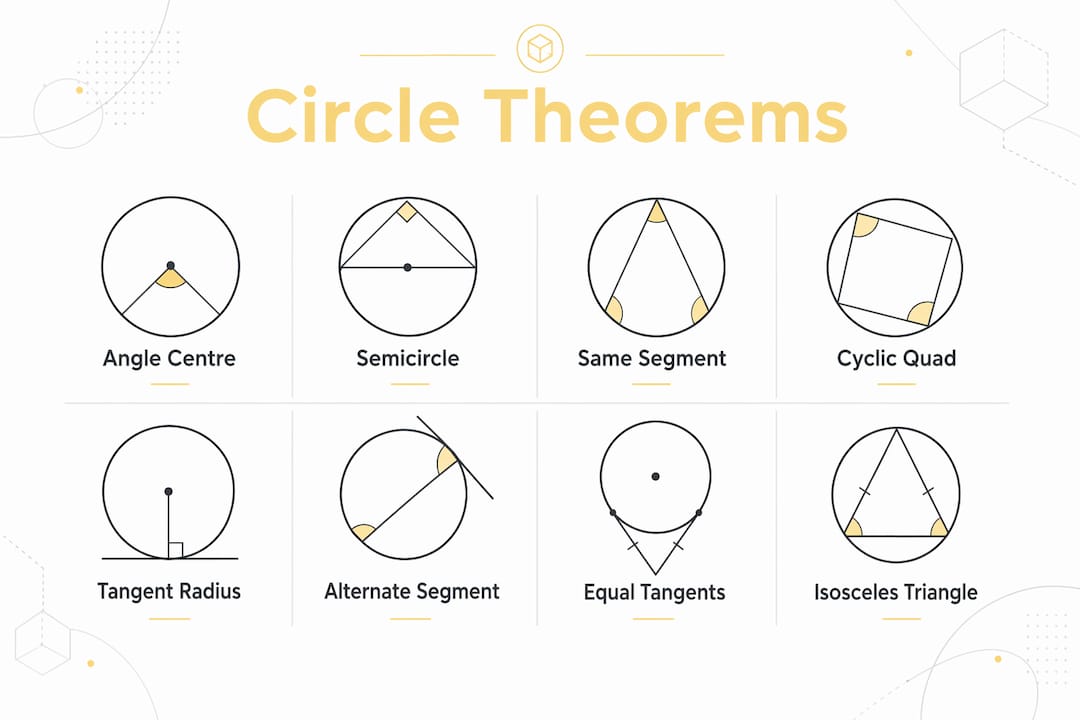
Pro Tip: BBC Bitesize emphasises labelling the subtending arc on your diagram. Write the arc name (e.g. “arc AB”) next to the angle before you apply any theorem — this single habit prevents the most common identification errors.
How do you spot which theorem applies on a diagram?
The quickest way to choose the right theorem is to read the diagram systematically before writing anything. Follow this checklist first, then use the step flow below.
Visual checklist:
- Is the centre O marked? Look for the angle-at-the-centre or isosceles-radii theorems.
- Is there a diameter? The angle in a semicircle is 90°.
- Are there two angles on the same side of a chord? Angles in the same segment are equal.
- Are all four vertices on the circle? Cyclic quadrilateral rules apply.
- Does a straight line touch the circle at one point? That is a tangent; check for tangent–radius (90°) or alternate segment.
- Is there an external point with two lines to the circle? Equal tangents from an external point.
- Are two line segments drawn from the centre? Mark them as equal radii and look for an isosceles triangle.
Step flow for any circle diagram:
- Label every point on the diagram (A, B, C, O) if they are not already labelled.
- Mark all radii with a tick to show they are equal.
- Check whether a diameter is present and mark the right angle it creates.
- Identify any tangent lines and mark the 90° angle at the point of contact.
- Note which arc each angle is subtended by and write the arc name lightly beside the angle.
- Write the candidate theorem name before you calculate anything.
Comparison: centre vs circumference cues
| Cue on diagram | Likely theorem | Reason to write |
|---|---|---|
| Angle vertex at centre O | Angle at the centre | “Angle at centre = twice angle at circumference, same arc” |
| Angle vertex on circumference, subtended by diameter | Angle in a semicircle | “Angle in a semicircle = 90°” |
| Two angles, same chord, same side | Angles in the same segment | “Angles in same segment are equal” |
| All four vertices on circle | Cyclic quadrilateral | “Opposite angles add to 180°” |
| Line tangent to circle | Tangent–radius or alternate segment | “Tangent meets radius at 90°” or alternate segment wording |
Confusion between the angle-at-the-centre theorem and cyclic quadrilateral properties is one of the most common errors at GCSE. Labelling the subtending arc is the simplest technique to decide which theorem fits.
Pro Tip: Before calculating, write the theorem name in the margin. If you later realise it is wrong, cross it out and write the correct one. Examiners can see your reasoning and will credit correct working even when an early line is amended.
Multi-step worked examples that chain two or more theorems
Many exam questions require combining basic geometry facts before applying a named theorem. The three examples below show the reasoning chain examiners expect.
Example 1: Isosceles radii + angle at the centre
O is the centre. OA = OB = OC (radii). Angle AOB = 80°. Find angle ACB.
- Identification: OA = OB, so triangle OAB is isosceles (two radii form an isosceles triangle).
- Intermediate step: Angle OAB = Angle OBA = (180° − 80°) ÷ 2 = 50°.
- Apply theorem: Angle at the centre is twice the angle at the circumference, same arc.
- Calculation: Angle ACB = 80° ÷ 2 = 40°
Examiner note: The method mark here sits on the isosceles step. Students who skip straight to halving 80° without justifying the isosceles triangle lose that mark.
Example 2: Tangent–radius + alternate segment
PT is a tangent at T. Angle PTQ = 62°. Find angle TRQ, where R is a point in the alternate segment.
- Identification: PT is a tangent at T; TQ is a chord.
- Intermediate step: Mark the right angle OTP = 90° (tangent meets radius at 90°) — confirms the tangent.
- Apply theorem: The angle between a tangent and a chord equals the angle in the alternate segment.
- Calculation: Angle TRQ = 62°
Examiner note: Students often forget to state that PT is a tangent before quoting the alternate segment theorem. One identification line secures the method mark.
Example 3: Cyclic quadrilateral + isosceles radii
ABCD is a cyclic quadrilateral. OA = OD (radii). Angle AOD = 130°. Find angle ABC.
- Identification: OA = OD, so triangle OAD is isosceles (two radii).
- Intermediate step: Angle OAD = Angle ODA = (180° − 130°) ÷ 2 = 25°. Therefore angle DAB includes this base angle.
- Apply theorem: Opposite angles in a cyclic quadrilateral add up to 180°.
- Calculation: Angle ABC = 180° − angle ADC. With angle ADC = 25° (base angle), angle ABC = 180° − 25° = 155°
Showing every intermediate step is not optional — it is where the method marks live. An answer of 155° with no working earns zero; the same answer with the isosceles step and the cyclic quadrilateral reason earns full marks.
Pro Tip: After writing each reason line, draw a small tick beside the angle you have just found. This prevents you from using the same angle twice and makes your chain of reasoning visible to the examiner.
Practice questions with model answers and marking notes
Attempt each question without looking at the model answer. Time yourself: aim for roughly 3–4 minutes per question under exam conditions.
Question 1. O is the centre of the circle. Angle AOB = 96°. A, B and C are points on the circumference. Find angle ACB.
Model answer:
Reason: The angle at the centre is twice the angle at the circumference subtended by the same arc.
Angle ACB = 96° ÷ 2 = 48°
Mark-scheme note: 1 mark for the reason; 1 mark for 48°. Common error: writing 96° × 2 = 192°.
Question 2. AB is a diameter of the circle. C is on the circumference. Angle BAC = 41°. Find angle ABC.
Model answer:
Reason: The angle in a semicircle is 90°, so angle ACB = 90°.
Angle ABC = 180° − 90° − 41° = 49°
Mark-scheme note: 1 mark for stating angle ACB = 90° with reason; 1 mark for 49°.
Question 3. PQRS is a cyclic quadrilateral. Angle QRS = 107°. Find angle QPS.
Model answer:
Reason: Opposite angles in a cyclic quadrilateral add up to 180°.
Angle QPS = 180° − 107° = 73°
Mark-scheme note: Reason line is required for the method mark. Writing only “73°” scores 1 out of 2.
Question 4. A tangent touches the circle at T. OT is a radius. Angle OPT = 33°. Find angle POT.
Model answer:
Reason: The angle between a tangent and a radius is 90°, so angle OTP = 90°.
Angle POT = 180° − 90° − 33° = 57°
Mark-scheme note: Marking the right angle on the diagram earns the method mark even if the arithmetic is wrong.
Question 5. The angle between a tangent at B and chord BC is 48°. D is a point in the alternate segment. Find angle BDC.
Model answer:
Reason: The angle between a tangent and a chord equals the angle in the alternate segment.
Angle BDC = 48°
Mark-scheme note: The reason line is the entire method here. No reason = no method mark.
Question 6. OA = OB (radii). Angle OAB = 31°. Find angle AOB.
Model answer:
Reason: Two radii form an isosceles triangle, so the base angles are equal.
Angle OBA = 31° (base angles equal).
Angle AOB = 180° − 31° − 31° = 118°
Mark-scheme note: 1 mark for identifying the isosceles triangle with reason; 1 mark for 118°.
| Question | Theorem used | Common error |
|---|---|---|
| 1 | Angle at the centre | Doubling instead of halving |
| 2 | Angle in a semicircle | Forgetting to state angle ACB = 90° |
| 3 | Cyclic quadrilateral | Subtracting from 360° instead of 180° |
| 4 | Tangent–radius | Not marking the right angle on the diagram |
| 5 | Alternate segment | Omitting the reason line entirely |
Pro Tip: Write a short method line before calculating and redo any question you got wrong after a short break. If you can solve the amended version correctly, you have genuinely understood the theorem rather than memorised the answer.
Common errors students make and how to avoid losing marks
The most avoidable mark losses in circle geometry come from three habits: omitting the reason, misidentifying the arc, and making doubling/halving errors. Here is how to fix each one.
Most frequent mistakes:
- Omitting the theorem reason entirely and writing only the numeric answer.
- Confusing the angle-at-the-centre theorem with cyclic quadrilateral properties (both involve 180° or doubling, so the arc label is the deciding factor).
- Halving when you should double, or vice versa, in the angle-at-the-centre theorem.
- Assuming a quadrilateral is cyclic without checking that all four vertices lie on the circle.
- Forgetting that a tangent and radius meet at exactly 90°, then failing to form the right-angled triangle needed for the next step.
- Treating two chords as equal without justification (only radii are guaranteed equal).
Examiners award method marks for the reason line and accuracy marks for the correct number. A correct reason with a small arithmetic slip still earns the method mark. A correct number with no reason earns only the accuracy mark — and on a two-mark question, that means losing half the available marks.
The single most reliable habit is to underline the arc or chord name in your reason line. Writing “subtended by arc AB” rather than just “same arc” removes all ambiguity and signals to the examiner exactly which theorem you are applying.
Quick habits that prevent the most common errors:
- Always label the centre O at the start of every diagram.
- Mark equal radii with a tick before applying any theorem.
- Underline the arc name in your written reason.
- Check all four vertices are on the circle before using cyclic quadrilateral rules.
Pro Tip: If you are unsure which theorem applies, write the nearest theorem name and show the short justification. Partial credit is often available for correct method work, even when the final identification is imperfect.
How to revise circle theorems effectively using active recall
Passive re-reading of notes produces weak recognition under exam pressure. Active recall with diagrams — drawing the figure and stating the theorem aloud or in writing — produces much stronger results when you face mixed questions.
Active-recall revision plan:
- Draw from memory. Close your notes and sketch each of the eight theorem diagrams. Label the key angles and write the exam-ready reason beneath each sketch.
- State the wording aloud. Say the theorem reason out loud as you write it. This reinforces both recognition and phrasing simultaneously.
- Practise without looking. Attempt five questions from a topic-specific set without your notes open.
- Self-mark with the reason. Check your reason line first, then the numeric answer. Annotate the exact reason wording on any question you got wrong.
- Correct and re-solve. Change one number in any question you answered incorrectly and solve it again. This is the three-corrections technique: after marking, alter one value in three problems and re-solve to confirm genuine understanding rather than answer memorisation.
- Repeat with timed mixed questions. Move from untimed topic practice to timed mixed past-paper questions as your confidence builds.
Suggested weekly schedule:
- Days 1–2: Learn and draw all eight theorems from memory (untimed).
- Days 3–4: Attempt the practice worksheet in this guide; self-mark and correct.
- Day 5: Attempt a timed mixed set of circle geometry questions from a past paper.
- Day 6: Review errors, apply the three-corrections technique, re-draw any theorem you still hesitate on.
- Day 7: Full timed past paper including all topics; note which circle theorem questions cost marks.
Mathvault’s worked solutions and video walkthroughs support each stage of this plan. Use the topic-specific past papers for Days 3–5 to get exam-style questions with mark-scheme reasoning. The video walkthroughs model spoken reasoning and show how to annotate diagrams correctly, which is particularly useful when you are unsure whether your reason line is phrased precisely enough. For timed mixed practice after topic consolidation, Mathvault’s organised past papers by topic let you target circle theorems specifically before moving to full mixed papers.
Pro Tip: Use the three-corrections technique after every marking session. Change one number in three questions you got wrong and re-solve them. If you can do it, you understand the method. If you cannot, you memorised the answer.
Key takeaways
Securing full marks on circle theorem questions comes down to one consistent habit: write the exact theorem wording as your reason before you calculate, name the arc or chord, and show every intermediate step.
| Point | Details |
|---|---|
| Write the reason first | State the exact theorem wording before calculating to secure the method mark on every question. |
| Name the arc or chord | Writing “subtended by arc AB” rather than “same arc” removes ambiguity and satisfies examiner expectations. |
| Use active recall to revise | Draw all six theorem diagrams from memory and state the wording aloud; passive re-reading produces weaker exam recognition. |
| Chain intermediate steps | Mark equal radii and right angles before applying a named theorem; missing these basics is the most common source of lost marks. |
| Practise with Mathvault | Use Mathvault’s past papers and worked solutions for timed mixed practice after completing this worksheet. |
Pro Tip: Before your next study session, attempt the six practice questions in this guide completely blind, then mark them strictly using the model answers. Any question where you wrote no reason line is a priority to revisit.
Why precise wording matters more than most students realise
There is a tendency among students to treat circle theorems as a memory task: learn the eight facts, apply them, done. The reality is more nuanced. The written reason is not a formality — it is the mechanism by which examiners verify that you understood which theorem you applied, not just that you arrived at a correct number.
This matters most in multi-step questions. When a question chains two or three theorems, each reason line is a separate mark. A student who writes the correct final answer but skips the intermediate reasons can lose two or three marks on a single question. The student who writes every reason line, even with a small arithmetic error on the final step, often scores higher.
The other underappreciated point is diagram annotation. Marking equal radii, right angles, and arc names before you calculate is not busywork. It is the process by which you identify which theorem applies. Students who annotate consistently make fewer identification errors and write more accurate reason lines as a direct result.
The approach in this guide — exact wording, diagram annotation, intermediate steps visible — is the one that examiners reward with full method and accuracy marks. It is also the approach that transfers to unfamiliar question formats, because it is based on understanding the geometry rather than pattern-matching to a memorised example.
Mathvault’s free resources for circle theorems practice
Mathvault gives you free access to past exam papers, fully worked step-by-step solutions, and video walkthroughs organised by UK exam board — everything you need to move from understanding the eight theorems to applying them confidently under timed conditions.
For circle theorems specifically, the most useful resources are the topic-based past papers (which let you drill circle geometry questions without wading through unrelated topics) and the video walkthroughs, which model exactly how to annotate a diagram and phrase a reason line. Once you have completed the practice worksheet in this guide, the logical next step is a timed past-paper session using Mathvault’s organised question sets. The WJEC GCSE resources and the full Mathvault homepage are the best starting points depending on your exam board. All core resources are free; downloadable revision packs are available for a small one-off cost if you want offline access.
Useful sources and further reading
The sources below are reliable starting points for additional practice questions, diagrams, and worked examples.
- BBC Bitesize — Circle Theorems (Foundation): Clear theorem statements with diagrams and short practice questions; good for checking your understanding of the core six theorems at foundation level.
- BBC Bitesize — Circle Theorems (Higher): Extends to seven or more theorems with worked slideshows; useful for higher-tier students who need deeper proofs and more complex examples.
- Corbettmaths — Circle Theorems Notes: Concise downloadable PDF summaries with worked examples; ideal for a quick-reference card during revision.
- Corbettmaths — Circle Theorems Practice Questions: A substantial bank of exam-style questions; work through these after completing the worksheet in this guide.
- Mr Barton Maths — Circle Theorems Practice: Chained-theorem exercises grouped by question type; the best resource for building fluency in multi-step questions once you are confident with individual theorems.
- Mathvault — Past Papers and Worked Solutions: Organised by UK exam board; use for timed mixed practice and to check your reason lines against mark-scheme wording.
Leave a Reply