
What are the AQA GCSE maths topics you need to know?
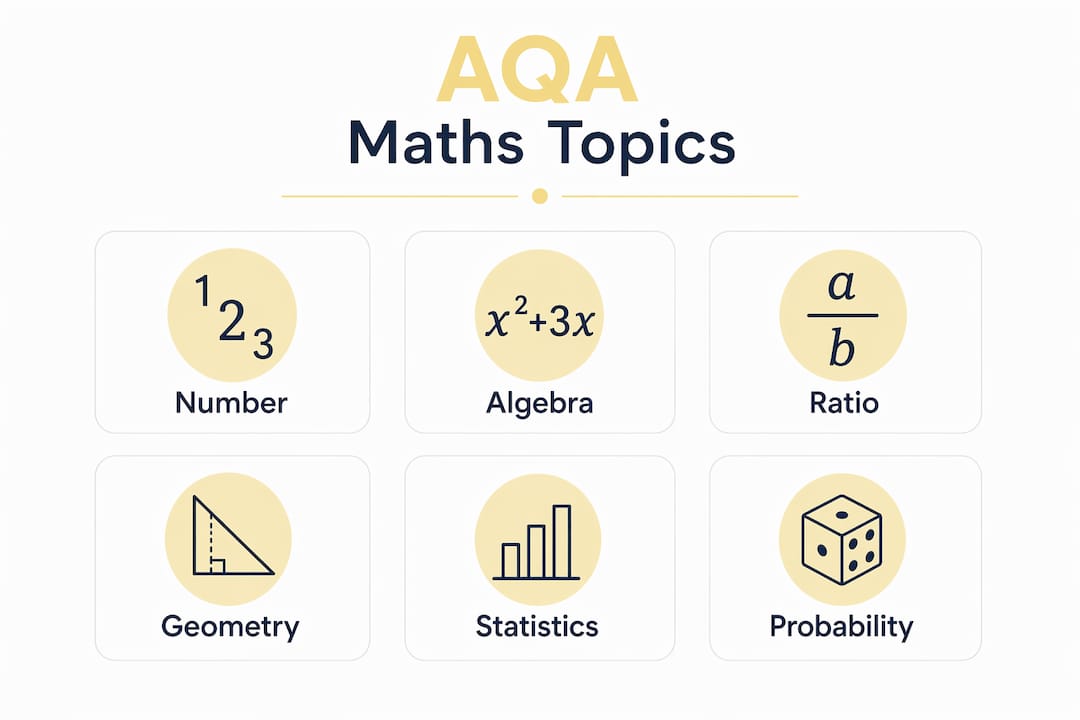
The AQA GCSE Mathematics 8300 specification organises all assessed content into six broad topic areas. Every question on every paper draws from one of these:
- Number — arithmetic, place value, fractions, decimals, percentages, indices, surds (Higher), and standard form
- Algebra — notation and manipulation, graphs, equations, inequalities, sequences, and functions
- Ratio, proportion and rates of change — proportional reasoning, percentage problems, direct and inverse proportion, compound measures
- Geometry and measures — properties of shapes, angle rules, Pythagoras’ theorem, trigonometry, vectors, and mensuration
- Probability — experimental and theoretical probability, Venn diagrams, tree diagrams, conditional probability (Higher)
- Statistics — data collection, representation, averages, spread, and cumulative frequency
Mark weighting differs significantly by tier. Number receives 25% of marks at Foundation but only 15% at Higher, while Algebra rises from 20% at Foundation to 30% at Higher. Knowing this shapes how you allocate revision time.
Foundation tier emphasises procedural fluency within a narrower content range. Higher tier extends into surds, advanced trigonometry, functions, iteration, and proof. Critically, Foundation questions can be conceptually demanding within their scope, so never assume Foundation simply means easier maths.

Table of Contents
- A closer look at each topic area
- How do assessment objectives shape your exam questions?
- What official AQA resources should you use?
- How Mathvault complements your AQA revision
- Effective revision strategies for AQA GCSE maths
- Mathvault: free revision resources for every AQA topic
- Key takeaways
A closer look at each topic area
Number
Number underpins everything else. At both tiers, you need confident arithmetic with integers, fractions, decimals, and mixed numbers, alongside place value, prime factorisation, HCF, LCM, and powers. Standard form and bounds appear in both tiers. Higher tier adds surds, fractional indices, and recurring decimals converted to fractions.

A typical exam question might ask you to show that √75 simplifies to 5√3, or to calculate the upper bound of a calculation given measurements rounded to one decimal place.
Algebra
Algebra carries the heaviest mark weighting at Higher tier, so it deserves serious attention. Core skills include:
- Simplifying and expanding expressions, including quadratics
- Solving linear and quadratic equations by factorising, completing the square, and the quadratic formula
- Simultaneous equations (linear/linear and linear/quadratic at Higher)
- Sketching and interpreting graphs: linear, quadratic, cubic, reciprocal, exponential, and trigonometric
- Sequences: arithmetic and geometric, nth term, and limits of sequences (Higher)
- Inequalities and iteration (Higher)
Higher tier extends into functions, composite functions, and inverse functions, as well as circle theorems and the equation of a tangent to a circle.
Ratio, proportion and rates of change
This topic area bridges Number and Algebra in practice. You need to:
- Work fluently with ratios, including splitting quantities and solving ratio problems involving fractions
- Solve percentage change problems, including reverse percentage and compound interest
- Apply direct and inverse proportion, both graphically and algebraically
- Use compound measures: speed, density, pressure, and unit pricing
Ratio problems are among the most frequently mishandled on Foundation papers, often because students set up the relationship incorrectly. Practising a range of worded problems here pays dividends.
Geometry and measures
A broad topic covering:
- Angle properties of parallel lines, triangles, polygons, and circles
- Pythagoras’ theorem and basic trigonometry (SOH CAH TOA) at Foundation; sine and cosine rules, 3D trigonometry, and exact trigonometric values at Higher
- Area, perimeter, volume, and surface area of standard shapes and composite figures
- Transformations: reflection, rotation, translation, and enlargement (including fractional and negative scale factors at Higher)
- Vectors and geometric proof (Higher)
- Loci and constructions
Probability
Probability questions test both calculation and interpretation. Foundation students work with single-event probability, relative frequency, and sample spaces. Higher tier introduces:
- Conditional probability
- Venn diagrams with set notation
- Tree diagrams for dependent events
Statistics
Statistics covers the full data-handling cycle: designing surveys, representing data (bar charts, histograms, scatter graphs, box plots, cumulative frequency curves), and interpreting results. You need to calculate mean, median, mode, and range from both raw data and frequency tables. Higher tier adds standard deviation concepts and more complex histogram interpretation.
How do assessment objectives shape your exam questions?
The AQA GCSE Mathematics 8300 exams assess three objectives across all topic areas:
- AO1 — Use and apply standard techniques: recalling facts, carrying out procedures, and performing calculations accurately. This is the most straightforward mark type.
- AO2 — Reason, interpret, and communicate mathematically: constructing arguments, justifying conclusions, and interpreting mathematical models. These questions often use words like “show that,” “explain,” or “prove.”
- AO3 — Solve problems within mathematics and in other contexts: multi-step problems where you must select the right approach, often in unfamiliar or real-world settings.
Examiners expect students to interpret and critique mathematical models, not just perform procedural calculations. Students who practise AO2 and AO3 question types consistently are better placed to access the marks that separate grades at the top end of each tier.
The exam consists of three papers: Paper 1 (non-calculator), Paper 2 (calculator), and Paper 3 (calculator). All three papers assess all six topic areas and all three assessment objectives. Paper 1 tests mental arithmetic and fluency particularly hard, especially fractions, indices, and standard form, so relying on a calculator in revision is a genuine risk.
A common reason students lose marks is not a lack of topic knowledge but difficulty mapping a complex word problem onto the correct mathematical operation. This is an AO3 skill, and it improves with deliberate practice on multi-step problems rather than repeated single-skill drills.
What official AQA resources should you use?
AQA provides a dedicated support platform called All About Maths, which is free to access and written by senior examiners. It includes:
- Route maps showing how topics connect and how to sequence teaching and revision
- Examiner guidance on common errors and how marks are awarded for AO2 and AO3 questions
- Goal-free problems designed to develop flexible mathematical thinking
- Mock exam analysis tools to identify patterns in student performance
For students, the most valuable materials are the specimen papers, past papers, and their associated mark schemes. Reading the mark scheme after attempting a question reveals exactly how method marks and accuracy marks are distributed, which is half the battle in understanding what examiners want.
Recommended steps for using official AQA resources:
- Download the specification from the AQA website and highlight every topic relevant to your tier
- Work through specimen papers under timed conditions
- Mark your work using the official mark scheme, noting where you lost method marks versus accuracy marks
- Use the All About Maths examiner commentary to understand why certain approaches earn marks and others do not
- Revisit weaker topic areas using the route maps to plan targeted practice
Pro Tip: Use the All About Maths goal-free problems regularly. Instead of asking “find x,” these problems ask “what can you work out?” — which trains the flexible thinking that AO3 questions demand.
Since summer 2022, an official formulae sheet is provided in all GCSE Maths papers, covering the quadratic formula, area and volume formulae, the sine and cosine rules, and compound interest. This means memorising these is no longer the priority it once was. Focus that time instead on knowing when and how to apply each formula correctly.
How Mathvault complements your AQA revision
Mathvault provides free access to GCSE and A-Level maths past papers organised by exam board and topic, with fully worked step-by-step solutions and video walkthroughs that break down complex problems in the AQA syllabus.
Here is what makes Mathvault particularly useful alongside official materials:
- Past papers by topic and board: resources are organised to match the AQA syllabus structure, so you can target specific topic areas rather than working through full papers every time
- Fully worked solutions: each solution shows the method clearly, helping you understand where marks are earned and where errors typically occur
- Video walkthroughs: ideal when a written solution alone does not clarify the reasoning behind a step
- Live weekly Q&A sessions: real-time support from maths specialists, tailored to GCSE students across England, Wales, and Scotland
- Revision notes and downloadable packs: structured guides aligned with AQA topics for offline study
If you are working through Edexcel A-Level content alongside your GCSE preparation, Mathvault covers that too, making it a single platform for progression beyond GCSE.
Pro Tip: After attempting a past paper question, watch the Mathvault video walkthrough before reading the mark scheme. Seeing the reasoning modelled step by step first makes the mark scheme far easier to interpret.
For students who want additional one-to-one support alongside self-study, personalised maths tutoring can complement the free resources available through Mathvault and AQA’s own platform.
Effective revision strategies for AQA GCSE maths
A structured approach to revision makes a measurable difference. Here is how to build one:
- Start with fundamentals. Close gaps in place value, fractions, and ratio before attempting Higher tier topics like algebraic fractions or iterative formulae. A shaky foundation makes advanced topics much harder to consolidate.
- Prioritise AO2 and AO3 practice. Mastery of reasoning and problem-solving questions is what separates grades at the top of each tier. Spend at least a third of your practice time on multi-step and worded problems.
- Use tier-appropriate papers. Attempting Higher papers when Foundation is your tier, or vice versa, wastes revision time and distorts your sense of readiness.
- Practise Paper 1 without a calculator. Mental arithmetic, fraction manipulation, and index laws need to be fluent without technological support.
- Self-assess with mark schemes. After every practice question, check the mark scheme and identify whether you lost marks on method, accuracy, or interpretation.
- Revisit the Mathvault blog for topic-specific guidance. Short, focused articles on common exam question types can sharpen your approach to areas like algebraic manipulation and ratio problems.
Pro Tip: Ratio problems and algebraic manipulation consistently appear across multiple papers and carry significant marks at both tiers. Extra revision in these two areas tends to produce the clearest grade improvements.
Time management matters too. In a 90-minute paper, spending too long on a single question is a common pitfall. If a question is not yielding progress after a few minutes, move on and return to it. The marks available for later questions are just as accessible.
Mathvault: free revision resources for every AQA topic
Every topic covered in this guide has corresponding practice materials on Mathvault. Past papers, fully worked solutions, video walkthroughs, and live Q&A sessions are all free, organised by exam board, and built specifically for students preparing for UK national exams.
Whether you are consolidating Number skills, working through Higher Algebra, or tackling AO3 problem-solving questions, Mathvault gives you the materials and the support to do it properly. The live weekly sessions mean you are never stuck on a problem without somewhere to turn. Visit Mathvault now and start working through AQA past papers by topic, at your own pace, with full solutions at hand.
Key takeaways
The AQA GCSE Mathematics 8300 specification covers six topic areas, with mark weighting and content scope varying significantly between Foundation and Higher tiers.
| Point | Details |
|---|---|
| Six topic areas | Number, Algebra, Ratio and proportion, Geometry, Probability, and Statistics form the full AQA syllabus. |
| Tier mark weighting | Algebra accounts for a larger share of marks at Higher tier compared to Foundation; Number marks constitute a smaller share at Higher tier than at Foundation. |
| Three assessment objectives | AO1 tests technique, AO2 tests reasoning, and AO3 tests problem-solving in context. |
| Formulae sheet provided | Since summer 2022, a formulae sheet is included in all papers, so focus shifts to applying formulae correctly. |
| Mathvault for targeted practice | Mathvault offers free past papers, worked solutions, and video walkthroughs organised by AQA topic and tier. |
Leave a Reply