
The official A level maths formula booklet is a free, standardised document provided by your exam board on the day of every A Level mathematics paper. You do not need to memorise every formula in it, but you do need to know exactly where each one lives and how to apply it under timed conditions. Here is where to find the current versions and how to get the most from them.
Where to download your official A level maths formula booklet
Each of the three main UK exam boards publishes its formula booklet as a free PDF. Download directly from the official source, not from third-party revision sites, to guarantee you have the correct version.
Pearson Edexcel

The Pearson Edexcel formulae book covers AS Mathematics, A Level Mathematics, AS Further Mathematics, and A Level Further Mathematics in a single document, with formulae arranged by qualification. Find it under Specification and Sample Assessment Materials on the Edexcel mathematics qualification page at qualifications.pearson.com.
AQA
AQA publishes two separate booklets. The formulae booklet for AS and A Level Maths (course codes 7356 and 7357) is currently at v1.2, issued August 2017. The combined formulae and statistical tables booklet for AS and A Level Further Mathematics (7366 and 7367) is at v1.5, issued February 2018. Both are available via AQA’s Assessment Resources section at aqa.org.uk.
WJEC
WJEC provides its formula booklet as part of the specification documentation on its website at wjec.co.uk. Navigate to the A Level Mathematics qualification page and look under Specification or Assessment Resources for the current PDF. Students preparing for WJEC exams can also find past papers and worked solutions organised by board at Mathvault’s WJEC resources.
All three booklets are free to download and print. Bring a clean, unannotated copy to every practice session so the format feels familiar before exam day.
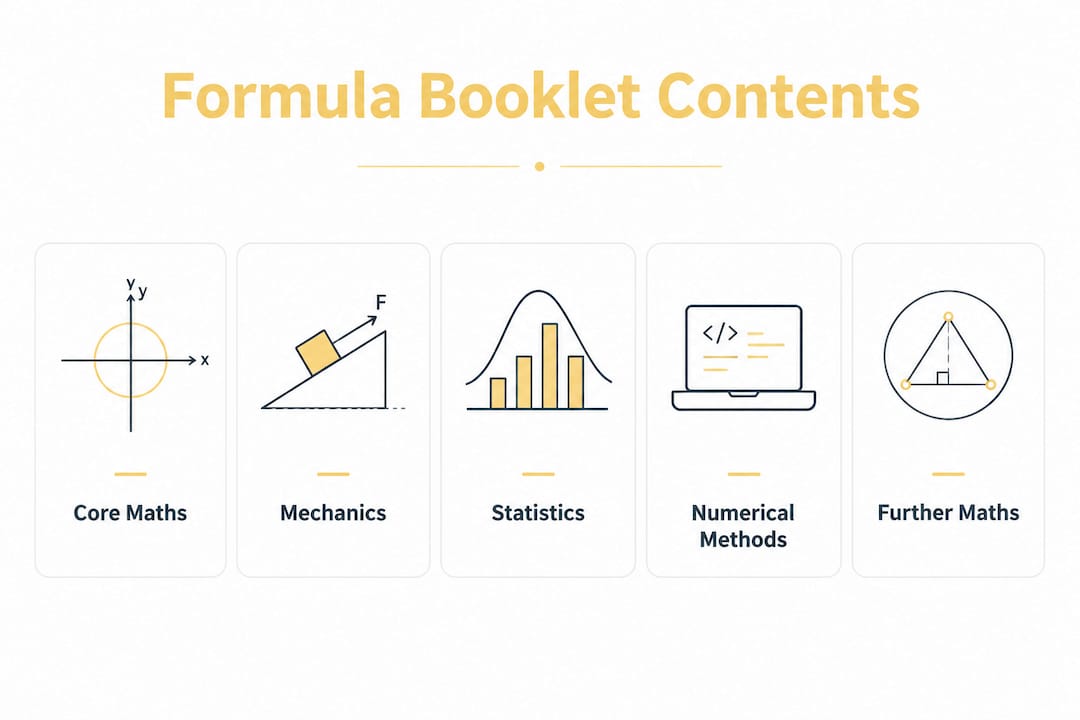
What does the formula booklet actually contain?
The scope of the booklet varies by exam board and qualification level, but the core structure is consistent across all three.
Pure Mathematics forms the largest section and typically includes:
- Arithmetic and geometric series (general term and sum formulae)
- Binomial series expansion
- Trigonometric identities, including addition formulae for sin(A ± B) and cos(A ± B)
- Small angle approximations: sin θ ≈ θ and cos θ ≈ 1 − θ²/2
- Differentiation results for tan x, sec x, cosec x, and cot x
- Integration results and standard forms
- Mensuration formulae: surface area of a sphere, curved surface area of a cone, arc length, and sector area
Mechanics covers constant acceleration equations and, in some boards, projectile motion and Newton’s second law in vector form.
Probability and Statistics includes probability rules such as P(A ∪ B) and conditional probability, standard deviation formulae, and sampling distribution results. The Edexcel booklet also contains full statistical tables: the Binomial Cumulative Distribution Function, Percentage Points of the Normal Distribution, Poisson Cumulative Distribution Function, and Critical Values for Correlation Coefficients.
Numerical methods appear in both AQA and Edexcel booklets, covering the Newton-Raphson iteration and the trapezium rule for numerical integration.
Further Mathematics booklets go considerably further. The A Level Further Mathematics section in the Edexcel document adds hyperbolic functions, Maclaurin’s series, summation formulae, and additional statistical tables including Percentage Points of the χ² Distribution and Student’s t Distribution. The Cambridge International equivalent, List MF19, covers Further Pure Mathematics with Maclaurin’s series, additional trigonometric identities, and unbiased estimator formulae for the 9709 and 9231 syllabuses.
One thing the booklet does not contain is everything. AQA’s specification lists formulae students must know without being given them, including the quadratic formula, laws of logarithms, coordinate geometry results, and fundamental trigonometric identities. Cross-referencing the booklet against your syllabus’s memorisation list is one of the most productive revision tasks you can do.
How to use the formula booklet effectively in revision and exams
The booklet is a tool for problem-solving, not a shortcut around understanding. Exam boards are explicit on this point: knowing when and how to apply a formula matters far more than being able to locate it on the page.
That said, speed of retrieval genuinely affects your score. Students who fumble through the booklet mid-question lose time and concentration. The fix is straightforward: practise with the booklet open from the very start of your revision, not just in mock exams.
Common mistakes to avoid:
- Copying a formula without checking it applies to the specific form of the question (e.g. using the wrong version of the binomial expansion)
- Forgetting that some formulae require conditions, such as |r| < 1 for an infinite geometric series
- Assuming a formula is in the booklet when it is on the memorisation list, and vice versa
- Annotating your personal copy and then expecting those notes to be there in the exam. Exam regulations are clear: only a clean, unannotated booklet is permitted
Practical revision habits that work:
- Highlight the page numbers for each major section during a quiet study session, then test yourself on retrieval speed
- When working through past paper questions by topic, keep the booklet beside you and note which formulae you reached for and whether you applied them correctly
- After each topic, write out the formulae you must memorise separately from those provided, using your board’s specification appendix as the reference
Pro Tip: Run at least three full timed papers with the official booklet as your only reference. Time how long it takes you to locate each formula you use. If any section takes more than 15 seconds to navigate, spend ten minutes that evening reading through that part of the booklet until the layout is second nature.
Why you must use the latest version and how to check it
Exam boards update their formula booklets when corrections are needed, when new statistical tables are added, or when constant values change. AQA’s Further Mathematics booklet moved from v1.4 to v1.5 in february 2018, and that update affected statistical tables used in exam questions. Using the previous version in revision could mean practising with slightly different values.
Using an outdated formula booklet in revision is a genuine risk. If the version you are working from differs from the one issued in the exam room, any formula or table value that changed between versions could cost you marks on questions where you believed you had the right starting point. Always verify the version number before you begin a new revision block.
The version number and issue date appear on the cover or first page of every official booklet. Here is how to confirm yours is current:
- Go directly to your exam board’s official website (aqa.org.uk, qualifications.pearson.com, or wjec.co.uk)
- Navigate to your specific qualification by course code (e.g. AQA 7357 for A Level Mathematics)
- Download the booklet from the Assessment Resources or Specification section and check the version number against what is listed on the news or updates page
- Never rely on a PDF passed on by another student or downloaded from a revision forum without checking the source URL
Different course codes carry different booklets. AQA’s standard A Level Mathematics booklet (7356/7357) and its Further Mathematics booklet (7366/7367) are separate documents with different content and version histories. Using the wrong one for your qualification is an easy mistake to make if you are not checking the course code on the cover.
How Mathvault helps you go further than the formula booklet
The formula booklet tells you what formulae exist. Mathvault shows you how to use them in real exam questions, under real exam conditions, with full explanations of every step.
Mathvault’s resources are free and organised by UK exam board, covering Pearson Edexcel, AQA, WJEC, and SQA. Here is what you get:
- Past papers by topic with fully worked solutions: rather than working through a whole paper at random, you can target the exact topics where your formula booklet knowledge is weakest. The Edexcel topic-based question bank is particularly useful for this
- Step-by-step video walkthroughs: each solution is explained in full, showing precisely how a formula from the booklet is selected, set up, and applied to reach the correct answer
- Live weekly Q&A sessions: if a formula application is not clicking, you can bring the question to a live session and get a direct explanation
- Structured revision guides and downloadable notes: these are aligned with UK exam board syllabuses and updated regularly to reflect recent exam content
- Mark scheme breakdowns: understanding how method and accuracy marks are distributed helps you see which steps in a formula-based calculation the examiner actually rewards
Mathvault adds the layer of practice and explanation that the official booklet, by design, cannot provide. Visit mathvault.io to access all resources free of charge.
Key takeaways
The most effective approach to using the A level maths formula booklet is to download the current official version for your specific exam board and course code, then practise with it open from the earliest stages of revision.
| Point | Details |
|---|---|
| Download from official sources | Get your booklet directly from aqa.org.uk, qualifications.pearson.com, or wjec.co.uk to guarantee accuracy. |
| Check the version number | Confirm your booklet’s version matches the current one listed on your exam board’s website before revising. |
| Know what is not included | Formulae on your board’s memorisation list (e.g. the quadratic formula for AQA) will not appear in the booklet. |
| Practise retrieval speed | Timed papers with the booklet open build the navigation speed that saves minutes in the real exam. |
| Further Maths needs a different booklet | The Further Mathematics booklet contains additional statistical tables and advanced formulae not found in the standard A Level version. |
Leave a Reply