
Surds are numbers left in square root form so that an answer stays exact. To revise them well, you need four skills: simplifying, combining, expanding brackets and rationalising denominators. Learn the three multiplication and division rules below, practise each skill on short questions, then move on to exam-style problems where several skills meet in one question. This guide takes you through all of it, with worked answers you can check line by line.
TL;DR
- A surd is a root that does not simplify to a whole number or fraction, such as √2 or √12. You leave it as a root so the answer is exact.
- Simplify by pulling out the largest square factor: √48 = √(16 × 3) = 4√3.
- You can only add or subtract like surds, in the same way that you collect like terms in algebra.
- To rationalise a denominator, multiply top and bottom by the surd, or by the conjugate if the denominator has two terms.
- Practise with exam-style questions and mark schemes, and write out every line of working, because method marks depend on it.
Table of Contents
- What a surd is and why exams use them
- The three rules you must know
- How to simplify surds
- Multiplying and dividing surds
- Adding and subtracting surds
- Expanding brackets with surds
- Rationalising the denominator
- Exam-style surds questions with worked answers
- Mistakes that cost marks
- A four-week plan for surds revision
- Our perspective on revising surds
- Practise surds with MathVault
- FAQ
- Sources
What a surd is and why exams use them
A surd is a number left in square root form when detailed accuracy is required. BBC Bitesize explains that the decimal forms of such numbers would go on forever, so writing √2 is more accurate than writing 1.414. Examiners use surds to test whether you can keep an answer exact rather than rounding on a calculator.
Not every square root is a surd. √25 = 5 and √(9/4) = 3/2 are rational, so they are not surds. √7, √20 and 3√5 are surds, because none of them is a whole number or a fraction.
Surds appear across the specification, not just in the “Number” topic. You meet them in Pythagoras’ theorem, exact trigonometric values, area and perimeter questions, circle work and quadratic formula answers. If you are revising by exam board, our AQA GCSE number revision page and OCR GCSE number page group surd questions with the rest of the topic.
The three rules you must know
BBC Bitesize lists the core rules for working with surds:
| Rule | In words | Example |
|---|---|---|
| √a × √a = a | A surd times itself gives the number inside | √7 × √7 = 7 |
| √(ab) = √a × √b | A root of a product splits into a product of roots | √12 = √4 × √3 = 2√3 |
| √(a/b) = √a / √b | A root of a fraction splits into a fraction of roots | √(5/9) = √5 / 3 |
The first rule matters most in the exam room. It is the reason that (√3)² is 3 and not 9, and it powers rationalising and expanding.
Also learn the square numbers up to at least 100, plus 121, 144 and 169. Mathcentre notes that knowing the common square numbers lets you spot square factors straight away, which is the key to simplifying.
How to simplify surds
A surd can be simplified if the number inside has a square number as a factor. BBC Bitesize gives the example √12 = √(4 × 3) = 2√3.
Method
- Find the largest square number that divides the number inside the root.
- Split the root into the square number and the remaining factor.
- Take the square root of the square number and write it as a coefficient.
Worked example 1: simplify √48
The largest square factor of 48 is 16, so:
√48 = √(16 × 3) = √16 × √3 = 4√3
If you spot only 4, you still get there, but in two steps: √48 = 2√12 = 2 × 2√3 = 4√3. The answer is the same; the only cost is time. Check that nothing is left to simplify: if the number inside still has a square factor, keep going.
Worked example 2: simplify 5√18
√18 = √(9 × 2) = 3√2, so 5√18 = 5 × 3√2 = 15√2. Remember that the number outside the root is multiplied by what you pull out.
Multiplying and dividing surds
To multiply surds, multiply the numbers inside the roots, then simplify. BBC Bitesize shows that √8 × √10 = 4√5. To divide, divide the component parts: the same page gives 8√6 ÷ 2√3 = 4√2.
Worked example 3: multiply with coefficients
Work out 3√2 × 4√6.
- Multiply the coefficients: 3 × 4 = 12.
- Multiply the surds: √2 × √6 = √12 = 2√3.
- Combine: 12 × 2√3 = 24√3.
Worked example 4: divide
Work out 10√15 ÷ 5√3.
- Divide the coefficients: 10 ÷ 5 = 2.
- Divide the surds: √15 ÷ √3 = √5.
- Answer: 2√5.
Adding and subtracting surds
Adding and subtracting follows the same logic as collecting like terms. BBC Bitesize says the numbers inside the roots must be the same: 5√2 − 3√2 = 2√2, but 4√2 − 3√3 cannot be combined.
The trick in exams is that surds often look unlike until you simplify them.
Worked example 5: simplify, then combine
Write √50 + √18 in the form a√2.
- √50 = √(25 × 2) = 5√2
- √18 = √(9 × 2) = 3√2
- 5√2 + 3√2 = 8√2
So whenever a question asks you to “write in the form a√b”, simplify every surd first, then look for matches.
Expanding brackets with surds
Expanding works exactly as it does in algebra: every term in one bracket is multiplied by every term in the other. BBC Bitesize gives (2 + √5)(3 + √2) = 6 + 2√2 + 3√5 + √10, and (5 − √3)(1 + √3) = 4√3 + 2.
Worked example 6: a squared bracket
Expand and simplify (√5 + 2)².
(√5 + 2)(√5 + 2) = √5 × √5 + 2√5 + 2√5 + 4 = 5 + 4√5 + 4 = 9 + 4√5
The classic slip here is writing (√5 + 2)² = 5 + 4 = 9. Squaring a bracket always produces a middle term, in surds just as in algebra.
Worked example 7: difference of two squares
Expand (3 + √2)(3 − √2).
9 − 3√2 + 3√2 − 2 = 7
The surd terms cancel. This pattern, (a + √b)(a − √b) = a² − b, is the engine behind rationalising a two-term denominator.
Rationalising the denominator
To rationalise is to rewrite a fraction so that the denominator has no root. AQA’s own wording defines the command as one where answers must have no square roots in the denominator.
One surd on the bottom
Multiply top and bottom by that surd. Mathcentre shows that 1/√13 becomes √13/13.
Worked example 8. Rationalise 6/√3.
6/√3 × √3/√3 = 6√3/3 = 2√3
Two terms on the bottom
Multiply top and bottom by the conjugate: the same two terms with the sign in the middle flipped. Mathcentre’s example turns 1/(1 + √2) into √2 − 1 by multiplying by (1 − √2)/(1 − √2). BBC Bitesize’s Edexcel page does the same for 5/(3 − √2), giving (15 + 5√2)/7.
Worked example 9. Rationalise 4/(2 + √3).
- Conjugate: 2 − √3.
- Numerator: 4(2 − √3) = 8 − 4√3.
- Denominator: (2 + √3)(2 − √3) = 4 − 3 = 1.
- Answer: 8 − 4√3.
The denominator becoming a whole number is your check that you chose the right conjugate.
Exam-style surds questions with worked answers
Here is a short practice set. Cover the answers and try each question first, ideally without a calculator, since surd questions often sit on non-calculator papers.
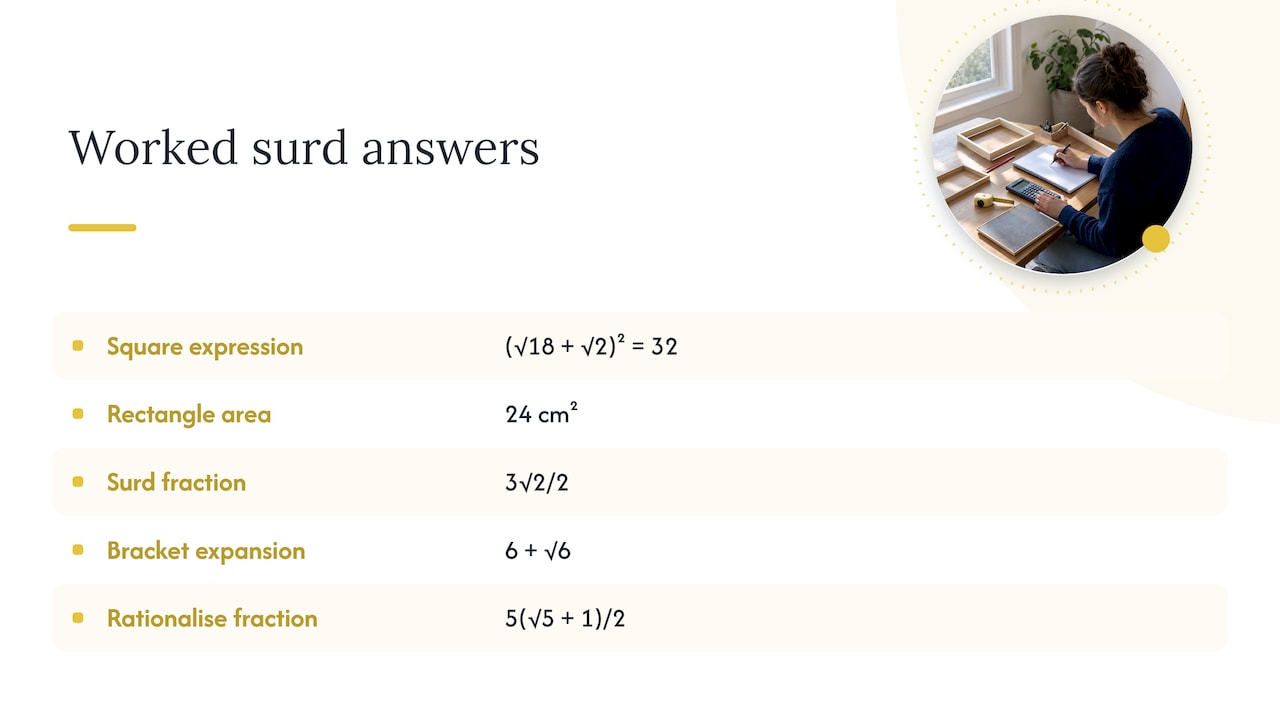
Question 1 (2 marks). Simplify √75.
Answer: √(25 × 3) = 5√3.
Question 2 (3 marks). Show that (√18 + √2)² = 32.
Answer: √18 = 3√2, so the bracket is 3√2 + √2 = 4√2. Squared: 16 × 2 = 32. Writing “4√2” as an intermediate line earns the method mark.
Question 3 (3 marks). A rectangle has length 3√2 cm and width 2√8 cm. Find its area as an integer.
Answer: 2√8 = 2 × 2√2 = 4√2. Area = 3√2 × 4√2 = 12 × 2 = 24 cm².
Question 4 (3 marks). Write 1/√2 + √2 in the form a√2/b.
Answer: 1/√2 = √2/2. Then √2/2 + √2 = √2/2 + 2√2/2 = 3√2/2.
Question 5 (4 marks). Expand and simplify (4 − √6)(3 + √6).
Answer: 12 + 4√6 − 3√6 − 6 = 6 + √6. This matches the practice question on BBC Bitesize’s bracket-expansion page.
Question 6 (5 marks). Rationalise and simplify 10/(√5 − 1).
Answer: Multiply by (√5 + 1)/(√5 + 1). Denominator: 5 − 1 = 4. Numerator: 10(√5 + 1). So 10(√5 + 1)/4 = 5(√5 + 1)/2, or (5√5 + 5)/2.
When you want real papers rather than invented ones, work through topic questions in our AQA GCSE past papers (2017 to 2025) and mark yourself against the mark scheme, line by line.
Mistakes that cost marks
These are the slips we see most often when students work through surd questions:
- √3 × √3 = 9. The answer is 3. Remember the first rule: a surd times itself gives the number inside.
- √(a + b) = √a + √b. Roots split over multiplication and division only, never addition. √9 + √16 = 7, but √25 = 5.
- Combining unlike surds. 2√3 + 3√5 stays as it is. It is not 5√8.
- Stopping too early. √72 = 2√18 is not fully simplified. Use 36 and you get 6√2 in one step.
- Rationalising a two-term denominator with the wrong sign. If the denominator is 3 − √2, the conjugate is 3 + √2. Check that the new denominator is a whole number.
- Forgetting the numerator. Multiply the top by exactly what you multiply the bottom by, and then expand the numerator in full.
With multi-step questions, a tidy layout protects marks. Rationalise each fraction before combining over a common denominator; it keeps the numbers small and makes errors easier to spot. If you want help with those fractions, see our guide to algebraic fractions at GCSE.
A four-week plan for surds revision
Surds are a small topic, so a short, focused plan works well.
- Week 1: foundations. Learn the square numbers and the three rules. Do 15 simplifying questions until pulling out the largest square factor is automatic.
- Week 2: combining. Practise multiplying, dividing, adding and subtracting. Include questions where you must simplify first to find like surds.
- Week 3: brackets and rationalising. Expand single and double brackets, then rationalise one-term and two-term denominators.
- Week 4: exam practice. Mix everything. Do surd questions from past papers under timed conditions, then mark and redo every question where you lost a mark.
The method behind steps 2 to 4 is simple: attempt first, then check. Our guide to written versus video solutions explains how to try a question before you look at a worked answer. For a longer schedule, the 4 to 6 week video walkthrough plan shows how to build walkthroughs into your revision.
Our perspective on revising surds
Surds reward students who are methodical. Nothing here needs unusual insight: it needs the square numbers at your fingertips, a habit of simplifying before you combine, and working that a marker can follow line by line.
That is why we pair every past-paper question with a fully worked solution. A final answer of 8√2 tells you nothing about where a method mark was won or lost. A worked solution shows the route, so you can compare it with yours and find the exact line where it diverged.
We built MathVault so that this support is free for students in England, Wales and Scotland: past papers organised by exam board, step-by-step solutions, video walkthroughs and live weekly Q&A sessions. Our aim is for you to walk into the exam knowing the pattern behind each surd question, not hoping to recognise it.
Oloru
Practise surds with MathVault
We offer free GCSE maths past papers with fully worked solutions, organised by exam board, plus video walkthroughs and live weekly Q&A sessions. Some downloadable packs and recent resources are available as one-off purchases, and donations help keep the free material going.
Start with the AQA GCSE revision topics or the OCR GCSE revision topics, or browse maths past papers across every major exam board. If a worked solution still leaves you stuck, bring the question to a session: our guide to getting the most from live Q&A shows how to prepare. You can also visit MathVault to see everything available.
FAQ
Are surds on the Foundation tier or only Higher?
Surds are most heavily tested on Higher tier, where rationalising denominators and expanding brackets with surds appear. Foundation students should still be comfortable with square roots and, depending on the specification, may meet simple surd work. Check your exam board’s specification for the exact content for your tier.
Can I use a calculator for surds questions?
A calculator can check a decimal value, but a decimal is not an exact answer. If a question says “give your answer as a surd” or “in the form a√b”, a decimal will lose the accuracy mark. Practise by hand so you can do the working without relying on a calculator.
How do I know when a surd is fully simplified?
Look at the number under the root. If it has no square factor other than 1, it is fully simplified. For √30, the factors are 2, 3, 5, 6, 10 and 15, and none of those is a square number, so it cannot be simplified further.
What is the quickest way to improve at surds?
Learn the square numbers, then do short daily sets of simplifying questions before moving on to brackets and rationalising. Mark each set against a worked solution and note the line where any error crept in. Repeating the questions you got wrong a few days later is more effective than starting new ones.
Sources
- BBC Bitesize: Simplifying surds (AQA GCSE Maths)
- BBC Bitesize: Module 8 Algebra, Surds
- BBC Bitesize: Multiplying out brackets including surds
- BBC Bitesize: Rationalising denominators (Edexcel Higher)
- Mathcentre: Surds, and other roots
- AQA: Command words, Level 2 Further Maths
Leave a Reply