
Effective GCSE revision notes are concise, exam-board aligned summaries that target your weakest topics. Start by traffic-lighting every statement in the official specification, then schedule past-paper practice for the red and amber topics. Everything else in your notes, from formula sheets to model answers, should serve those gaps.
TL;DR:
- Move from open book, untimed papers to timed open book, then closed book under exam conditions; mark every answer strictly against the official scheme.
- Log each lost mark as knowledge, application, or technique, then match the fix to the error; repeated mistakes belong in notes and another practice question.
- Use 48 hours to condense weak topics, 24 hours for targeted questions, and the final 8 hours for light recall and rest.
- For science, give required practicals their own notes covering aims, numbered methods, variables, hazards, and evaluation points, then redraw labeled diagrams from memory.
- Match every resource to your exam board, qualification, tier, and current specification; answers outside answer spaces or on unnumbered pages may go unmarked.
Table of Contents
- What belongs in board-aligned GCSE revision notes?
- How do you use past papers and mark schemes to improve your marks?
- How should your notes look in maths, sciences, English and humanities?
- Which revision techniques are backed by evidence, and how do you build them into your notes?
- What does a 13-week plan and a 48/24/8 last-minute plan look like?
- How do you avoid losing marks through exam technique?
- Where can you find board-aligned notes, past papers and mark schemes?
- Why does structured note-making matter so much?
- How do our free maths papers and live Q&A fit your revision?
- FAQ
- Sources
What belongs in board-aligned GCSE revision notes?
Good notes are a tool for recall, not a record of everything you were taught. Before you write a single line, open the official specification for your exam board (AQA, Edexcel, OCR or WJEC) and treat it as the checklist your notes must satisfy. Every note you make should map to a specification point. If a note cannot be tied to one, it is probably decoration.
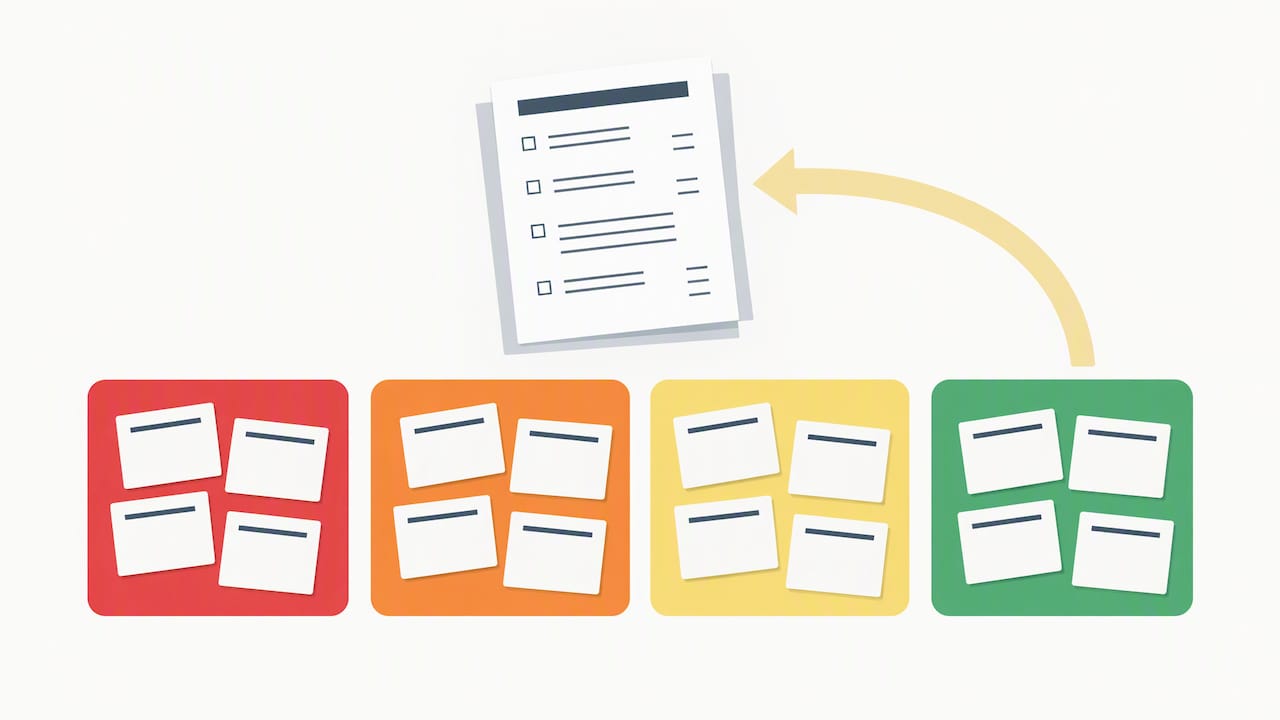
A simple way to start is to traffic-light the specification. Go through each statement and mark it red or amber if it is tricky and needs deep revision, yellow if it needs a review, and green if it is a strength you only need to embed. Your notes then grow where the red and amber sit, and stay thin where you are already secure. That is how you avoid the common trap of producing beautiful notes on topics you already know.
Each topic note should usually contain the following:
- A condensed summary of the topic, covering definitions, rules and the links between ideas.
- A formula or equation sheet for the topic, written out from memory first and then checked against the specification.
- Key diagrams, labelled by you, such as a cell diagram, a circuit, a graph sketch or a timeline.
- A model answer or worked example that uses the language of the mark scheme.
- Quick self-test items: questions you can answer without looking.
- Links to topic past papers, so you know exactly which questions to attempt next.
Keep the size of each note realistic. If a topic note becomes very long, you may have copied the textbook rather than condensed it. Aim for a compact chunk, whether on paper or on screen, so that you can cover it, recall it and check it quickly. Smaller notes get used more often, and notes that get used are the only ones that help.
Format matters less than function, but a few habits make notes easier to revise from. Put the specification reference in the margin so you can tick it off. Use headings that match the specification wording, because examiners write questions from the same language. Leave a column or a gap where you can add corrections after you mark a past paper. Your notes are a living document, and the gaps are where your error log feeds back into them.
Be wary of notes that are only rewritten text. Highlighting and copying out feel productive, but they do little to test whether you can retrieve the information in an exam. The Education Endowment Foundation recommends teaching students to plan, monitor and evaluate their own learning, and warns against passive rereading as an ineffective revision habit. A good note is built so that you can quiz yourself from it, not simply read it.
Pro Tip: Write each topic note, then cover it and rewrite it from memory on a blank page. Whatever you forget goes back into the note in a different colour, and that colour shows you your weak spots at a glance.
If you revise maths, our GCSE maths exam checklist may help you plan what your maths notes need to contain.
How do you use past papers and mark schemes to improve your marks?
Past papers are the closest thing you have to the real exam, and the mark scheme is the closest thing you have to the examiner’s mind. Used together, they turn vague revision into measurable progress. The key is a routine, because working through a paper once and glancing at the answers teaches you very little.
AQA examiner reports advise completing multiple past papers under timed conditions and marking strictly against official mark schemes. The reason is that many students lose marks by giving correct facts that do not meet what the mark scheme actually requires, as the Justin Craig exam technique guidance explains. A statement can be true and still earn nothing if it does not answer the question as the mark scheme frames it.
Here is a three-stage routine, adapted from the staged approach that school revision booklets recommend, such as the Hertfordshire school GCSE revision guidance:
- Open book, open time. Attempt the paper with your notes beside you and no clock. Your aim is to learn how the questions are built and where your notes fail you. Mark every point where you had to look something up.
- Open book, timed. Repeat with a fresh paper or fresh topic questions, still using your notes, but this time against the official timings. You are practising pace as well as content.
- Closed book, timed. Sit a paper in exam conditions with nothing to hand. This is your honest measure of where you stand, and the result tells you which topics to turn from amber to green.
Then comes the part many students skip: marking. Mark strictly. Give yourself a mark only when your answer matches the wording or method in the mark scheme, not when you feel you “basically” said it. Where the scheme splits marks by assessment objective, record which objective each lost mark belongs to. According to the exam technique guidance, marks are often divided across AO1 (knowledge), AO2 (application) and AO3 (analysis or evaluation), so knowing which one you are dropping tells you what kind of practice you need.
Practising past papers under accurate timed conditions is the single most effective way to learn exam skills, and successful students keep an error log that categorises exactly why marks were lost. This is the habit that separates students who plateau from those who keep climbing.
Your error log is simple to build. Create a table with four columns: the question, the marks lost, the type of error, and the fix. Sort every mistake into one of three types:
- Knowledge: you did not know or could not recall the fact.
- Application: you knew the content but did not apply it to the context in the question.
- Technique: you misread the command word, ran out of time, skipped working or wrote in the wrong place.
After you have marked some papers, patterns appear. If most of your lost marks are technique errors, more content notes will not help, and you need to practise reading the question and showing steps. If they are knowledge errors, the fix is a sharper note and a retrieval quiz on that topic. Turn each repeated mistake into one line in your notes and one extra practice question, then check later that it has stopped recurring.
Maths students can use our self-mark past papers with board-aligned solutions, which makes the strict marking stage far easier because you can compare each line of working against a full solution. For a broader plan on structuring maths practice, our guide to effective GCSE maths revision walks through the techniques in more detail.
One last point on timing. Do not save closed-book papers for the final week. Space them out across your plan so that each one informs the next round of note-making. A paper you sit in March and mark properly is worth more than three papers rushed through in June.
How should your notes look in maths, sciences, English and humanities?
The same principle applies across subjects, but the shape of a good note changes. Below are formats you can copy and adapt. In each case, tie the note to the specification and to the assessment objectives, so that you are practising what the exam actually rewards.
Maths: formulas, worked examples and showing working
Maths notes are strongest when they combine a short rule with a worked example. For each topic, build three parts: a formula or method box, a fully worked example in your own handwriting, and a “show working” checklist.
A worked-example template might run as follows. Write the question, list what you know, state the method, carry out each step on its own line, and finish with a check (does the answer make sense, are the units right?). Because a large share of the marks in maths reward method, not just the final answer, your notes should model the habit of laying out steps. Our page on banking marks by showing working explains why this matters for the reasoning and problem-solving marks.
Your “show working” checklist can be short:
- Have I written down the formula before substituting?
- Is every step on its own line?
- Have I included units and rounded only at the end?
- Have I checked my answer against the question?
Check which formulas you are given and which you must memorise for your board and tier. Our exam checklist may help with your revision planning.
Sciences: required practicals, diagrams and mark-scheme phrasing
For biology, chemistry and physics, build each note around three things: the core ideas, the required practicals, and short model answers.
Required practicals deserve their own note. For each one, write the aim, the method in numbered steps, the variables (independent, dependent, control), the main hazards, and the likely evaluation points. AQA examiner reports for science papers, such as the Foundation Paper 1 Chemistry report, note that unfamiliarity with required practicals is a common problem and that application and analysis questions often prove challenging. That is a direct prompt to rehearse practicals as thoroughly as you rehearse facts.
Label your diagrams yourself, then redraw them from memory. For model answers, copy the phrasing pattern the mark scheme rewards: a point, then the reason, then the consequence. A short answer such as “the rate increases because particles have more kinetic energy, so collisions are more frequent and more are successful” earns marks because each clause does a job.
English: vocabulary, paragraph skeletons and annotated exemplars
English notes work best as banks and skeletons, not summaries of plot.
- A vocabulary bank of precise analytical verbs and terms, grouped by purpose (to show contrast, to suggest tension, to build sympathy).
- A model paragraph skeleton, such as point, quotation, technique, effect, link back to the question. Write it once, then reuse it.
- Annotated exemplars: take a strong paragraph, annotate it with the assessment objectives it hits, and note why it works.
Learn a small set of quotations per text and tag each with the themes it can support. Quality beats quantity: quotations you can unpack in depth will serve you better than those you can only name. Map every skeleton and exemplar to the assessment objectives for your paper, so that you are rehearsing what the examiner credits.
Humanities: timelines and source-analysis templates
For history, geography and similar subjects, condense evidence and argument structure rather than narrative.
A timeline note should show cause and consequence, not just events. Draw arrows between events and add a one-line “so what?” to each. A source-analysis template can be a simple grid: what the source is, who made it and when, what it says, what it leaves out, and how useful it is for the question. In extended-answer subjects, the move from recall to explanation is where marks are won.
The EEF’s article on conceptual retrieval practice in the history classroom describes practising recall that stresses connections and the “why” rather than only facts, which supports higher-order thinking in essay subjects. You can build this into your notes by ending each timeline entry with a question such as “why did this lead to that?” and answering it from memory later.
Across all four subject groups, a few points hold:
- Use the specification wording as your headings.
- Add a self-test box to every note.
- Leave space to record corrections after marking a paper.
- Keep each note small enough to recall in one sitting.
If you want ready-made structure for maths, our GCSE maths revision guides give you topic-by-topic layouts you can adapt into your own condensed notes.
Which revision techniques are backed by evidence, and how do you build them into your notes?
Not every revision habit is equal. Some feel productive and do very little, while others feel harder and work much better. The aim is to build the useful ones into the way you make and use your notes.
Start with prioritisation. Traffic-lighting the specification, as described earlier, is the simplest way to decide where your time goes. Red and amber topics get the most attention, yellow topics get a review, and green topics get light-touch maintenance. Revisit the colours after each past paper, because topics should move towards green as your marks improve.
Next, think about how you space your practice. The SMART Spaces project from the EEF trialled a spaced-learning approach that combines short spacing within a lesson and a gap of 24 hours. The evidence is mixed, but the underlying spacing principles are supported by cognitive science, and the approach shows promise when it is combined with application tasks. A related revision programme pilot found the combination of ten-minute and 24-hour spacing a promising variant, and its structured, repeatable lessons were feasible for schools at low cost per pupil. You can borrow the idea without any special programme: study a topic, leave it, come back after a short break, then return the next day.
Then there is retrieval. Instead of rereading, close the book and bring information back from memory. Three simple methods fit neatly with your notes:
- Blank-page retrieval: write everything you remember about a topic on an empty page, then compare it with your note and add what you missed.
- The Leitner system: put flashcards in boxes; correct answers move to a box you review less often, wrong answers return to the first box.
- Self-testing: use the quiz items at the bottom of each note, ideally a day or more after you wrote it.
Finally, monitor yourself. The EEF guidance on metacognition points to planning, monitoring and evaluating your own learning as a core skill. A plan, do, review loop makes this practical:
- Plan: decide which specification points you will cover and how you will test yourself.
- Do: revise actively, using retrieval rather than rereading.
- Review: check what you recalled, mark the gaps, and adjust the next session.
Your notes are where this loop lives. The traffic lights show your plan, the self-test boxes carry out the retrieval, and the correction space and error log record the review.
Do not neglect the basics of looking after yourself. AQA’s revision advice highlights consistent sleep, stopping revision an hour before bed, short regular breaks and manageable daily habits as supports for concentration. Revision that eats into sleep tends to cost more than it gains, so build breaks into your timetable from the start.
Pro Tip: After each revision session, write down what you can now recall without looking and what you still cannot. The gap becomes the first task of your next session.
What does a 13-week plan and a 48/24/8 last-minute plan look like?
A plan is only useful if it tells you what to do with your notes each week. Below are two templates: a longer term plan and a last-minute plan for the final days. Adjust the timings to your own mock dates and exam timetable.
The 13-week plan: Condense, Memorise, Apply
School revision booklets such as the Hertfordshire GCSE guidance recommend a Condense, Memorise, Apply cycle: use the specification to create condensed notes, learn them by retrieval, then apply them to exam questions. You can run that cycle weekly for each subject, with checkpoints for past papers.
- Audit. Traffic-light the whole specification for each subject and build condensed notes for the red and amber topics.
- First full cycle. Condense a block of topics, memorise it with blank-page retrieval and flashcards, then apply it with topic questions from past papers. Log every error.
- Checkpoint. Sit a timed paper for a subject you are worried about, mark it strictly, and recolour your specification.
- Second cycle. Return to the topics still red or amber, revise thin notes, and add spaced reviews of previously covered topics.
- Closed-book paper. Sit a full closed-book timed paper in each key subject and update your error log.
- Targeted repair. Use your error log to choose practice tasks. Spend time on technique errors and repeated knowledge gaps.
- Consolidate. Reduce your notes to a compact format per topic, run a final retrieval round, and rest properly before the exams begin.
Split your time between condensing new material, retrieving older material, and applying it to questions. As the weeks go on, shift the balance towards application and retrieval.
The 48/24/8 last-minute plan
When time is short, you need a ruthless version. The idea is to split the final stretch before a given exam into three windows. Our last-minute revision plan sets this out for maths, and the logic applies to any subject.
- 48 hours before: condense. Pull out your red and amber specification points. Reduce each to a single compact note: key facts, formulas, a model answer and one self-test question.
- 24 hours before: practise. Work through targeted past-paper questions on those topics, then mark them strictly against the mark scheme. Fix errors straight into your notes.
- 8 hours before: polish. Do a light retrieval pass, from a blank page, of your one-page summaries. Check your equipment, your timings and the exam logistics, then stop and rest.
In every phase, notes do a different job. At 48 hours they are being shortened. At 24 hours they are being tested against real questions. At 8 hours they are being skimmed and recalled, never rewritten from scratch.
How do you avoid losing marks through exam technique?
Strong notes can still be undone by avoidable mistakes on the day. Exam technique is a skill you can rehearse, and it is where a surprising amount of lost marks can be recovered.
Start with time. Work out roughly how many minutes you can spend per mark for each paper, and practise those splits under timed conditions. A paper with a mix of short and long questions needs a plan: move on when you are stuck, flag the question, and return if time allows. You only learn your own pace by timing yourself, which is why the closed-book timed stage of your practice routine matters.
Layout matters more than students expect. Professional marking systems scan scripts on screen, so writing outside the answer spaces or failing to number extra pages can result in answers not being scanned and therefore not marked. If you need extra space, use the additional pages and number them clearly to match the question number.
Answers written outside the answer space, or on extra pages that are not clearly numbered, may not be scanned and so may not be marked. Treat the answer space as a boundary, and use extra pages deliberately.
Finally, answer the question that is asked. AQA examiner reports, such as the June 2023 Paper 1 report, repeatedly show students losing marks by not linking answers to the question context and by failing to follow the instruction precisely. A few habits help:
- Underline the command word (explain, evaluate, state, calculate) and answer in that mode.
- Use the vocabulary of the mark scheme and the stem of the question, so your answer is visibly linked to what was asked.
- Link your point to the context given, whether that is a named experiment, a source or a scenario.
- Check each answer against the number of marks, and make sure your response addresses what the question asks.
Reading examiner reports is one of the best ways to see these pitfalls in practice. Each one is a catalogue of what real students got wrong, and every item can become a line in your technique notes.
Where can you find board-aligned notes, past papers and mark schemes?
Reliable resources save you from revising the wrong thing. The golden rule is that the resource must match your exam board, your tier and the right year of the specification.
Start with the official sources. Your exam board publishes the specification, past papers, mark schemes and examiner reports for each qualification. The specification is the definitive list of what can be examined, and the mark scheme is the definitive statement of how marks are awarded. AQA’s student revision pages are a good starting point for AQA candidates, and the other boards offer equivalent pages for their own subjects.
For maths, we run a free archive that sits alongside those official sources. You can browse AQA GCSE maths past papers by year and use Edexcel past paper questions sorted by topic, which is helpful when you want to practise one red topic at a time and match your notes to question practice. We pair papers with fully worked step-by-step solutions and run live Q&A sessions, so you can mark your own work against a complete method and ask when something is unclear.
Use this checklist before you trust any resource:
- It names your exam board and qualification, such as AQA GCSE Mathematics, and not just “GCSE”.
- It matches your tier (Foundation or Higher) where tiers apply.
- It is written for the current specification, not an older one that has since changed.
- It uses the mark scheme’s own wording and shows how marks are allocated.
- It lets you check answers against official mark schemes.
- It covers topics in the same order and language as your specification, so you can tick points off.
If a resource fails one of these tests, treat it with caution. A well-presented guide for the wrong specification can send you off revising content you will never be asked, or missing content you will.
Why does structured note-making matter so much?
Having helped students prepare for maths exams, I hold a clear view: the students who improve fastest are not the ones with the neatest notes, but the ones who treat examiner language and past-paper practice as the centre of their revision. A note is only as good as the questions it helps you answer.
That is why we organise our maths material by board and topic. When a paper is sorted this way, self-marking becomes straightforward: you attempt a paper, compare each line of working with a full solution, log where marks slipped, and fold the lesson into a note. The loop is short, so you do it more often, and doing it more often is what moves marks.
I would also push back on the idea that more notes mean better revision. Many students collect resources endlessly and sit very few papers. Turn that around. Make fewer, sharper notes, and spend the saved time on papers you mark strictly.
So here is a small challenge. Pick one past paper this week, sit it under timed conditions, mark it against the official scheme, and start an error log with three columns: knowledge, application and technique. You will learn more from that single, honest paper than from another evening of rewriting.
— Oloru
How do our free maths papers and live Q&A fit your revision?
If maths is one of your subjects, we built our resources around exactly the workflow described in this guide. Our free archive covers AQA and Edexcel GCSE maths past papers, each with fully worked step-by-step solutions, so you can mark strictly and see precisely where your method differs from the model one.
Alongside the papers, we run live weekly Q&A sessions where you can bring the questions your error log throws up, and our downloadable revision packs help you turn those corrections into tidy, board-aligned notes. Together they give you the cycle at the heart of this guide: practise, mark, log, repair and retest.
You can start today with one paper. Open our self-mark past papers page, pick your board, sit a paper under timed conditions, mark it against the worked solutions, and begin your error log.
FAQ
What should GCSE revision notes include?
GCSE revision notes should include a condensed summary of each topic, key formulas or definitions, labelled diagrams, a model answer and a few self-test questions. Each note should map to a point in your exam board’s specification. Keep it small enough to recall in one sitting.
How do I start revising for GCSEs?
Begin by traffic-lighting the official specification for each subject, marking each statement red, amber, yellow or green, as the exam technique guidance describes. Then build notes and practice around the red and amber topics first. Sit a past paper early to see where you really stand.
Are past papers the best way to revise for GCSEs?
Past papers are one of the strongest revision tools, because they show you the real question style and the mark scheme. Practise them in stages, from open book to closed book under timed conditions, and mark strictly against the official scheme. Use an error log to turn lost marks into targeted revision.
How often should I review my revision notes?
Review notes in short sessions spread over several days rather than in one long sitting. The EEF’s SMART Spaces project explored short gaps combined with a 24-hour gap, and the evidence is mixed but promising. Use retrieval, such as blank-page recall, at each review instead of rereading.
Does rereading notes work for GCSE revision?
Rereading on its own is a weak way to revise, and the EEF warns against passive rereading as an ineffective habit. Closing the book and recalling from memory, then checking and correcting, works far better. Build self-test items into your notes so retrieval is part of every session.
Sources
- Justincraig
- Educationendowmentfoundation
- GCSE Course Overview Booklet: Subject Exam Information and Revision Guidance
Leave a Reply