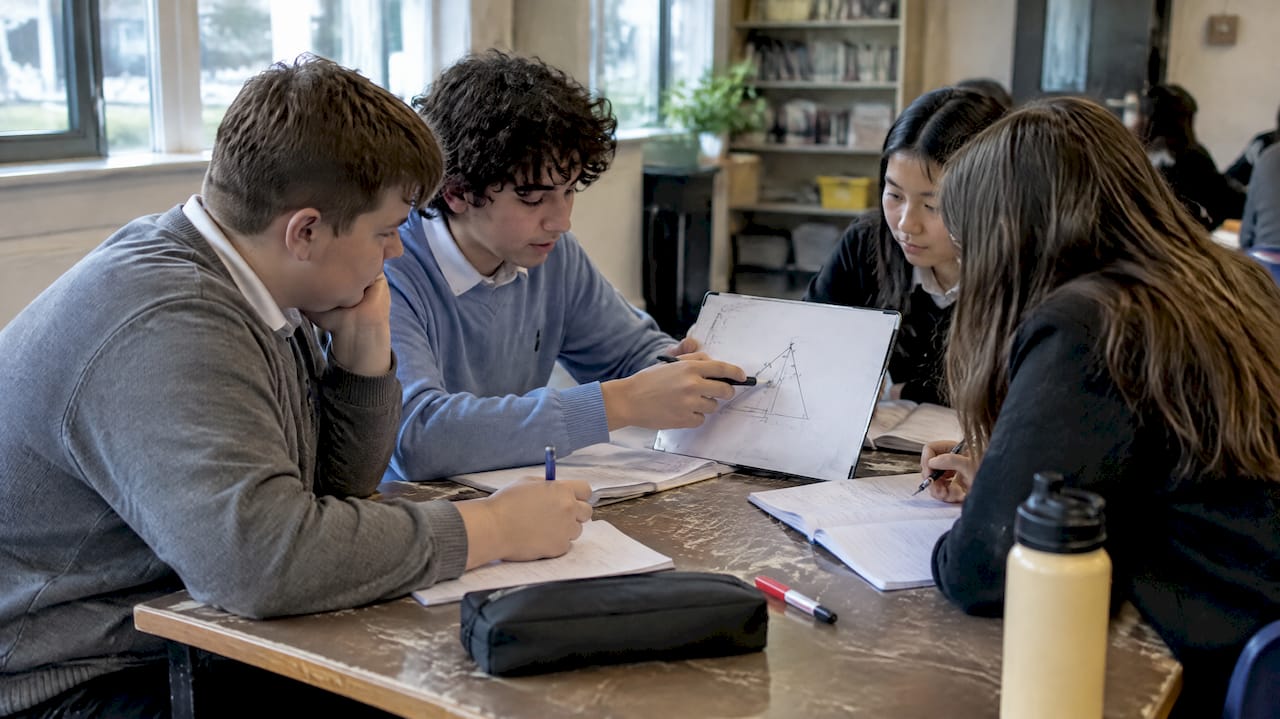
Use structured small groups of three to five pupils with a shared outcome and defined roles for a single lesson, and maths progress follows. The EEF collaborative learning toolkit backs this with measurable gains in secondary maths classrooms. Below, we set out a ready-to-run activity bank and a full lesson template so you can put this into practice today.
TL;DR:
- The EEF estimates about five months of additional maths progress on average, rising to six months in secondary settings when collaboration is structured.
- Mixed attainment grouping can slightly reduce progress for high attainers, while disadvantaged pupils and lower attainers show broadly similar outcomes; deliberately balance confidence and skill.
- Rotate facilitator, scribe, checker, and reporter roles each lesson, and use an eight to ten minute checkpoint to confirm every group is progressing.
- A 30 to 40 minute lesson can use five minutes for setup, 20 to 25 for group work, and five to 10 for presentations.
- Use a three point rubric to score reasoning, method, justification, and teamwork; mini whiteboards, peer questions, and individual exit slips provide quick evidence.
Table of Contents
- Why structured collaborative group study works
- Five ready-to-use group maths activities for lower-secondary classes
- How to organise groups and manage classroom logistics
- Assessing collaborative work and using joint outcomes for feedback
- How MathVault resources support group study
- A short sample 30 to 40 minute lesson plan teachers can copy
- Classroom-tested tips from a practising maths educator
- How MathVault can help: ready-made packs and self-mark past papers
- FAQ
- Sources
Why structured collaborative group study works
Collaborative learning approaches increase pupil progress in maths by several months on average, with evidence suggesting a somewhat stronger effect in secondary settings, according to the EEF collaborative learning toolkit. The same toolkit identifies groups of three to five pupils with shared responsibility as the most effective configuration.
Well-structured collaborative learning is reported to lead to meaningful additional progress in maths, according to the EEF. This effect appears to be larger in secondary classrooms, making this approach particularly relevant at key stage 3.
Why does group size of three to five matter so much? Smaller groups give every pupil a reason to speak and a stake in the outcome. When we look for successful collaboration in our own classrooms, we check for three things:
- Every pupil contributes mathematical reasoning aloud, not just arithmetic.
- The group produces one agreed answer or explanation rather than several unconnected attempts.
- Pupils challenge each other’s reasoning before accepting a method.
Five ready-to-use group maths activities for lower-secondary classes
These five tasks need minimal preparation and map directly onto the evidence above.
- Seven Squares. Pupils arrange square tiles to spot a pattern, then generalise it algebraically. The Seven Squares group-worthy task from NRICH is designed for ages 11 to 14 and moves naturally from pattern spotting towards nth-term expressions. Allow 20 minutes and a set of squared paper or tiles per group.
- Making Rectangles. Each pupil holds a different piece of information, so the group can only succeed by communicating clearly. The Making Rectangles task works well with a silent variation, where pupils pass hint cards instead of speaking, or an observer variation, where one pupil watches and reports back on how the group communicated.
- Collaborative problem-solving challenge. Set an open task with clear success criteria written on the board and two extension prompts ready for groups that finish early. This keeps faster groups stretched without needing separate worksheets.
- Reasoning and proof task. Assign each pupil a role (propose, check, challenge, record) and ask the group to produce one collective written explanation of why a result holds. This format reveals gaps in understanding faster than individual written work.
- Mixed-maths relay. Groups complete a sequence of short timed questions, rotating who writes the answer each round. Track a group score on the board to keep pace and energy high across the lesson.
Pro Tip: Give each group a single whiteboard and one pen for Making Rectangles. Sharing one pen forces turn-taking and stops the fastest writer from dominating the task.
How to organise groups and manage classroom logistics
Group composition affects outcomes more than most teachers expect. The EEF Student Grouping Study found that mixed-attainment grouping produces variable results and can slightly reduce progress for high-attaining pupils, while outcomes for disadvantaged pupils and lower attainers stay broadly similar. Purposeful grouping, where you deliberately balance confidence and skill, tends to outperform random grouping for tasks that need sustained reasoning.
Assign roles explicitly rather than letting pupils default to habits:
- Facilitator: keeps the group on task and moving through the steps.
- Scribe: records the group’s working and final answer.
- Checker: verifies each step before the group moves on.
- Reporter: presents the group’s answer to the class.
Rotate these roles every lesson so every pupil practises each skill over a term. Set a checkpoint every 8 to 10 minutes, where you ask one question per group to confirm progress, and give high attainers an extension prompt from the start so they stretch reasoning rather than simply finishing first.
Assessing collaborative work and using joint outcomes for feedback
A one-page rubric keeps marking light while still capturing what matters: mathematical reasoning, method, justification and teamwork, each scored on a simple three-point scale.
- Use mini-whiteboards at the checkpoint stage so every group shows working without you collecting books.
- Run a 60-second peer-questioning round, where one group asks another to justify a step.
- Set an exit slip asking each pupil to write one sentence explaining what their group decided and why.
- Keep brief observational notes on who took which role, and ask pupils to self-assess their contribution against the rubric.
Group reports, kept alongside these notes, give you concrete evidence of progress to share with parents or senior leaders without extra marking load.
How MathVault resources support group study
Worked solutions and video walkthroughs give you material to extend or adapt collaborative tasks without writing new content from scratch.
- A worked-solution walkthrough works well as a reasoning group task: pupils watch the first few steps together, then complete the solution as a group before checking it against a model solution.
- Past papers organised by topic let you build challenge cards or relay stations straight from exam-style questions.
- Live Q&A sessions and downloadable revision materials can give groups a follow-up task or remediation route once the lesson ends.
A short sample 30 to 40 minute lesson plan teachers can copy
- Starter (5 minutes): introduce the task, assign roles, and display success criteria on the board.
- Group activity (20 to 25 minutes): run the task in two timed stages with a checkpoint question between them.
- Plenary (5 to 10 minutes): each group’s reporter presents in under two minutes, followed by brief teacher feedback.
For lower-attaining groups, pre-fill one row of the task to reduce the entry barrier. For higher attainers, remove scaffolding and add an algebraic generalisation prompt. For mixed or remote provision, set the group task as a shared document and keep the same roles, with the facilitator managing turn-taking in the chat.
Pro Tip: Keep reporting windows to 90 seconds. A tight limit forces groups to identify their clearest point rather than narrating the whole process.
Classroom-tested tips from a practising maths educator
Rotating roles every lesson keeps engagement high. Pupils who know they will scribe next week pay closer attention to how the current scribe works. Short reporting windows of 90 to 120 seconds force clarity and quickly reveal which groups understood the task and which were simply busy. The same discipline that works well in structured group lessons in other subjects, such as group piano teaching, holds true in maths: clear roles and a shared outcome beat open-ended collaboration every time.
— Oloru
How MathVault can help: ready-made packs and self-mark past papers
Running group activities well takes preparation time most of us do not have spare. We offer self-mark past papers with board-aligned solutions that groups can use for peer marking, which cuts your marking load and gives pupils instant feedback on their joint answers.
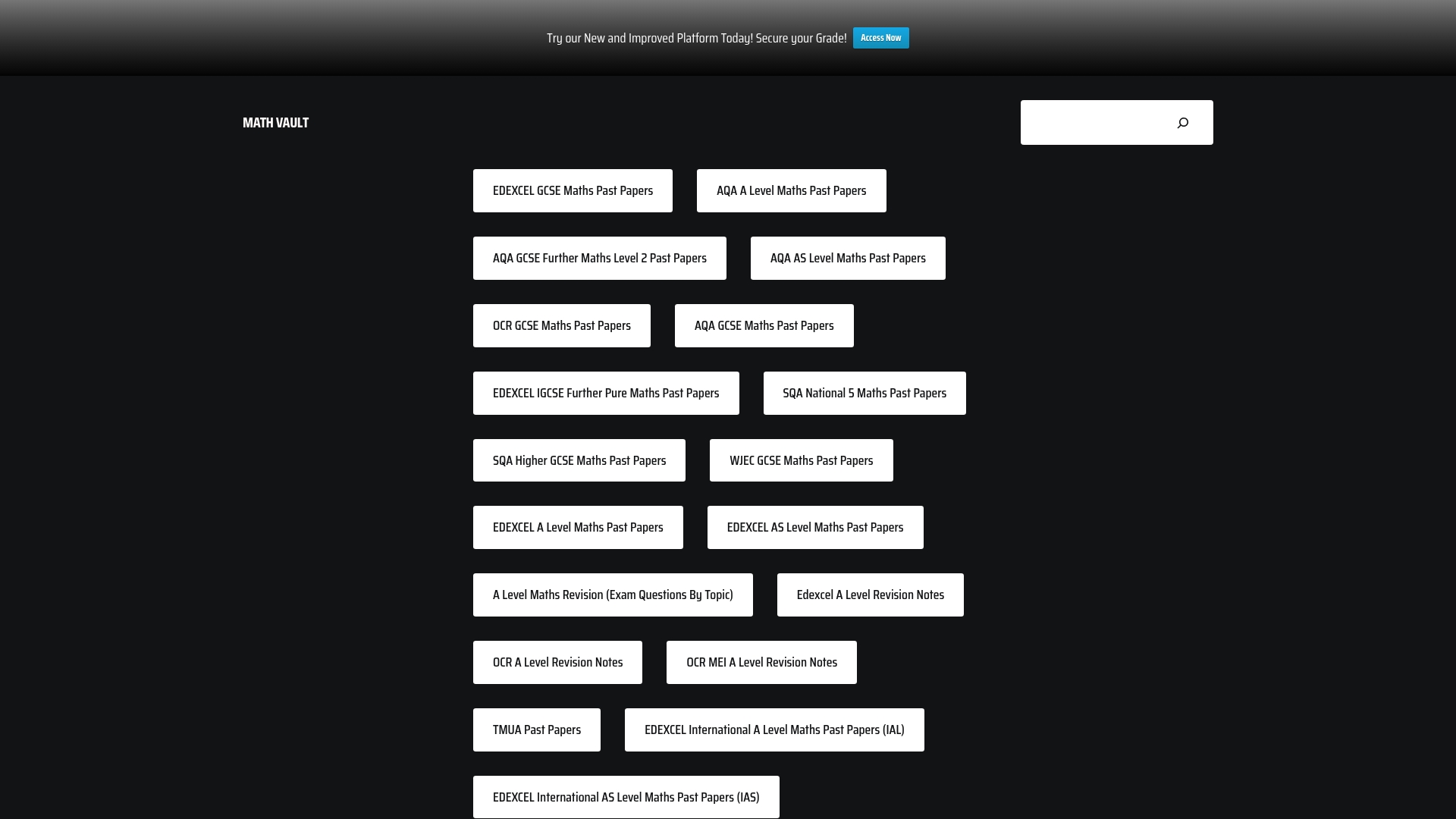
- Self-mark past papers let groups check their own work against board-aligned solutions.
- Video walkthroughs give groups a model answer to compare against their own reasoning after a task.
- Live Q&A sessions offer a follow-up route for groups who want to talk through a sticking point directly.
Download a pack for your next topic or book a place at our next live Q&A session to see how it fits your group activities.
FAQ
What are some ideas for maths group projects?
Group-worthy tasks that require interdependence work best, such as Seven Squares for pattern generalisation or Making Rectangles for communication under constraint. Reasoning and proof tasks, where pupils collectively justify a result, and timed relay challenges also work well for lower-secondary classes.
What grade is 67% in A level maths?
Grade boundaries vary by exam board, series and year, so a fixed percentage does not map to a single grade across the board. Check the specific exam board’s published grade boundaries for the relevant series before giving pupils a definitive answer.
What is group collaboration worth in terms of progress?
Collaborative learning approaches can add around five months of progress in maths on average, rising to about six months in secondary settings, according to the EEF toolkit. This depends on groups being small, usually three to five pupils, with a shared outcome rather than individual parallel work.
What are the common types of groups used in maths lessons?
Teachers typically choose between random grouping, mixed-attainment grouping and purposeful grouping based on confidence and skill balance. The EEF Student Grouping Study found mixed-attainment grouping can slightly reduce progress for high attainers, so purposeful grouping often suits tasks that need sustained reasoning.
How can I mark group maths work without extra workload?
A one-page rubric scoring reasoning, method, justification and teamwork keeps assessment quick. Pairing this with mini-whiteboard checks, exit slips and short self-assessment notes gives you evidence of progress without collecting and marking every book.
Sources
- Collaborative learning approaches | EEF
- Seven Squares – Group-Worthy Task | NRICH
- Making Rectangles | NRICH
Leave a Reply