
Textbooks teach you a topic properly; revision notes get it back into your head fast under exam pressure. If you are meeting a topic for the first time or keep getting it wrong, open the textbook. If your exam is six weeks away or closer, start condensing notes and testing yourself daily. Board-aligned guides work well for that second stage.
TL;DR:
- Textbooks are essential for first learning and understanding the logic behind concepts, especially in procedural subjects like maths and science.
- Condensed revision notes excel in rapid recall and are ideal in the final weeks, but lack the detailed reasoning needed for unfamiliar exam questions.
- Practicing active retrieval, spaced over days or weeks, significantly improves memory retention regardless of resource choice.
- Tailoring resource use to subject type and revision stage maximizes effectiveness, with textbooks for initial learning and notes for quick review and memorization.
- Reliable revision notes must align with your exam board, include worked examples, and be structured to prompt active recall rather than passive rereading.
Table of Contents
- Revision notes vs textbook: the quick rules
- What revision notes are and when they help
- What textbooks are and when they help
- Revision notes vs textbook: the differences that decide your grade
- Matching the resource to your stage of revision and how you learn
- A term-by-term timetable for using textbooks and notes
- The learn, retrieve, condense, test workflow
- What the evidence actually says about textbooks and notes
- Tips for creating effective revision notes from textbooks
- Common pitfalls when relying solely on revision notes or textbooks
- How to evaluate the quality and reliability of revision notes
- Where revision notes win and where textbooks win by subject
- A publisher’s note on getting this balance right
- Put this into practice with MathVault.io
- Sources
- FAQ
Revision notes vs textbook: the quick rules
Before you overhaul your whole study routine, here are the rules that matter most.
- Learning something new? Start with a textbook, not notes.
- Exam within four to six weeks? Switch to condensed notes and daily retrieval.
- Spacing and self-testing beat rereading, whichever resource you use.
- Maths and science benefit from worked examples first; memory-heavy subjects like history or biology often respond well to flashcards and one-page summaries.
- Pick one subject today and match it to the resource it actually needs, rather than defaulting to whatever’s on your desk.
What revision notes are and when they help
Revision notes take several forms: condensed one-page summaries, flashcards, mind maps, digital decks, and annotated past-paper answers. Each is built for the same job, getting information out of long-term memory quickly, not putting it in.
Their strength is speed. A well-made set of notes turns a two-hour textbook chapter into a two-minute scan, which is exactly what you need in the final fortnight before an exam. Notes also lend themselves to spaced retrieval, where you test yourself on the same content at increasing intervals.
The risk is that shorthand hides the reasoning. Notes that skip the “why” behind a method leave you stuck the moment an exam question phrases things differently to how you memorised them.
A good set of notes should cover:
- A clear definition of the concept, in your own words.
- One worked example, not just a formula.
- Any exceptions or common exam traps.
- One applied question you’d expect to see in a real paper.
Pro Tip: If you can’t write a one-sentence definition from memory without peeking, your notes aren’t ready. That gap is exactly what the textbook is for.
What textbooks are and when they help
A good textbook sequences a subject properly: it builds each idea on the last, gives worked examples, includes diagnostic checks, and offers extension tasks for once you’ve got the basics down. That structure is what makes it good for first encounters with a topic, not fast recall.
Its strength is depth. When you don’t understand why a method works, only a textbook (or a teacher) can walk you through the logic step by step, correcting the misconception before it hardens into a habit. Cambridge Assessment’s Tim Oates has argued that declining reliance on high-quality textbooks risks fragmenting pupils’ learning and weakening curriculum coherence.
The drawback is time. Flicking through 40 pages to find one worked example is a poor use of the final week before an exam, and not every school textbook is written with exam-board phrasing in mind.
- Best used when you’re learning a topic properly for the first time.
- Best used when you keep making the same mistake and need the reasoning re-explained.
- Best used for step-by-step practice in procedural subjects like maths and chemistry.
- Weakest under time pressure, when speed of recall matters more than depth of explanation.
Revision notes vs textbook: the differences that decide your grade
Six axes decide which resource wins for any given topic: purpose, depth, time cost, practice availability, syllabus alignment, and portability.
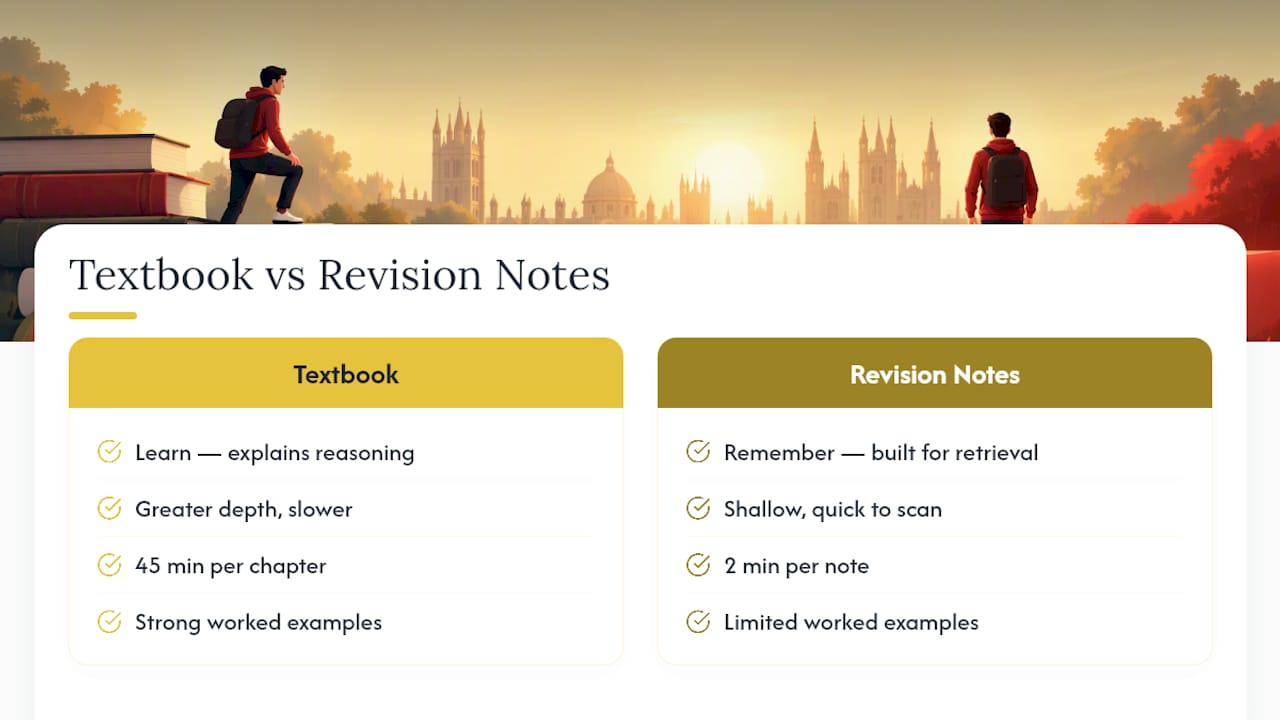
Purpose is the biggest one. If you need to learn something, a textbook wins because it explains reasoning. If you need to remember something you’ve already learned, notes win because they’re built for fast retrieval.
Depth versus speed follows from that. A textbook chapter might take 45 minutes to read properly; the equivalent revision note takes two minutes to scan. Neither is “better”, they’re built for different jobs.
Syllabus alignment matters more than students think. A generic textbook might cover content an exam board doesn’t test, while board-specific notes (like the GCSE and A level packs on MathVault.io) stay tightly focused on what actually appears in the paper.
Practise availability tips towards textbooks for procedural subjects. Maths, physics, and chemistry all demand worked examples with method marks explained, something a condensed note can’t replicate on its own.
As a rough rule: if the question is “do I understand this?”, reach for the textbook. If the question is “can I recall this under pressure?”, reach for your notes. Subjects like further maths and chemistry lean textbook-first; subjects like history, biology, and geography lean note-first once the initial learning is done.
Matching the resource to your stage of revision and how you learn
Where you are in the revision calendar should decide what’s on your desk, not habit.
- First learning a topic (months out): lean heavily on textbooks. Read a small chunk, work through the examples, and don’t move on until you can explain the idea without the book.
- Consolidation (six to ten weeks out): mix both. Use the textbook to patch gaps, but start building condensed notes as you go, rather than leaving that job to the last fortnight.
- Final stretch (four to six weeks and closer): notes and past papers take over. The textbook becomes a reference for the specific misconceptions that keep tripping you up.
How you learn best matters too. If you’re a procedural learner, you retain more from doing worked examples repeatedly than from reading summaries, so lean on textbook practice questions longer. If you’re a factual learner, flashcards and condensed notes will get you further, faster. If you’re a reflective learner, textbook explanations paired with self-explanation (talking through the “why” out loud) tend to stick best.
The clearest signal to switch resources is repeated failure on past-paper questions. If you’re getting the same type of question wrong twice, that’s a misconception, not a memory gap, and it needs a textbook, not another flashcard.
A term-by-term timetable for using textbooks and notes
A workable revision timetable follows the same shape most exam boards expect, moving from depth to speed as the exam approaches.
- Term-time (months before exams): learn with the textbook during lessons, then run a weekly 20 to 30 minute low-stakes quiz on that week’s content. This is where spaced retrieval starts paying off, even months before the exam itself.
- Mid-revision, six to four weeks out: shift the balance towards condensed notes. Run short daily retrieval sessions, 15 to 20 minutes per subject, and increase past-paper practice weekly.
- Final week: short, focused testing only, using flashcards, formula sheets, and error logs from earlier papers. This is not the week to open a textbook chapter you haven’t read yet.
Pro Tip: Match session length to subject type. Maths and science reward 30 to 40 minute worked-example blocks; memory-heavy subjects respond better to five short 10 minute retrieval bursts spread across the day.
The learn, retrieve, condense, test workflow
This is the routine that turns textbook understanding into exam-ready recall, and it works for almost any subject.
- Read a small chunk of the textbook, one sub-topic, not a whole chapter.
- Close the book and write down everything you remember, a “brain dump”, with no peeking.
- Check your brain dump against the textbook and mark what you missed.
- Condense the corrected version into a one-page note or a small flashcard set.
- Use those notes for spaced self-testing over the following days.
- Return to the textbook only for the specific points you still can’t explain.
For maths and science, turn each textbook worked example into either a flashcard prompt or a short exam-style question, never copy the working verbatim, since copying reduces the retrieval effort that actually builds memory. The golden rule: always test yourself from memory before checking the answer.
What the evidence actually says about textbooks and notes
Retrieval practice, actively pulling information from memory rather than rereading it, produces measurably larger learning gains than passive review, according to the Education Development Trust’s guidance for early career teachers. Spacing that retrieval out over days and weeks strengthens it further, and feedback (checking your answer against the textbook or mark scheme) improves the effect again.
Practical retrieval techniques including quizzes, brain dumps, and flashcards work best when spaced, varied, and kept low-stakes, according to Education NI’s classroom guidance.
On the textbook side, DfE exemplar materials stress that knowledge sequencing and diagnostic checks, exactly what a good textbook provides, underpin durable learning. The practical takeaway holds regardless of which resource you prefer: retrieval, spacing, and honest self-checking convert study hours into marks. The medium matters less than the method.
Tips for creating effective revision notes from textbooks
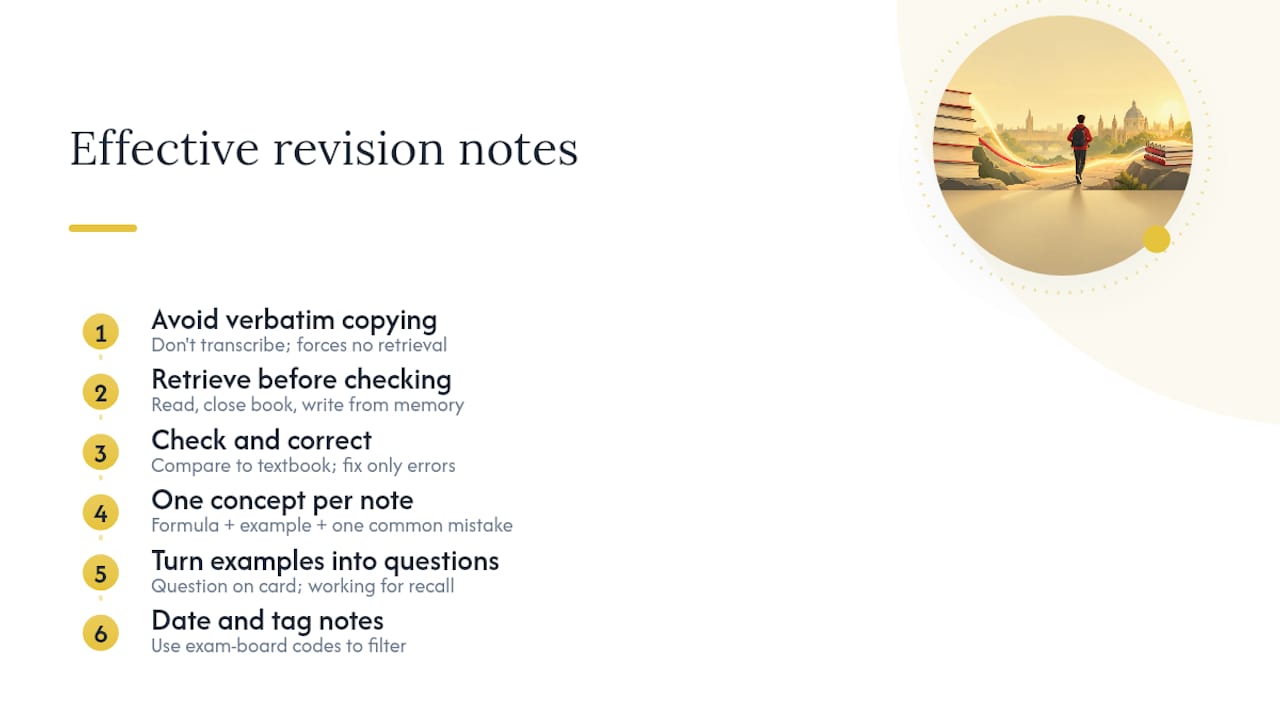
The mistake most students make is transcribing the textbook rather than translating it. Copying a paragraph word for word feels productive but does almost nothing for memory, because you never had to retrieve anything.
Read a section, close the book, and write the note from memory first. Then check it against the textbook and correct only what’s wrong. This single change, retrieving before checking rather than checking before writing, is the difference between a note that helps you recall something and one that just looks tidy.
Keep each note focused on one concept, not one page of the book. A note titled “Quadratic Formula” should contain the formula, one worked example, one common mistake, and nothing else. Bundling three sub-topics into a single page makes revision slower, not faster, because you can’t test yourself on just one idea at a time.
Turn every worked example into a question. Instead of writing out the textbook’s solution to a simultaneous equation, write the question on one side of a flashcard and leave the working for active recall. Static notes get reread; question-based notes get tested.
Date and tag your notes by exam-board topic code where possible. Come the final fortnight, being able to filter notes by spec reference saves hours compared to hunting through a folder by memory.
Finally, review and revise your own notes at least once. First-draft notes made straight after a lesson are rarely as clean as the version you’d write a week later, once you know what actually confused you the first time.
Common pitfalls when relying solely on revision notes or textbooks
Relying only on revision notes is the more common trap, and the most dangerous one close to exams. Notes compress reasoning into shorthand, so when an exam question phrases something unfamiliarly, students who only ever revised from notes often can’t reconstruct the logic to answer it. This shows up most in maths and science, where method marks depend on understanding a process, not just recognising a final answer.
Over-reliance on notes also breeds false confidence. Recognising a fact on your own page feels like knowing it, but recognition and recall are different skills, and exams only test the second one.
Relying only on textbooks carries the opposite risk: running out of time. Students who never condense their learning into quick-access notes often find themselves rereading whole chapters days before an exam, when they should be testing recall instead. Textbooks also vary in quality and exam-board alignment, and a chapter that doesn’t match your specification can waste hours of study time on content you’ll never be examined on.
A subtler pitfall applies to both: studying without ever closing the book or the notes to test yourself. Passive review, of either kind, produces smaller learning gains than active retrieval, and it’s easy to mistake the comfort of familiarity for genuine readiness. The fix is the same whichever resource you favour: build in regular, low-stakes self-testing rather than another read-through.
How to evaluate the quality and reliability of revision notes
Not all revision notes are equal, whether they’re yours, a friend’s, or downloaded from a website. Before trusting a set of notes for exam prep, check four things.
First, does it match your exam board’s specification, not a generic version of the subject? Notes written for one board’s syllabus can miss content another board tests, or include content yours doesn’t cover at all.
Second, does it include worked examples, not just definitions? A note that states a rule without demonstrating it applied to a real question won’t prepare you for the application-based questions most GCSE and A level papers now favour.
Third, is it structured for retrieval or for rereading? Good notes prompt you to answer something; weak notes just restate the textbook in fewer words. If a set of notes reads like a summary rather than a set of questions or prompts, it’s built for the wrong purpose.
Fourth, check the source. Notes produced by exam-board-aligned platforms or experienced teachers tend to reflect actual mark-scheme language and command words, which matters more than students expect, since examiners reward specific phrasing. Board-aligned digital notes, such as the Mathvault, are built directly against exam-board specifications rather than a generic version of the subject, which is worth checking for any resource you rely on heavily.
Where revision notes win and where textbooks win by subject
The right resource depends heavily on what a subject actually tests. Maths and the sciences reward textbooks early on, because most marks come from applying a method correctly, and that method has to be learned properly before it can be condensed into a quick reference. GCSE and A level maths students who skip straight to notes often memorise a formula without understanding when to use it, which falls apart the moment a question is phrased unfamiliarly.
History, geography, and religious studies lean the other way. These are largely memory and argument-construction subjects, so once you understand the content, condensed notes, timelines, and flashcards of key dates, causes, and quotations become the more efficient tool. Rereading a 30-page textbook chapter on the causes of a historical event is far less productive than testing yourself against a one-page summary you built yourself.
English literature sits in between. You need the textbook (or the actual text) to understand character and theme in depth, but exam success depends on recalling quotations precisely under time pressure, which favours a condensed quotation bank over rereading the novel.
Biology and chemistry often need both resources working together: textbooks for mechanisms and processes (photosynthesis, reaction rates), and notes for the sheer volume of specific facts and definitions that exam boards expect verbatim.
A publisher’s note on getting this balance right
Having reviewed how UK students actually revise, the pattern is consistent: those who treat textbooks and notes as sequential tools, not competing choices, get more marks per hour of study than those who pick one and stick with it… The platform was built around that sequence, pairing structured guides with board-aligned notes and worked past-paper solutions so students can move from understanding to recall without losing momentum…
— Oloru
Put this into practice with MathVault.io
Knowing the theory is one thing; having board-aligned materials ready to use is another. This platform gives you both stages of this workflow for free: structured topic guides for the learning phase, and condensed, exam-board-specific revision notes for the recall phase.
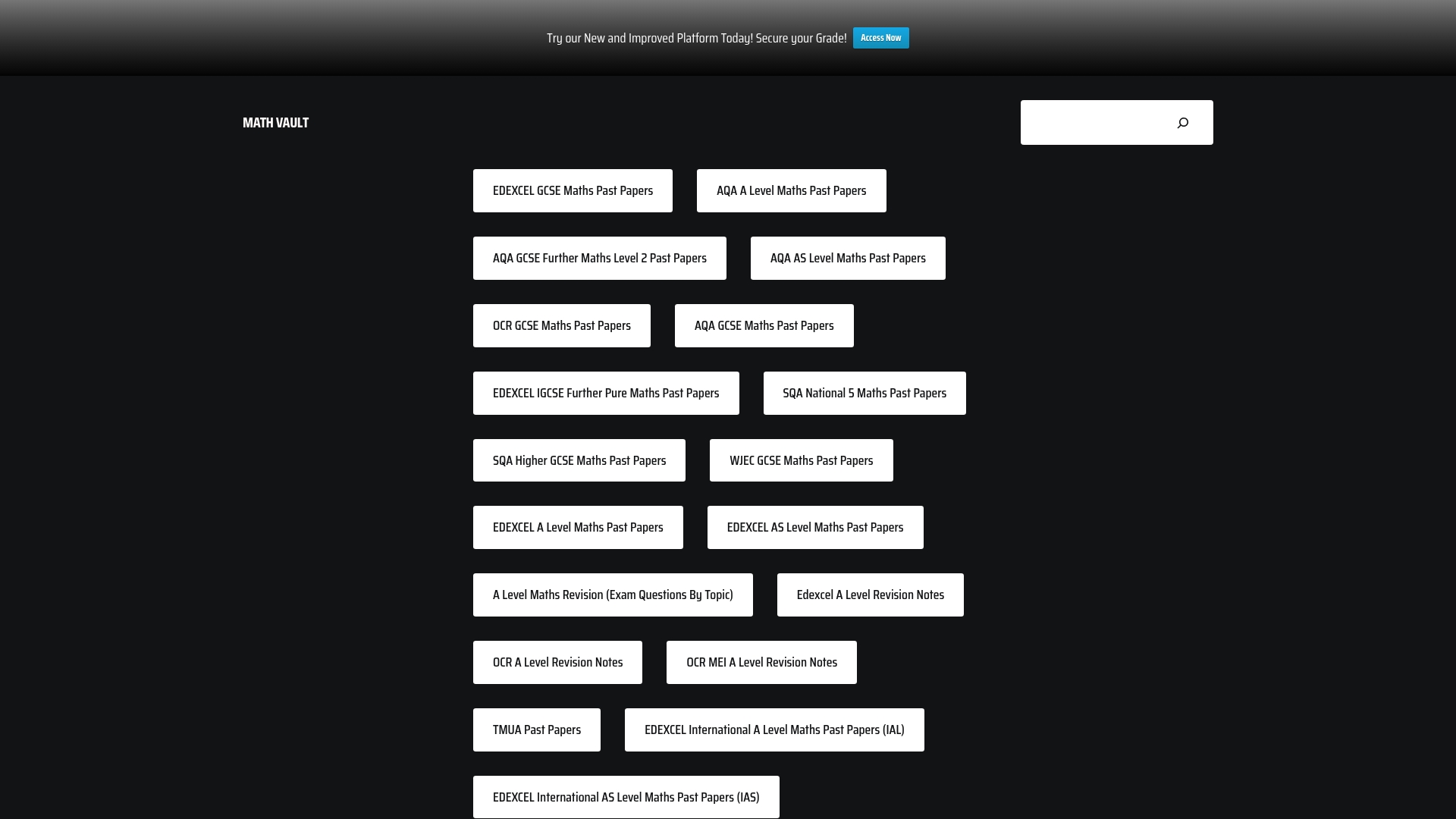
Start with the GCSE maths revision guides if you’re building understanding from scratch, or move straight to past-paper questions organised by topic once you’re ready to test recall under exam conditions. If you’re stuck on a specific misconception, a live weekly Q&A session can resolve it faster than another hour of rereading, turning one hour of live support into weeks of progress. Every past paper, worked solution, and video walkthrough is free to use; downloadable revision packs and direct support are available for those who’d like extra structure or want to contribute via Buy Me a Coffee. Pick one topic you’re behind on and work through it with MathVault.io this week.
Sources
- How pupils learn: making it stick — Education Development Trust (support for early career teachers)
- Retrieval practice: what it is, why it works and how to do it better — Education NI (May 2025 newsletter PDF)
- A textbook a day? Cambridge Assessment commentary on the value of textbooks
- How pupils learn: exemplars — Department for Education (DfE) PDF
FAQ
Is four hours of revision a day enough?
Four hours can be enough if it’s spent on active retrieval and spaced testing rather than passive rereading, since effortful recall produces far larger gains than the same time spent rereading notes or a textbook. Quality of method matters more than raw hours, so shorter, focused sessions with self-testing usually beat longer, unfocused ones.
Why do British students call studying “revising”?
In UK English, “revision” specifically means reviewing material you’ve already learned in preparation for an exam, as distinct from first-time learning. That’s why this guide draws a line between textbooks (learning) and revision notes (revising), since the two words describe genuinely different stages of study in England, Wales, and Scotland.
What is the best way to revise for GCSEs?
The most effective approach combines spaced, low-stakes self-testing with condensed notes built from a solid textbook understanding, rather than relying on either resource alone. Board-aligned resources like MathVault.io’s GCSE revision guides and topic-based past papers help keep that practice tightly matched to what your exam board actually tests.
Does “revision” mean the same as “studying” in England?
Not quite. In England, “studying” usually refers to first learning material, while “revision” refers to reviewing and consolidating it before an exam, which is why textbooks tend to dominate the studying phase and notes dominate the revision phase.
Should I trust revision notes I find online?
Only if they’re aligned to your specific exam board’s specification and include worked examples rather than just definitions. Check that the source reflects actual mark-scheme language, and treat any notes that only restate facts, without prompting you to recall or apply them, as a starting point rather than a finished resource.
Leave a Reply