
The Edexcel maths specifications you need are Pearson Edexcel GCSE (9–1) Mathematics (1MA1) and Pearson Edexcel A level Mathematics (9MA0). GCSE 1MA1 is assessed through three written papers, each 1 hour 30 minutes and worth 80 marks, with Paper 1 non-calculator and Papers 2 and 3 calculator-allowed. A level 9MA0 splits into three 2-hour papers, each worth 100 marks, covering Pure 1, Pure 2, and Statistics & Mechanics.
TL;DR:
- Edexcel GCSE (9–1) mathematics is assessed through three 1h30m papers, with only Paper 1 non-calculator, and total marks needed for a grade are evenly spread across all three papers.
- The A level qualification includes three 2-hour exams covering pure mathematics, statistics, and mechanics, with no tiering and all sitting the same papers in June.
- The specification clearly defines exam content, mark distribution, allowable equipment, and grading, making it essential to consult the official document before revision.
- Timed practice aligned with the specification and understanding assessment objectives, especially problem-solving (AO3), is crucial for consistent exam performance.
- Both GCSE and A level assessments rely solely on timed written exams; there is no coursework or non-exam assessment involved.
Table of Contents
- Edexcel maths specification explained: qualification at a glance
- What’s in the Edexcel GCSE maths specification?
- Edexcel A level maths: the paper map and topic guide
- How marks become grades: assessment objectives and grading
- Formulae sheets and calculator rules explained
- Turning the specification into a revision plan
- How Mathvault maps its resources to the Edexcel specification
- Controlled assessment and coursework: what’s required for A level maths
- Non-exam assessment: does Edexcel maths have any?
- Access arrangements for candidates with additional needs
- An educator’s view on where students actually lose marks
- Getting exam-ready with Edexcel resources
- Sources
- FAQ
Edexcel maths specification explained: qualification at a glance
Before you plan a single revision session, confirm you’re looking at the right document. Pearson publishes separate specifications for GCSE and A level, and mixing them up wastes hours.
Here’s the quick reference:
- GCSE 1MA1 — Pearson Edexcel Level 1/Level 2 GCSE (9–1) in Mathematics. First taught from September 2015, with the current specification still governing exam series through the current cycle.
- A level 9MA0 — Pearson Edexcel Level 3 Advanced GCE in Mathematics. First teaching began in September 2017 under the reformed linear A level structure.
- Assessment series — GCSE candidates normally sit exams in the May/June series, with a restricted November series available for post-16 resits. A level candidates sit all three papers in a single May/June series, with no equivalent autumn resit window.
- Where to find the official documents — Pearson hosts the full specification PDF, sample assessment materials (SAMs), and examiner reports on its qualifications website, searchable by specification code.
A specification is not a revision guide. It’s the legal and academic contract between Pearson, Ofqual, and every school that enters candidates. It defines exactly what content is examinable, how marks are distributed, what equipment students may use, and what grade boundaries mean in practical terms. If you’ve ever wondered why a topic appeared on a mock exam but never on a real paper, or why a teacher insists on a particular method, the answer usually traces back to a specific clause in this document.
Pro Tip: Download the specification PDF once and keep it on your phone or tablet during revision. When a past paper question feels unfamiliar, checking the content list against the spec takes thirty seconds and tells you instantly whether it’s in scope or an edge case worth skipping.
Students often assume the specification is only useful for teachers writing schemes of work. That’s a mistake. The content list at the back of each document tells you precisely which topics are Foundation-only, Higher-only, or shared, which matters enormously when you’re deciding where to spend your final six weeks. Understanding Edexcel maths at this level of detail, rather than relying on generic revision guides, is what separates students who walk into the exam hall confident from those hoping for the best.
What’s in the Edexcel GCSE maths specification?
GCSE mathematics content is organised under six headings: number, algebra, ratio and proportion, geometry and measures, probability, and statistics. Every topic within those headings carries a code, and the subject content document that underpins all exam boards’ GCSE maths specifies which content is standard, which is shown in bold (Higher tier only), and which is underlined to indicate greater depth expected at that tier.
Tiering shapes your entire revision strategy. Foundation tier covers grades 1 to 5; Higher tier covers grades 4 to 9, with grade 4 and 5 available as a safety net at the bottom of the Higher range. If you’re predicted a grade 5 or 6, your teacher’s tier decision has real consequences: sit Foundation and a grade 9 becomes mathematically impossible, no matter how well you perform. Sit Higher and score too low, and you risk missing a grade altogether. This decision typically gets made in Year 11, so raise it with your teacher early if you’re unsure which tier fits your trajectory.
The paper structure is identical regardless of tier:
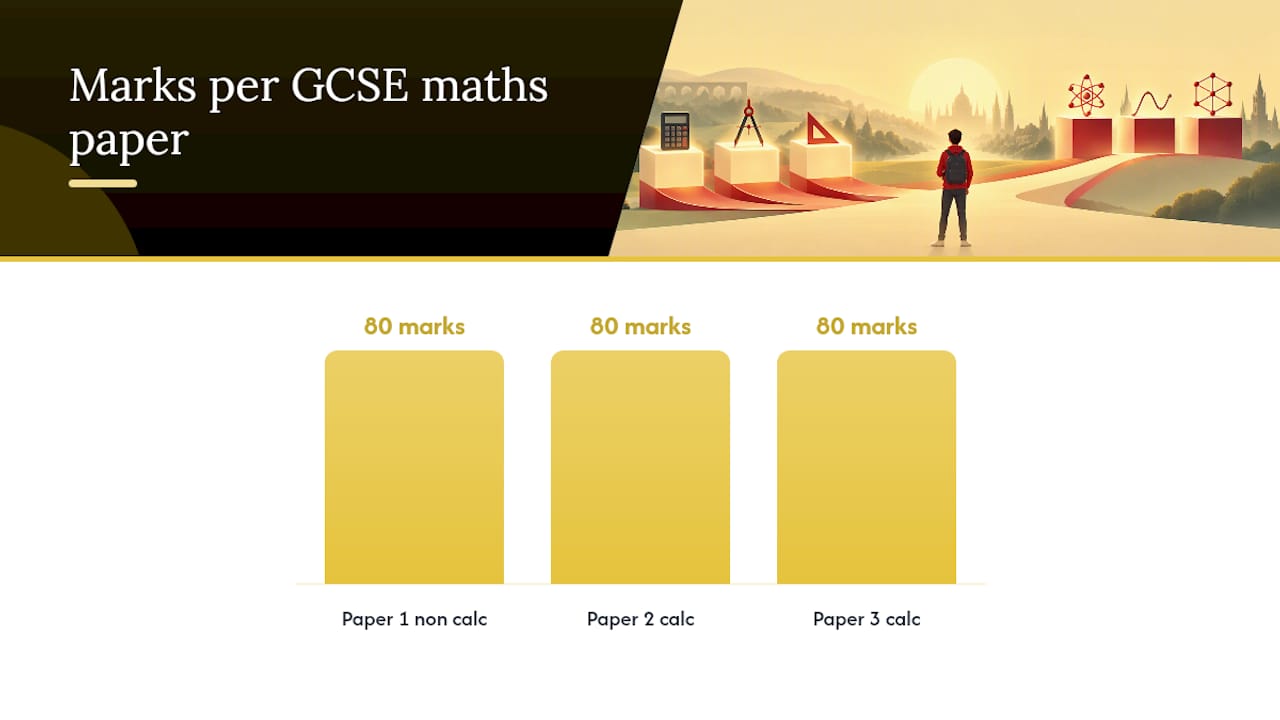
- Paper 1 — non-calculator, 1 hour 30 minutes, 80 marks
- Paper 2 — calculator allowed, 1 hour 30 minutes, 80 marks
- Paper 3 — calculator allowed, 1 hour 30 minutes, 80 marks
Each paper contributes equally to the final grade, meaning a weak Paper 1 can still be recovered across Papers 2 and 3. That’s a genuinely useful piece of exam strategy: if the non-calculator paper throws you off with an unfamiliar question, don’t panic-spiral into the next two papers. You have 160 further marks to make up ground.
240 total marks decide your GCSE maths grade — split evenly across three papers, which means no single paper can sink you on its own, but consistency across all three matters more than a brilliant showing in just one.
Assessment objectives determine how those 240 marks get distributed:
- AO1 tests whether you can accurately recall and use standard mathematical techniques. Think straightforward calculations, applying a formula correctly, or solving a routine equation.
- AO2 tests reasoning, interpreting, and communicating mathematically. These questions ask you to explain, justify, or interpret rather than just calculate.
- AO3 tests problem solving in unfamiliar contexts, often requiring you to translate a real-world scenario into mathematics before you can even begin calculating.
AO3 questions are where most grade 6 to 8 students lose marks, not because the mathematics is harder, but because the question doesn’t tell you which method to use. You have to work that out yourself. The specification’s appendices list permitted notation, the formulae you’re expected to memorise versus those provided, and guidance on acceptable calculator models, all of which are worth checking well before exam day rather than discovering gaps under timed conditions.
Edexcel A level maths: the paper map and topic guide
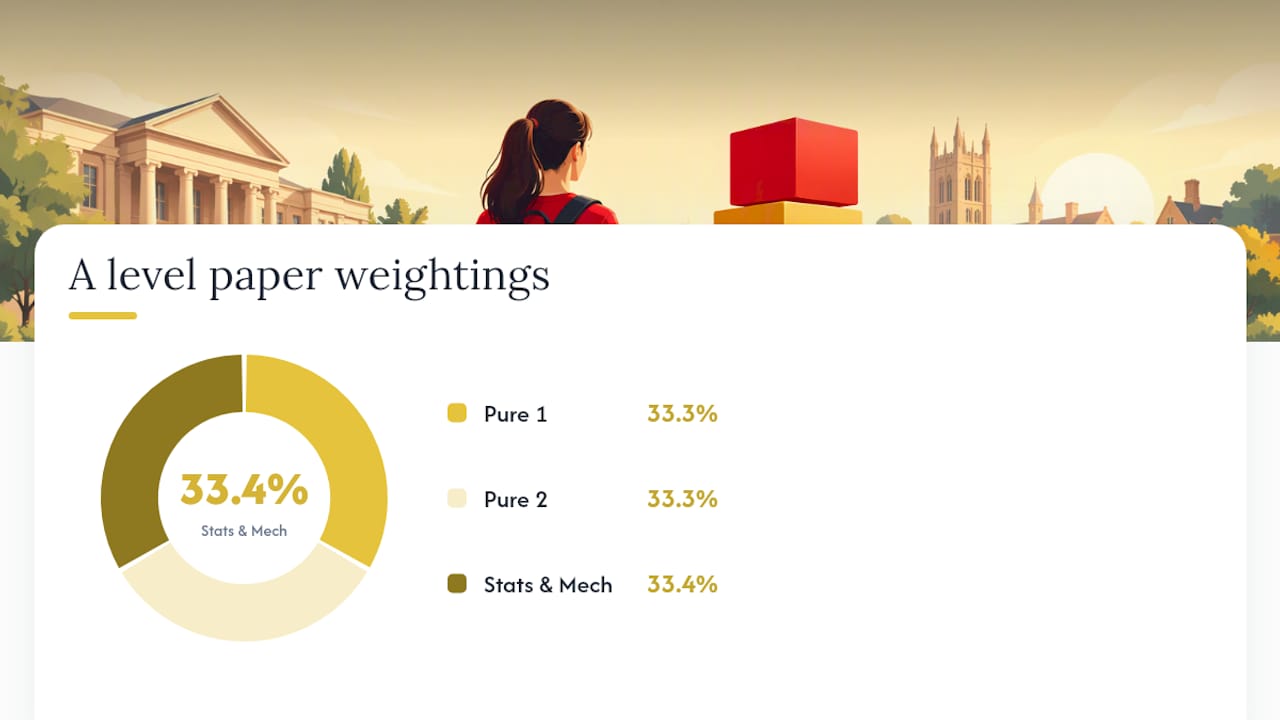
A level Mathematics (9MA0) is built around three 2-hour papers, each worth 100 marks and each contributing exactly one third of your final grade. Unlike GCSE, there’s no tiering. Every candidate sits the same three papers regardless of predicted grade, which raises the stakes on breadth of preparation.
Here’s how the papers break down:
- Paper 1: Pure Mathematics 1 — 2 hours, 100 marks, covering roughly the first half of the pure content.
- Paper 2: Pure Mathematics 2 — 2 hours, 100 marks, covering the remaining pure content, often with slightly more demanding applications of Paper 1 material.
- Paper 3: Statistics and Mechanics — 2 hours, 100 marks, split roughly evenly between the two applied strands.
Pure content dominates the qualification, spanning proof (including proof by contradiction), algebraic manipulation, coordinate geometry, sequences and series, trigonometry, exponentials and logarithms, differentiation, integration, numerical methods, and vectors. If you master differentiation and integration thoroughly, you’ll find they resurface constantly across mechanics and even some statistics applications, so time invested there compounds.
The statistics strand covers sampling methods, data presentation, probability, statistical distributions (including the binomial and normal distributions), and hypothesis testing. Mechanics covers kinematics, forces and Newton’s laws, moments, and the mathematical modelling assumptions that examiners expect you to state explicitly, a detail students frequently skip and lose easy AO2 marks for omitting.
A level assessment runs on a single-series model. Every candidate sits Papers 1, 2, and 3 in the same May/June window, with no autumn resit route equivalent to the GCSE November series. That single-shot structure makes mock exam performance and topic-by-topic timed practice throughout Year 13 far more important than it might feel at the time, because there’s no safety net six months later.
Pearson’s specification appendices list every formula you’re expected to have memorised versus those printed on the formulae sheet, alongside guidance on notation and permitted calculators. Graphical calculators are allowed across all three papers, but check your specific model against the permitted list. Some functions, particularly those that could perform symbolic algebra automatically, are explicitly banned.
How marks become grades: assessment objectives and grading
Every Edexcel maths paper, GCSE or A level, is marked against the same three assessment objectives, just weighted differently by qualification and question type.
AO1 (use and apply standard techniques) rewards accurate, fluent execution. A question asking you to solve a quadratic equation or differentiate a polynomial is testing AO1. Get the method right, execute it cleanly, and the marks follow.
AO2 (reason, interpret, and communicate mathematically) rewards your ability to explain why something is true, interpret a result in context, or spot an error in someone else’s working. These questions often include the word “show that”, “explain”, or “justify”, and examiners expect a clear chain of logic, not just a final answer.
AO3 (solve problems within mathematics and in other contexts) rewards translating an unfamiliar or multi-step scenario into a solvable mathematical structure. This is the objective that separates a grade 7 from a grade 9, or an A from an A* at A level, because it can’t be crammed the night before. It requires practice recognising problem types.
Grade boundaries shift slightly every series depending on overall paper difficulty, so raw marks needed for a given grade vary year to year. Pearson publishes grade boundaries after every exam series, and checking recent boundaries gives you a realistic target: if a grade 8 typically needs around 205 out of 240 marks at GCSE, you know precisely how many marks you can afford to drop across three papers.
Pro Tip: Method marks exist specifically so that a correct approach with an arithmetic slip still earns credit. Always show full working, even on calculator papers, because examiners award process marks independently of your final answer.
To convert marks into grades reliably, prioritise: showing complete working on every question (never just the answer), practising “show that” and “explain” questions specifically since they test AO2 directly, and deliberately seeking out unfamiliar problem-solving questions rather than only repeating question types you already find comfortable. Reviewing exactly how AO3 marks map onto the 240-mark total makes this far less abstract.
Formulae sheets and calculator rules explained
Ofqual and the Department for Education confirmed that formulae and equations sheets will continue to be provided for GCSE mathematics exams for the lifetime of the current specifications. Exam boards, Edexcel included, must publish these sheets by 1 September the year before each exam series takes place, and must include a clean copy of the sheet within the actual exam paper.
Formulae sheets must be published by 1 September, a full academic year before the exams they cover — giving schools a clear, predictable window to build them into revision from the very start of Year 11.
Ofqual has also indicated it expects the content of these sheets to stay consistent across boards and series, which reduces the administrative burden on schools switching resources between year groups or exam boards.
Here’s the trap students fall into: treating the formulae sheet as a substitute for understanding rather than a memory aid. The sheet tells you what a formula is, not when to use it or how to rearrange it under pressure. Practise using the actual sheet during timed past papers, not a mental checklist, so the exam-day version feels familiar rather than unfamiliar under stress.
Calculator rules worth checking before results day approaches:
- Scientific and graphical calculators are permitted on GCSE Papers 2 and 3, and on all three A level papers.
- Calculators with symbolic algebra, calculus manipulation, or retrievable stored text are not permitted under either specification.
- Check your specific calculator model against Pearson’s published list well before the exam window, not the morning of your first paper.
Our own GCSE formula sheet guide walks through exactly which formulae are provided versus which you’re expected to memorise, broken down by tier.
Turning the specification into a revision plan
A specification document is a list of what’s examinable. It isn’t a revision plan on its own, and trying to revise “the whole spec” in one go is exactly why so many students burn out in the six weeks before results matter most. Here’s a structured way to convert it into action.
- Map every topic heading to past paper questions. Go through the six GCSE content headings, or the A level pure/statistics/mechanics split, and pull past paper questions by topic rather than working through whole papers chronologically. This lets you spot weak topics fast instead of discovering them mid-exam.
- Build a timed, topic-by-topic schedule. Spend focused 45-minute blocks on a single topic, working through five to eight past questions, then mark strictly against the official mark scheme, not your own judgement of what “should” be right.
- Read examiner commentary alongside your marking. Pearson’s content guidance documents show alternative valid methods students used and explain how process marks were awarded, which is invaluable for understanding AO3 questions where multiple approaches can score full marks.
- Sit full timed papers under exam conditions. Once topic weaknesses are addressed, move to complete papers with strict timing, no notes, and the actual formulae sheet, replicating exam-day conditions as closely as possible.
- Review grade boundaries against your practice scores. Compare your marked totals against recently published grade boundaries to see where you realistically sit and which topics still need attention.
Pro Tip: Keep a running “error log” of every mark lost across practice papers, categorised by whether it was a careless slip, a misunderstood question, or a genuine content gap. After four or five papers, patterns emerge that tell you exactly where your remaining revision time should go.
Our GCSE maths revision guides follow this exact structure, organised by specification topic rather than arbitrary chapter order, so the mapping from spec to practice is immediate.
How Mathvault maps its resources to the Edexcel specification
Every past paper pack, worked solution, and video walkthrough on Mathvault is organised by specification topic, not by paper number or exam date, because that’s how revision actually works best. If a student is weak on trigonometric identities, they shouldn’t have to hunt through six different past papers to find every relevant question.
Here’s what that looks like in practice:
- Past paper packs by topic — questions pulled from multiple exam series and grouped under the same content headings used in the official specification, so Foundation and Higher tier content stays clearly separated.
- Fully worked step-by-step solutions — every practice question includes complete working, mirroring the method-mark structure examiners actually use, not just a final answer.
- Video walkthroughs — for topics where AO3 problem-solving trips students up most often, a talked-through video often clarifies the reasoning faster than a written solution alone.
- Weekly live Q&A sessions — a direct route to ask about a specific question or topic that’s still not clicking, run alongside the resource library rather than instead of it.
None of this replaces the official specification or Pearson’s sample assessment materials. It’s built to sit alongside them: use the spec to know what’s examinable, use Pearson’s SAMs and past papers as the primary practice source, and use Mathvault’s topic organisation and worked solutions to close specific gaps faster than working through disorganised past papers alone.
Controlled assessment and coursework: what’s required for A level maths
Neither GCSE (1MA1) nor A level (9MA0) mathematics includes controlled assessment or coursework as part of the final grade. Both qualifications are assessed entirely through timed written examinations, a structure that has remained consistent since the reformed linear GCSEs and A levels replaced the older modular system with internally assessed coursework components.
This matters more than it might seem, particularly for students moving from subjects like English or science, where coursework or practical endorsements still contribute to the final grade. In maths, your GCSE grade rests entirely on three exam papers sat in the same series, and your A level grade rests entirely on three exam papers, also sat in a single series. There’s no portfolio to build across the year, no practical component to schedule, and no teacher-assessed element that factors into your final mark.
The practical upshot is that every mark available in Edexcel maths comes down to exam performance under timed conditions. That makes timed past paper practice, not classroom project work, the single highest-value use of revision time. If you’re used to balancing coursework deadlines alongside exam prep in other subjects, maths revision can be planned more simply: identify weak topics, practise them against real exam questions, and repeat under timed conditions closer to the exam date.
Non-exam assessment: does Edexcel maths have any?
Edexcel GCSE and A level mathematics carry no non-exam assessment (NEA) component whatsoever. Every mark across both qualifications comes from the written papers described earlier: three papers at GCSE, three papers at A level, all sat under formal exam conditions and marked externally by Pearson-appointed examiners.
This puts Edexcel maths in a different category from subjects like art and design, drama, or certain science practical endorsements, where NEA can contribute a meaningful share of the final grade or run as a separate reported outcome. If you’re a student juggling multiple subjects, it’s worth knowing that maths won’t demand coursework deadlines competing for your time alongside exam revision, unlike some of your other GCSE or A level subjects.
For teachers planning department time across a school year, this also means curriculum time for maths can be allocated almost entirely to content delivery and past paper practice, without needing to build in supervised coursework sessions or moderation windows that other subjects require. It simplifies scheduling, but it also means there’s no coursework mark to fall back on if exam performance dips on the day. Every candidate’s grade rests on how they perform across those three papers, which is precisely why timed practice under realistic conditions carries so much weight in preparation.
Access arrangements for candidates with additional needs
Pearson applies access arrangements to GCSE and A level maths in line with Joint Council for Qualifications (JCQ) regulations, which govern how exam boards across England support candidates with special educational needs, disabilities, or temporary conditions affecting exam performance.
Applications for these arrangements are made by the school or college, not the candidate directly, and generally require evidence from a specialist assessor alongside a history of the arrangement being used normally within the school.
Schools need to apply for most access arrangements well before the exam series, often months in advance, since JCQ approval isn’t automatic and some arrangements require supporting documentation to be submitted and processed first. If you’re a parent or student concerned about whether an arrangement applies to your situation, the starting point is always your school’s SENCO (Special Educational Needs Coordinator), who manages JCQ applications on behalf of candidates.
It’s worth noting that access arrangements adjust how a candidate takes the exam, not what is examined. The content coverage, paper structure, and assessment objectives described throughout this article remain identical regardless of the arrangements in place, ensuring the qualification means the same thing for every candidate who receives it.
An educator’s view on where students actually lose marks
Most students preparing for Edexcel maths spend too long on topics they already understand and not enough time on the ones they quietly avoid. If a topic feels uncomfortable to revise, that’s usually the clearest signal it needs attention first, not last.
The single most common error isn’t a content gap. It’s skipping working on calculator papers because the answer “seems obvious”, then losing method marks when that answer turns out to be wrong. Writing full working costs seconds and protects marks even on mistakes.
In the final fortnight, prioritise timed practice over new content. Watching a worked video walkthrough on a question type that’s still shaky, or asking about it directly in a live Q&A session, tends to fix a stubborn misunderstanding faster than another hour reading notes alone.
— Oloru
Getting exam-ready with Edexcel resources
Once you know exactly what the specification covers, the next step is targeted practice, and that’s where a lot of revision time gets wasted on poorly organised materials. Resources are best organised around the same topic headings and paper structures covered throughout this guide, so there’s no gap between knowing what’s examinable and finding practice questions that match.
If you’re revising GCSE content, the Edexcel GCSE past paper questions by topic pack lets you drill a single weak area, like circle theorems or simultaneous equations, without wading through unrelated questions first. A level students have an equivalent resource in the Edexcel A level past paper questions by topic collection, organised around the Pure, Statistics, and Mechanics split described earlier. Both come with fully worked solutions that show complete method marks, not just final answers, and both sit alongside free video walkthroughs and weekly live Q&A sessions for questions that still aren’t clicking after independent practice. Most of what’s on Mathvault is free to use; downloadable revision packs and direct support are the only areas where a small purchase or a Buy Me a Coffee donation comes in.
If you want a clear estimate of where your practice scores translate to on results day, the grade boundary converter turns raw marks into realistic grade predictions based on recent series. Start with a topic pack in your weakest area this week, mark it strictly against the scheme, and use that result to decide what comes next.
Sources
For anything specification-critical, always go to the primary document rather than a summary, including this one.
- Specification: Level 1/2 GCSE (9-1) in Mathematics
- Decisions on changes to the assessment of mathematics, physics and combined science GCSEs in 2025, 2026 and 2027
- GCSE mathematics subject content and assessment objectives
FAQ
What is the Edexcel GCSE maths specification?
It’s the official Pearson document (code 1MA1) that sets out everything examinable in GCSE mathematics: content by topic, assessment structure, and grading rules. Assessment runs across three 1h30 papers worth 80 marks each, with Paper 1 non-calculator and Papers 2 and 3 calculator-allowed.
What is the difference between Edexcel IGCSE maths Spec A and Spec B?
Spec A follows a broadly linear structure closer to the standard UK GCSE content, while Spec B is designed with a more international focus and slightly different topic emphasis, often preferred by schools teaching predominantly overseas cohorts. Both are separate qualifications from the UK domestic GCSE (1MA1) covered throughout this article, so check with your school which one you’re actually entered for.
What are the Edexcel exam specifications?
The two main mathematics specifications are GCSE (9–1) Mathematics, code 1MA1, and A level Mathematics, code 9MA0. GCSE is assessed through three 80-mark papers; A level through three 100-mark papers covering Pure 1, Pure 2, and Statistics & Mechanics.
What grade is 60% in Edexcel A level maths?
There’s no fixed universal answer, because A level grade boundaries shift slightly each series depending on overall paper difficulty. Pearson publishes exact grade boundaries after every exam series, and checking the most recent set through a grade boundary converter gives a realistic estimate for that specific year rather than a fixed percentage.
Does Edexcel A level maths include coursework or non-exam assessment?
No. Both GCSE and A level Edexcel mathematics are assessed entirely through timed written examinations, with no coursework, controlled assessment, or non-exam assessment component contributing to the final grade.
Leave a Reply