
Structured live Q&A sessions reliably improve short term retention, close conceptual gaps before they compound, and reduce exam stress by resolving doubts on the spot. The evidence points to a practical routine, not a passive habit: a focused 45 to 60-minute session, followed by a 7-day practice loop, converts a single hour of live support into weeks of measurable progress. If you take one action from this article, book a session this week and commit to the follow up.
TL;DR:
- Immediate clarification during live Q&A sessions helps detect misunderstandings early, preventing them from affecting exam results later.
- Structuring sessions with pre-submitted questions and strict time limits ensures productive use of the 45-60 minute format and prevents domination by confident students.
- Following up within 24 hours with targeted practice, quizzes, and error tracking significantly reinforces retention and closes learning gaps.
- Using a hybrid model of recorded lessons plus live AMA sessions provides flexibility and depth for different revision needs and schedules.
- Free weekly live Q&A sessions connect directly to exam board-aligned practice material, making them highly effective for targeted GCSE and A-Level revision.
Table of Contents
- What does live Q&A revision do for retention and stress?
- How do you prepare for and run a high-impact live Q&A?
- What should you do in the seven days after a live Q&A?
- Synchronous, asynchronous, or hybrid: which format actually helps?
- What mistakes make live Q&A sessions a waste of time?
- How I use live Q&A in a revision plan
- Try Mathvault’s live Q&A and board-aligned revision packs
- Sources
- FAQ
What does live Q&A revision do for retention and stress?
The gains from live Q&A are not vague or anecdotal. They sit on a foundation of established teaching research and a growing body of quasi-experimental studies on immediate questioning.
Government guidance on high impact teaching strategies identifies formative assessment and feedback as one of the most reliable levers for improving attainment, precisely because it forces students to test understanding before an exam does it for them. Live Q&A is formative assessment in its most direct form: you attempt a problem, get feedback within minutes, and correct course while the concept is still fresh.
That immediacy matters more than it sounds. Research on embedded low stakes questioning found that inserting immediate questions into instruction, rather than delaying them, increases formative and summative performance alongside engagement and self-regulation. A separate study on student-generated questions followed by group discussion showed significant post-test gains that were still measurable 15 days later. The retention effect isn’t a short-lived bump.
What does this look like in practical terms for a GCSE or A-Level student?
- Faster gap detection: a misunderstanding surfaces in the session, not on results day.
- Reduced exam stress, because unresolved doubts stop piling up in the background of your revision.
- A measurable performance signal, since formative session performance has been shown to strongly predict final exam outcomes.
Pro Tip: Treat every live Q&A as a mini diagnostic test. If a question catches you off guard, that’s the exact gap worth fixing first, not a sign you’re behind.
That’s a realistic, achievable number rather than a marketing promise, and it depends entirely on what you do in the hours after the session, not just during it. Immediate clarification also does something less obvious: it prevents the slow accumulation of unresolved doubts that drives exam stress, according to university wellbeing guidance built around routine, active revision habits.
How do you prepare for and run a high-impact live Q&A?
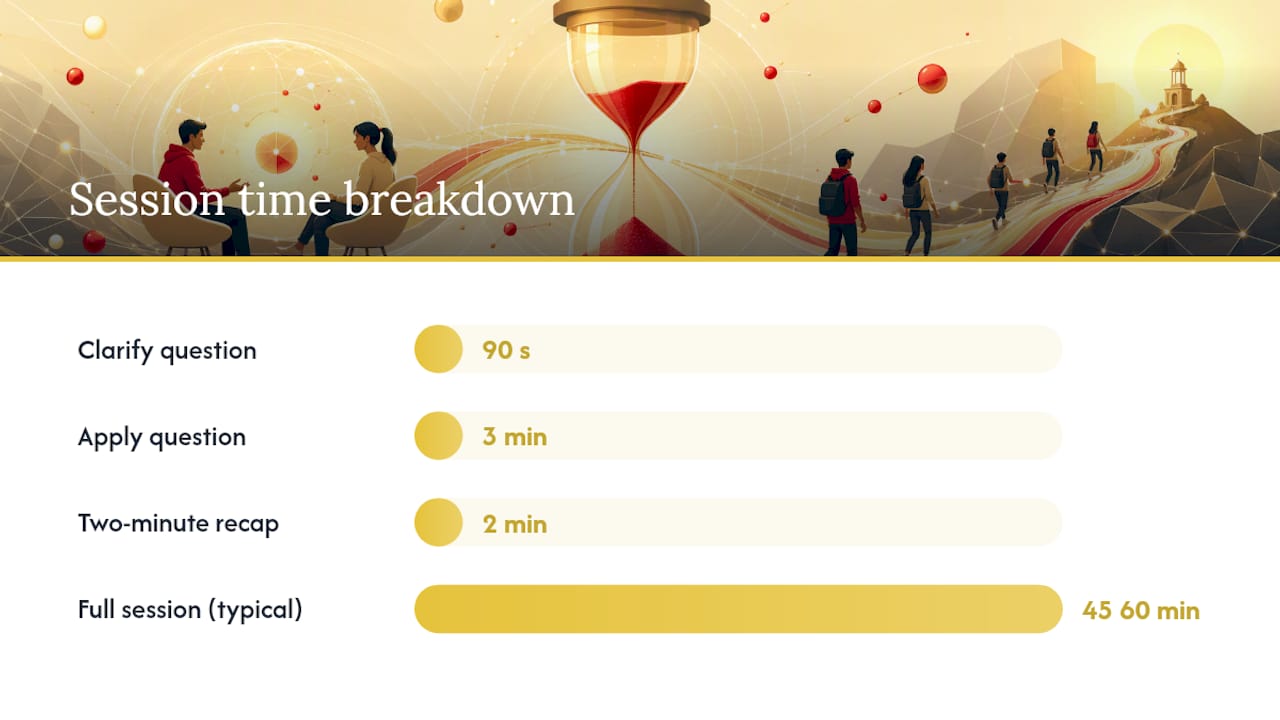
A live Q&A only works as revision if it runs like a structured lesson, not a chat room. The difference between a session that produces real gains and one that produces vague reassurance comes down to three things: what students submit beforehand, how the session is paced, and how the moderator triages questions.
Here’s a run-book that turns a loose session into a study sprint:
- Pre-submission template. Require every question to include a genuine attempt (even a wrong one) and a one-line goal: “I got stuck applying the quotient rule here, and I want to know where my sign went wrong.” Vague questions like “I don’t get differentiation” get filtered out before the session starts.
- Timed session structure. Run in blocks: a two-minute recap of the topic, a worked example, a timed student attempt, then rapid feedback. Forty-five to sixty minutes is usually the sweet spot for a GCSE or A-Level topic session.
- Moderator triage. Tag incoming questions as Clarify, Apply, or Extend. Clarify questions get 90 seconds, Apply questions get three minutes with a worked example, Extend questions (exam technique, common pitfalls) get flagged for a short group discussion since these often help more students than a single hard problem.
- Accessibility built in. Captions and a saved transcript aren’t an afterthought. Students who can’t attend live, or who process better on a second pass, need the same material available afterwards.
The moderation layer is what separates a productive Q&A from a scattered one. Without triage tags and time limits, a handful of confident students dominate, and the quieter half leaves with the same gaps they arrived with.
What should you do in the seven days after a live Q&A?
A live session without follow-up is a missed opportunity dressed up as revision. Listening to a good explanation feels like learning, but the research on immediate questioning is consistent: retention depends on active verification, not passive exposure.
Start within five minutes of the session ending, while the explanation is still fresh: jot down the one concept that clicked and the one that didn’t. Then apply the 24-hour rule: attempt a similar problem to the one covered in the session within a day. This is the single highest-leverage habit in the whole loop, because it forces retrieval before the memory fades.
From there, a simple day-by-day sequence keeps the gains compounding:
- Day 0 (session day): Save the highlight reel or transcript and note your one weak spot.
- Day 1: Take a short quiz built from the session’s core question.
- Day 3: Do guided practice on the same topic, ideally from a board-aligned past paper.
- Day 6: Join or run a five-minute micro-AMA to check the concept has stuck.
- Day 7: Fold the corrected concept into your next full past-paper attempt.
Use the session transcript to build a running error file, one line per mistake, then turn recurring errors into spaced-repetition flashcards. This is also where past papers earn their keep: once you know exactly which method caught you out, using past papers deliberately to hunt down similar questions closes the gap for good, rather than leaving it to chance on exam day.
Synchronous, asynchronous, or hybrid: which format actually helps?
Not every revision moment calls for a live session, and treating every question as one wastes time you could spend practising. The two formats trade off differently, and knowing which one suits your situation avoids a lot of wasted evenings.
Synchronous Q&A wins on immediacy and community energy. Comparative engagement research shows live events produce higher immediate satisfaction, largely because you get an answer while the confusion is still active in your head. That makes synchronous sessions the right call before exams, or whenever you’re stuck on a genuine conceptual hurdle rather than a careless slip.
Asynchronous formats, recorded walkthroughs, short personalised clips, forum answers, scale better and can produce stronger long-term completion when packaged well. They suit revision at odd hours, or topics you’re reviewing rather than struggling with for the first time.
- Choose synchronous for new conceptual difficulty, pre-exam nerves, or anything you’ve already failed to grasp from written explanations.
- Choose asynchronous for topic review, awkward time slots, or when you want to revisit the same explanation twice.
- A simple hybrid model: a short pre-recorded lesson covering the mechanics, followed by a live “office hour” AMA for the questions the recording didn’t answer.
What mistakes make live Q&A sessions a waste of time?
Most failed sessions share the same handful of causes, and every one of them is avoidable with a small process change.
- Vague submissions. “I don’t understand trigonometry” gives a moderator nothing to work with. Require a genuine attempt and a specific goal before a question gets queued.
- Long-winded answers. A five-minute answer to a 90-second Clarify question kills the pace and loses the rest of the group. Enforce time limits per question type and vary the pacing deliberately.
- No follow-up. A brilliant session with zero practice afterwards fades within days. Automate what you can, a Day 1 quiz link and a Day 3 practice set take minutes to set up in most learning platforms and remove the excuse to skip them.
How I use live Q&A in a revision plan
My own approach, built from what the evidence actually supports rather than what sounds impressive, is one themed AMA a week paired with one or two focused past-paper sessions. The themed AMA handles the conceptual gaps; the past-paper sessions turn those corrections into exam-ready technique.
What makes this work reliably is when the live session links directly to board-aligned material afterwards. MathVault.io’s sessions do exactly that, connecting a live answer to the matching past-paper question and worked solution, so the gap you closed on Tuesday shows up as a mark you can bank in your next full paper attempt. That link between explanation and practice is where most revision plans quietly fall apart, and it’s the piece worth protecting above all else.
— Oloru
Try Mathvault’s live Q&A and board-aligned revision packs
Free weekly live Q&A sessions are offered alongside fully worked solutions and downloadable revision packs, organised by exam board so the questions connect straight to matching practice material. There’s no cost barrier and no sign-up hurdle to sit in on a session or download a topic guide.
If you’re preparing for GCSE papers, the GCSE maths revision guides hub is the natural starting point, with packs organised by topic and board. A-Level students working through mechanics or pure maths will find the A-Level past paper questions by topic pack pairs directly with live session content. Whichever stage you’re at, the next concrete step is simple: join the next live session, then sit the Day 1 quiz afterwards. That single follow-through step is what separates a pleasant hour of revision from a mark gain on the actual exam.
Sources
- Immediate versus delayed low‑stakes questioning — Technology, Knowledge and Learning (2024)
- Formulation of questions followed by group discussion improves retention (Wiley)
FAQ
Does live Q&A actually improve exam results?
The key variable is what happens after the session, not the session alone.
How long should a revision live Q&A session last?
A focused 45 to 60 minute block works best, structured as recap, worked example, student attempt, then rapid feedback. Longer sessions tend to lose pace and dilute the moderation quality that makes the format effective.
What should I do straight after a live Q&A session?
Spend five minutes noting your weakest point from the session, then attempt a similar problem within 24 hours while the explanation is still fresh. Follow with a short quiz on Day 1 and guided practice by Day 3, using resources like self-marked past papers to check your work.
Is a live session better than a recorded one for revision?
Live sessions give higher immediate satisfaction and suit genuine conceptual hurdles, while recorded or asynchronous formats scale better for topic review. A hybrid approach, a short recording followed by a live AMA, works well for most revision schedules.
Does Mathvault offer live Q&A sessions for free?
Yes, Mathvault runs free weekly live Q&A sessions alongside worked solutions and downloadable revision guides for GCSE and A-Level students. Current session times and topics are listed on the site.
Leave a Reply