The AQA GCSE Maths exam consists of three papers, each 1 hour 30 minutes long and worth 80 marks, making 240 marks in total. Paper 1 is non-calculator, while Papers 2 and 3 allow calculators throughout. All three papers are sat in the same exam series and count equally towards your final grade, with Foundation tier covering grades 1 to 5 and Higher tier covering grades 4 to 9.
TL;DR:
- All three AQA GCSE Maths papers test any topic on the specification and increase in difficulty as you progress through each paper.
- Marking rewards method marks for approach, accuracy marks for final answers, and follow-through marks for consistent working, emphasizing clear working and labeled answers.
- The specification design allocates approximately 20-25% of marks to algebra and ratio topics, with the hardest questions in later sections focused on reasoning and problem solving.
- Practice with official past papers and mark schemes, especially under timed conditions, is essential to develop exam pacing and identify common student mistakes.
- The linear format requires taking all three papers in the same series, with no opportunity to re-sit or bank individual papers across different sittings.
Table of Contents
- AQA maths exam structure at a glance
- How question types progress within each paper
- Assessment objectives: what AO1, AO2 and AO3 actually mean
- How marks are actually awarded
- Subject content: where the marks are concentrated
- Exam-day logistics: formula sheet, equipment and access arrangements
- Where to find official practice materials
- Foundation vs Higher: which tier and what grades
- Why all three papers count as one linear qualification
- How questions get harder as you move through a paper
- Where to get the real papers, specifications and mark schemes
- What types of questions actually appear on the paper
- Command words in AQA maths questions and what they’re really asking
- Managing your time across a 90 minute paper
- A quick note on where students actually lose marks
- Practise AQA-style papers with Mathvault’s free resources
- Sources
- FAQ
AQA maths exam structure at a glance
Every candidate sits the same three-paper format, whichever tier they’re entered for. The difference between Foundation and Higher lies in the difficulty of the questions, not the number of papers or the time allowed.
Here’s how the scheme of assessment breaks down:
- Paper 1: 1 hour 30 minutes, 80 marks, non-calculator
- Paper 2: 1 hour 30 minutes, 80 marks, calculator allowed
- Paper 3: 1 hour 30 minutes, 80 marks, calculator allowed
- Total: 240 raw marks across the qualification, with each paper worth roughly a third
Because the qualification is linear, you take all three papers in the same series. You can’t bank Paper 1 in one year and sit Papers 2 and 3 later. There’s one important exception worth flagging: students under 16 generally can’t enter for the November resit series, which is reserved for post-16 candidates retaking the qualification. If you’re planning a resit, check with your school about which series you’re eligible for well before results day.
How question types progress within each paper
Here’s something students often miss: any paper can test any topic on the specification. AQA doesn’t split algebra into Paper 1 and geometry into Paper 2. Number, algebra, ratio, geometry and probability can all turn up on any of the three papers, which is exactly why mixed-topic practice matters more than topic-by-topic drilling alone.
Within a single paper, difficulty climbs steadily. According to AQA’s own notes on the specification’s design, mathematical demand increases as you move through the paper. That typically looks like this:
- Early questions (1 to 2 marks): short, single-step recall, such as rounding a number or simplifying an expression
- Middle questions (3 to 4 marks): multi-step calculations combining two or more techniques
- Later questions (4 to 6+ marks): extended reasoning or problem solving, often with little scaffolding
The revision implication is straightforward. Drill short, timed questions until they’re automatic, then move on to multi-step and reasoning problems where the real marks are won or lost.
Assessment objectives: what AO1, AO2 and AO3 actually mean
Every question on every paper maps to one of three assessment objectives, and understanding them changes how you revise. AO1 tests whether you can use and apply standard techniques, things like solving an equation or calculating a percentage. AO2 tests whether you can reason, interpret and communicate mathematically, which includes explaining why an answer is correct or spotting an error in someone else’s working. AO3 tests whether you can solve problems, translating a real-world or unfamiliar scenario into mathematics and working through it.
The official weightings, confirmed in the scheme of assessment, are AO1 at roughly 50%, AO2 at roughly 25%, and AO3 at roughly 25%. In practice, AO1 marks cluster near the start of a paper, while AO2 and AO3 dominate the later, longer questions. If you’re comfortable with standard techniques but panic on wordy problems, you’re losing AO3 marks, not AO1 ones, and that should shape where you spend your revision hours.
How marks are actually awarded
Marking on AQA maths papers isn’t all or nothing. Method (M) marks reward a correct approach even if the final number is wrong, while accuracy (A) marks reward the correct final answer, usually dependent on the method mark being earned first. Examiners also apply follow-through (ft) marks, which is where showing your working really pays off: if you make an early arithmetic slip but correctly carry it through the rest of the method, you can still pick up marks for everything after the mistake, according to AQA’s own marking guidance.
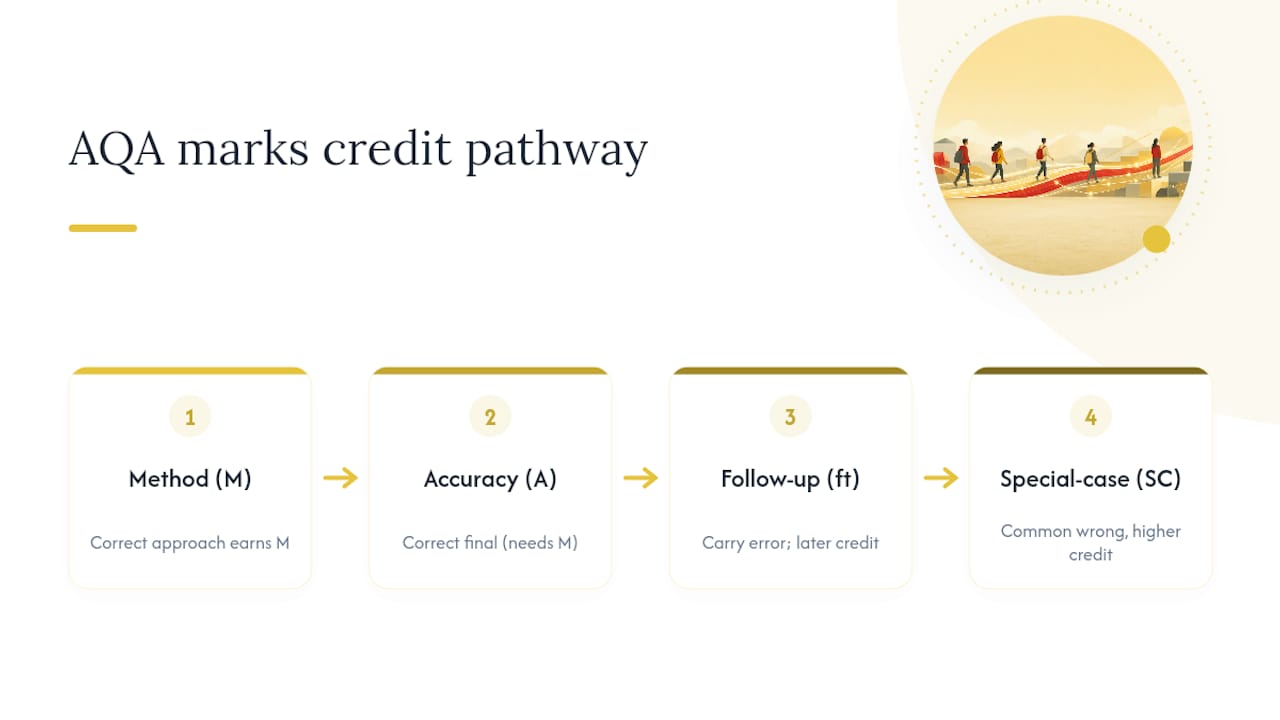
There’s also a category called special-case (SC) marks, awarded for common incorrect answers that still demonstrate partial understanding. Examiners are instructed to award whichever mark, standard or special-case, gives the higher credit.
Pro Tip: Label your final answer clearly and never cross out working unless you’ve replaced it with something better. Examiners mark what’s on the page, and a crossed-out method mark is a lost method mark, even if it was correct. You can see this in more detail in this breakdown of method marks and how they’re applied.
Subject content: where the marks are concentrated
The specification splits content into five broad areas, each with an approximate weighting for the overall grade. Based on the AQA GCSE Mathematics specification, a rough guide looks like this:
| Topic area | Approximate weighting |
|---|---|
| Number | 15 to 20% |
| Algebra | 20 to 25% |
| Ratio, proportion and rates of change | 20 to 25% |
| Geometry and measures | 15 to 20% |
| Probability and statistics | 15 to 20% |
These figures are approximate, and some content, such as more advanced algebraic proof or trigonometric identities, only appears on Higher tier papers. Don’t chase perfect coverage of every sub-topic at the expense of the big-ticket areas like algebra and ratio, where the bulk of the marks genuinely sit.
Exam-day logistics: formula sheet, equipment and access arrangements
A prescribed formula sheet has been included in AQA GCSE Maths papers in recent years, typically covering things like the cone and sphere volume formulas, so you don’t need to memorise them, though you should still know when to use each one.
For equipment, bring:
- A scientific calculator (permitted on Papers 2 and 3 only)
- A ruler, protractor and compasses
- Pens, pencils and an eraser
Mobile phones and smartwatches aren’t permitted at the desk. Use any spare space or additional answer pages for full working, not shorthand, since that’s where follow-through marks live.
Where to find official practice materials
Nothing replicates real exam pressure like timed, full papers. AQA publishes past papers directly on its GCSE Mathematics page, alongside mark schemes and examiner reports that reveal exactly where students commonly lose marks.
Practising with official mark schemes trains you to present answers the way examiners expect, not just to get the right number. Alongside past papers, Mathvault offers:
- Free worked solutions and video walkthroughs mapped to AQA’s paper structure
- Downloadable past-paper packs organised by year and tier
- Weekly live Q&A sessions for questions you can’t resolve alone
A sensible routine is one full timed paper a week, self-marked against the official scheme, followed by a focused session correcting whichever AO you lost the most marks on.
Foundation vs Higher: which tier and what grades
Foundation tier caps out at grade 5, while Higher tier runs from grade 4 to grade 9, with grade 4 acting as the overlap between the two. This overlap is deliberate. It gives students on the boundary a safety net: a Higher tier candidate who underperforms can still achieve a grade 4 or 5 rather than falling straight through to an ungraded result.
Choosing a tier isn’t just about ambition. Foundation papers are pitched to be accessible right down to grade 1, with more straightforward AO1 content and fewer multi-step reasoning questions. Higher papers assume a faster pace and expect students to handle abstract algebra, trigonometric identities, and more demanding AO3 problems from the outset. According to AQA’s specification at a glance, you must sit all three papers at the same tier. You can’t mix a Foundation Paper 1 with a Higher Paper 2.
Teachers usually make the tiering decision based on mock results and classwork performance across Year 10 and Year 11, but it’s worth discussing openly with your teacher if you feel torn. A student comfortably scoring grade 6 or 7 on Foundation-style questions is often better served attempting Higher, since Foundation’s grade ceiling of 5 can’t be exceeded no matter how well the papers go. Conversely, a student who struggles with algebra fundamentals may find Higher’s pace punishing, even if they understand individual concepts when given time. If you’re unsure which tier fits you, working through both Foundation and Higher versions of the same past paper is often more revealing than any single mock result.
Why all three papers count as one linear qualification
AQA GCSE Maths is a linear qualification, which means there’s no modular structure and no opportunity to bank individual papers across different exam series. All three papers, whichever tier you’re sitting, must be taken within the same series, typically the May/June window for 16-year-olds in Year 11.
This differs from how some vocational or modular qualifications work, where you might sit and pass individual units over several sittings. With linear GCSE Maths, your final grade is calculated only after all three papers have been marked and combined, each contributing roughly a third of the 240 total marks. There’s no partial certification and no way to carry forward a strong Paper 1 score into a different series if Papers 2 and 3 don’t go to plan that year.
The practical upshot is that consistency across the exam period matters more than a single standout performance. A student who scores well on Paper 1 but has a poor day on Paper 3, perhaps due to illness or exam nerves, will see that reflected in the final combined mark, since AQA doesn’t discount or reweight individual papers after the fact. This is also why revision plans that spread evenly across number, algebra, ratio, geometry and statistics tend to outperform plans that lean heavily into one area at the expense of others. You genuinely don’t know which topics will dominate which paper.
One planning implication worth flagging: because entries are locked in for a specific series and tier, any late change of mind about Foundation versus Higher needs to happen well before the entry deadline, not in the weeks before the exam itself. Speak to your maths teacher early if you have any doubts.
How questions get harder as you move through a paper
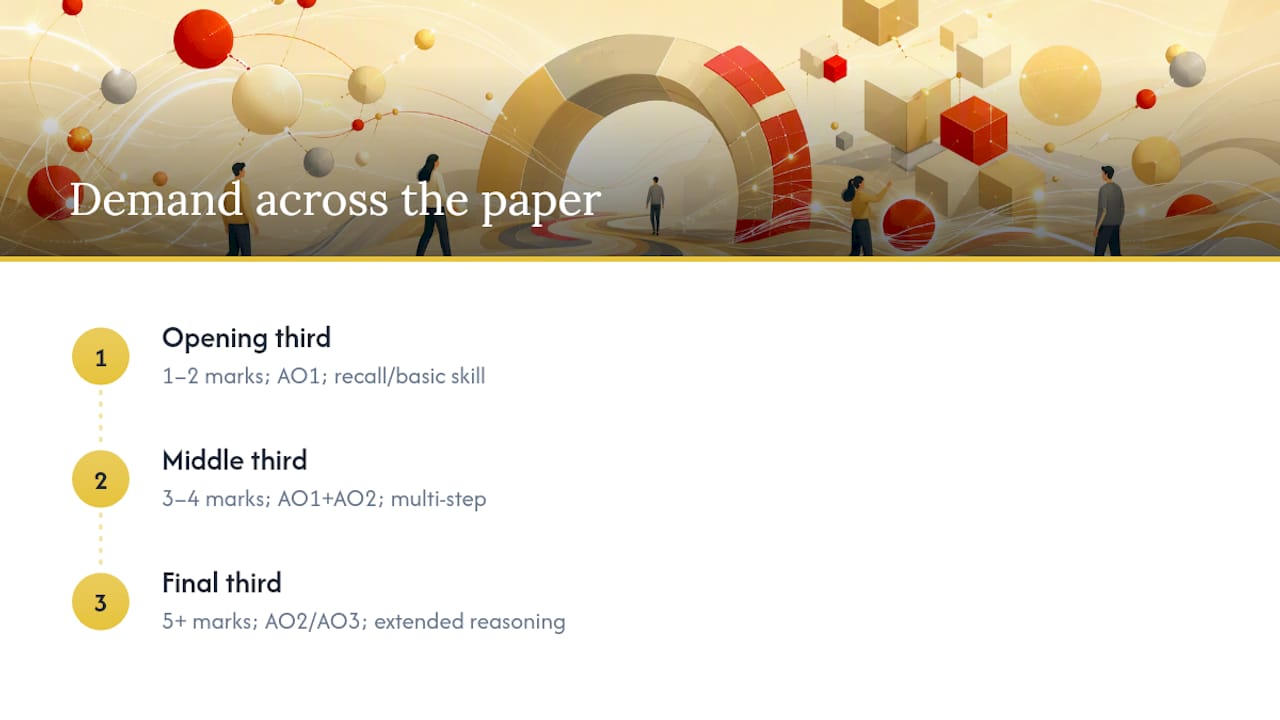
Every AQA maths paper follows a broadly similar shape, opening with accessible questions and building toward genuinely demanding ones by the final few pages. This isn’t accidental. AQA designs papers so that mathematical demand increases progressively, according to its own notes on the specification’s structure, giving every candidate a chance to demonstrate some competence before the harder material arrives.
In the opening third of a typical paper, expect single-mark or two-mark questions testing recall and basic technique. Simplify an expression, round a number to two decimal places, or read a value directly from a chart. These are almost pure AO1, and they’re the questions where losing marks through carelessness, rather than lack of knowledge, is most common and most avoidable.
The middle section introduces multi-step questions worth three to four marks, often requiring you to combine two techniques in sequence, for instance converting units before applying a formula. This is where AO1 and AO2 start to blend, and where showing clear intermediate steps becomes essential for picking up method marks even if your final answer drifts off track.
The closing questions on any paper are typically worth five, six, or occasionally more marks, and they lean heavily on AO2 and AO3. These are extended, often wordy problems requiring you to interpret a scenario, choose your own strategy, and justify your reasoning, sometimes with no clear starting formula given. Higher tier papers push this further with abstract algebraic proof or multi-context problems that combine three or more topic areas in a single question.
Recognising this shape changes how you should pace a paper. Rushing through the easy opening questions to “save time” for the end is usually a mistake. Those early marks are the cheapest ones on the entire paper.
Where to get the real papers, specifications and mark schemes
The single most reliable source for AQA GCSE Maths materials is AQA itself. The GCSE Mathematics (8300) specification sets out every topic you’re required to know, broken down with reference codes for number (N), algebra (A), ratio ®, geometry (G), probability (P) and statistics (S), which teachers commonly use to structure revision timetables around specific weak areas.
Past papers and their accompanying mark schemes are published directly on AQA’s site, and they’re worth treating as the gold-standard practice resource precisely because the mark schemes show you exactly how examiners award method, accuracy, follow-through and special-case marks on real questions, not simplified textbook versions. Examiner reports, published after each series, go a step further, highlighting the specific errors that cost the most marks that year. These are genuinely underused. Most students revise from a textbook and skip the examiner commentary entirely, missing a direct account of where their peers actually lost marks.
Beyond AQA’s own site, Mathvault organises AQA-specific revision resources by topic and tier, pairing official past papers with fully worked, step-by-step solutions so you’re not left guessing why a mark scheme awarded credit the way it did. For readers who want a broader teaching perspective on how question demand builds across a paper, Trinity Education’s tutoring resources offer additional explanation from working tutors.
What types of questions actually appear on the paper
AQA maths papers use a narrower range of question formats than you might expect from other subjects. There’s no multiple-choice on GCSE Maths papers themselves. Instead, expect a mix of the following styles, each testing a different combination of assessment objectives.
Short-answer calculation questions dominate the early parts of every paper. You’re given a direct instruction, work through a technique, and write your answer in a box. These are almost always AO1 and worth one to three marks.
Structured multi-part questions break a longer scenario into labelled sub-parts, often (a), (b), ©, building on each other. An early sub-part might ask you to calculate a value, while a later one asks you to use that value to solve a further problem. This format rewards students who read the whole question before starting, since later parts often hint at the method needed.
Problem-solving questions present an unfamiliar or real-world scenario with no clear formula stated. You’re expected to identify the relevant maths yourself, structure your own method, and justify each step. These sit squarely in AO3 territory and typically carry the highest mark values on the paper.
Proof and “show that” questions ask you to demonstrate a mathematical statement is true using algebraic or geometric reasoning, rather than simply stating an answer. These appear more frequently on Higher tier and reward precise, logically ordered written explanation over quick calculation.
Command words in AQA maths questions and what they’re really asking
Misreading a command word is one of the most avoidable ways to lose marks, because it often means answering a different question to the one actually set. AQA uses a consistent set of instructional verbs across its maths papers, and each one signals a specific type of response examiners are trained to look for.
“Calculate” or “work out” means examiners expect to see a numerical answer supported by working, and method marks are available even if the final figure is wrong. “Show that” requires you to prove a given statement is correct through clear algebraic or logical steps. Simply stating the answer without the working, even if correct, typically earns few or no marks, since the mark scheme is built around the method itself. “Simplify” asks you to reduce an expression to its most basic form, and stopping halfway, for instance leaving a fraction unreduced, usually costs you the final accuracy mark.
“Explain” or “give a reason” demands written justification rather than a bare number, testing AO2 directly. “Estimate” signals that an exact answer isn’t required or possible from the information given, and rounding your inputs sensibly before calculating is part of what’s being assessed. “Sketch” wants a rough, labelled diagram showing key features like intercepts or turning points, not an accurately plotted graph, which “plot” or “draw” would instead require.
Getting comfortable with this vocabulary before the exam, rather than during it, saves valuable time and prevents the common mistake of over-answering a “calculate” question with an unnecessary written explanation.
Managing your time across a 90 minute paper
With 80 marks available in 90 minutes, the working rule of thumb is roughly one minute per mark, leaving a small buffer for checking. That means a six-mark question should take about six to seven minutes, not fifteen, and a one-mark question shouldn’t be taking two minutes of hesitation.
A sensible approach is to move through the paper in order but not get stuck. If you hit a question that isn’t clicking after roughly the time its marks suggest, circle it, leave a gap, and move on. Coming back with fresh eyes after finishing the rest of the paper often unlocks a method that felt impossible under pressure the first time. Since any paper can test any topic, getting stuck early doesn’t mean the rest of the paper will be equally hard.
Reserve the final five to ten minutes purely for checking, not for starting anything new. Recheck any question where you left an answer blank or wrote a rushed guess, and verify that answers to multi-part questions are consistent with each other, since an error in part (a) often cascades into part (b) if you’re not careful. Also double-check units. Losing an accuracy mark for writing “50” instead of “50 cm” is one of the most common and entirely preventable losses on any paper.
Practising full past papers under strict timed conditions, rather than working through questions at leisure, is the only way to build a genuine feel for this pacing before it matters on the day.
A quick note on where students actually lose marks
The most common error isn’t a knowledge gap. It’s not showing enough working, which strips away the chance of follow-through and method marks even when the underlying maths is sound. If you take two things from this article, make them these: practise AO3 problem-solving questions specifically, since they carry the highest marks and the least scaffolding, and self-mark every past paper against the official scheme rather than just checking the final answer. Mathvault’s worked solutions are built for exactly that second step, letting you compare your method line by line against what examiners actually rewarded.
— Oloru
Practise AQA-style papers with Mathvault’s free resources
Free access to structured, tier-aligned practice matches how AQA marks its papers, with worked, step-by-step solutions showing how marks are earned.
Start with the GCSE maths revision guides, organised by topic and tier to match the AO weightings covered earlier in this guide. If you’d rather jump straight into timed practice, the self-mark past papers with board-aligned solutions let you sit a full paper under exam conditions and then check your working against the same standard AQA examiners use, with live Q&A sessions available if a mark scheme decision doesn’t make sense. Visit the revision guides page today to build a practice routine around your actual tier and weak topics, not a generic checklist.
Sources
- GCSE Mathematics 8300 | Specification | Scheme Of Assessment | AQA
- Marking guidance: 8300 Mathematics (AQA marking guidance PDF)
FAQ
What grade is 67% in AQA maths GCSE?
There’s no single fixed answer, since grade boundaries shift slightly each series depending on overall difficulty.
What is the syllabus for the GCSE maths exam in 2026?
The AQA GCSE Mathematics (8300) syllabus covers number, algebra, ratio and proportion, geometry and measures, and probability and statistics, assessed across three papers with no coursework element. The full topic list and reference codes are published in AQA’s specification.
What’s the hardest AQA maths paper?
There’s no officially designated “hardest” paper, since any of the three can test any topic and difficulty increases progressively within each one rather than between them. Many students find Paper 3 feels toughest simply because it comes last, when fatigue from two previous 90 minute papers has already set in.
Is AQA maths harder than Edexcel GCSE?
Both boards follow the same government-set national curriculum content and grading scale, so neither is inherently harder in terms of what’s assessed. Differences students report tend to come down to question phrasing style and paper pacing rather than genuine differences in difficulty, and Mathvault’s Edexcel GCSE maths resources follow the same structured approach if you’re preparing for that board instead.
Do all three AQA maths papers have to be taken in the same year?
Yes. AQA GCSE Maths is a linear qualification, meaning all three papers must be sat within the same exam series, with no option to carry a result from one paper into a different series.
Leave a Reply