
Command words are the verbs and phrases that tell you exactly how to answer a maths question, from “calculate” to “prove” to “sketch.” The moment you spot one, underline it and decide whether the question needs working, some justification, or a fully reasoned argument. Ofqual sets the framework these words sit within, AQA publishes an official glossary, and Mathvault’s worked solutions show you what a correct response actually looks like on the page.
TL;DR:
- Most command words require different levels of working: no working for “write down,” step showing for “solve,” and full argument for “prove.”
- Words like “calculate” and “find” focus on numerical results, with “solve” meaning finding an unknown, and “evaluate” involving substitution into an expression.
- Cross-referencing official glossaries and mark schemes for your exam board ensures precise understanding of each command word’s demands.
- In exam settings, underline the command word and plan your steps clearly to improve accuracy and maximize marks, especially on justification questions.
- Practicing with actual past papers and mark schemes, rather than summaries, is the most effective way to master command word responses.
Table of Contents
- What are command words in maths, exactly?
- Command word examples: what examiners actually expect
- Do all exam boards use the same command words?
- How to turn a command word into the right exam answer
- Practising command words with Mathvault’s resources
- A classroom note on command words
- Practise command words on real WJEC past papers
- Sources
What are command words in maths, exactly?
Every exam board groups its command words into rough tiers based on how much working you need to show, and getting this triage right in the first ten seconds of reading a question can save you real marks. AQA’s official list, which aligns with Ofqual’s national standards, splits words into those where working is optional, those where it’s expected, and those demanding a full logical argument.
No working required. Words like “write down,” “state,” and “give” ask for a fact you either know or can read straight off a diagram. There’s no method mark on offer here because there’s no method to show. If a question says “write down the value of x,” a bare answer scores full marks; adding a paragraph of explanation just wastes time you need elsewhere.
Working may be needed. This is the largest group, and it covers “calculate,” “find,” “solve,” and “work out.” Examiners generally don’t require you to justify why your method works, but they do need to see the steps to award method marks if your final answer goes wrong. OCR’s command words poster is explicit on this split: these verbs need working shown, but not formal justification.
Full justification required. “Prove,” “show that,” and “justify” sit in a different category entirely. Here the working is the answer. A correct final value with no reasoning can score zero, because the mark scheme is built around the argument, not the number.
- No working: write down, state, give
- Working expected: calculate, find, solve, work out
- Full justification: prove, show that, justify
Pro Tip: When you’re short on time, tackle every “state” or “write down” question first across the whole paper. They take seconds each and bank easy marks before you commit time to proof-style questions.
Command word examples: what examiners actually expect
Confusing similar-sounding words costs marks every single exam season, so it’s worth being precise about what each one demands.
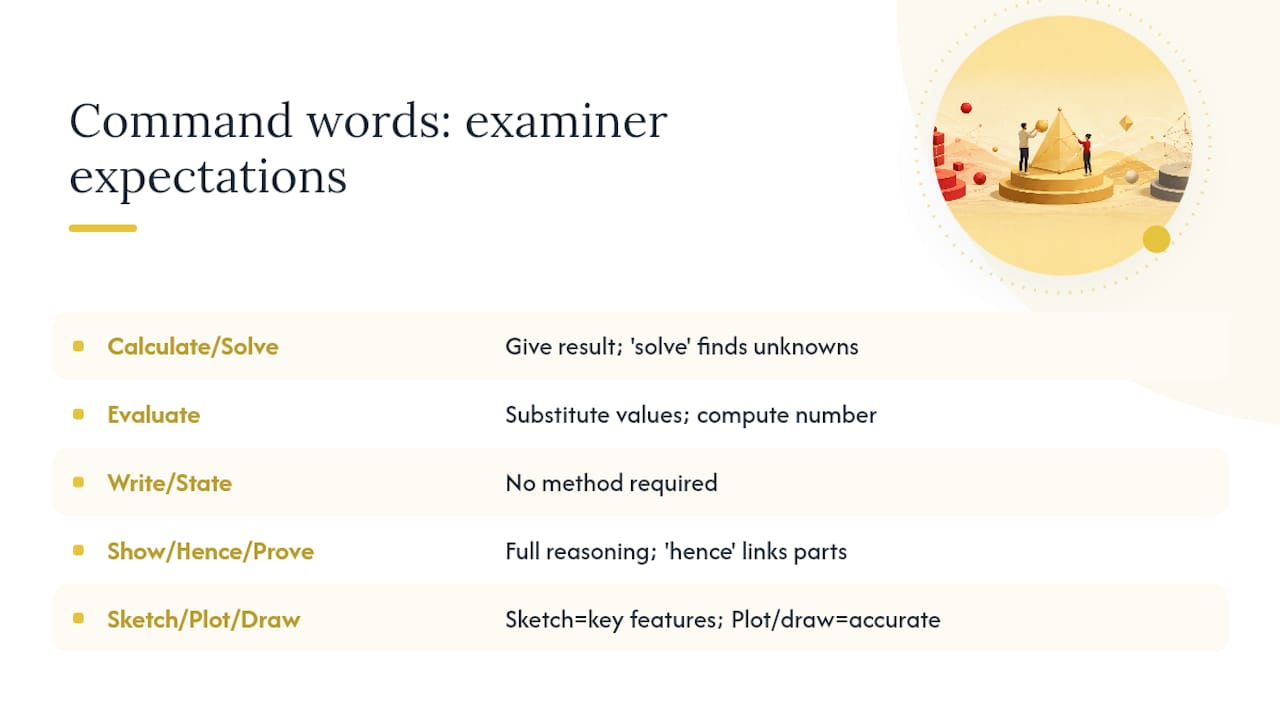
Calculate, find, solve, work out all ask for a numerical or algebraic result, and the route matters. “Solve” typically means finding the value of an unknown, such as solving an equation for x. “Evaluate,” by contrast, asks you to substitute values into an expression and simplify to a number. Teachers regularly flag confusion between the two as a common source of lost marks, since students sometimes try to “solve” an expression that has nothing to solve for.
Write down, state need no method at all, as covered above. Don’t overthink these.
Show that, prove, hence. “Show that” requires a complete chain of reasoning from the given information to the stated conclusion; you’re not finding an unknown answer, you’re demonstrating that a known one is correct. “Hence” is stricter still. It’s a direct instruction to build on the previous part of the question, and OCR’s A-level poster makes clear that ignoring the link risks losing marks reserved specifically for that connected method. “Hence or otherwise” is more generous, allowing a fresh approach, though examiners may still favour the hence route for linked marks.
Sketch, plot, draw. “Sketch” wants key features (intercepts, turning points, asymptotes) without graph-paper precision. “Plot” and “draw” usually demand accuracy from a table of values or given data.
Simplify, factorise, evaluate. “Simplify” means reduce an expression to its lowest terms. “Factorise” means rewrite as a product of factors, full stop, not solve for anything. “Evaluate” means substitute and compute.
Do all exam boards use the same command words?
Mostly, yes. AQA, OCR, Edexcel, and SQA all publish glossaries that map onto Ofqual’s national guidance, so a “calculate” on one board’s paper means much the same as a “calculate” on another’s. But board-specific phrasing does creep in, and it can change what a mark scheme rewards.
Two examples worth knowing. SQA’s guidance defines “prove” as requiring a formal argument, phrasing that’s slightly more explicit than some GCSE boards use, which matters if you’re moving between Scottish qualifications and English A-Level content. Meanwhile, OCR’s poster spells out the “hence” versus “hence or otherwise” distinction in more procedural detail than some other boards’ documents, which affects whether an alternative method still qualifies for linked marks.
The fix is simple — check your specification’s command word glossary before your final revision push.
- Check your specification’s command word glossary before your final revision push.
- Read the exact wording on a real past paper, not just a summary.
- Cross-reference the mark scheme for the same question to see which words triggered which marks.
How to turn a command word into the right exam answer
Follow this sequence every time you meet an unfamiliar command word under exam conditions.
- Underline the command word and classify it: no working, working expected, or full justification.
- Plan your steps on paper, labelling them “Method 1,” “Method 2” and so on. Examiner-style labelling makes it far easier for a marker to spot and award method marks even when your final answer is wrong.
- Check the accuracy instruction. If the question says “to 2 decimal places” or “leave your answer as an exact value,” that phrasing overrides your instinct to round early or simplify to a decimal.
Common pitfalls: rounding too soon, skipping steps on a “show that” question because you already know the answer, and ignoring a “hence” link by starting the next part from scratch.
Pro Tip: Keep a small checklist taped inside your revision folder: underline, classify, label steps, check accuracy wording. Thirty seconds of habit, every question, every paper.
Practising command words with Mathvault’s resources
Reading a definition and answering under exam pressure are different skills, and the gap between them is where marks disappear. Past papers, fully worked solutions, video walkthroughs, and live weekly Q&A sessions are built around closing that gap, letting you see exactly how a “show that” or “prove” answer should be structured line by line.
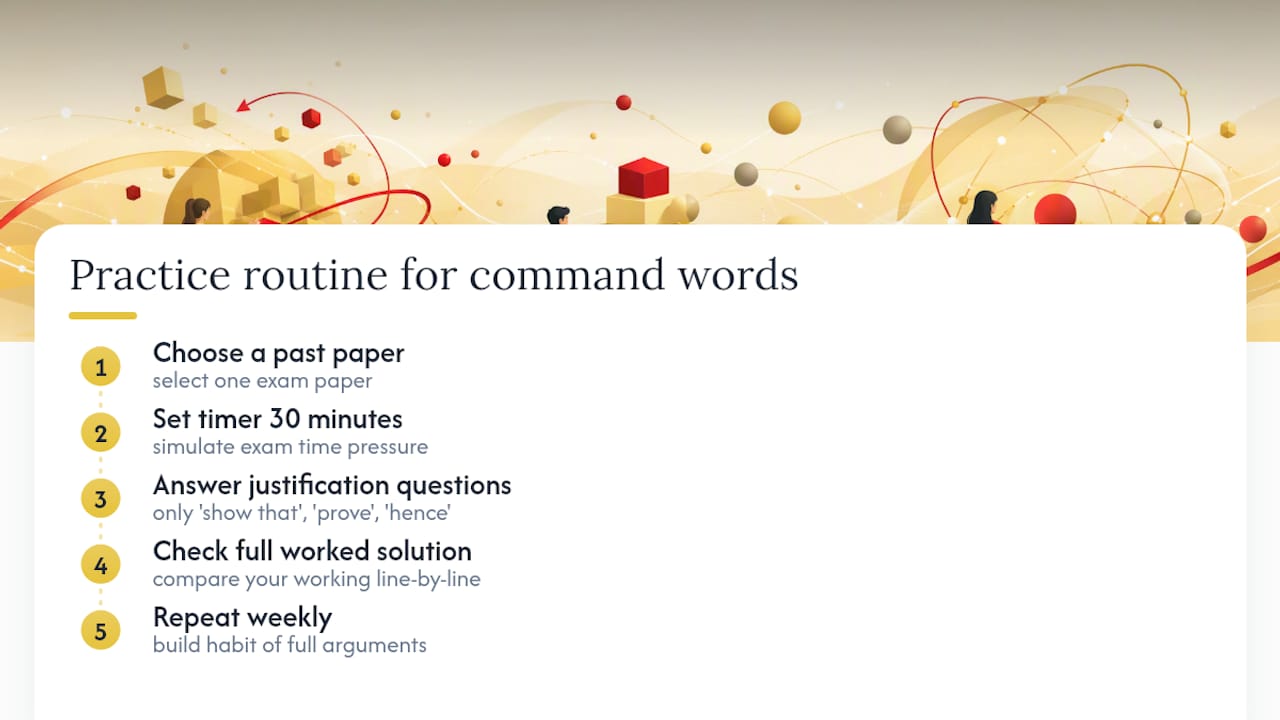
A practical routine: pick a past paper, set a 30 minute timer, and answer only the “show that,” “prove,” and “hence” questions. Then check your working against the full worked solution rather than just the final answer. Repeating this weekly, focused solely on justification-style questions, builds the habit of writing complete arguments under time pressure rather than skipping steps when the answer feels obvious.
A classroom note on command words
The mistake I see most often isn’t a maths error at all. It’s a student who knows the method but writes “answer = 12” on a “show that” question and loses every mark going. The fix is boring but reliable: underline the command word before you touch your pen to working, every single time. Practise this on real past papers, not summaries, and it becomes automatic well before results day.
— Oloru
Practise command words on real WJEC past papers
Reading about command words only gets you halfway there. The fastest way to fix “show that” and “prove” mistakes is to sit a real paper against the clock and mark yourself honestly against the actual scheme, and This practice is offered for free where many revision sites charge for full past-paper packs.
Start with the WJEC 2021 video solution to watch a full worked answer talk through exactly how a “hence” or “show that” response should be structured, then pair it with the matching WJEC 2021 mark scheme to see where each mark actually lands. Once you’ve got the pattern, download the WJEC 2020 question paper, set a 30 minute timer, and answer only the justification-style questions. Check your working line by line against the scheme rather than just glancing at the final number.
Sources
Check these directly when a command word’s exact meaning is unclear on your syllabus:
Always read the mark scheme alongside the glossary. The command word tells you the shape of the answer; the mark scheme tells you exactly where the marks sit inside it.
Leave a Reply