A good Advanced Higher Maths paper strategy comes down to four things: knowing how the marks are split between the two papers, spending time in proportion to marks, practising core routines until they are automatic, and presenting working so that a marker can award every mark you have earned. This guide sets out each one, with the timings, the common traps and a revision routine you can start this week.
It is written for Scottish S6 students, and for the teachers, tutors and parents supporting them.
TL;DR
- The assessment is worth 115 marks: Paper 1 (non-calculator) is 35 marks in 1 hour, and Paper 2 (calculator) is 80 marks in 2 hours 30 minutes.
- Budget roughly 1.7 to 1.9 minutes per mark, and move on when a question stalls.
- Drill established routines, such as integrating factors and logarithmic differentiation, until they are second nature. Qualifications Scotland’s 2026 course report stresses this.
- Protect marks through clean notation, legible corrections and the exact vocabulary a proof requires.
- Practise under timed conditions with past papers, then mark yourself against the official marking instructions.
Table of Contents
- What you are actually sitting
- Build a time budget before exam day
- Paper 1: the non-calculator strategy
- Paper 2: the calculator strategy
- Present your working so the marks reach you
- Method marks and how to protect them
- A revision routine that builds paper strategy
- Our perspective on paper strategy
- Where MathVault fits into your preparation
- How Advanced Higher compares and why it matters for your plan
- Exam-day checklist
- FAQ
- Sources
What you are actually sitting
The course specification sets out two components:
| Component | Calculator | Marks | Time |
|---|---|---|---|
| Paper 1 | No | 35 | 1 hour |
| Paper 2 | Yes | 80 | 2 hours 30 minutes |
| Total | 115 | 3 hours 30 minutes |
Two things follow from this table.
First, Paper 2 carries more than two thirds of the marks (80 of 115). A student who treats Paper 1 as the “main” paper because it feels harder is misallocating revision time. Paper 1 is short and unforgiving, but Paper 2 is where the bulk of your result is decided.
Second, the papers test different habits. Paper 1 rewards algebraic fluency and exact answers. Paper 2 rewards stamina, organisation and the judgement to know when a calculator helps and when it hides the structure of a problem.
Advanced Higher is an SCQF Level 7 qualification normally taken in S6, and it is designed to offer in-depth study and to build independent learning. That second point matters for strategy: nobody can drill every question type for you. Your preparation has to become self-directed.
Build a time budget before exam day
Do the arithmetic once, write it on your revision plan and rehearse it in timed practice.
Paper 1: 60 minutes for 35 marks is about 1.7 minutes per mark. A 5-mark question therefore gets roughly 8 to 9 minutes. With no calculator, slow arithmetic is your main risk, so every minute lost to an avoidable algebra slip is a minute taken from a later question.
Paper 2: 150 minutes for 80 marks is about 1.9 minutes per mark. If you set aside the final 10 to 15 minutes for checking, you are working at roughly 1.75 minutes per mark. These figures are our own working suggestion rather than an official rule, but they give you checkpoints.
A simple checkpoint system for Paper 2:
- At the 50-minute mark, you should have gained about 28 marks’ worth of attempts.
- At 100 minutes, about 57 marks’ worth.
- At 135 minutes, you should be on your last question or back-filling gaps.
When a question stalls
Set a limit before you start. If you have spent double the budget on a question, write a line to mark where you stopped, circle the question number on the front of the paper and move on. Partial working that you return to is worth more than a half-finished attempt that ate fifteen minutes and left the last question untouched.
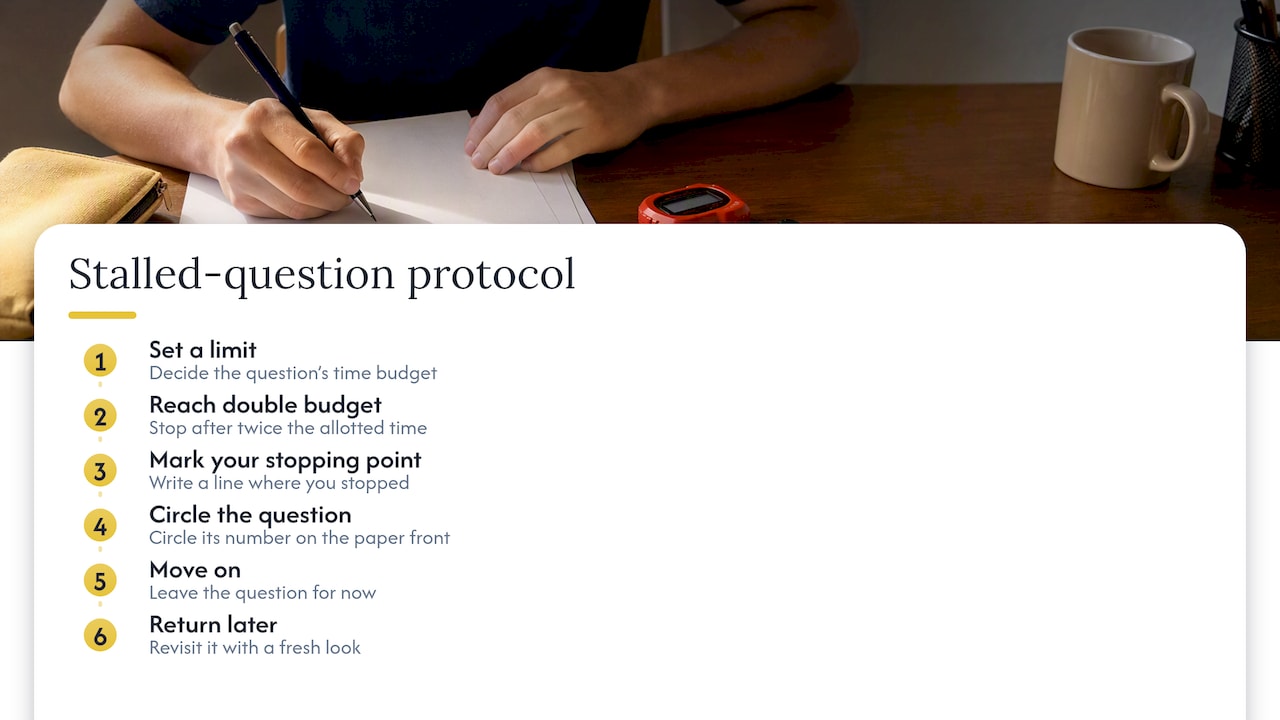
When you come back, you often see the missing step at once. The brain keeps working on a problem in the background, and a fresh look at a different question first is rarely wasted.
Paper 1: the non-calculator strategy
Paper 1 is short enough that careful sequencing makes a real difference.
Read the whole paper first
Spend the first two or three minutes scanning every question. Mark the ones where you can see the method immediately. Start there. Early momentum steadies your hands for the longer or less familiar items.
Keep answers exact
Without a calculator, expect surds, fractions, exact trigonometric values and multiples of pi. Leave answers in exact form unless the question asks otherwise. A decimal you have approximated by hand adds a chance of error and rarely adds a mark.
Make your routines automatic
Qualifications Scotland’s 2026 course report advises that candidates should practise established techniques, such as integrating factors for differential equations and logarithmic differentiation, until they are second nature. The reasoning is practical: when the routine costs you no thought, you have capacity left for the unfamiliar part of a question.
A useful self-test is to write out the steps of each routine from memory, on a blank page, without looking at notes:
- Integrating factor method: put the equation into standard form, find the integrating factor, multiply through, recognise the left-hand side as a derivative of a product, integrate.
- Logarithmic differentiation: take logs, simplify using the laws of logarithms, differentiate implicitly, rearrange for the derivative.
- Partial fractions, Maclaurin series, and the standard integration techniques: the same approach, step by step.
If you cannot write the sequence cleanly, you are not yet at “second nature”.
Do not neglect the basics
The same report highlights basic algebra and laws of indices as recurring failure points, even among strong candidates. One trap it describes: when asked to solve a quadratic, some candidates re-factorise from scratch after already having expanded, instead of using the factors provided by their earlier work. Read what you have already written before starting again.
Fluency here is not glamorous, but it is cheap marks. Ten minutes of indices, surds and factorising each week during revision is time well spent.
Paper 2: the calculator strategy
With 80 marks and 150 minutes, Paper 2 is an endurance test as much as a mathematical one.
Plan your calculator use
A calculator is for checking, evaluating and handling awkward numbers. It is not a substitute for setting up the problem. Before you type anything, write the equation or integral you are evaluating. If your final answer is wrong but the setup is on the page, you can still gain the method marks.
Set your calculator to the right angle mode (radians or degrees) before the paper starts, and check it again when a question switches. This is a classic way to lose an otherwise secure answer.
Do not round early
Carry full calculator values through multi-step working and round only at the end, to the accuracy the question asks for. Store intermediate results in memory where you can.
Sanity-check every numerical answer
Ask three quick questions. Is the sign sensible? Is the size plausible? Do the units or context make sense? A negative probability or a length of 400 metres for a garden fence is a signal to stop and look for the slip.
Keep stamina up
Two and a half hours is long. In practice sessions, sit the whole paper at least twice before the exam so that the final 40 minutes is not unfamiliar territory. Eat beforehand, take water if allowed and keep your pace even.
Present your working so the marks reach you
Most lost marks are not about knowledge. They come from presentation, and the 2026 course report is specific about it.
Legibility and corrections
Markers see your work as a scanned image, so clarity matters. If you make a mistake, do not write over it, because that creates ambiguity. Draw a single clear line through the incorrect work and write the replacement in a blank space, so that there is no doubt about what should be marked. Use a dark pen or pencil that scans well, and leave space between lines.
Notation
Precision in notation costs marks when it slips. The report notes examples such as omitting brackets in algebraic expressions or using an equals sign inappropriately between a function and its derivative. In matrix questions, distinguish carefully between inverse, transpose and adjoint, and never “divide” one matrix by another.
A habit worth building: when you write a derivative, write it as a derivative (for example f’(x) or dy/dx), not as f(x) = something. The equals sign claims two things are equal. Make sure they are.
Proof by induction
Proof questions reward exact structure. The report warns that having the right logic is not enough: omitting required terms, or failing to show the algebraic manipulation clearly, can invalidate the proof. It also reminds candidates that not every induction question involves a sum, so a memorised summation template will not always fit.
A safer approach is to build your own checklist:
- State the proposition P(n) clearly.
- Show it is true for the base case, with the working visible.
- Assume it is true for n = k, stating this explicitly.
- Show that it then holds for n = k + 1, laying out each algebraic step.
- Write a closing statement that links the base case and the inductive step to all the relevant integers.
Practise on divisibility, inequality and matrix or sequence cases as well as sums.
Method marks and how to protect them
In a multi-mark question, marks are usually awarded for steps as well as for the final answer. That has a practical consequence: writing down the method gives you a chance of credit even if arithmetic goes wrong later.
- Write the formula or the equation you are using before you substitute.
- Show each stage of a calculation on its own line.
- If you realise a result is wrong, cross it out and, if time allows, redo it. If time does not allow, leave your working visible rather than erasing it.
- Where a question says “hence”, use the previous result. Starting from scratch can lose the marks that the question is steering you towards.
Reading the official marking instructions for past papers is the best training here. You see exactly where marks are allocated and how alternative methods are treated. After a few papers, you begin to anticipate what a marker looks for.
A revision routine that builds paper strategy
Strategy is a skill, so it needs practice just like integration does. Here is a routine that works across the final months before the exam.
Weeks 1 to 4: fluency
- Work through topics in blocks, writing out the standard routines from memory.
- Keep an error log: each mistake gets a one-line cause, such as “sign error”, “forgot chain rule” or “did not read question”.
- Spend 10 minutes per session on algebra and indices.
Weeks 5 to 8: mixed practice
- Move to mixed-topic questions so that you must decide which method applies.
- Do short timed sets at 1.7 minutes per mark.
- Revisit your error log weekly and look for patterns.
Final weeks: full papers
- Sit full papers in exam conditions, alternating Paper 1 and Paper 2.
- Mark with the official instructions and note marks lost to presentation separately from marks lost to knowledge.
- Rehearse the final-hour checking routine: sign, size, units, notation.
Grade boundaries are not fixed. They are set each year to reflect the difficulty of that year’s paper, so the GOV.UK guidance on GCSE and A level applies to the principle in those systems. Rather than chasing a rumoured cut-off, aim to bank every mark available to you.
When number work itself is the obstacle
Some students lose marks to difficulties with number processing, not to a lack of mathematical understanding. If that sounds familiar, it is worth reading about practical classroom strategies for dyscalculia and speaking to your school’s support for learning team about exam arrangements well before the exam season.
Our perspective on paper strategy
We see the same pattern in students across GCSE, Higher and A-Level preparation: the gap between a good result and a very good one is rarely a missing topic. It is usually a handful of marks lost to habits, such as rushing the setup, crossing out messily, rounding too soon or skipping the line where a formula is written down.
That is why we built MathVault around fully worked solutions alongside past papers. A solution that only shows the answer teaches you nothing about strategy. A solution that shows every line lets you compare your own presentation with a model one, and that comparison is where most improvement happens.
Our advice is to treat each practice paper as two exercises: one in mathematics and one in communication. Mark both. The second one is much easier to improve, and it pays off in every paper you will ever sit.
— Oloru
Where MathVault fits into your preparation
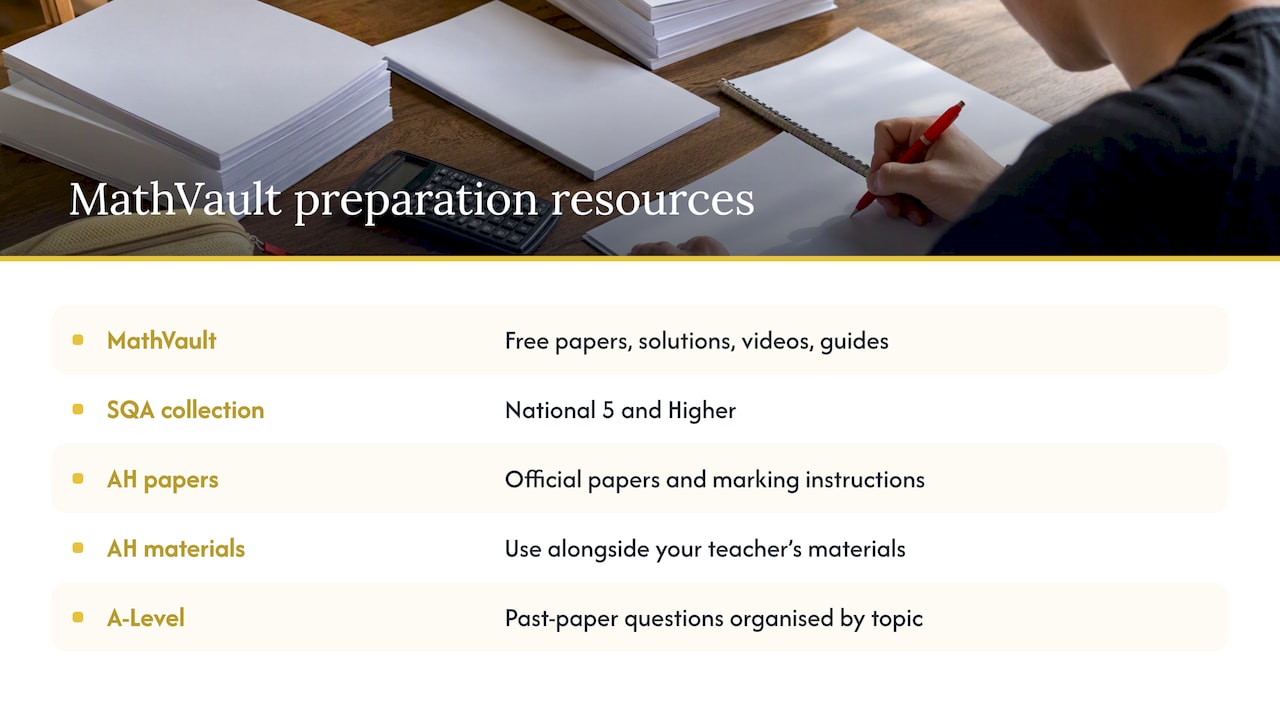
MathVault is a free platform of past papers, step-by-step worked solutions, video walkthroughs and revision guides for UK students. We should be clear about scope: our SQA collection centres on National 5 and Higher, and for Advanced Higher you should use the official papers and marking instructions published by Qualifications Scotland alongside your teacher’s materials.
Where we help is in building the underlying fluency. Higher papers are excellent for rehearsing the algebra, calculus and trigonometry that Advanced Higher builds on, and for practising the discipline of showing method. Try the SQA Higher 2025 question paper under timed conditions, then compare your layout with the 2019 worked solution and mark scheme. If you are also considering A-Level routes or helping a sibling, our A-Level past-paper questions are organised by topic.
Everything in the revision materials is free. Parents, tutors and older students who want offline packs can buy downloadable bundles, and donations are welcome but never required.
How Advanced Higher compares and why it matters for your plan
Two points from UCAS help you set your priorities.
Advanced Higher is distinct from the A Level taken in England, Wales and Northern Ireland, though both are recognised for progression into higher education. Do not assume that advice written for A Level translates exactly: the structure, the paper lengths and the marking instructions are different.
Advanced Highers can also lead to subject exemptions or direct entry into the second year of a four-year Scottish degree. If that is your goal, check each university’s own entry requirements, as they vary by course. The qualification was designed to support progression into honours degrees by developing independent learning skills, and your exam strategy should reflect that: self-testing, error logs and explaining solutions aloud are habits that carry into first-year university maths.
Exam-day checklist
- Calculator charged or with fresh batteries, set to the correct angle mode for Paper 2.
- Spare pens, pencil, ruler and eraser.
- Time checkpoints written on the front of the paper.
- A first-pass scan of the whole paper before writing.
- One line crossed out, never overwritten.
- Final ten minutes reserved for checking sign, size, notation and units.
FAQ
Is Advanced Higher Maths harder than A Level maths?
They are different qualifications, so a direct comparison is difficult. Advanced Higher is an SCQF Level 7 course taken in S6 with an emphasis on in-depth study and independent learning, while A Level is taken in England, Wales and Northern Ireland. Ask your teacher or the universities you are applying to how they treat each one.
How long should I spend on each question?
A good starting point is about 1.7 minutes per mark on Paper 1 and 1.9 on Paper 2, or slightly less if you reserve time for checking. A 6-mark question on Paper 2 therefore gets roughly 10 to 11 minutes. Treat these as guides and practise them under timed conditions.
Should I do Paper 1 or Paper 2 revision first?
Start with fluency, because it serves both papers. Then give Paper 2 the larger share of your timed practice, since it carries 80 of the 115 marks, while keeping regular non-calculator sessions so that exact arithmetic stays sharp.
Do universities care about Advanced Highers?
Yes, they are recognised for entry to higher education, and in some cases they can give exemptions or entry to the second year of a four-year Scottish degree. Entry requirements differ between universities and courses, so check each institution’s published criteria.
Sources
- Advanced Higher Mathematics course specification (SQA)
- Advanced Higher Mathematics course report 2026 (Qualifications Scotland)
- UCAS terms and abbreviations explained
- Scottish Advanced Highers (UCAS)
- Scottish qualifications expert group report (UCAS)
- GCSE and A level grading: what you need to know (GOV.UK)
Leave a Reply