
IGCSE maths question styles fall into a short list: short recall, structured multistep, graph and drawing, geometry and construction, statistics, and combined-topic problem solving. This guide pairs each style with exam-style example prompts, a weekly practice plan and links to past papers with worked solutions, so you know what to expect and how to prepare.
TL;DR:
- From 2025, Cambridge papers include a formula sheet, but students must memorize formulas it omits, including cube volume, triangle area, circumference, and the Pythagorean relationship.
- Show every step: method marks reward correct approaches despite arithmetic slips, and examiners may credit later work that uses an earlier result.
- Prioritize questions with several steps and combined topics; practice untimed, mark your work, redo errors two days later, then add timed sets once scores stabilize.
- Paper formats differ across boards, so use other boards’ questions for topic practice, then use your own board’s papers to rehearse timing and exam style.
Table of Contents
- How are IGCSE maths papers organised?
- Which question styles appear most often, with examples?
- How should you change your practice for calculator and non-calculator papers?
- How do examiners mark your answers?
- How do you build a topic-based practice plan from past papers?
- How do our resources support each question style?
- How do question styles differ across exam boards?
- What traps and tricky question formats should you watch for?
- How do you adapt to question styles and manage your time?
- What is the best way to practise, in my view?
- Where can you start revising with our packs?
- FAQ
- Sources
How are IGCSE maths papers organised?
Your tier decides which papers you sit, and the paper decides which question styles you meet. For the 2025–2027 cycle, Cambridge IGCSE Mathematics has two balanced papers per tier, and all papers mix structured and unstructured questions.
- Core: Paper 1 (non-calculator) and Paper 3 (calculator), each lasting 1 hour 30 minutes and worth 80 marks.
- Extended: Paper 2 (non-calculator) and Paper 4 (calculator), each lasting 2 hours and worth 100 marks.
- Non-calculator papers: expect cleaner numbers, fractions, surds and exact answers, because you must show every step by hand.
- Calculator papers: expect longer, more realistic contexts with decimals, trigonometry and multi-stage calculations.
- Formula sheet: from 2025 onwards, a formula sheet is included on each paper, and Cambridge’s FAQs confirm you must still memorise formulas that are not listed, such as the volume of a cube.
Cambridge also runs related Mathematics syllabuses. The 0607 International Mathematics syllabus uses core and extended tiers with calculator and non-calculator papers, so check which code your school entered you for before you pick practice papers.
Your teacher may also mention the grading scale. Cambridge explains its grading choices: some centres report A*–G and others 9–1, so confirm which applies to you.
The tier tells you how long each question set will test you. Short, quick items make up the early part of a paper, and the heavier, multi-part questions come later. Knowing this lets you pace yourself before you open the booklet.
Which question styles appear most often, with examples?
Here are the main styles, grouped by topic, each with an example prompt you can adapt for practice. The specimen material for Cambridge International Mathematics Paper 1 shows the pattern clearly: short numerical prompts, frequency tables, basic factorisation, algebra manipulation, coordinate geometry and multi-part problems that award marks for both method and accuracy.
- Short recall (1 to 2 marks). “Write a terminating decimal as a fraction in its simplest form.” These test a single skill, so a wrong answer costs you the whole mark.
- Structured multi-part questions. “(a) Expand and simplify (x + 3)(x – 5). (b) Hence solve x² – 2x – 15 = 0.” Each part feeds the next, and method marks reward a clear first step even when a later slip appears.
- Algebra manipulation. “Factorise fully 6x² – 9x.” “Make t the subject of v = u + at.” “Solve 3(2x – 1) = 4x + 7.” Show each line of working so a method mark is available.
- Geometry and trigonometry. “An angle in a circle is given. Use circle theorems to find another angle, giving a reason.” Reasons carry marks, so name the theorem. Construction tasks ask you to draw bisectors or arcs with compasses and leave your construction lines visible.
- Graphs and functions. “Complete the table for y = x² – 3x, plot the graph and use it to estimate the gradient at x = 2.” Plotting accuracy, curve smoothness and a drawn tangent all earn marks.
- Statistics and probability. “The table shows students’ heights. Estimate the mean.” “A bag holds 5 red and 3 blue counters. Two are taken without replacement. Draw a tree diagram and find the probability that both are the same colour.”
- Combined-topic problem solving. “A rectangle has length (x + 4) cm and width (x – 1) cm. Its area is 50 cm². Form and solve an equation to find x, then find the perimeter.” One question links algebra, a quadratic equation and geometry.
Work through these in order of difficulty, but keep returning to number 7. In our experience, students struggle most with combined-topic questions, and they improve fastest when practice deliberately links algebraic technique with geometry or graph interpretation.
Pro Tip: When a question has several parts, write the answer to part (a) clearly even if you are unsure, because later parts often reuse it and follow-through marks depend on it.
Our IGCSE past-paper hub groups real questions by topic, so you can pick one style at a time and practise it in a focused block.
How should you change your practice for calculator and non-calculator papers?
Each type of paper rewards different habits, and mixing them up costs marks.
On Core, Paper 1 is the non-calculator paper and Paper 3 allows a calculator. On Extended, Paper 2 is non-calculator and Paper 4 allows one, according to the syllabus. Cambridge’s getting-ready factsheet adds that learners must practise selecting formulas and showing working without a calculator.
- Non-calculator questions reward exact values: fractions, surds, multiples of π and standard form. Your working is the evidence, so write it fully.
- Calculator questions reward careful rounding, correct mode settings (degrees, not radians) and sensible units. Store intermediate values and round only at the end.
- Mental arithmetic: practise times tables, square numbers, common fractions and decimal conversions regularly.
- Checking: estimate before you calculate. If a triangle side comes out longer than the hypotenuse, something has gone wrong.
- The formula sheet: learn where each formula sits so you can find it in seconds, but do not rely on it to teach you how to use a formula.
The formula sheet helps with the harder formulas, but it does not cover everything. As the official FAQs state, you still need to memorise basic formulas that are not listed. Build your own short list of what the sheet leaves out, such as area of a triangle, circumference and the Pythagorean relationship, and test yourself on it weekly.
Pro Tip: Do your first run through any topic without a calculator, then repeat the same questions with one. You will spot where the calculator genuinely saves time and where it only tempts you to skip working.
How do examiners mark your answers?
Marks reward the process as well as the result. The syllabus describes papers with both structured and unstructured questions, and the mark scheme splits credit into types.
- M marks (method): awarded for a correct approach, even if the arithmetic slips.
- A marks (accuracy): awarded for a correct answer, and usually dependent on the method mark before it.
- B marks: independent marks for a correct statement or value that needs no method.
- FT (follow-through): credit for using an earlier wrong answer correctly in a later part.
Command words set the depth of working you need. “Calculate” and “find” want a method and an answer. “Show that” gives you the answer, so every step towards it must be visible. “Explain” and “give a reason” need a written statement that names the rule. “Prove” demands a logical chain from start to finish.
Cambridge confirms that its standards are checked through examiner research and awarding processes, which is why mark schemes reward clear, correct working consistently.
Common mistakes are easy to avoid once you know them:
- Writing only the final answer on a multi-mark question.
- Rounding too early and losing the accuracy mark.
- Leaving out units or the reason in a geometry proof.
- Crossing out working without replacing it.
To see real marking language, open the official-style Paper 1 mark scheme and read how M and A marks are assigned line by line. For a calculator paper, compare it with the Paper 3 mark scheme.
How do you build a topic-based practice plan from past papers?
A good routine turns topic knowledge into exam skill. Follow these steps over the weeks before your exam.
- Build topic packs. Pick one topic, such as algebra or probability, and collect every question on it from several past papers. Start with the IGCSE hub and sort by topic.
- Start untimed. Work through the pack slowly, writing full working. Your aim is to find gaps, not to beat the clock.
- Mark it honestly. Use the mark scheme. Give yourself M marks only where your method matches, and note every lost A mark.
- Read the examiner language. Look at how the scheme words each step, and rewrite any answer where your working was thin.
- Redo the misses. Wait two days and attempt the questions you lost marks on, without looking at the solution.
- Add the clock. Once you score steadily, time yourself, using the marks available as a guide to pacing, and push into harder multi-part questions.
- Move to full papers. When you have covered most topics, sit whole papers under exam conditions, then review them the same way.
A simple weekly rhythm keeps this manageable:
- Monday and Tuesday: learn or revise one topic and complete its pack untimed.
- Wednesday: mark the pack and write corrections.
- Thursday: attempt a timed set of mixed questions from that topic.
- Friday: redo your errors and make a one-page summary.
- Weekend: one timed section of a full paper, alternating calculator and non-calculator.
Aim to attempt calculator and non-calculator papers regularly, using the right tier. A Core student should use papers like the Paper 1, which shows short-answer and frequency-table items. An Extended student can stretch themselves on the Paper 2, which has longer multi-step questions.
Pro Tip: Keep an error log with three columns: the topic, the mistake and the fix. Reviewing it before each paper is worth more than another hour of fresh questions.
How do our resources support each question style?
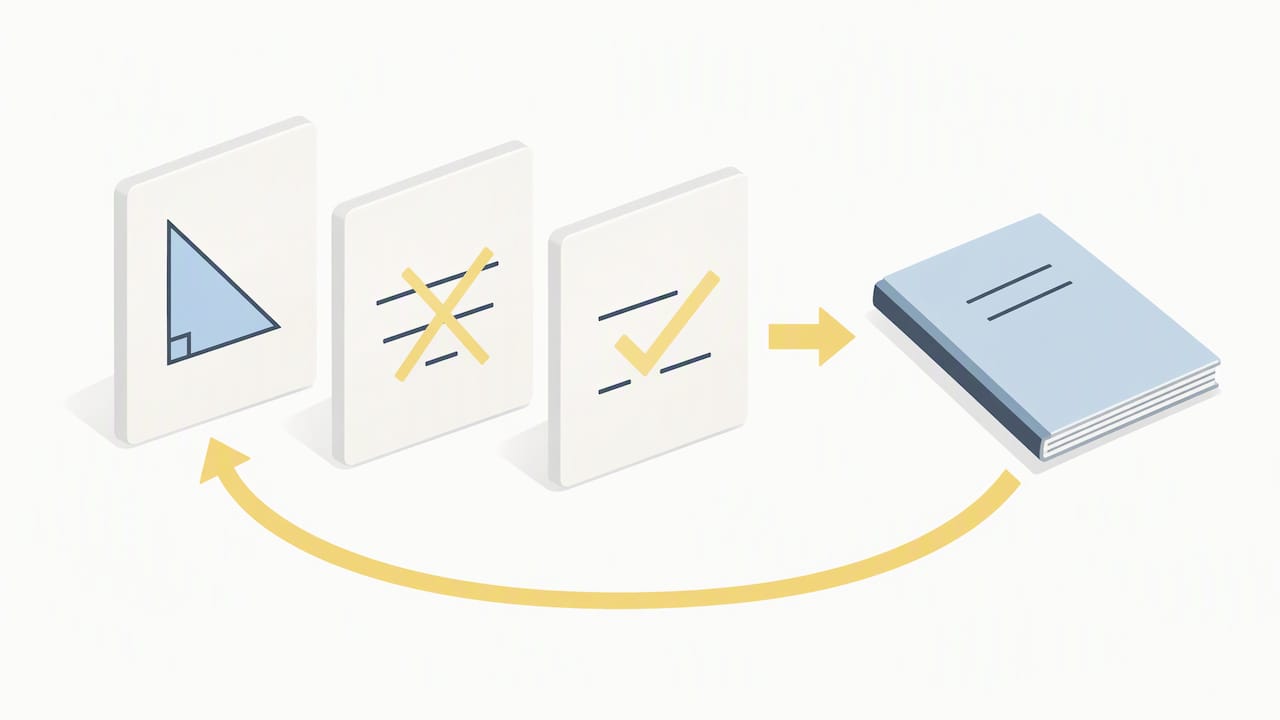
We built our collections around the practice plan above, so each step has a matching resource. Our curated past-paper packs are organised by topic and exam board, so you can build the topic packs from the plan in minutes instead of hunting through whole papers.
Every paper comes with fully worked, step-by-step solutions. These mirror mark-scheme logic, which means you can see exactly where method marks are earned and rewrite your own answers to match. When a solution still feels unclear, our video walkthroughs break the same question down visually, one stage at a time.
Combined-topic questions are where most students need extra help, so our live Q&A sessions focus on them. You can bring a question that links algebra to geometry or graphs and get it explained in real time.
The platform covers the main UK exam boards so you can practise with the style of paper you will sit. Start with the IGCSE past-paper hub, then use the mark-aligned solutions to recover method marks in your own answers.
How do question styles differ across exam boards?
IGCSE maths is offered by more than one board, and the papers do not look identical. Cambridge, the board covered by our official sources, uses the paper structure described earlier, with balanced calculator and non-calculator papers at each tier and a mix of structured and unstructured questions.
Other boards, including Edexcel, OCR and AQA, run their own IGCSE or GCSE-style specifications. Their question wording, paper counts and the balance between short and extended questions can differ, so we do not assume one board’s format applies to another. The safest approach is to check your own board’s specification and specimen papers for the number of papers, their lengths and calculator rules.
What stays similar across boards is the underlying skill set. Every board tests algebra manipulation, geometry reasoning, graphs, statistics and problem solving, and every board awards method marks for clear working. So topic-based practice transfers well, even when the exact layout changes.
Use this checklist to compare any board:
- How many papers, and how long is each?
- Which papers allow a calculator?
- Is a formula sheet provided, and what does it include?
- How are marks split between short and extended questions?
If you practise with a different board’s paper, treat it as extra topic practice and then return to your own board’s papers for timing and style.
What traps and tricky question formats should you watch for?
Some questions look easy and still cost marks. Knowing the shape of these traps helps you slow down at the right moment.
- “Show that” questions. You are given the answer, so a missing step costs the mark. Write every line from the starting point to the stated result.
- Hidden multi-step problems. A short-looking question, such as finding a percentage change, may need a reverse calculation. Read it twice before you start.
- Unit mismatches. Areas in cm² and lengths in metres, or time in minutes against speed in kilometres per hour, are classic ways to lose an accuracy mark.
- Rounding instructions. “Give your answer to 3 significant figures” is not the same as 3 decimal places. Check which one is asked for.
- Estimated and exact answers. A non-calculator question may ask for an answer in terms of π or as a surd, and a decimal will not earn the mark.
- Diagrams not drawn to scale. Never measure from a diagram marked “NOT to scale”. Use the given values and the reasoning rules.
- Reasons in geometry. An angle value without the named theorem often earns only part of the marks.
- Wrong calculator mode. Degrees versus radians can ruin a whole trigonometry question.
Before you move on from any question, ask three things: did I answer what was asked, in the right form, with the right units? A ten-second check at the end of each question catches most of these slips.
How do you adapt to question styles and manage your time?
Time management on an IGCSE paper comes down to matching your pace to the question type. A rough guide is about one minute per mark, so a 3-mark question deserves around three minutes. Check this against the length of your own paper, 1 hour 30 minutes for Core papers or 2 hours for Extended papers, as the syllabus sets out.
Adjust by style:
- Short recall items: answer fast, bank the marks and move on. Spending five minutes on a 1-mark question is a bad trade.
- Structured multi-part questions: read the whole question first, then work through part by part. Write each result clearly because later parts depend on it.
- Graph and drawing tasks: set aside time for plotting and drawing neatly. A rushed curve loses accuracy marks.
- Geometry and construction: have your compasses, protractor and ruler ready before the paper starts, and keep construction arcs visible.
- Statistics: read tables slowly and underline what is asked, whether mean, median or range.
- Combined-topic problems: break them into stages and label each one, so you earn method marks even if you do not finish.
A three-pass approach works well. On the first pass, answer everything you can do quickly. On the second, attempt the longer questions you skipped. On the final pass, use any remaining time to check units, rounding and any “show that” steps.
If you are stuck, write down any correct method or formula you can think of and move on. Partial credit is real, and a blank space can never earn a mark.
What is the best way to practise, in my view?
Most students treat past papers as a test to be endured. I think the opposite works better: treat each paper as a source of small, repeatable skills. The students who improve fastest are rarely the ones doing the most papers. They are the ones who take one weak style, such as multi-step algebra inside a geometry problem, and practise it until the link between the two topics feels automatic.
Timed papers matter, but only after topic practice has built the habits. Sitting a full paper too early mostly confirms what you already know is shaky. Read the mark scheme as if it were a teacher’s instruction manual, because it shows exactly which lines of working the examiner is hunting for. Then go back and write your answers in that language.
So practise a little each day, review every lost mark, and keep linking topics together. That habit, more than any single trick, is what turns a familiar syllabus into confident exam performance.
— Oloru
Where can you start revising with our packs?
If you are preparing now, our GCSE revision guides and past-paper collections follow the same topic-first routine described above. Each topic page pairs revision notes with real exam questions and worked solutions, so you can move from learning to timed practice without changing resources. Downloadable packs are available if you prefer to revise offline.
Visit our GCSE maths revision guides to choose a topic, then use the past-paper collection to build your first practice pack today.
FAQ
Which IGCSE maths paper is non-calculator?
On Cambridge IGCSE Mathematics, Paper 1 for Core and Paper 2 for Extended are the non-calculator papers. Paper 3 (Core) and Paper 4 (Extended) allow a calculator, as the syllabus sets out.
Do IGCSE maths papers include a formula sheet?
Yes. From 2025 onwards, a formula sheet appears in the papers, according to Cambridge’s FAQs. You still need to memorise basic formulas that are not listed on it.
What question styles should I practise most?
Practise structured multi-part questions and combined-topic problems first, because they carry the most marks and the most method credit. Add short recall items for speed, then graph, geometry and statistics tasks for coverage.
How do I earn method marks?
Show every step of your working and write clear intermediate results. Examiners award method marks for a correct approach even when the final answer is wrong, so a blank or answer-only response throws credit away.
Sources
- Cambridge IGCSE 0980 Mathematics syllabus for examination in 2025, 2026 and 2027
- FAQs for IGCSE Mathematics (0580 & 0980) – What can we help you with?
Leave a Reply