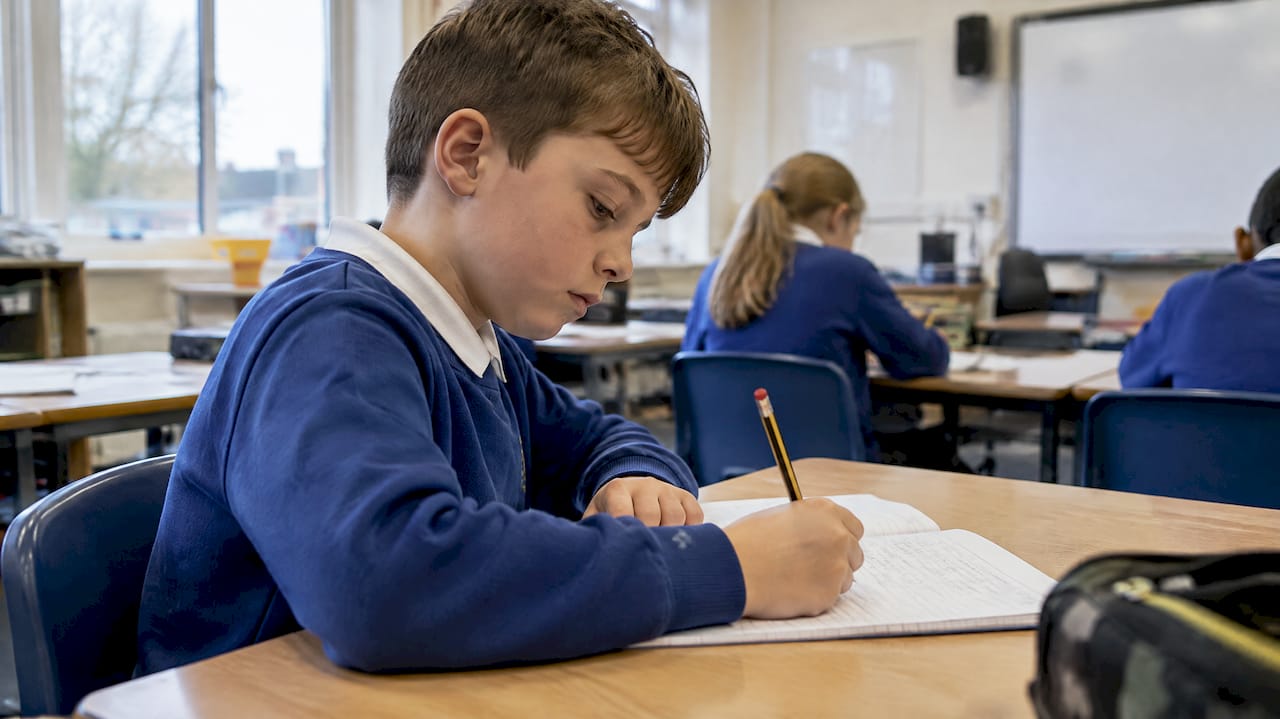
Showing working in maths means recording the method and each linked step clearly enough that another person, a teacher, a parent, or an examiner, can follow the reasoning without guessing. The national curriculum in England asks pupils to reason mathematically and break problems into steps, so visible working is the habit worth building first.
TL;DR:
- Most primary students should show clear, linked working for different problem types, using diagrams and equations appropriate for their stage.
- Representations should connect visually to calculations, with labels and arrows, to avoid confusion and build understanding.
- When checking work, students should use estimation, inverse operations, alternative representations, or reasonableness to verify their answers.
- Marking should preserve crossed-out work and ask students to explain their reasoning to identify gaps and deepen understanding.
- Following the eight-step routine and understanding the order of operations help pupils develop consistent, logical problem-solving skills.
Table of Contents
- Why showing working matters in the national curriculum
- A simple step-by-step template pupils can use
- Choosing the right representation: concrete, pictorial and abstract
- Order of operations made sensible: BODMAS in UK classrooms
- Checking strategies and how much working is enough
- Two worked examples pupils can copy
- Classroom-tested tips and next steps
- Where to practise showing your working
- FAQ
- Sources
Why showing working matters in the national curriculum
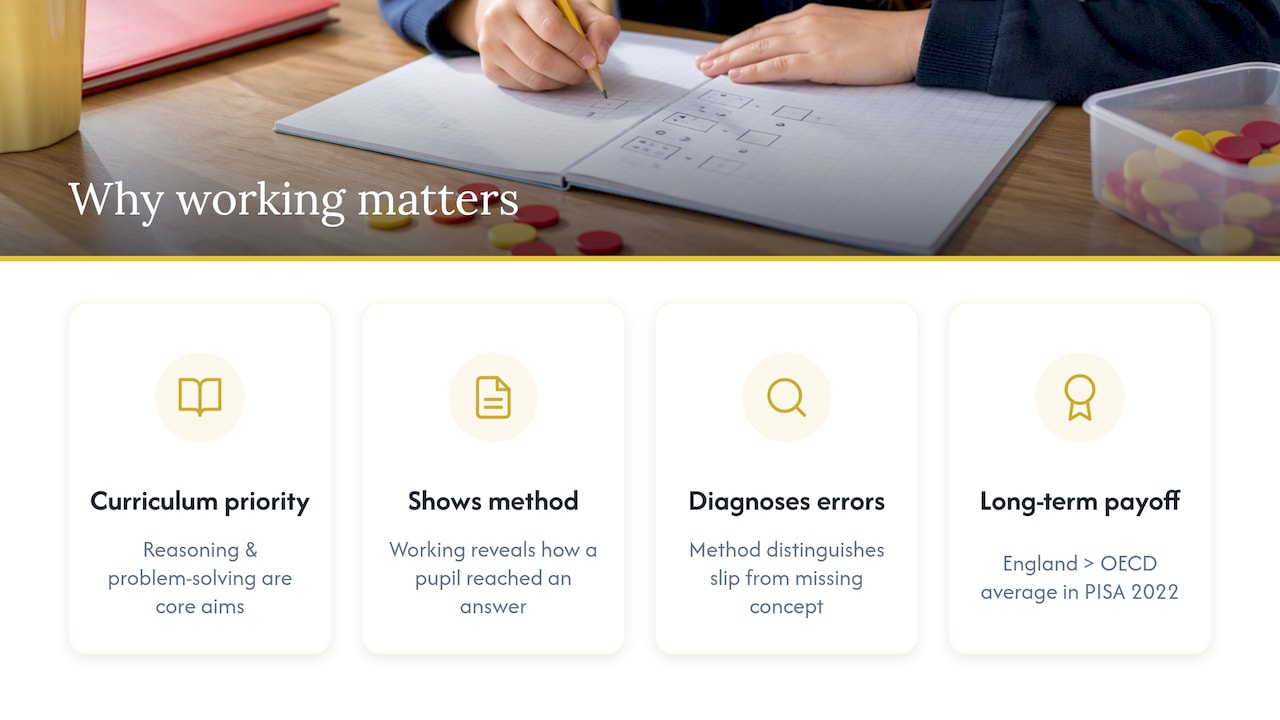
The national curriculum in England treats reasoning and problem-solving as core aims alongside fluency, not optional extras bolted onto a correct answer. Pupils are expected to construct mathematical arguments, justify their choices and break a problem into simpler steps, which only shows up on paper if the working is there to see.
A final answer tells you what a pupil got. The working tells you how they got there, where their understanding is solid and where it wobbles. That distinction matters most when a wrong answer comes from a small slip rather than a missing concept, since the method reveals which one happened.
There is also a wider reason to take reasoning seriously. England scored above the OECD average in mathematics in the PISA 2022 national report, which frames mathematical reasoning as a central assessed skill rather than a bonus. Building that reasoning habit early, through visible working, pays off well beyond primary school.
A simple step-by-step template pupils can use
A repeatable routine takes the guesswork out of “how much should I write”. This eight-step template works for most primary problems and adapts easily as pupils progress:
- Underline or identify what the question is actually asking.
- Record the key facts and numbers given.
- Draw a representation if it helps, such as a bar model or number line.
- Write the operation or equation you plan to use.
- Calculate on clear, linked lines so each step follows from the last.
- Label any units, such as centimetres, minutes or pounds.
- Write the answer as a full sentence.
- Check the answer using estimation or the inverse operation.
Younger pupils in Years 1 and 2 will lean on pictures and short jottings rather than formal equations, and that is appropriate: the KS1 to KS2 mathematics guidance confirms that working can be concrete, pictorial or abstract depending on the pupil’s stage. By upper Key Stage 2, pupils should move towards clearly labelled equations alongside any diagrams.
Pro Tip: Number each calculation line and link it back to the representation above it: markers and parents can follow the logic far more quickly than with a block of unexplained figures.
Choosing the right representation: concrete, pictorial and abstract
Representations only help if they connect clearly to the calculation that follows. The KS1 to KS2 guidance describes three stages that pupils move through, often blending them on the same page:
- Concrete: physical objects such as counters or a tens frame to model a quantity.
- Pictorial: a bar model, number line or array that stands in for the objects.
- Abstract: the written equation or number sentence, such as 24 ÷ 6 = 4.
Each representation should sit next to the working it supports, with an arrow or a short label showing how the drawing turned into the sum. A bar model that never reconnects to the written calculation leaves the marker guessing. Pushing a pupil into abstract notation before they understand the concept behind it tends to produce correct-looking answers built on shaky foundations, so it is worth resisting that shortcut even when it looks tidier.
Order of operations made sensible: BODMAS in UK classrooms
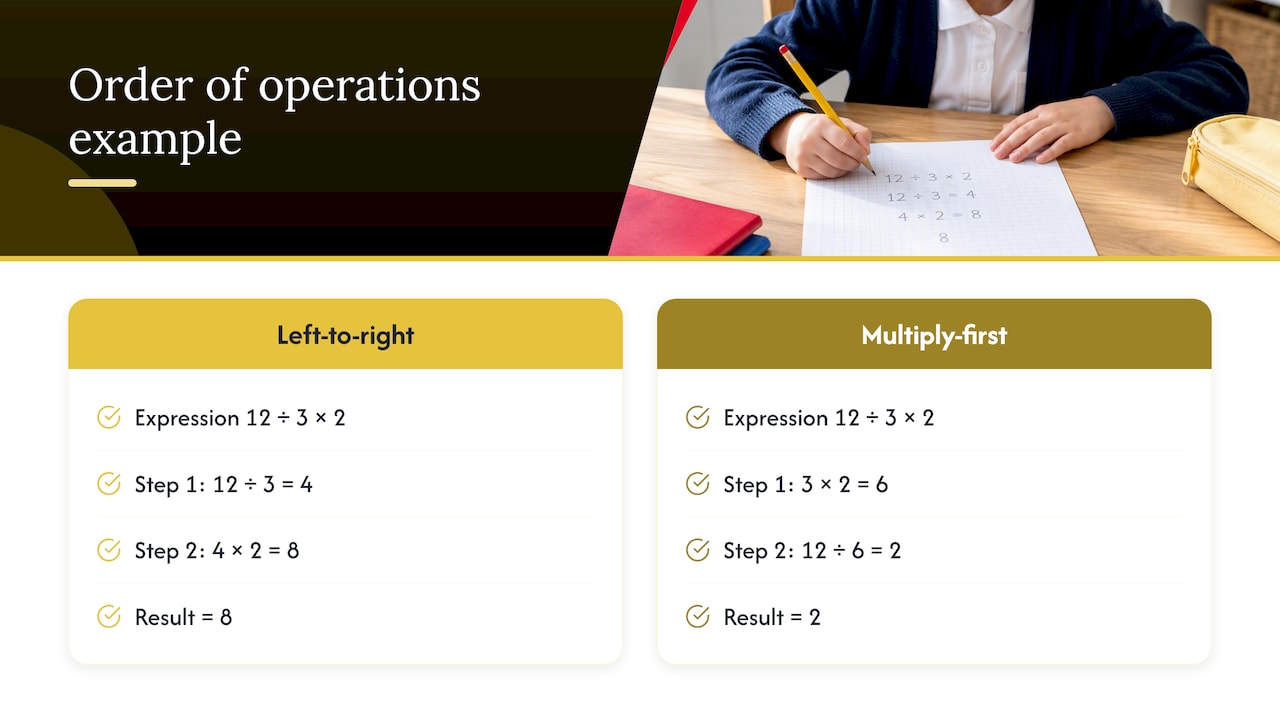
BODMAS is a memory aid rather than a rigid ladder, and the national curriculum treats it that way. Multiplication and division share equal priority, as do addition and subtraction, so within each pair pupils work left to right rather than always doing multiplication before division.
Take 12 ÷ 3 × 2. Read left to right: 12 ÷ 3 = 4, then 4 × 2 = 8. Treating multiplication as automatically “first” would wrongly give 12 ÷ 6 = 2.
When a pupil’s order looks unusual, ask them to explain their choice before correcting it. Often the reasoning is sound even if the layout looks unfamiliar.
Checking strategies and how much working is enough
A finished calculation is not finished until it has been checked. Four methods cover most primary situations:
- Estimate first, then compare the estimate with the final answer.
- Use the inverse operation, such as checking subtraction with addition.
- Try an alternative representation, such as a number line instead of column method.
- Ask whether the answer is reasonable for the context of the question.
How much working counts as enough changes by stage. Years 1 and 2 pupils might show a drawing and a number sentence. Years 3 and 4 typically add a written method alongside any jottings. By Years 5 and 6, pupils should show full linked calculations with a check and a sentence answer.
Pro Tip: When marking, preserve crossed-out jottings rather than asking for a clean rewrite: the national curriculum guidance notes that this evidence often reveals exactly where understanding broke down, and a simple “How do you know?” opens up far more than the final figure ever will.
Two worked examples pupils can copy
These two examples show the template doing its job on different problem types.
- Addition and subtraction: A baker has 145 buns, sells 68, then bakes 40 more. A bar model shows the three amounts linked in sequence: 145 − 68 = 77, then 77 + 40 = 117. The answer sentence reads “The baker has 117 buns left,” with the estimate (150 − 70 + 40 = 120) confirming the answer is close to expected.
- Division with a remainder: 29 pencils shared between 4 pupils. An array or grouping diagram shows four groups of 7 with 1 left over, matching 29 ÷ 4 = 7 remainder 1. The sentence explains the remainder: “Each pupil gets 7 pencils, with 1 pencil left over.”
For teachers, the useful diagnostic moment in the division example is whether the pupil can explain what the remainder means in context, rather than just stating the number. A gap there usually points back to multiplication-table recall, per the KS1 to KS2 guidance, rather than a deeper misunderstanding of division itself.
Classroom-tested tips and next steps
Pupils who narrate their steps out loud before writing them down almost always produce clearer working, because the explaining forces the logic into order first. Asking “Can you show it another way?” after a correct answer often does more for reasoning skills than correcting a wrong one. Reasoning-focused questioning, of the kind used in Bocconi test preparation for older students, shows the same principle holds well beyond primary school: explanation builds understanding faster than repetition alone. Make explicit working a routine habit, not an occasional request, and it becomes second nature by the time pupils sit formal exams.
— Oloru
Where to practise showing your working
An online platform hosts fully worked solutions, board-aligned past papers and video walkthroughs that show exactly how a complete answer should look, including the method lines examiners expect to see. The dedicated page on showing working in GCSE maths is a natural next step once primary pupils move towards secondary exam technique, explaining how AO3 marks reward visible reasoning.
For families wanting structured practice now, the GCSE maths revision guides organise topics clearly and sit alongside free worked examples pupils can follow at their own pace.
FAQ
How do I show my working out in maths?
Write down your chosen method step by step, including any diagrams, so someone else could follow your reasoning without asking you to explain it. Label units, link each calculation line to the one before it, and finish with an answer sentence and a quick check.
Does the UK use BODMAS or PEMDAS?
UK classrooms use BODMAS, but it works the same way as PEMDAS: multiplication and division share priority, as do addition and subtraction, and equal-priority operations are worked left to right rather than strictly by letter order.
Where does England rank in maths internationally?
England scored higher than the OECD average in the PISA 2022 national report, which also cautions that exact international rankings are sample estimates rather than precise positions.
How hard is the UKMT?
UKMT challenges are designed to stretch pupils beyond standard curriculum questions, with problems that reward strong reasoning and the ability to show a clear method rather than just a final answer. Difficulty varies by paper and year group, so preparation through worked examples helps build the confidence needed to tackle them.
Leave a Reply