
SQA maths exams (National 4 to Advanced Higher) are assessed mainly through externally marked papers, split between a non-calculator and a calculator paper, and graded A to D. Before revising anything else, open the official subject page and confirm this session’s timings, permitted calculators and specimen papers, because these details change year on year.
TL;DR:
- The biggest revision challenge between National 4 and National 5 is adapting from school-marked assessments to a single external exam with two papers, one non-calculator and one calculator-based.
- Most marks are awarded for correct working and presentation, so practicing labeling diagrams and avoiding early rounding significantly improves exam performance.
- Grade boundaries are not fixed percentages but are adjusted after each session based on exam difficulty and cohort performance, making target scores unpredictable.
- Official SQA resources, including past papers and marking instructions, are essential for accurate self-assessment and should be integrated into a practice routine.
- Focusing on diagnosing weaknesses through timed practice exams and reviewing examiner reports helps target common pitfalls like basic arithmetic errors, unclear diagrams, and poor presentation.
Table of Contents
- Which levels cover maths and how they differ
- How maths is assessed: papers, coursework and session modifications
- Paper structure and marking: what actually earns you marks
- Grading and grade boundaries: how A–D is decided
- Where to find official SQA resources and how to use them
- Examiner-backed revision tips that actually move your grade
- How MathVault fits your revision plan
- What SCQF levels mean for your maths qualification
- What your grades mean for progression
- How to register and enter for SQA maths exams
- Qualifications Scotland replacing SQA: what’s changing
- Building a preparation strategy that targets real weaknesses
- A final word on how to prepare
- Mathvault gives you the practice official papers alone can’t
- Sources
- FAQ
Which levels cover maths and how they differ
Scotland’s maths qualifications sit on a ladder, and each rung assesses you differently. Getting this right matters because the wrong assumption about how a level is marked can cost you weeks of misdirected revision.
- National 4 is graded pass or fail, with no external exam. You complete unit assessments set and marked by your own school, plus an Added Value Unit that pulls skills together into one task.
- National 5 moves to a course assessment model. You sit externally marked papers, and your final grade comes from that written assessment rather than teacher judgement alone.
- Higher builds on National 5 content with more demanding algebra, calculus and trigonometry, again assessed by external papers marked centrally by Qualifications Scotland.
- Advanced Higher goes further still, typically covering topics like further calculus, matrices, and vectors, and remains fully externally assessed.
The jump from National 4 to National 5 is the biggest structural change: unit-based, school-marked assessment gives way to a single external exam that decides your grade. Most students take National 5 before Higher, and Higher before Advanced Higher, though schools sometimes fast-track strong candidates straight from National 4 into National 5 within a year. If you’re mapping out which topics sit where, a National 5 topic-by-topic guide makes the transition easier to plan.
How maths is assessed: papers, coursework and session modifications
For National 5, Higher and Advanced Higher, the exam itself carries almost all the weight. There’s no coursework component in the way English or Art has a folio. Instead, you sit a question paper structure built around two distinct papers:
- Paper 1 is non-calculator, testing whether you can manipulate algebra, fractions and surds without a machine to lean on.
- Paper 2 allows a calculator and tends to include longer, multi-step problems and applied questions.
Both papers are marked externally by Qualifications Scotland (formerly SQA), not by your own teacher, which is why consistent national marking instructions matter so much. National 4 is the exception: your Added Value Unit and unit assessments are set and marked at centre level, following national guidelines, but there’s no external paper to sit.
One detail that catches students out every year: modifications. In some sessions, Qualifications Scotland adjusts content coverage, removes certain question types, or allows extra time to reflect disruption or curriculum changes. These modifications are published on the subject’s official course page and can differ between National 5, Higher and Advanced Higher in the same year. Never assume this year’s paper looks exactly like last year’s specimen; always check the current session’s notice before you build a revision plan around old assumptions.
Paper structure and marking: what actually earns you marks
A typical National 5 Paper 1 runs for around an hour and carries roughly 50 to 60 marks, while Paper 2 is longer, often 70 to 90 minutes, with a similar or slightly higher mark allocation. Higher and Advanced Higher follow the same two-paper logic but scale up in length and demand. Exact timings shift between sessions, so treat these figures as a planning guide, not gospel, and confirm the current session’s paper lengths on the official course page.
Marking works on a principle called positive marking: examiners look for what you got right, not just what you got wrong. Two marking schemes sit behind this:
- Generic schemes apply broad principles like “1 mark for correct method, 1 mark for correct answer” across similar question types.
- Illustrative schemes show specific acceptable working for a particular question, including alternative valid methods examiners will accept.
- Follow-through marking means that if you make an early slip but apply correct method afterwards, you can still pick up method marks for the later steps.
Higher Maths examiner guidance is explicit about this: candidates who show logically connected working, even when the final answer is wrong, consistently outperform those who write only a final number, according to SQA’s Higher Mathematics course support. A correct answer with no working can score zero on a method-heavy question; a wrong answer with clear, valid method can still bank most of the marks.
Practical presentation habits make a measurable difference. Write each calculation directly beside the question it answers, not in a separate scratch area the marker might miss. Label every diagram you draw, since unlabelled sketches can’t be credited even when the underlying idea is right. Avoid rounding too early. Rounding a value halfway through a multi-step calculation, then carrying that rounded figure forward, is one of the most common ways students lose accuracy marks they’d otherwise keep. Our guide on showing your working properly breaks this down with real examples.
Pro Tip: Keep a running list, on a scrap page, of every calculator function you’ll need (statistical mode, degree/radian switch, fraction display) and rehearse switching between them under timed conditions. Losing thirty seconds hunting through calculator menus in the real exam adds up across a 90 minute paper.
Grading and grade boundaries: how A–D is decided
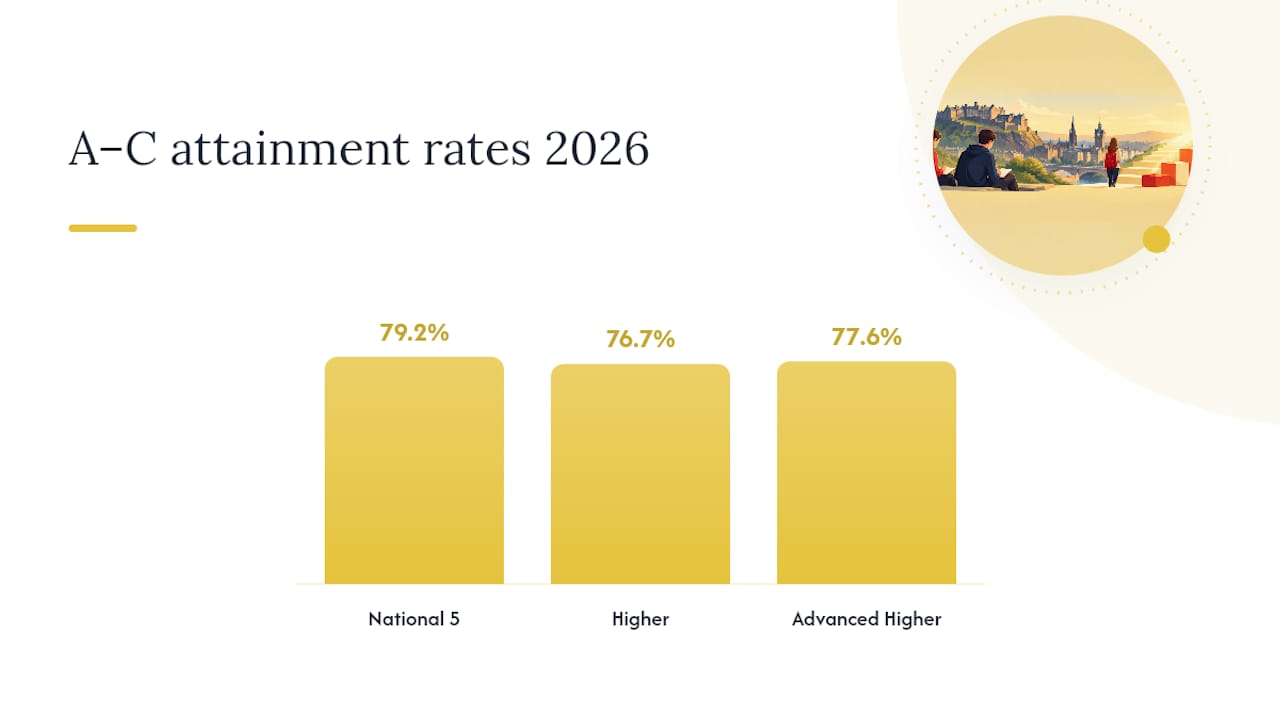
National 5, Higher and Advanced Higher results are reported as grades A, B, C or D. Anything below the D threshold is recorded as “no award”, meaning the qualification isn’t achieved at that sitting, according to Qualifications Scotland’s own explanation of the results process.
Here’s the part most students never see explained clearly: grade boundaries aren’t fixed percentages carried over year to year. After every paper is marked, principal assessors run grade-boundary meetings, reviewing a mix of statistical evidence (how the cohort performed compared with previous years) and qualitative evidence (how difficult specific questions actually turned out to be in practice, based on sampled scripts). Boundaries shift slightly between sessions specifically to keep a Grade A this year comparable in standard to a Grade A five years ago, even when the paper itself was harder or easier.
- A–D is the full grading scale for external papers; anything below D is “no award,” not a numeric fail grade.
- Boundaries are set per subject, per session, not published in advance as a percentage target.
- The 2026 awarding round involved marking more than 1.5 million assessments nationally, with whole-qualification attainment (A to C) running at 79.2% for National 5, 76.7% for Higher and 77.6% for Advanced Higher. Treat these as overall qualification figures across all subjects, not maths-specific pass rates.
This is exactly why chasing a specific percentage from an old textbook or forum post is a mistake. Focus your energy on maximising marks against the published marking instructions instead of guessing at a boundary nobody can predict in advance.
Where to find official SQA resources and how to use them
Every subject has one official home page, and it’s the single most useful bookmark you’ll make this year. On the National 5 Mathematics course page, and its Higher and Advanced Higher equivalents, you’ll find:
- The course specification, which lists exactly what content can be examined.
- Specimen question papers, showing the format before any real past papers existed under the current course structure.
- Past papers, searchable by subject, level and year, alongside the matching marking instructions for each one.
- Course reports, written by principal assessors after each exam diet, flagging exactly where candidates nationally lost marks.
- The exam timetable, confirming your paper’s date, time and permitted materials.
The single highest-value revision method is simple to describe and easy to underuse: sit a past paper under strict timed conditions, then mark it yourself using the official marking instructions rather than a memory of what “felt right.” Go through every mark you lost and label the cause, whether it was a knowledge gap, an algebra slip, poor presentation, or simply running out of time. That annotated list becomes your personalised revision checklist rather than a generic one. Our SQA National 5 resource hub pairs past papers with worked solutions if you want a second reference point while marking. Before exam day, double-check the permitted calculator model and formula sheet listed for your specific session; these do occasionally change.
Examiner-backed revision tips that actually move your grade
Course reports published after each diet aren’t dry administrative documents. They’re a direct account of where candidates nationally threw away marks, and reading one for your subject is close to seeing the examiner’s own notes before you sit the paper.
The recurring weaknesses examiners flag are strikingly consistent year to year:
- Basic number skills let candidates down more than advanced topics do. Fraction manipulation, surds and negative indices trip up students who can handle calculus but fumble the arithmetic underneath it, according to the National 5 course report.
- Unclear or missing diagram labels cost marks even when the underlying reasoning is sound.
- Premature rounding during multi-step problems throws off final accuracy marks that would otherwise be secured.
- Missing working on method-heavy questions means no method marks are available, regardless of whether the final answer happens to be correct.
Build your practice routine around these gaps rather than around comfortable topics you already know well. Run timed non-calculator drills specifically on fractions, surds and indices until they’re automatic, then switch to calculator-paper practice focused on efficient button use and answer-checking, a two-mode approach Higher course reports recommend explicitly.
Pro Tip: On exam day, write your working directly next to each question rather than on a separate page, label every diagram as you draw it, and check the units on your final answer before moving on. These three habits alone address the four most common examiner complaints.
If you’re weaker on applied, worded questions specifically, a problem-solving strategies guide can help you break contextual questions into the underlying maths before you start calculating.
How MathVault fits your revision plan
Pairing official documents with guided practice is where most improvement actually happens. A platform provides SQA-aligned past papers, fully worked step-by-step solutions, and live Q&A sessions where students can ask about a method they are stuck on in real time.
- Work a past paper from the official SQA past paper search under timed conditions.
- Mark it yourself against the official marking instructions to see exactly where marks were lost.
- Then watch Mathvault’s worked solution walkthrough for that same paper to compare your method against an alternative approach and understand why a particular technique earns full marks.
- Return to Mathvault’s SQA hub for further papers once a topic feels solid.
This sequence turns marking from a chore into a diagnostic tool, showing you precisely which method or presentation habit needs work.
What SCQF levels mean for your maths qualification
The Scottish Credit and Qualifications Framework (SCQF) sits underneath every Scottish qualification, including maths, and it’s worth understanding because it explains how your grade compares across subjects and even across countries. SCQF assigns a numerical level, from 1 to 12, to every qualification based on its difficulty and depth, independent of the subject itself.
National 4 Maths sits at SCQF level 4. National 5 Maths sits at SCQF level 5. Higher Maths sits at SCQF level 6. Advanced Higher Maths sits at SCQF level 7. Each level also carries a credit value reflecting the notional learning hours involved, so a Higher isn’t just “harder” than a National 5 in a vague sense, it occupies a formally defined step above it on a shared national scale used across school, college and university qualifications.

Why does this matter practically? Universities and colleges use SCQF levels to set entry requirements, so a course asking for “SCQF level 6 in a numerate subject” is really asking for Higher, or an equivalent qualification sitting at that same level. It also explains why some colleges accept a strong National 5 pass in lieu of Higher for certain courses. The framework is what makes qualifications comparable, even though “National 5” and “Higher” sound like arbitrary labels on their own. When you’re checking entry requirements for a course, look for the SCQF level quoted, not just the qualification name.
What your grades mean for progression
An A–D grade at National 5 or above isn’t just a number for your certificate; it’s the gatekeeper for what you can study next. Most schools require a National 5 pass, typically A to C, before allowing entry into Higher in the same subject, though some will admit a strong D or teacher recommendation depending on the pupil’s overall profile.
A D grade counts as a genuine pass at National 5, Higher or Advanced Higher, and it appears on your certificate as an achieved qualification, not a fail. Universities and colleges do differentiate between grades when setting entry requirements though: a course demanding “Higher Maths, B” won’t accept a D, even though both are passes. This is where the gap between “technically passed” and “meets the entry requirement” catches families out. Always check the specific grade a course or apprenticeship demands, not just whether maths appears on the list at all.
For students planning ahead, Higher Maths at grade C or above is the typical minimum many STEM-related university courses expect, while more competitive courses in engineering or physics often want a B or A. If your target course lists Advanced Higher as desirable rather than essential, a strong Higher grade combined with other subjects can sometimes substitute, but this varies by institution, so verify directly with the course’s own entry profile rather than assuming.
How to register and enter for SQA maths exams
You don’t register for SQA exams yourself in most cases; your school does it on your behalf, usually in the autumn term of the exam year. Your school submits your entries to Qualifications Scotland, selecting the specific level (National 4, National 5, Higher or Advanced Higher) and, where relevant, the specific unit or course combination you’ve been studying.
Private candidates, including home-schooled students or adults returning to education outside a school setting, register through the official Qualifications Scotland channels directly, and this process typically involves an earlier deadline and sometimes a fee, unlike school-entered candidates. If this applies to you, start the process well before the autumn entry window closes, since late registration options are limited and not guaranteed.
Once entries are submitted, your school confirms your personal exam timetable, listing exact dates, times and locations for each paper you’re sitting. Check this against the official published national timetable as soon as it’s released, and flag any clash or concern with your school’s exams office immediately rather than close to the exam date. If you’re studying independently or through a college rather than a mainstream school, confirm with your centre exactly how and when your entries are submitted, since deadlines can differ from the standard school calendar.
Qualifications Scotland replacing SQA: what’s changing
Scotland’s qualifications body underwent a genuine structural change, not just a rebrand. Following the Education (Scotland) Act 2025, Qualifications Scotland replaced the SQA as the national body responsible for setting and awarding qualifications, and it has set out early priorities that go beyond a name change on a letterhead.
The stated direction includes reducing reliance on high-stakes, single-sitting exams over time and giving classroom teachers a greater role in developing qualifications, rather than leaving that work entirely to central assessors. For maths students sitting exams in the near term, day-to-day mechanics like paper structure, marking instructions and grade-boundary meetings continue much as before; the current external-paper model for National 5 and above hasn’t been dismantled overnight.
What this means practically is that you shouldn’t assume next year’s exam looks exactly like this year’s, or that a sibling’s experience from a few years ago still applies precisely. Reform signals move gradually, but they do move. Treat the official subject page as the single source of truth each session, since it’s updated to reflect exactly what’s changed and what hasn’t, rather than relying on general knowledge about “how SQA exams work” that might be a year or two out of date.
Building a preparation strategy that targets real weaknesses
Generic revision advice like “practise past papers” is true but incomplete. The more useful strategy starts with diagnosis: sit one past paper cold, under proper timed conditions, before you revise a single topic. Mark it honestly against the official instructions and you’ll immediately see, in specific terms, whether your weakness is fundamentals (fractions, surds, algebra), applied problem-solving, presentation, or simple timing.
From there, build a rotation rather than a single long session. Alternate non-calculator drills on number skills with calculator-paper practice on longer applied questions, mirroring the two-paper structure you’ll actually face. Set aside separate short sessions purely for presentation habits: labelling diagrams, writing working beside each question, and avoiding early rounding. These cost nothing to fix and recover marks fast once they become automatic.
In the final fortnight, shift weighting toward past papers over topic worksheets. Working under exam time pressure, then marking against the real marking instructions, surfaces problems that isolated topic practice never reveals, particularly around pacing across a 60 to 90 minute paper. Keep a running error log across every past paper you mark, sorted by cause rather than by topic, and revisit that log the night before each paper rather than starting a new topic cold.
A final word on how to prepare
Reasoning through everything above, the students who do best treat the official course specification and course reports as their primary study text, not an afterthought consulted once in April. Past papers matter, but past papers marked properly against real marking instructions matter far more; that single habit surfaces exactly where marks are being lost.
Combine that discipline with guided worked solutions when you’re stuck on method, rather than guessing at what an examiner “probably wants.” The two together, official documents for accuracy and worked explanations for understanding, cover the gap that generic revision advice usually misses.
— Oloru
Mathvault gives you the practice official papers alone can’t
Past papers tell you what to expect. They don’t tell you why your method lost marks, or show you a cleaner way to reach the same answer under time pressure. Mathvault closes that gap with free, fully worked step-by-step solutions and live weekly Q&A sessions alongside SQA-aligned past papers, so you’re never stuck staring at a marking scheme wondering where the method mark actually came from.
Whether you’re working through National 5 fundamentals or pushing toward a top Higher grade, resources are organised so students can go from official past paper to marked attempt to worked video explanation in one sitting, without hunting across multiple sites. If you want a structured starting point rather than sifting through content alone, our GCSE and SQA revision guides hub is the place to begin, and the self-marking past papers with live Q&A support page is worth bookmarking before your next practice session.
Sources
- Results 2026: how we decide your grades (Qualifications Scotland blog)
- National 5 Mathematics – Course overview and resources (SQA)
FAQ
Is a D grade a pass in SQA exams?
Yes. A D grade at National 5, Higher or Advanced Higher counts as an achieved qualification, and it’s recorded on your certificate as a pass. Anything below the D boundary is recorded as “no award” rather than a numeric fail, according to Qualifications Scotland’s grading explanation.
What are the hardest Higher subjects generally considered to be?
Difficulty varies by student, but Higher subjects with heavy content demands, abstract reasoning or extensive practical skills (commonly cited examples include Higher Maths, Physics, and subjects requiring extended essay writing under time pressure) tend to feature most often in student discussions about difficulty. There’s no official SQA ranking of subject difficulty, so treat any such list as informal rather than authoritative.
Are Scottish Highers the same as GCSEs?
No, they’re different qualifications from different systems. Highers sit closer in depth and content to the first year of an English A-Level, and are typically studied a year later than GCSEs, at SCQF level 6, while GCSEs follow England, Wales and Northern Ireland’s own separate framework.
What’s the difference between National 4 and National 5?
National 4 is graded pass or fail through school-marked unit assessments and an Added Value Unit, with no external exam. National 5 is graded A to D through an externally marked question paper (a non-calculator and a calculator paper), and it’s the qualification most students need before progressing to Higher.
Where can I find official SQA maths past papers and marking instructions?
The National 5 Mathematics course page hosts the course specification, specimen papers, past papers and their matching marking instructions directly from Qualifications Scotland. Mathvault’s SQA National 5 resource page pairs the same past papers with free worked-solution videos if you want a second explanation alongside the official marking scheme.
Leave a Reply