
The fastest way to raise your Higher Maths grade is deliberate past-paper practice marked against official schemes, combined with focused drilling on the topics that carry the most marks. Start today: download the nearest past paper and its marking instructions from Qualifications Scotland, then run a timed 30 to 40 minute block on one topic. Follow that with BBC Bitesize for quick topic refreshers and MathVault for fully worked solutions when you need to check your method, not just your answer.
TL;DR:
- Focus on high-yield topics like straight line equations, quadratics, and trigonometric identities, as they frequently appear and yield quick revision gains.
- Use timed past-paper attempts with official marking instructions and log errors to transform practice into targeted grade improvements.
- Schedule revision with emphasis on recent exam-based topics, practicing short focus sprints and full-length papers close to the exam date.
- Incorporate a mistake bank to track errors, understand their causes, and prevent repeating the same mistakes under exam conditions.
- Regularly review examiner reports and exemplar responses to identify common pitfalls and refine problem-solving and reasoning skills.
Table of Contents
- Where to find official Higher Maths past papers Scotland-wide
- Which Higher Maths topics carry the most marks?
- How do you turn past papers into higher marks, not just more practice?
- How should you schedule Higher Maths revision each week?
- What is a mistake bank and why does it work?
- What are the most trustworthy Higher Maths revision resources?
- What calculator should you use for Paper 2?
- What skills does the Higher Maths exam actually test?
- How do you revise proofs and graph sketching effectively?
- How should you manage time in each part of the exam?
- How do you read an examiner report properly?
- Why classroom drilling still beats passive revision
- Get exam-ready with MathVault’s Higher Maths resources
- Sources
Where to find official Higher Maths past papers Scotland-wide
Everything you need sits in one place: Qualifications Scotland’s Higher Mathematics page hosts the course specification, past papers, specimen papers, marking instructions, and the “understanding standards” exemplars that show how markers actually award credit. Qualifications Scotland took over from the SQA name on 1 February 2026. Older SQA-branded papers and marking schemes remain fully current, so do not skip a paper just because the header says SQA rather than Qualifications Scotland.
Pull the last three to five years of past papers plus the specimen papers, then treat each attempt as a genuine exam simulation rather than a casual read-through.
- For paper 1, work strictly without a calculator and without the formula sheet unless the question explicitly allows it.
- Time yourself against the real allocation, not a rounded guess.
- Complete the whole paper before checking anything.
- Mark using the official instructions line by line, not from memory of what you think should be correct.
- Note any marker wording you would not have written yourself. That phrasing is often the difference between a method mark and a lost one.
This sequence, timed attempt, then immediate self-marking against the scheme, is the single habit Scottish exam revision guidance points to most consistently as the difference between passive revision and grade movement.
Which Higher Maths topics carry the most marks?
Not every topic deserves equal revision time. A handful of areas turn up in some form on almost every past paper, and getting comfortable with their standard question styles pays back faster than anything else you could do this week.
- Straight line and gradients: expect perpendicular/parallel line questions and finding equations from given points. Drill: given two conditions, produce the equation in under three minutes.
- Quadratic theory and factorisation: discriminant questions and completing the square appear repeatedly. Drill: sketch the graph from the equation without a calculator.
- Differentiation and integration: chain rule slips are the most common error. Drill: differentiate five composite functions cold, checking each step against the rule rather than the final number.
- Trigonometric identities, equations and wave functions: candidates often forget the full solution set within the given domain. Drill: solve one equation and list every valid solution, not just the first.
- Vectors and circle geometry: setting up the right vector before calculating is the usual sticking point.
- Logarithms and exponentials: law application errors, particularly combining terms incorrectly.
- Recurrence relations: limit conditions are frequently missed entirely.
Straight line work, quadratics, and most trigonometric identity proofs tend to land on paper 1 (non-calculator), while integration, vectors, and applied recurrence questions lean towards paper 2. The paper structure itself carries real weight: Higher Maths typically splits into paper 1 non-calculator at around 70 marks and paper 2 calculator-allowed at around 80 marks, so paper 2 alone can decide a grade boundary.
How do you turn past papers into higher marks, not just more practice?
Doing paper after paper without a clear review process is one of the biggest wastes of revision time. What separates candidates who improve from those who plateau is a fixed cycle applied every single time.
- Revise the topic properly first, using notes or a worked example, before touching a past-paper question on it.
- Select four or five past-paper questions on that exact topic across different years.
- Time yourself against the real per-question allocation, not a relaxed guess.
- Mark immediately using the official marking instructions, checking every line against the scheme.
- Log each error in a mistake bank with its cause, not just its correction.
Full timed papers matter, but partial runs by question type build fluency faster in the early weeks; running focused timed practice sessions and mock exams is key to progress as outlined in Mock Exams – ESS. If a proof question typically takes eight minutes in the real exam, practise that exact question type against that exact clock rather than working it at leisure.
Pro Tip: When you self-mark, copy the marker’s exact phrasing for a full-credit step into your notes, such as “state the factor theorem” or “interpret in context.” That transcription trains your written answers to match the structure examiners are actually looking for, which the Understanding Standards exemplars illustrate clearly across past candidate responses.
MathVault’s self-marking guide walks through this exact cycle if you want a structured version to follow rather than building your own from scratch.
How should you schedule Higher Maths revision each week?
A revision timetable that treats every topic equally wastes hours on things you have already mastered. Weight your week towards whichever exam is nearest, and use short, defended blocks of time rather than long unfocused sessions.
- Give 70 to 80% of your weekly maths time to the topics most likely to appear soon, based on the exam date and your own weak spots.
- Run daily sessions in 25 minute focused sprints with a five-minute break, the Pomodoro structure that university study-support services recommend to keep concentration sharp and avoid diminishing returns.
- Reserve weekends for one longer intensive: a full timed past paper plus its self-marking review.
- In the final six weeks, shift almost entirely to full papers and mixed-topic drills rather than single-topic revision.
- Protect at least one rest day a week. Stamina on exam day depends on not having burned out three weeks earlier.
Alongside school work, two or three sprints most evenings will comfortably outperform one exhausting weekend cram, and it protects the exam-day focus you need for a paper that can run close to two and a half hours across both sittings.
What is a mistake bank and why does it work?
A mistake bank is simply a running log of every error you make in practice, alongside why it happened and the specific fix. Recording “lost the method mark on differentiation because I forgot the chain rule multiplier” is far more useful than a vague “need to revise calculus.” Reviewing this list weekly turns repeated slip-ups into a short, solvable checklist rather than a source of vague anxiety.
- Record the exact error, the topic, and the corrective step in one line.
- Revisit the bank before each new topic drill, not just before the exam.
- Use flashcards for formulae and definitions you keep forgetting under time pressure.
- Attempt questions closed-book first, then check against fully worked solutions for method, not just the final number.
Pro Tip: When checking a worked solution, cover the answer and try to predict the next line before revealing it. If you cannot predict it, that is exactly where your understanding breaks down, and it is worth a line in your mistake bank.
What are the most trustworthy Higher Maths revision resources?
Three sources cover almost everything you need, and each does a different job. Qualifications Scotland remains the canonical authority: the course specification, every recent past paper, the official marking instructions, and the “understanding standards” exemplars that show exactly how marks are awarded in borderline cases. Nothing else carries that same weight, because nothing else is written by the people who set and mark the exam.
BBC Bitesize’s Higher Mathematics pages are the fastest route to a topic refresher when a concept has gone hazy, with short quizzes to check understanding before you commit to a full past-paper question. For pupils aiming at the very top grades, NRICH’s enrichment problems push beyond standard past-paper style into deeper problem-solving, useful once the core topic list is solid.
MathVault sits alongside these as the practical layer: organised Higher past-paper packs, fully worked step-by-step solutions, and video walkthroughs mapped directly to the download, practise, self-mark, and review cycle this guide recommends throughout. If you are moving up from National 5, MathVault’s topic-by-topic revision guide also helps close any gaps before you start Higher-level drills.
What calculator should you use for Paper 2?
Paper 2 allows a calculator, and the model you bring matters more than most pupils assume. Qualifications Scotland permits scientific and graphic calculators, but any device with symbolic algebra manipulation, meaning it can solve equations or perform calculus symbolically rather than numerically, is banned from the exam hall. Check your specific model against the current approved list before results season creeps up on you, because rules do get revised between diets.
Practically, a calculator does not replace algebraic setup. The most common error in paper 2 is reaching for the calculator before working out what to calculate. Set up the integral, the vector equation, or the quadratic correctly on paper first, then use the calculator purely to process the arithmetic. Markers award method marks for the setup step regardless of whether your final numerical answer is correct, so a rushed calculator-first approach can cost marks even when the number on the screen is right.
A few habits worth building into every paper 2 drill:
- Clear your calculator’s memory before starting, so no stray values from an earlier question carry through.
- Practise switching between degree and radian mode deliberately, since trigonometric equations in context questions sometimes specify one over the other.
- Keep spare batteries in your exam bag. It sounds obvious until it happens to someone in the hall next to you.
- Use your calculator to check a final numerical answer, never to shortcut the working a question is actually testing.
Familiarity matters as much as permission. Practise every timed past-paper attempt with the exact calculator you will bring to the exam, not a borrowed one on the day.
What skills does the Higher Maths exam actually test?
Higher Maths is not really testing whether you remember formulae. It is testing three separate skills, and most mark losses trace back to weakness in one of them rather than a genuine gap in topic knowledge.
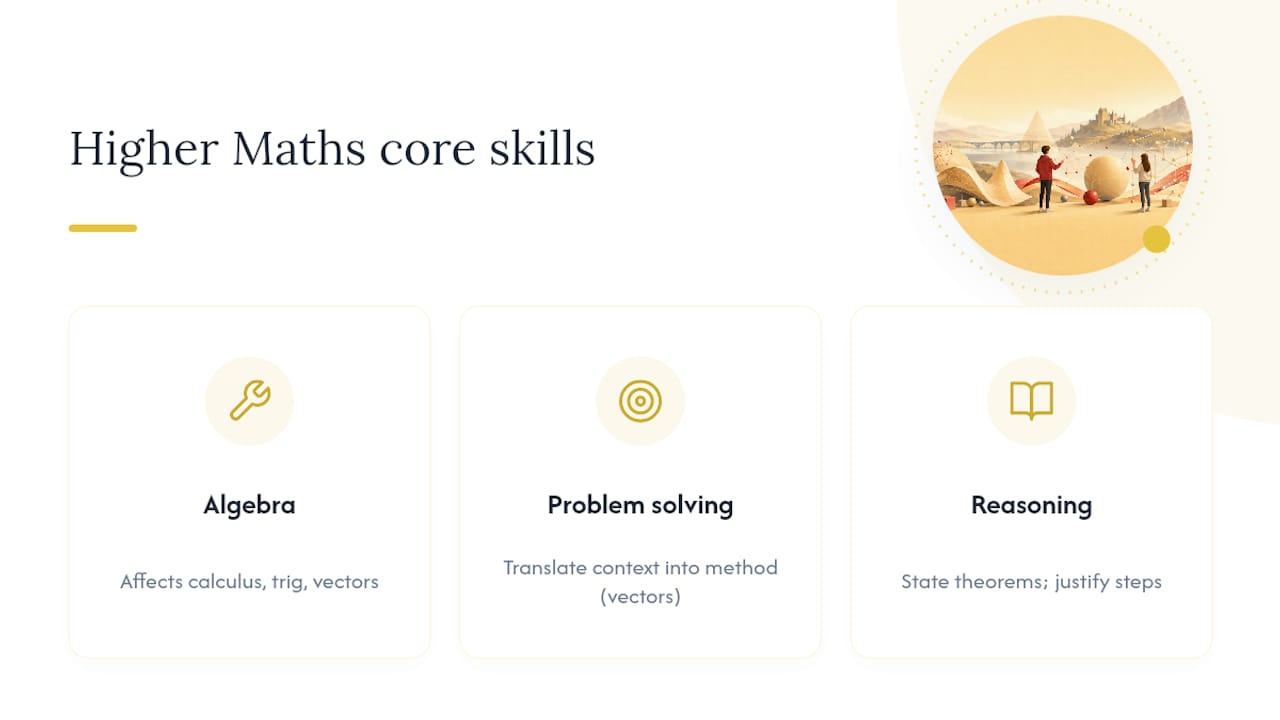
Algebraic manipulation is the foundation: rearranging expressions, solving equations, and simplifying correctly under time pressure. This is where careless errors, a dropped negative sign, a misapplied law of logarithms, cost the most marks relative to how easy they are to prevent.
Problem solving is the skill of translating a worded or contextual question into the right mathematical setup. A vector geometry question dressed up as a real-world scenario, for instance, tests whether you can strip out the irrelevant detail and identify which technique actually applies. This is usually where the biggest gap sits between candidates who understand a topic in isolation and those who can apply it under exam conditions.
Reasoning and communication covers proof-style questions and any answer that requires you to justify a step rather than just produce a number. Markers look for specific language here, stating a theorem by name, showing why a condition holds, rather than assuming the working speaks for itself.
Because these three skills recur across every topic, a weakness in algebraic manipulation will quietly cost marks in calculus, trigonometry, and vectors alike. Isolating which of the three is actually holding you back, rather than assuming every lost mark is a “topic problem,” is one of the more useful diagnostic exercises your mistake bank can do.
How do you revise proofs and graph sketching effectively?
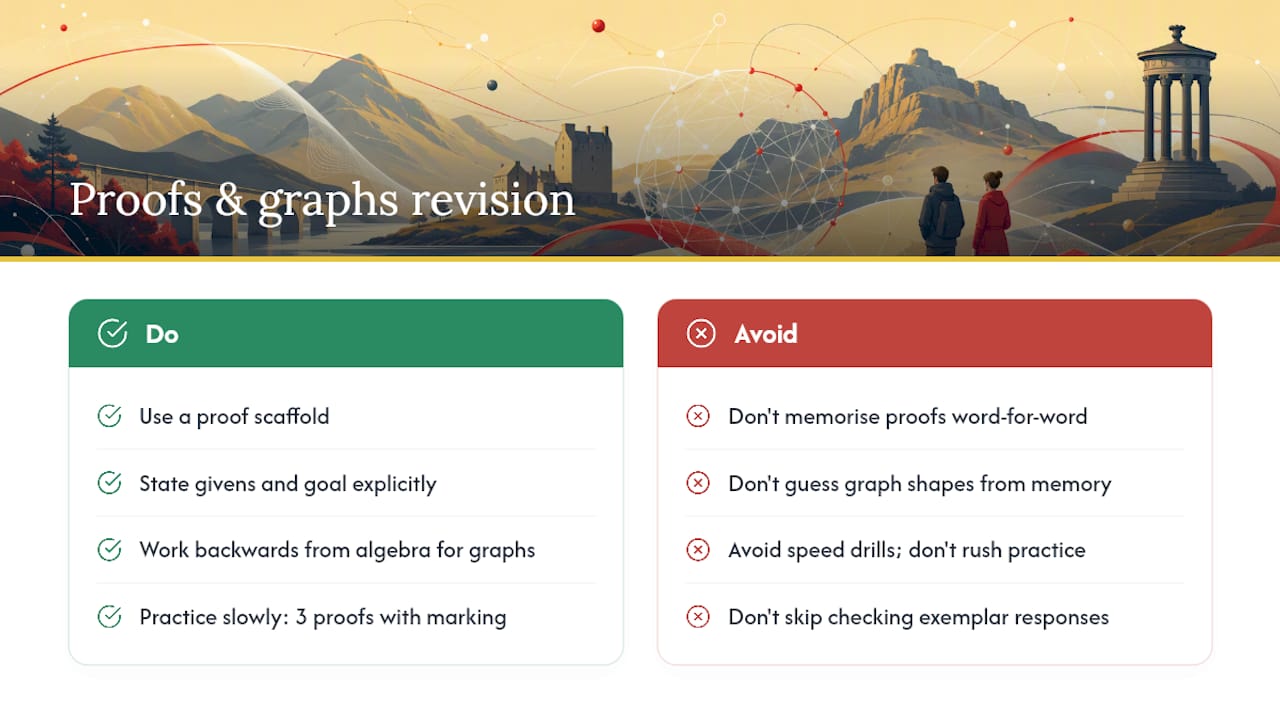
Proof and graph-sketching questions get revised badly more often than any other topic type, mostly because pupils treat them as memorisation exercises rather than skills.
For proofs, the fix is structural, not content-based. Learn the shape of a proof, state what is given, state what you are proving, show the logical steps, conclude explicitly, rather than trying to memorise specific proofs word for word. Practise writing out the same proof structure for different content: proving a line is tangent to a circle, proving a trigonometric identity, proving a sequence converges. The scaffolding repeats even when the maths changes.
For graph sketching, work backwards from the algebra every time rather than guessing a shape from memory. Identify the type of function first (quadratic, cubic, trigonometric, exponential), then find the key features methodically: intercepts, turning points, asymptotic behaviour, and domain restrictions. Sketch only after you have those features written down, not before.
Both question types reward slow, deliberate practice far more than speed drills. Spend a session doing three proofs properly, checking each step against a marking scheme, rather than ten proofs rushed. The understanding standards exemplars are particularly useful here, since they show real candidate responses at different mark levels for exactly this question style.
How should you manage time in each part of the exam?
Time pressure causes more lost marks than genuine lack of knowledge, particularly in the final third of each paper when fatigue sets in. A rough per-mark pacing rule works well: aim for roughly one minute per mark across both papers, which leaves a buffer for the harder multi-part questions near the end.
On paper 1, resist the urge to solve algebraically what you could sketch or estimate faster, but never skip showing method, since paper 1 rewards clean working heavily. If a question is not yielding after roughly double its expected time, mark it and move on rather than losing ten minutes chasing one mark.
On paper 2, the calculator speeds up arithmetic but not the setup, so budget extra thinking time for vector and integration questions where the setup step is where marks actually live. Leave the final five minutes of each paper purely for a re-check pass: unanswered parts, units, and whether every “show that” question has a written conclusion rather than just a number.
How do you read an examiner report properly?
Examiner reports and the “understanding standards” materials are consistently underused, and that is a mistake, because they tell you exactly where candidates lost marks the previous year, not just what the correct answer was.
Read them topic by topic rather than cover to cover. Look specifically for the phrase describing what weaker candidates did wrong on a given question, since that phrasing usually points to a specific, fixable habit rather than a knowledge gap. If a report notes that candidates frequently omitted the domain restriction on a trigonometric solution, that is a direct instruction: check your own recent practice for exactly that omission.
Cross-reference the report against your own mistake bank. If the examiner’s most common error matches something already logged there, it confirms the fix is worth prioritising rather than assuming it was a one-off slip.
Why classroom drilling still beats passive revision
Fluency comes from repetition against real marking criteria, not from rereading notes. Pupils who treat past papers as timed rehearsal, then immediately compare their working against the official scheme, close gaps faster than those relying on textbook review alone. The habit is simple to teach and simple to sustain, which is exactly why it works across an entire class rather than just for the strongest pupils in the room.
— Oloru
Get exam-ready with MathVault’s Higher Maths resources
Some online platforms provide a practical layer for this plan: organised Higher past-paper packs, fully worked step-by-step solutions, and video walkthroughs, all built around the download, practise, self-mark, review cycle covered above.
Start with one concrete action tonight rather than waiting for a “proper” revision session. Download a Higher paper pack, watch a video walkthrough for a question type you keep getting wrong, such as chain rule differentiation or vector geometry, and log the fix in your mistake bank. If you get stuck mid-question, live weekly Q&A sessions may allow you to ask directly rather than guessing at a solution. For the exact self-marking workflow this article recommends, MathVault’s self-marking guide is the fastest place to start, or head to the MathVault homepage to browse everything organised by exam board and topic.
Sources
- Higher Mathematics – Course overview and resources (Qualifications Scotland)
- BBC Bitesize — Higher mathematics subject pages
- Higher Exam Revision Strategies Scotland 2026 — What Works (Eduscot)
- Pomodoro technique guidance (Birmingham City University exams and revision tips)
- NRICH — enrichment maths problems
Leave a Reply