
Integration by parts turns a hard integral of two multiplied functions into an easier one, using the formula ∫u dv = uv − ∫v du. Use it when you’re integrating a product of two unlike functions (a polynomial and an exponential, a log and x, an exponential and a trig function) and simplifying or substitution won’t work.
Before reaching for it, always check whether the integral simplifies algebraically or yields to a quick substitution.
- Write this first on your paper: state your choice of u and dv clearly, then derive du and v before touching the formula.
- Quick marker check: differentiate your final answer. If you don’t get back to the original integrand, something’s gone wrong.
Key Takeaways
Integration by parts converts a hard product integral into a simpler one using ∫u dv = uv − ∫v du, and exam success depends on notation discipline and correct choice of u.
| Point | Details |
|---|---|
| Try simpler methods first | Check for algebraic simplification or substitution before reaching for integration by parts. |
| Choose u with LIATE | Logs and algebraic terms usually work best as u; exponentials and trig usually work as dv. |
| Evaluate limits early | For definite integrals, substitute boundaries into uv before integrating the remaining term. |
| Solve cyclic cases algebraically | For integrals like eˣcos x, set the result equal to I and solve rather than repeating parts forever. |
| Practise with board-matched papers | Mathvault’s Edexcel A Level past papers by topic offer worked solutions to build exam timing and accuracy. |
Table of Contents
- What integration by parts a level students need to know first
- How do you choose u and dv?
- What to write, step by step, in the exam
- Worked examples of integration by parts
- When should you use the tabular method?
- Common mistakes examiners see with integration by parts
- Building a revision routine for integration by parts
- Practise integration by parts with Mathvault’s free resources
- Frequently asked questions
- Sources
What integration by parts a level students need to know first
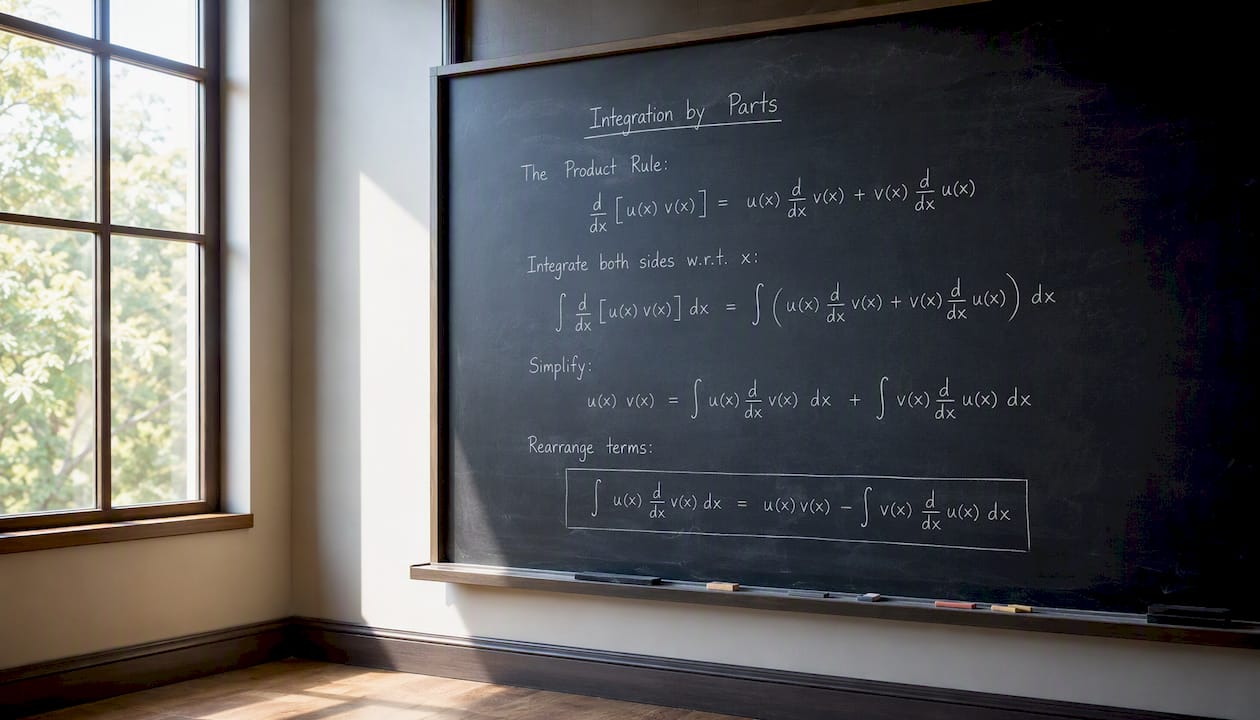
The formula comes straight from the product rule. Differentiating uv gives (uv)′ = u′v + uv′. Integrate both sides with respect to x, and rearrange, and you land on ∫u dv = uv − ∫v du. That’s the whole derivation, and it’s worth knowing because examiners occasionally ask you to reproduce it.
For definite integrals, the formula becomes:
∫ₐᵇ u dv = [uv]ₐᵇ − ∫ₐᵇ v du
Evaluate the uv term at the limits before integrating the second part. Doing the boundary substitution early avoids the classic mistake of losing track of the constant or muddling which limit goes where.
Run through this decision order before you commit to parts:
- Can the expression be simplified or split into separate terms first?
- Does a substitution (spotting a function and its derivative) make it disappear?
- If neither works and you’ve got a product of two different function types, that’s your signal for integration by parts.
How do you choose u and dv?
Most students learn LIATE: Logarithmic, Inverse trig, Algebraic, Trigonometric, Exponential. Whichever function type sits highest in that list usually makes the better choice for u.
- Logarithmic functions (ln x) — nearly always u, since they don’t integrate simply.
- Inverse trig functions (arcsin x, arctan x) — also strong candidates for u.
- Algebraic functions (x, x², x³) — good as u because differentiating drops the power.
- Trigonometric functions (sin x, cos x) — usually dv, since they integrate cleanly.
- Exponential functions (eˣ) — usually dv, for the same reason.
The practical test matters more than memorising the acronym: pick u so its derivative gets simpler, and pick dv so it integrates without fuss. When two choices both look workable, that’s when experienced students switch to what one Harvard calculus course calls the “method of the opportunist.”
Pro Tip: If you’re stuck between two choices, try both on rough paper for one line. Whichever choice reduces the algebraic degree of what’s left is almost always the right one to commit to.
What to write, step by step, in the exam
Examiners reward clean, visible working. Follow this order every time:
- Identify u and dv from the integrand.
- Differentiate u to get du.
- Integrate dv to get v (no +C needed at this stage).
- Substitute into ∫u dv = uv − ∫v du.
- Simplify the remaining integral and solve it.
- Add +C for an indefinite integral.
A few presentation habits earn marks and save you from silly errors:
- Write out du and v explicitly, even when they look obvious. Method marks depend on it.
- Box or underline the uv term before you move to the remaining integral.
- For definite integrals, substitute the limits into uv straight away, then deal with the leftover integral separately.
Worked examples of integration by parts
1. ∫ln x dx. Choose u = ln x, dv = 1 dx. Then du = 1/x dx and v = x. Applying the formula gives x ln x − ∫x · (1/x) dx = x ln x − ∫1 dx = x ln x − x + C. Common pitfall: forgetting the +C, or writing dv as “ln x” by mistake.
2. ∫x eˣ dx. Choose u = x, dv = eˣ dx, giving du = dx and v = eˣ. One application gives x eˣ − ∫eˣ dx = x eˣ − eˣ + C. Check by differentiating: you should recover x eˣ exactly.
3. ∫x sin x dx. Choose u = x, dv = sin x dx, so du = dx and v = −cos x. This gives −x cos x + ∫cos x dx = −x cos x + sin x + C. Watch your signs here; this is where most marks get dropped.
4. ∫eˣ cos x dx. This is the cyclic case. Apply parts once with u = eˣ, dv = cos x dx to get eˣ sin x − ∫eˣ sin x dx. Apply parts again to the remaining integral, and the original integral reappears on the right-hand side. Set the whole expression equal to I and solve algebraically rather than integrating forever. You end up with I = ½eˣ(sin x + cos x) + C.
Pro Tip: For the cyclic case, keep track of signs on your second application. Flip a sign accidentally and you’ll get 0 = 0 instead of a solvable equation for I.
When should you use the tabular method?
Repeated integration by parts on a polynomial times an exponential or trig function (think x³eˣ or x²sin x) gets tedious fast. The tabular method speeds this up: differentiate the polynomial column down to zero, integrate the other function repeatedly in a parallel column, then multiply diagonally with alternating signs.
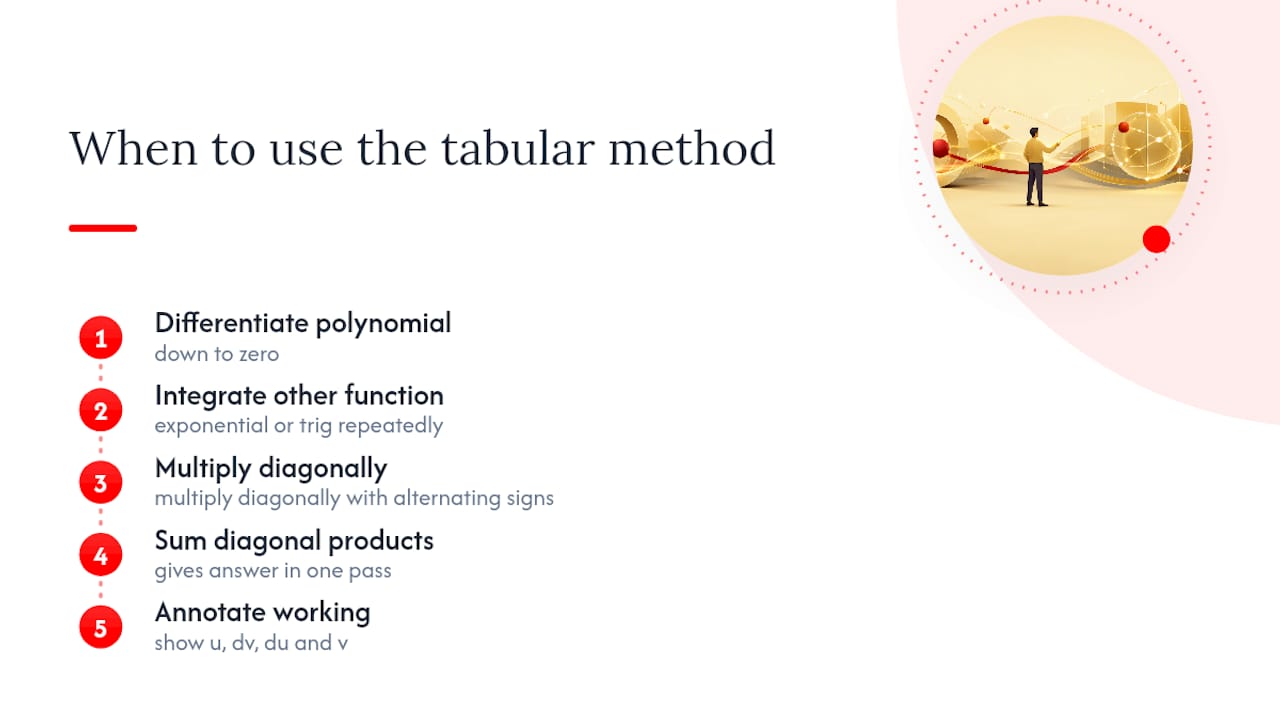
For something like ∫x²eˣ dx, differentiating x² twice (to x, then 2, then 0) against three integrations of eˣ gets you the answer in one pass rather than three separate applications. Once a pattern like this repeats predictably, it’s often worth deriving a reduction formula, which A Level papers sometimes ask for directly.
Pro Tip: The tabular method doesn’t replace understanding, it just organises the working. Examiners still want to see u, dv, du and v somewhere, so annotate your table if you use it.
Common mistakes examiners see with integration by parts
Most lost marks come from a small set of repeated errors:
- Sign errors, especially with sin and cos, or when subtracting a negative.
- Dropping +C on indefinite integrals (an easy, avoidable mark loss).
- Not evaluating uv at the limits before tackling the remaining integral in definite cases.
- Choosing u and dv the wrong way round, leading to an integral that gets harder instead of simpler.
- Messy algebra once the second integral appears, particularly in cyclic problems.
Before you move on, run three quick checks: does the sign pattern look right, does a simple value substituted in give a sensible number, and have you stated +C or shown the limit evaluation explicitly?
Pro Tip: Even when the final integral proves difficult, showing correct method, clear u, dv, du, v notation, still earns partial marks. Never leave a question blank because the algebra got messy.
Building a revision routine for integration by parts
A focused 45 minute session works better than an unstructured hour. Try three worked examples from scratch, then five timed past-paper parts questions, then spend the last stretch reviewing exactly where marks were lost.
- Practise board-matched questions on Edexcel A Level past papers by topic, timing yourself against real mark schemes.
- Use past paper collections to build speed under exam conditions, not just accuracy.
- Read fully worked solutions immediately after attempting a question, not days later, so the correction actually sticks.
Why practising the method matters more than memorising it
Students who drill the notation, writing out du and v every time, tend to make fewer sign errors under pressure. That consistency, more than raw practice volume, is what shows up as extra method marks on results day.
Practise integration by parts with Mathvault’s free resources
Mathvault gives you exactly what a timed exam demands: board-matched past papers, fully worked step-by-step solutions, and video walkthroughs, all organised by exam board so you’re never practising the wrong syllabus by accident.
If you’re preparing for Edexcel, start with the Edexcel A Level past paper questions by topic page and run the 45 minute routine above using real exam questions rather than generic textbook drills. AQA students can find equivalent board-specific practice organised the same way. Every solution shows the u, dv, du and v steps in full, so you can check exactly where a mark would have been lost. Pick a topic set, work through five questions against the clock, and mark your own paper against the worked solution before your next session.
Frequently asked questions
What is the integration by parts formula for A Level?
The formula is ∫u dv = uv − ∫v du for indefinite integrals, or [uv]ₐᵇ − ∫ₐᵇ v du for definite integrals with limits a and b.
When should I use integration by parts instead of substitution?
Try simplifying or substitution first. Use integration by parts when you’re facing a product of two unlike function types, such as x and eˣ, or ln x and a polynomial.
How do I choose u and dv in integration by parts?
Use LIATE as a guide: logarithmic and algebraic functions usually work best as u, while trig and exponential functions usually work best as dv, since they integrate without complication.
Do I need integration by parts for both Edexcel and AQA A Level maths?
Yes. Integration by parts appears across Edexcel, AQA, and OCR A Level pure maths specifications, typically in Year 2 content, and features regularly in exam papers.
What’s the trick for integrals like eˣ cos x?
Apply integration by parts twice. The original integral reappears on the right-hand side, so set the whole expression equal to I and solve for it algebraically rather than integrating repeatedly.
Sources
- Integration by parts (mathcentre)
- Integration by Parts – Calculus Tutorials (HMC)
- Unit 25: Integration by parts (Knill, Harvard)
Leave a Reply