
Implicit differentiation is the technique you use to find dy/dx when y is not written on its own, and it works by differentiating both sides of an equation with respect to x while treating y as a hidden function of x. For the classic example x² + y² = 25, the result is dy/dx = −x/y, and you get there by applying the chain rule to every y term before rearranging. You reach for this method in A Level questions whenever solving for y first would be awkward, produce two branches with a ± sign, or simply isn’t possible with the algebra tools you have.
That single fact covers most of what a Paper 1 or Paper 2 question is actually testing. Everything else in this guide, the worked examples, the tangent line method, the second derivative shortcut, is really just applying that one idea consistently and showing your working in a way that earns method marks.
Key Takeaways
Implicit differentiation finds dy/dx for equations that mix x and y by differentiating both sides and applying the chain rule to every y term.
| Point | Details |
|---|---|
| Use it when y is tangled | Choose implicit differentiation whenever isolating y produces branches or isn’t algebraically possible. |
| Follow the four-step method | Differentiate both sides, apply chain and product rules, collect dy/dx terms, then factorise and solve. |
| Show every dy/dx explicitly | Write out the differentiation of both sides before simplifying to capture method marks. |
| Verify with a point or explicit check | Substitute a coordinate pair, or differentiate explicitly where possible, to confirm your answer. |
| Practise with topic-sorted papers | Mathvault’s Edexcel past paper collection groups every implicit differentiation question by topic for targeted revision. |
Table of Contents
- What is implicit differentiation and when do you use it?
- What’s the step-by-step method for implicit differentiation?
- Worked example: differentiating the circle x² + y² = 25
- Worked example: x³ sin y + y = 4x + 3
- How do you find the tangent line using implicit differentiation?
- How do you find the second derivative implicitly?
- What mistakes cost the most marks in implicit differentiation questions?
- Practice questions to test your method
- Where should you practise implicit differentiation for A Level?
- Practise implicit differentiation with Mathvault’s topic-sorted past papers
- Frequently asked questions about implicit differentiation A Level
- Sources
What is implicit differentiation and when do you use it?
An explicit function gives you y directly in terms of x, something like y = 3x² + 2x. You differentiate it term by term with no extra thought required. An implicit relation, by contrast, tangles x and y together in the same equation, x² + y² = 25 being the standard case, so there’s no single y = … form sitting ready to differentiate.
That’s the whole distinction, and it’s worth being precise about it because exam questions often hinge on recognising which type you’re looking at. Mathsisfun’s explainer puts it plainly: implicit differentiation still uses the ordinary rules of differentiation, it just adds the chain rule every time you differentiate a term containing y, because y itself is secretly a function of x.
You’d choose implicit differentiation over rearranging for y when:
- Solving for y explicitly gives you a ± square root, meaning two separate branches to differentiate.
- The equation mixes x and y in a way that can’t be untangled algebraically (think x³ sin y + y = 4x + 3).
- The question specifically instructs you to differentiate “with respect to x” without isolating y first, a strong exam signal.
| Situation | Explicit approach | Implicit approach |
|---|---|---|
| y = 3x² − 5x | Differentiate directly, no extra steps | Not needed, explicit already |
| x² + y² = 25 | Requires y = ±√(25 − x²), then two cases | One differentiation, no branching |
| x³ sin y + y = 4x + 3 | Cannot isolate y algebraically | Only workable method |
What’s the step-by-step method for implicit differentiation?
Examiners reward a consistent method, so it pays to run through the same four steps every time, regardless of how messy the equation looks at first glance.
- Differentiate every term on both sides with respect to x. Treat dx/dx as 1, and whenever you differentiate a term containing y, multiply by dy/dx (the chain rule in action).
- Apply product or chain rules where terms mix x and y. A term like x²y needs the product rule; a term like sin y needs cos y · dy/dx.
- Collect every term containing dy/dx onto one side of the equation, and move everything else to the other side.
- Factorise out dy/dx and divide to leave dy/dx isolated on its own.
Two algebra habits trip students up more than anything else. First, treating dy/dx as though dy and dx were separate variables you can cancel or split, they aren’t, dy/dx is a single symbol representing a derivative. Second, forgetting to apply the chain rule at all when a y term appears, which is the single most common mark loss on this topic according to OpenStax’s worked treatment of the method.
Pro Tip: Write out d/dx(…) = d/dx(…) explicitly for both sides before you differentiate anything. Examiners scanning for method marks look for that line, and it also stops you missing a term halfway through.
Worked example: differentiating the circle x² + y² = 25
This is the equation most Edexcel, AQA and OCR papers use to introduce the topic, so it’s worth knowing cold.
Differentiate both sides with respect to x:
d/dx(x²) + d/dx(y²) = d/dx(25)
The left side gives 2x + 2y(dy/dx), using the chain rule on y², and the right side gives 0, since 25 is a constant. That leaves:
2x + 2y(dy/dx) = 0
Rearranging: 2y(dy/dx) = −2x, so dy/dx = −x/y. OpenStax’s own version of this example confirms the same result and uses it to demonstrate tangent slope calculations directly afterwards.

Now substitute a point. At (3, 4), which does lie on the circle since 3² + 4² = 25, dy/dx = −3/4. But try (3, −4), also a valid point on the circle, and dy/dx = −3/(−4) = 3/4. The gradient flips sign depending on which branch of the circle you’re on, exactly the ± branching problem that made implicit differentiation the sensible choice here in the first place.
You can check this against explicit differentiation for reassurance. Solving for y gives y = √(25 − x²) on the upper half, and differentiating that with the chain rule produces dy/dx = −x/√(25 − x²), which is just −x/y rewritten. The two methods agree, as the practice problem sets from Lamar University regularly demonstrate for students checking their own working.
Worked example: x³ sin y + y = 4x + 3
This question style appears on harder A Level papers because it forces you to combine the product rule and chain rule in the same line, then untangle the algebra afterwards.
- Differentiate x³ sin y using the product rule. Treat x³ as one factor and sin y as the other: d/dx(x³ sin y) = 3x² sin y + x³ cos y (dy/dx). The second term needs the chain rule because you’re differentiating sin y with respect to x, not y.
- Differentiate the remaining terms. d/dx(y) = dy/dx, and the right side gives d/dx(4x + 3) = 4.
- Write the full equation. 3x² sin y + x³ cos y (dy/dx) + dy/dx = 4.
- Collect dy/dx terms on one side. x³ cos y (dy/dx) + dy/dx = 4 − 3x² sin y.
- Factorise and solve. dy/dx (x³ cos y + 1) = 4 − 3x² sin y, so dy/dx = (4 − 3x² sin y) / (x³ cos y + 1).
The most common slip here is forgetting that sin y differentiates to cos y (dy/dx), not just cos y, students often apply the chain rule correctly on the first y term of a question and then drop it on a later one out of habit. Keep every dy/dx visible in your working until the factorising step, even if the expression looks cluttered.
How do you find the tangent line using implicit differentiation?
Once you have dy/dx as a formula, finding a tangent line is just substitution followed by the standard straight-line equation, but examiners expect to see both steps written out clearly.
The procedure runs in three stages. First, confirm the given point actually lies on the curve, substitute its coordinates into the original equation and check both sides match. Second, find dy/dx using implicit differentiation, then substitute the point’s x and y values to get a numerical gradient, m. Third, use y − y₀ = m(x − x₀) with that gradient and the original point to produce the tangent equation.
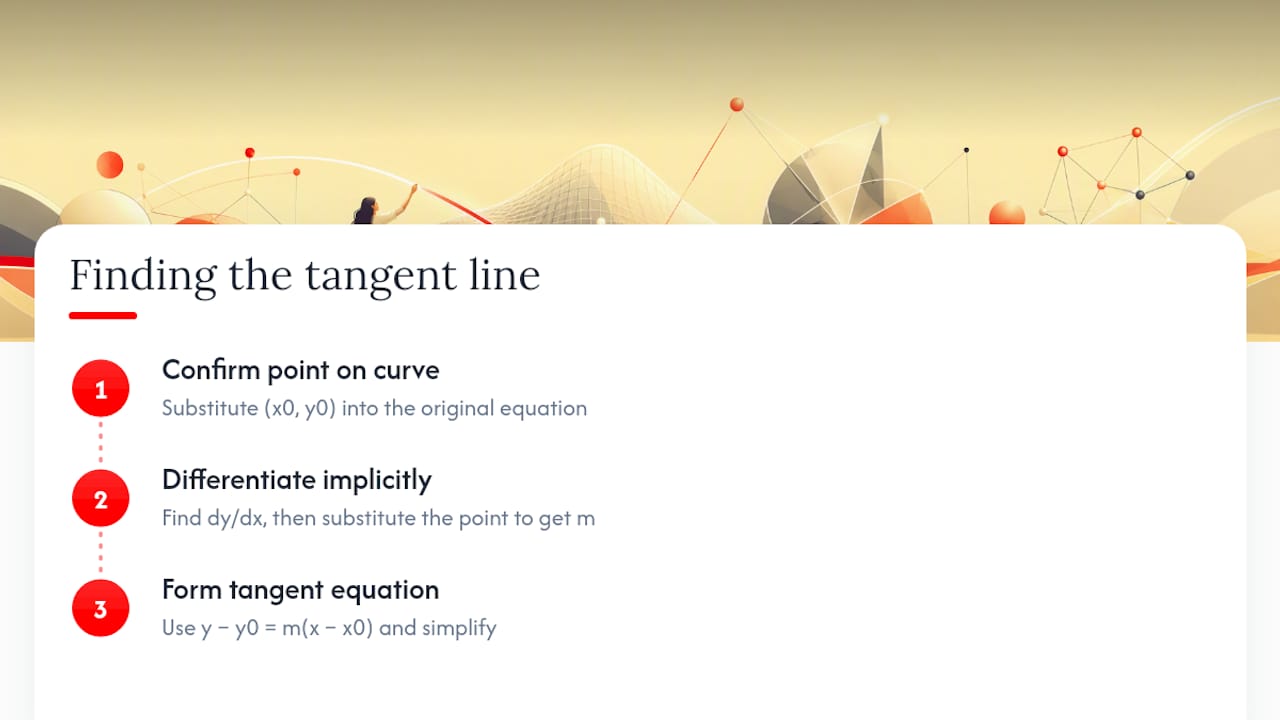
Take the circle x² + y² = 25 again, at the point (3, 4). We already found dy/dx = −x/y, so at (3, 4), m = −3/4. Substituting into y − 4 = −3/4(x − 3) and tidying gives 4y = −3x + 25, or 3x + 4y = 25.
Mark schemes typically split credit between the derivative step and the substitution step, so never skip straight to a final tidied answer without showing both lines of working on the page.
How do you find the second derivative implicitly?
Second derivative questions on implicit relations appear less often, but when they do, they’re usually worth several marks precisely because most students rush the algebra. The method is a direct extension of the first derivative process.
Differentiate your dy/dx expression again with respect to x, applying the chain rule to any y terms exactly as before, and applying the quotient or product rule if dy/dx is itself a fraction or product. This nearly always introduces a second dy/dx term partway through, which you then substitute using the formula you already found in the first stage.
For x² + y² = 25, differentiating dy/dx = −x/y using the quotient rule gives:
d²y/dx² = [−y − (−x)(dy/dx)] / y² = (−y + x·dy/dx) / y²
Substituting dy/dx = −x/y back in: d²y/dx² = (−y + x(−x/y)) / y² = (−y² − x²) / y³. Since x² + y² = 25, this simplifies accordingly.
The implicit function theorem underpins why this substitution step is valid. It guarantees that y behaves as a genuine differentiable function of x wherever the relevant partial derivative isn’t zero, which is why the chain rule keeps applying cleanly at every stage. In practice, always simplify your first derivative as far as possible before differentiating again, messy fractions compound quickly into unmanageable algebra otherwise.
What mistakes cost the most marks in implicit differentiation questions?
A handful of errors account for the overwhelming majority of dropped marks on this topic, and nearly all of them are avoidable with a bit of exam discipline.
- Forgetting the chain rule on a y term, differentiating y² as 2y instead of 2y(dy/dx).
- Treating dy and dx as separable algebraic quantities rather than one combined symbol.
- Dropping a sign when moving terms across the equals sign during the collecting stage.
- Forgetting to apply the product rule when x and y appear multiplied together in the same term.
- Skipping the check that a given point actually lies on the curve before using it in tangent or evaluation questions.
- Presenting a final answer without factorising dy/dx out cleanly, leaving it embedded inside a bracket.
To capture full method marks, write out the differentiation of both sides explicitly before simplifying, show every dy/dx term as you collect it, and factorise before dividing rather than trying to divide through a mixed expression. Where you can, verify your final answer either by substituting a coordinate pair or, when the relation happens to be solvable for y, by differentiating explicitly and checking the two results match, exactly the cross-checking approach practice problem collections recommend.
Practice questions to test your method
Try these under timed conditions, roughly four minutes each, and mark yourself against the method steps rather than just the final answer.
Question 1. Find dy/dx for x² + y² = 169, then evaluate it at the point (5, 12).
Question 2. Given x²y + sin y = x, find dy/dx in terms of x and y.
Outline: Apply the product rule to x²y and the chain rule to sin y, collect dy/dx terms, then factorise: dy/dx = (1 − 2xy) / (x² + cos y).
Question 3. For e^y + xy = 10, find dy/dx.
Outline: Differentiate e^y using the chain rule to get e^y(dy/dx), apply the product rule to xy, then collect and solve: dy/dx = −y / (e^y + x).
For a wider spread of question styles, including trig, exponential and log-based variations, Lamar University’s assignment problem sets are worth working through once you’re confident with the basics above.
Where should you practise implicit differentiation for A Level?
Once you’ve worked through the examples above, the next step is repetition against real exam-style questions, ideally ones marked against an actual mark scheme so you can see exactly where the method marks sit.
Mathvault’s differentiation rules revision guide walks through implicit differentiation alongside the chain, product and quotient rules it depends on, which is useful if any of those feel shaky before you tackle harder implicit questions. For genuine exam practice, Edexcel A Level past papers organised by topic let you pull every implicit differentiation question from recent papers into one place rather than hunting through full papers question by question. Students on other boards should check their own syllabus, AQA’s A Level maths resources and Edexcel’s A Level maths hub both flag where question styles and assessment objectives differ slightly between boards.
A sensible revision routine looks like this: work a topic-sorted set of past questions under timed conditions, mark strictly against the official scheme rather than just checking your final answer matches, review any worked solution where you lost a mark to see exactly which step the examiner wanted, then repeat with a fresh set of similar questions a few days later. That spacing is what actually moves questions from “I can follow this” to “I can produce this from memory under pressure.”
A quick note from the author
Showing full working on implicit differentiation questions isn’t just good practice, it’s often the difference between three marks and zero on a question you technically got right. Examiners can only credit steps they can see, and a correct final answer with no supporting algebra risks losing method marks if a sign error creeps in anywhere along the way.
If there’s one habit worth building now, it’s this: practise a batch of implicit differentiation questions under strict timed conditions, then go back afterwards and annotate every step you hesitated on or nearly got wrong. Those annotations become your personal list of exam traps, and revisiting them a week later is far more useful than reworking questions you already find easy.
Practise implicit differentiation with Mathvault’s topic-sorted past papers
Working through the method once isn’t enough, real exam confidence comes from seeing implicit differentiation in a dozen different disguises across past papers, and Mathvault is built to get you there faster than trawling full exam papers question by question. Every implicit differentiation question from recent series sits together on the Edexcel A Level past paper hub organised by topic, alongside fully worked solutions and video walkthroughs, so you can drill the exact question type without wading through unrelated content.
Alongside the past papers, Mathvault’s differentiation rules revision guide covers the chain, product and quotient rules that implicit differentiation leans on, useful if you want to shore up the foundations before tackling the harder trig and exponential questions above. All of it, past papers, worked solutions and revision guides, is free to access. Head to the topic-sorted Edexcel collection now, pick a batch of implicit differentiation questions, and work through them against the mark scheme before your next mock.
Frequently asked questions about implicit differentiation A Level
What is implicit differentiation used for at A Level?
It’s used to find dy/dx when an equation mixes x and y in a way that can’t easily be rearranged into y = f(x), such as circles, or equations combining trig and polynomial terms.
Is implicit differentiation harder than normal differentiation?
The individual rules are the same ones you already know, chain rule, product rule, and so on. The extra challenge is remembering to apply the chain rule to every y term and then rearranging the algebra to isolate dy/dx.
Do I need implicit differentiation for every A Level exam board?
Yes, implicit differentiation appears on Edexcel, AQA and OCR A Level maths specifications, though question phrasing and mark allocation can vary slightly between boards.
How do you check if your implicit differentiation answer is correct?
Substitute a known point from the curve into your dy/dx formula and see if the gradient looks sensible, or, where the equation can be rearranged for y, differentiate explicitly and confirm both methods agree.
Can implicit differentiation give more than one answer at a point?
Yes, on curves like circles that have two y values for a given x, such as (3, 4) and (3, −4) on x² + y² = 25, the gradient differs between the two branches even though both points satisfy the same equation.
Sources
Cross-checking your understanding against more than one explanation helps catch gaps a single guide might miss, particularly around edge cases like branching or validity conditions.
- 3.8 Implicit Differentiation – Calculus Volume 1 | OpenStax
- Implicit differentiation — Math is Fun
- Implicit differentiation — Wikipedia
- Calculus I – Implicit Differentiation (Practice Problems)
Always check your own exam board’s syllabus and formula booklet before an exam, Edexcel, AQA and OCR occasionally differ slightly in notation and the assessment objectives they attach to this topic, so a quick syllabus check alongside these sources ensures nothing catches you off guard on the day.
Leave a Reply