
A grade boundary is the minimum raw mark a student needs to achieve a particular grade in a GCSE or A-Level exam. Boards set these boundaries after marking is complete each year, adjusting them to reflect how difficult that series’ papers were, so that a grade 4 in 2026 represents the same standard as a grade 4 in any previous year. As Gov, boundaries change annually to maintain standards, not to fix the proportion of students receiving each grade.
Here is what this article covers:
- What grade boundaries are and why they shift year to year
- How exam boards actually set them (the awarding process)
- How marking and quality assurance protect fairness
- Where and when to find official boundaries
- How to interpret your raw mark, including pass thresholds and appeals
- How to use past boundaries to sharpen your revision
Key takeaways
Grade boundaries are set after marking to preserve standards year to year, not to fix the proportion of students receiving each grade.
| Point | Details |
|---|---|
| What a boundary is | The minimum raw mark needed for a specific grade on a specific paper and series. |
| When boundaries are published | On results day (mid-August for A-Level, late August for GCSE) by each exam board. |
| Why boundaries change | Paper difficulty varies; boundaries adjust so the same grade always represents the same standard. |
| Where to check them | AQA, Edexcel, OCR, and WJEC each publish boundary PDFs on their websites; GOV.UK links to Ofqual guidance. |
| Mathvault for revision | Free board-specific past papers and worked solutions help you practise to a target raw mark before results day. |
Table of Contents
- Grade boundaries explained: what they are and why they change
- How grade boundaries are actually set during awarding
- How marking, moderation and quality assurance protect fairness
- Where to find grade boundaries and when they are published
- How to interpret your raw mark and what to do if you are borderline
- Using past boundaries and past papers to target your revision
- Common myths about grade boundaries
- Why understanding boundaries matters more than most students think
- Mathvault’s revision resources to close the grade gap
- Primary sources and further reading
- Sources
Grade boundaries explained: what they are and why they change
Your raw mark is simply the total number of marks you score on a paper or across a set of papers. A grade boundary is the lowest raw mark that earns a specific grade for that particular exam series. Nothing is fixed in advance.
Think of it this way: if a maths paper is unusually tricky one year and most students find question 14 harder than expected, the overall mark distribution will shift downward. Examiners account for that by lowering the boundary for, say, a grade 5, so that students who demonstrated grade-5 standard work still receive a grade 5, even though their raw mark is lower than it would have been on an easier paper. The reverse applies when a paper is more accessible: boundaries rise. GOV.UK’s grading guidance is explicit on this point: boundaries reflect paper difficulty, not a predetermined grade distribution.
England’s GCSE grading runs on a 9–1 scale, with 9 the highest and 1 the lowest; U means ungraded. The bottom of grade 7 broadly aligns with the old grade A, and grade 4 is widely treated as the modern equivalent of the old grade C. The Ofqual blog offers a plain-language guide for parents on how grade 9 was created and why the scale was designed to carry standards forward year to year.
Key fact: There are no quotas. No exam board decides in advance that 30% of students will receive a grade 6. Boundaries are set to preserve standards, not to produce a target distribution.
How grade boundaries are actually set during awarding
The awarding process is more structured than most students realise. It combines statistical analysis with expert human judgement, and it happens after every script has been marked.
- Data analysis. The exam board collects all marked scripts and generates a statistical picture of the cohort: how marks are distributed, how this year’s cohort compares with previous years, and what National Reference Test or key stage data suggests about the cohort’s overall ability.
- Script sampling. Senior examiners select scripts from the current series that sit near the likely boundary marks. They read these scripts carefully, asking: does this piece of work look like the standard we expect for this grade?
- Comparison with previous years. Examiners place current scripts alongside scripts from past series that were awarded at the boundary. This direct comparison is central to the process. As GOV.UK’s grade scale explainer notes, senior examiners use both statistical evidence and professional judgement to make sure a grade represents the same standard from one year to the next.
- Recommended boundaries. Senior examiners propose boundary marks for each grade. These recommendations go to an awarding meeting where they are scrutinised further.
- Ofqual oversight. Ofqual monitors the process and can challenge decisions that appear inconsistent with maintaining comparable standards. Boundaries are not finalised until this oversight stage is complete.
A useful distinction: notional component boundaries are sometimes published alongside official subject boundaries. They show how the overall subject boundary breaks down across individual papers, but they are illustrative only. The official subject boundary is what determines your grade.
Pro Tip: Read the examiner report for your subject after results day. These reports identify the questions where candidates most commonly lost marks and explain what a top-band answer looked like. That information is more targeted than any revision guide.
How marking, moderation and quality assurance protect fairness
Marking a national exam is not a single person reading your script and assigning a number. It is a pipeline with multiple checks.
- Standardisation meetings take place before marking opens. All markers work through a set of sample scripts together, agreeing on how the mark scheme applies to real answers. This is where interpretations are aligned.
- Sampling and second-marking happen throughout the marking window. Senior examiners monitor samples of each marker’s work. If a marker is consistently too generous or too strict, their marks are adjusted or their scripts are re-marked.
- Moderation applies particularly to non-exam assessment (coursework, controlled assessment). A moderator checks a sample of a school’s internally marked work against national standards and adjusts the school’s marks up or down if they are out of line.
- Scaling and rounding affect how component marks combine into a subject total. Where a subject has two or three papers, the raw marks from each are sometimes weighted before being added. Rounding rules determine what happens at the half-mark. BBC Bitesize gives worked examples of how rounding in component weighting can shift a student’s total by a mark or two.
The cognitive demands of manual marking are well documented in the edtech sector: fatigue and inconsistency are real risks at scale, which is precisely why sampled moderation and standardisation meetings exist. These checks mean that, once boundaries are set, a raw mark of, say, 54 out of 80 should represent comparable work regardless of which examiner marked your script.
Worth knowing: A raw mark is only meaningful once you know the boundary table for your specific paper and series. The same raw mark can represent different grades in different years or on different boards.
Where to find grade boundaries and when they are published
AQA publishes grade boundaries on results day, and the other major boards follow the same pattern. For GCSE, that means A-Level results day (mid-August) and GCSE results day (late August). Boundaries are typically available from 8:00 AM on results day itself.
Here is where to look for each board:
- AQA: aqa.org.uk → Exams administration → Results days → Grade boundaries. PDFs are organised by qualification and series.
- Edexcel (Pearson): qualifications.pearson.com → Support → Grade boundaries. Tables cover all Pearson qualifications including BTEC.
- OCR: ocr.org.uk → Administration → Results and certificates → Grade boundaries.
- WJEC: wjec.co.uk → Qualifications → Grade boundaries. WJEC covers Wales primarily; its English-market arm is Eduqas.
- GOV.UK: The GOV.UK grading guidance page links to Ofqual’s regulatory framework and explains what the published tables mean.
Each board’s boundary PDF typically contains: the subject name, specification code, series date, and the minimum mark for each grade from the highest down to grade 1 (or E at A-Level). Notional component boundaries, where published, appear in a separate section and are labelled clearly as illustrative.
Past boundary archives are available on every board’s site, usually going back several years. Comparing boundaries across series for the same specification tells you how much the boundary has moved and in which direction, which is useful context when you are setting revision targets.
Pro Tip: When checking past boundaries, always match the specification code, not just the subject name. AQA GCSE Maths (8300) and Edexcel GCSE Maths (1MA1) have different boundary tables even though both are called “GCSE Maths.” A board-by-board comparison can help you understand where the specifications differ.
How to interpret your raw mark and what to do if you are borderline
GCSE pass thresholds
Under the 9–1 system, two thresholds matter most:
- Grade 4 (standard pass): broadly equivalent to the old grade C. Most sixth forms, colleges, and employers treat this as the minimum acceptable GCSE grade.
- Grade 5 (strong pass): the government’s preferred benchmark for English and maths. Many selective sixth forms require a grade 5 or above in relevant subjects.
A-Level grades run from A* down to E, with U for ungraded. The boundary for an A* is set separately from the A boundary and typically requires a high mark on the A2 units specifically.
Rounding and component totals
Where a subject has multiple papers, your raw marks are combined, sometimes after weighting. A student who scores 62 on paper 1 and 58 on paper 2 does not simply add to 120 if the papers carry different weights. The weighted total is then compared against the subject boundary. Rounding at the half-mark point can move a student one mark either way, which occasionally makes the difference at a boundary.
Borderline marks and appeals
If your total sits within a mark or two of a boundary, you are in borderline territory. Here is what you can do:
- Request a clerical check. This confirms that all marks have been added correctly and no pages were missed.
- Request a review of marking. A senior examiner re-marks your script. The mark can go up, stay the same, or go down.
- Appeal to the exam board. If you believe the review was conducted incorrectly, a formal appeal is the next step.
Boundaries differ by board and subject, so a raw mark of 48 might earn a grade 5 on one specification and a grade 4 on another. Never assume your mark maps to a grade without checking the specific boundary table for your paper. The GCSE results day guide on Mathvault walks through appeals and resit timelines in detail.
Using past boundaries and past papers to target your revision
Past boundaries are not just historical data. Used correctly, they become a revision planning tool.
- Download the past boundary tables for your specification and subject from the relevant exam board’s archive. Note the boundary for your target grade over the last three to five series.
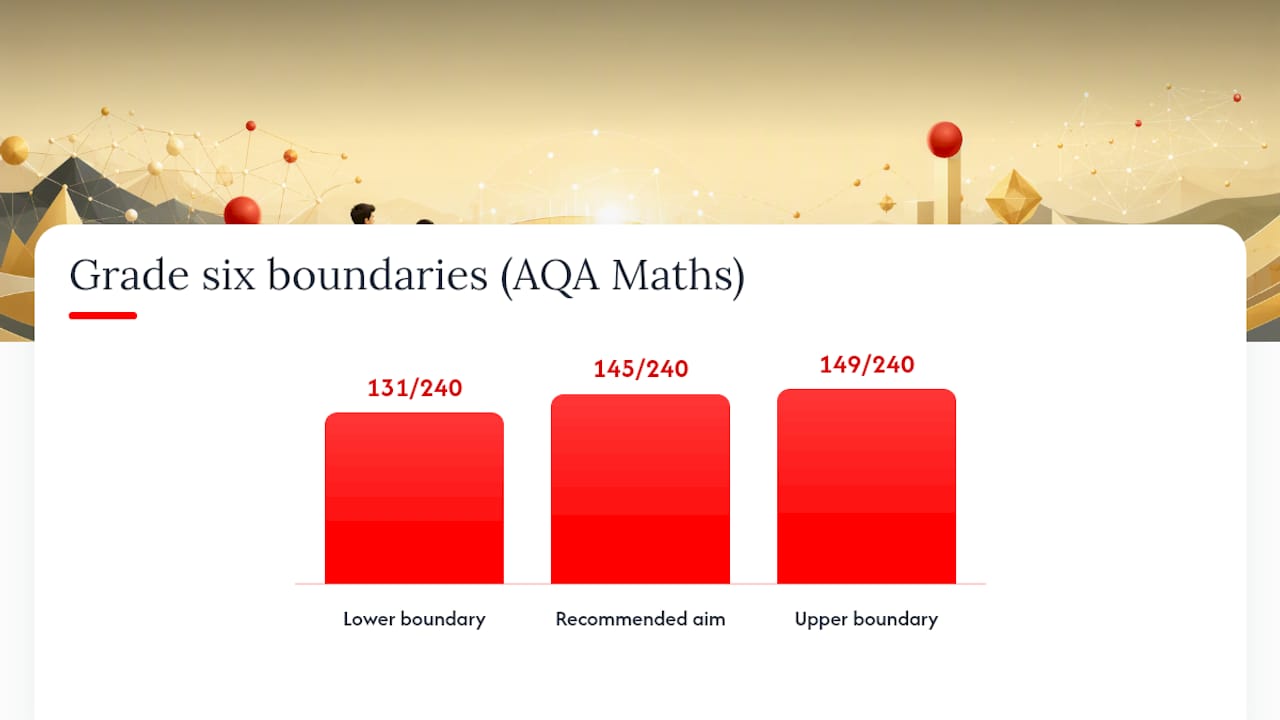
- Calculate your target raw mark. If the grade 6 boundary for AQA GCSE Maths has ranged from 131 to 149 out of 240 across recent series, aim for at least 145 to give yourself a buffer against a higher boundary year.
- Sit past papers under timed conditions and record your raw mark for each paper. Do not convert to a grade yet; work in raw marks throughout your revision so you can track progress against the boundary directly.
- Use notional component boundaries to identify which paper is costing you the most marks. If your paper 3 raw mark is consistently below the notional boundary, that paper needs more attention than papers 1 and 2.
- Read the examiner report for each past paper you attempt. Reports flag the questions where candidates most commonly dropped marks and describe what distinguishes a top-band answer from a mid-band one.
Pro Tip: Record your raw mark immediately after each timed practice paper, before you look at the mark scheme. That number, compared against the historical boundary range, tells you more about your readiness than any percentage score. Teachers who use this method with classes report that students become much more precise about where their marks are going.
The GOV.UK grading toolkit for schools includes resources specifically designed to help teachers explain this process to students and parents, which makes it a useful starting point for educators building a results-day communication plan.
Common myths about grade boundaries
Myth: Grade boundaries are fixed percentages.
Reality: No boundary is set before a single script is marked. Senior examiners review actual student work from the current series before any boundary is finalised.
Myth: Boards set boundaries to produce a quota of grades.
Reality: GOV.UK is clear that boundaries are set to preserve standards, not to engineer a grade distribution. If a cohort performs exceptionally well, more students can receive high grades.
Myth: Teachers or schools can influence boundaries for their pupils.
Reality: Boundaries apply uniformly to every candidate sitting the same specification. A school has no mechanism to shift the boundary for its own students. What schools can influence is the quality of preparation, not the boundary itself.
Myth: The same raw mark means the same grade across all boards.
Reality: AQA, Edexcel, OCR, and WJEC set boundaries independently for their own specifications. A raw mark of 55 on an AQA paper and 55 on an Edexcel paper may correspond to different grades because the papers, mark schemes, and cohorts are different.
For official corrections to these and other misconceptions, the GOV.UK toolkit for schools provides ready-made explanations that headteachers and teachers can share directly with students and parents.
Why understanding boundaries matters more than most students think
Most students treat grade boundaries as something to check on results day and then forget. That is a missed opportunity.

Knowing how boundaries work changes how you revise. When you understand that a boundary is set to reflect the standard of work at that grade, you stop chasing a percentage and start asking a better question: does my answer demonstrate the standard expected at grade 6, or grade 7? That shift in thinking is what separates students who plateau from those who break through.
There is also an anxiety dimension worth addressing directly. Many students assume that a harder paper means they are penalised. The opposite is true: a harder paper produces lower boundaries, so the system is designed to protect you. Understanding that mechanism before results day removes a significant source of unnecessary stress.
For teachers, the awarding process is a reminder that examiner reports are not optional reading. They are the clearest signal available about what the board considers grade-worthy work, and they are free. Schools that build examiner report analysis into their schemes of work give students a structural advantage that no amount of generic revision can replicate.
Mathvault’s revision resources to close the grade gap
Knowing where the boundary sits is only half the work. Getting your raw mark above it is the other half, and that is where structured practice makes the difference.
Mathvault gives you free access to GCSE and A-Level maths past papers organised by exam board, fully worked step-by-step solutions, and video walkthroughs that show exactly how marks are earned on each question type. Whether you are targeting a grade 5 in GCSE maths or pushing for an A in A-Level, the resources are built around the raw mark, not vague percentages. Start with the GCSE maths revision guides to find board-specific papers matched to your specification, or go straight to AQA A-Level Maths if you are revising for A-Level. Live weekly Q&A sessions mean you can get a specific question answered in real time, not days later. Everything is free to use, with downloadable revision packs available for those who want offline access.
Primary sources and further reading
Use these official sources to verify boundaries and understand the awarding process in full.
Regulatory and government guidance:
- Gov — the definitive plain-English explanation of how boundaries are set and why they change. Use this to answer questions from parents.
- Gov — covers the 9–1 scale, grade 4 vs grade 5 pass thresholds, and how the scale aligns with the old A*–G system.
- Gov — resources for headteachers and teachers to explain grading and debunk myths with students and parents.
- GCSE 9 to 1 grades: a brief guide for parents (Ofqual blog) — accessible explanation of grade 9 and how standards are carried forward.
Exam board boundary pages (check these on results day):
- AQA grade boundaries — PDFs by qualification and series, including notional component boundaries where published. Use on results day to convert your AQA raw mark to a grade.
- Edexcel (Pearson): qualifications.pearson.com → Support → Grade boundaries. Covers all Pearson qualifications.
- OCR: ocr.org.uk → Administration → Results and certificates → Grade boundaries.
- WJEC / Eduqas: wjec.co.uk → Qualifications → Grade boundaries. Primary source for Welsh-specification candidates.
Accessible explainers:
- What are the grade boundaries for GCSEs? (BBC Bitesize) — explains pass thresholds, cross-board differences, and rounding behaviour in component weighting.
- Grade boundaries: what are they and how do they work? (Tes) — sector analysis with worked examples of how scripts and cohort data inform boundary setting; useful for classroom-facing explanations.
Leave a Reply