
The hardest A level maths topics, ranked by mark loss in exam conditions, are: proof, integration, differentiation (including from first principles and the chain and product rules), 3D vectors and geometry, algebraic manipulation and partial fractions, parametric equations, hypothesis testing and statistical distributions, and mechanics modelling. Start your revision with integration. It appears across multiple question types, carries both method and accuracy marks, and students consistently identify it alongside proof and vectors as the area where marks disappear fastest.
Examiner evidence backs this up. Ofqual confirmed it was closely monitoring A level maths marking after teachers and students reported a significant increase in difficulty on a recent paper, with connected, multi-part questions identified as a principal driver. When a paper is demonstrably harder than previous years, Pearson adjusts grade boundaries using statistical data and expert judgement to keep final grades comparable, so the difficulty is real but the grading system accounts for it.
Key takeaways
The hardest A level maths topics cost marks primarily through absent working, wrong method selection, and imprecise statistical conclusions — all of which are correctable with targeted practice.
| Point | Details |
|---|---|
| Prioritise integration first | Integration appears across multiple question types and carries method and accuracy marks throughout. |
| Build and review an error log | Log every dropped mark by topic and specific error; review it at the start of each session. |
| Use topic-filtered past papers | Drill each hard topic in isolation before attempting mixed papers to build method recognition. |
| Write every line of working | Method marks are available even when the final answer is wrong; absent working scores zero. |
| Mathvault for targeted practice | Free topic-organised past papers, worked solutions, and live Q&A sessions cover every topic on this list. |
Table of Contents
- Why do certain A level topics become so hard in exams?
- The hardest A level maths topics ranked, with common mistakes and quick fixes
- How do you tackle the hardest topics with a practical revision routine?
- Why should you trust this ranking? Examiner reports and mark scheme evidence
- What markers actually see on scripts
- Mathvault has the resources to fix your hardest topics
- Sources
Why do certain A level topics become so hard in exams?
The difficulty rarely comes from a single topic being conceptually impossible. It comes from how questions are designed. Analysis of A level question features shows that unfamiliar context, multi-step logic, and the need to select a method without prompts are the main drivers of mark loss, not the underlying mathematics itself.
Several structural features compound this:
- Multi-step reasoning without scaffolding. A question on integration by parts might require you to first spot a substitution, then apply the parts formula, then evaluate limits. Each step depends on the previous one. One slip cascades through the whole solution.
- Method selection under time pressure. When a question says “find the area enclosed by the curve,” it does not tell you whether to integrate directly, use parametric form, or split the region. Choosing the wrong method costs every mark that follows.
- Unfamiliar context. A mechanics question set in a real-world scenario (a bead on a wire, a particle on a slope) uses the same equations you know, but the setup disguises them. Students who have only practised standard templates freeze.
- “Show that” and “hence” prompts. These are traps for students who skip working. “Show that” requires every line of algebra to be visible. “Hence” means you must use the previous result, not start fresh. Examiners award zero method marks when the instruction is ignored.
- Heavy algebraic manipulation. Topics like partial fractions and parametric differentiation require sustained, accurate algebra over many lines. A sign error in line three invalidates lines four through eight.
- Reliance on prior knowledge. Proof by contradiction requires solid number theory intuition. Connected particles in mechanics require Newton’s second law applied simultaneously to two bodies. Neither topic is self-contained.
A simple example: completing the square is a routine GCSE skill. Embedded in an A level proof question, it becomes hard because you must recognise it is the right tool, apply it to a general expression, and then interpret the result as a logical argument.
The hardest A level maths topics ranked, with common mistakes and quick fixes
The ranking below reflects examiner report patterns, student consensus on the most challenging topics, and the frequency with which each topic appears in high-tariff questions.
-
Integration (technique and applications)
Why it costs marks: Integration questions combine technique selection (substitution, parts, partial fractions) with applications (area, volume, differential equations). Errors compound across steps.
Common mistakes: Forgetting the constant of integration in indefinite integrals; incorrect limits when integrating parametric curves; confusing the formula for volume of revolution with the area formula.
Quick fix: Practise five integration questions per day this week, one from each technique type. Check your answer by differentiating it. -
Proof
Why it costs marks: Proof requires a mode of reasoning most students have not practised at GCSE. Examiners expect rigorous logical structure, not just a correct answer.
Common mistakes: Assuming what you are trying to prove (circular reasoning); using specific examples to prove a general statement; writing “therefore” without a logical connection.
Quick fix: Write out three proof by contradiction and three proof by exhaustion examples from past papers, then compare your structure line-by-line with the mark scheme. -
Differentiation (chain, product, and quotient rules; first principles)
Why it costs marks: The rules are individually manageable, but questions combine them. Differentiating a composite function that is also a product of two functions requires applying both rules simultaneously. See Mathvault’s differentiation rules revision guide for worked examples on each rule.
Common mistakes: Forgetting to apply the chain rule to the inner function; sign errors in the quotient rule; failing to simplify before differentiating from first principles.
Quick fix: Drill ten mixed differentiation questions without a calculator. Write the rule you are applying at the top of each solution before you start. -
3D vectors and geometry
Why it costs marks: 3D vector questions require spatial reasoning alongside algebraic technique. Students must set up equations for lines and planes, find intersections, and interpret geometric meaning.
Common mistakes: Confusing the direction vector with the position vector; incorrect dot product calculation when finding angles; failing to check whether lines are parallel, intersecting, or skew.
Quick fix: Sketch every 3D vector question, even roughly. Label position vectors and direction vectors before writing any algebra. -
Algebraic manipulation and partial fractions
Why it costs marks: Partial fractions underpin integration of rational functions and binomial expansion. Errors here block marks in two or three subsequent parts of the same question.
Common mistakes: Incorrect factorisation of the denominator; forgetting a repeated linear factor requires two separate terms; algebraic slips when equating coefficients.
Quick fix: Factorise the denominator fully before setting up any partial fraction. Check your result by recombining the fractions. -
Parametric equations
Why it costs marks: Students must move fluently between parametric and Cartesian forms, differentiate parametrically, and integrate to find areas. Each skill is tested in the same question.
Common mistakes: Incorrect chain rule application when finding dy/dx parametrically; wrong limits when converting a parametric integral; failing to eliminate the parameter correctly.
Quick fix: Practise converting between forms on five past-paper examples, then attempt the differentiation and integration parts under timed conditions. -
Hypothesis testing and statistical distributions
Why it costs marks: Statistics questions demand precise language. A correct calculation with an incorrectly stated conclusion loses the final mark.
Common mistakes: Comparing the p-value to the wrong significance level; stating the conclusion in terms of the test statistic rather than the original context; confusing one-tailed and two-tailed tests.
Quick fix: Write a conclusion template and use it every time: “Since [p-value] [is/is not] less than [significance level], there [is/is not] sufficient evidence to reject H₀. We conclude that [in context].” -
Mechanics modelling (connected particles, projectiles, variable acceleration)
Why it costs marks: Mechanics questions embed the mathematics in physical scenarios. Students must translate the scenario into equations before solving anything.
Common mistakes: Incorrect direction conventions (mixing up positive directions for two connected particles); forgetting to resolve forces along the slope; using constant-acceleration formulae when acceleration is variable.
Quick fix: Draw a clear force diagram for every mechanics question, label all forces and your positive direction, before writing a single equation.
How do you tackle the hardest topics with a practical revision routine?
Knowing which topics are hard is only half the battle. The other half is a structured routine that converts that knowledge into marks.
A step-by-step revision approach
- Audit your errors first. Before you practise anything new, open your last two past papers and list every question you dropped marks on. Group them by topic. This is your personal ranked list, and it is more accurate than any generic one.
- Build an error log. For each mistake, write: the topic, the specific error (e.g. “forgot chain rule on inner trig function”), and the correct method. Review this log at the start of every session.
- Drill the technique in isolation. Spend the first 20 minutes of each session on focused technique drills for one hard topic. Use topic-organised past paper questions rather than full papers.
- Move to mixed questions. After the drill, attempt one or two questions that combine the topic with another area. This is where question difficulty comes from method selection, so practising recognition is as important as practising technique.
- Time yourself. A level maths papers allocate roughly 1.8 minutes per mark. A 6-mark integration question should take no more than 11 minutes. Practise under this constraint from week one.
Sample two-week and four-week schedules
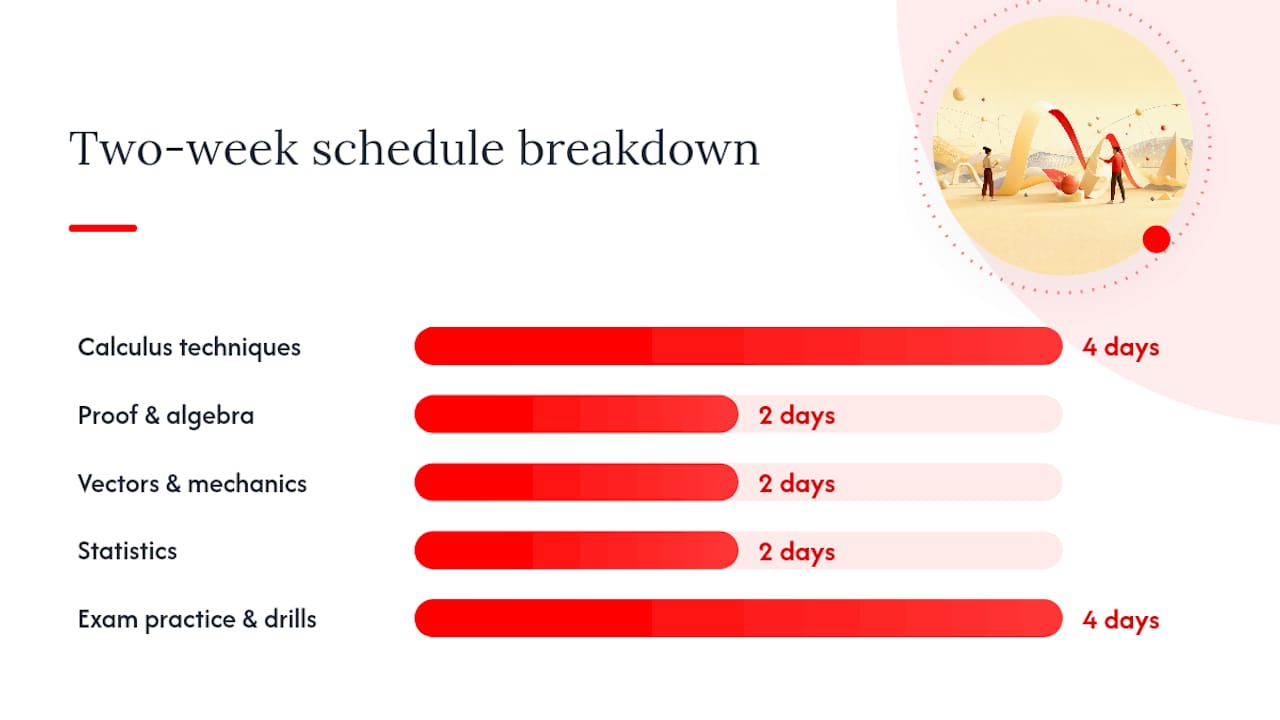
Two-week schedule (final push)
| Days | Focus |
|---|---|
| Days 1–2 | Integration: technique drills (substitution, parts, partial fractions) |
| Days 3–4 | Proof and algebraic manipulation |
| Days 5–6 | Differentiation and parametric equations |
| Day 7 | Full timed past paper, then error log review |
| Days 8–9 | Vectors and mechanics modelling |
| Days 10 and 11 | Statistics: hypothesis testing and distributions |
| Days 12 and 13 | Mixed topic drills targeting your personal error log |
| Day 14 | Full timed past paper under exam conditions |
Four-week schedule: run the two-week plan twice, but in the first two weeks use older papers (three to five years back) and in the second two weeks use the most recent series. This builds familiarity with the current style of question.
Securing method marks
Even when you cannot complete a question, method marks are available. Write every step of your working clearly. Label what you are doing (“applying product rule,” “substituting limits”). If you reach a wrong intermediate answer, carry it forward consistently. Examiners award follow-through marks when the method is correct even if the arithmetic is not.
Keep the A level maths formula booklet open during timed practice so you learn exactly which formulae are given and which you must recall.
When and how to ask for help
Ask for help when you have attempted a question at least twice and still cannot identify where your method breaks down. Bring your attempted solution, not a blank page. Show your teacher or tutor the specific line where you think the error occurs. This makes the session productive in five minutes rather than thirty.
For live support, Mathvault runs weekly Q&A sessions where you can bring specific questions and get them worked through in real time.
Pro Tip: When reviewing a mark scheme, cover the solution and try to write down just the method steps before reading the working. This trains method recognition, which is the skill that separates a B from an A.
Why should you trust this ranking? Examiner reports and mark scheme evidence
The ranking above is not based on opinion alone. It reflects patterns visible in official examiner reports and recent news coverage of exam difficulty.
Ofqual confirmed it was monitoring A level maths marking closely after students and teachers reported a significant increase in difficulty on a recent paper. The regulator’s concern centred on connected, multi-part questions that required students to navigate several stages of reasoning without clear scaffolding. A student petition describing an Edexcel paper as significantly harder than previous years cited multi-layer reasoning and extended algebraic manipulation as the specific causes.
Key patterns from examiner reports and mark scheme analysis:
- Integration and differentiation consistently attract examiner comments about students losing accuracy marks through incomplete working or skipped steps.
- Proof questions generate the most “zero-mark” responses, because students attempt numerical verification rather than a general argument.
- Statistics conclusions are a reliable source of dropped final marks, even when the calculation is correct.
- Mechanics diagrams are absent in a high proportion of scripts where the method is also wrong, suggesting the two are connected.
Pearson’s official qualifications support pages publish past papers and examiner reports for every series. Reading the examiner comments for the two most recent series of your specific paper takes about 30 minutes and is one of the highest-return revision activities available. Look specifically for phrases like “many candidates,” “a common error was,” and “few candidates scored full marks on.” These phrases map directly onto the pitfalls listed above.
The grade boundary adjustment process also matters here. When a paper is harder than usual, Pearson uses statistical data and expert judgement to set boundaries that keep grades comparable across series. This means a difficult paper does not automatically mean lower grades, but it does mean that the topics which caused difficulty are likely to recur in a modified form.
What markers actually see on scripts
The pattern that stands out most, across hundreds of scripts, is not wrong answers. It is absent working. A student who writes the correct final answer with no method shown scores zero on a “show that” question and loses all method marks on a multi-step question. The examiner cannot award what they cannot see.

The single daily habit that prevents this: write one line of working for every logical step, even when the step feels obvious. Practise it on every question, not just the hard ones, so it becomes automatic under pressure. The specific question type that trips students most consistently is the “hence” integration question, where the previous part gives a result that must be used. Students who ignore “hence” and integrate from scratch often reach the correct answer but score zero, because the instruction was to use the earlier result.
Mathvault has the resources to fix your hardest topics
Knowing the topics is one thing. Having the right materials to practise them efficiently is another. Mathvault gives you free access to past papers organised by topic, fully worked step-by-step solutions, and video walkthroughs covering every topic on this list, all without a subscription.

For the hardest topics specifically, the Edexcel A level resources include topic-filtered past paper banks so you can drill integration, proof, or vectors in isolation rather than hunting through full papers. The worked solutions show every line of method, which means you can compare your working step-by-step rather than just checking the final answer. Live weekly Q&A sessions let you bring the specific questions from your error log and get them resolved in real time. Use the free resources to run the two-week schedule above, then join a live session for the topics where your error log still shows repeated mistakes. Access everything at Mathvault.
Sources
These are the official and high-quality sources worth bookmarking now.
- A-level maths exam marking to be watched closely by regulator after students say paper was ‘unfair’ — BBC
- Qualifications
- A Level maths exam question difficulty: get better grades — Quextro blog
- Is A Level Maths Hard? The Honest Guide for Students
- Is A-Level Maths Hard? What to Expect & How to Succeed — Lead Academy
Leave a Reply