
If you have 48 hours or fewer, do three things: complete a timed past paper for your exact exam board and tier, mark it immediately using the official mark scheme, and target your biggest topic errors. That single loop, repeated as many times as your remaining time allows, is the fastest route to a higher grade.
Start here, right now:
- Download your exam board’s most recent past paper (AQA, Edexcel, OCR, WJEC, or CCEA) and the matching mark scheme from the board’s website.
- Open Mathvault for fully worked step-by-step solutions organised by board, so you can see exactly where your method went wrong.
- Use BBC Bitesize for five-minute topic quizzes when you need a quick confidence check between papers.
Quick-start checklist:
- [ ] Set a timer for the full paper duration
- [ ] Work in exam conditions (no phone, no notes)
- [ ] Stop when the timer ends, even mid-question
- [ ] Mark using the official mark scheme and log every error
- [ ] Pick two topics to fix and do a targeted drill before your next paper
Past-paper practice is the single most effective last-minute activity because it replicates the exact format and reveals the recurring errors that cost you marks.
Table of Contents
- What should you do in the 48, 24, and 8 hours before your exam?
- Which resources give you the fastest gains right now?
- How do you run a timed past paper and turn errors into a revision plan?
- Exam technique that saves marks: how to prioritise and avoid costly mistakes
- Which topics should you prioritise in your final revision sprint?
- Why sleep and active practice matter more than extra hours tonight
- Key takeaways
- What actually works in the final hours before a maths exam
- Mathvault: free worked solutions and past papers to get you started in ten minutes
- Useful sources and quick links
What should you do in the 48, 24, and 8 hours before your exam?
The key principle is simple: the closer you are to the exam, the less time you spend learning and the more time you spend practising and checking.
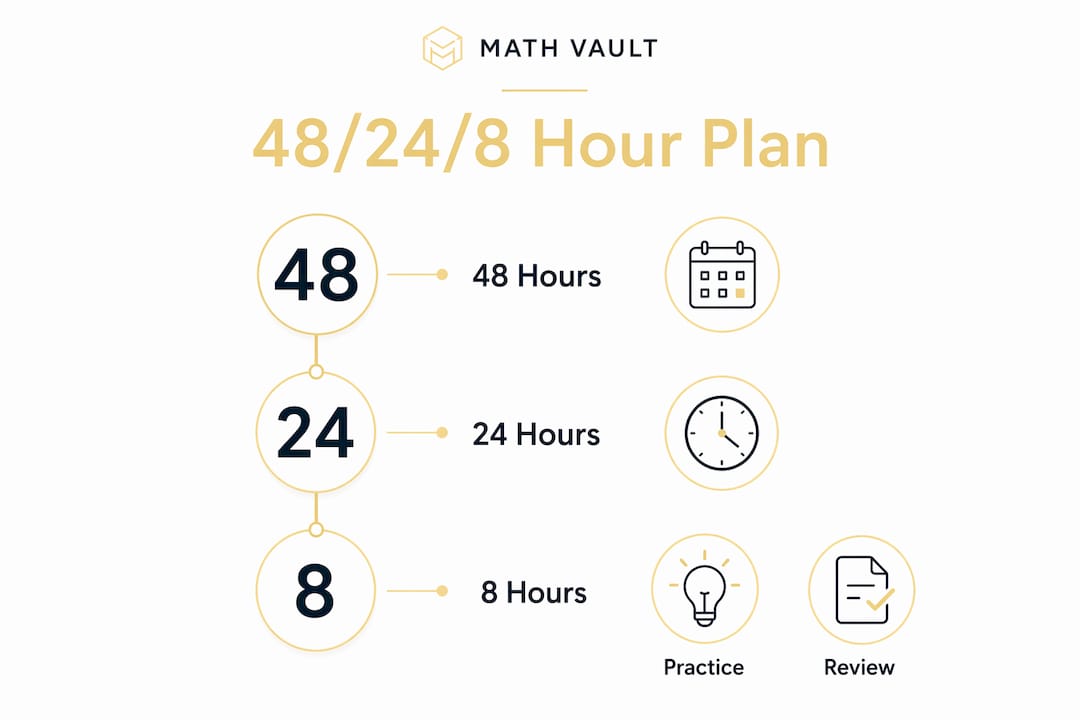
48-hour plan
Day one (today): Complete one full timed past paper in the morning. Mark it immediately and log every error as either careless (misread, units, transcription) or method/concept (you did not know how to approach it). Spend the afternoon on targeted drills for your two weakest topics. Aim for 15–20 minute focused sessions rather than a single two-hour block — short, active practice consolidates more than cramming.

Day two (tomorrow): Complete a second timed paper in the morning, ideally from a different year. Repeat the marking and error-log process. Spend the afternoon reviewing your formula sheet and doing quick quizzes on any topic that appeared twice in your error log. Stop active revision by early evening. Pack your exam kit, eat a proper meal, and sleep.
24-hour plan
Complete one timed paper or two shortened sections (one non-calculator, one calculator). Mark immediately. Spend limited time on targeted topic practice based on your errors. Spend the final session reviewing key formulas: the quadratic formula, circle area and circumference, Pythagoras, trigonometric ratios, and the compound interest formula. Sleep at a normal time.
8-hour / last-day plan
This is not the moment to start a new topic. Use short sprints of focused study: one topic quiz, one formula check, one set of focused questions. Check your calculator button sequences for standard form, trigonometric functions, and surds on the exact model you will use. Pack your bag, eat well, and stop revising at least an hour before bed.

What to drop: deep reading of new topics, lengthy notes, and passive re-reading of textbooks. None of these will move your grade today.
Pro Tip: Divide each revision hour into three parts: 25 minutes of active practice, 10 minutes of marking and error logging, and 25 minutes of targeted correction on the specific questions you got wrong. That rhythm beats an hour of unfocused reading every time.
Which resources give you the fastest gains right now?
Not all revision materials are equal when time is short. The table below shows the highest-impact options, what each is best for, and when to use them.
| Resource | Best for | Format | Exam board coverage | Free or paid |
|---|---|---|---|---|
| Exam-board past papers + mark schemes | Realistic practice and error diagnosis | Full papers, PDFs | AQA, Edexcel, OCR, WJEC, CCEA | Free (board websites) |
| Mathvault | Worked solutions, video walkthroughs, board-organised packs | Step-by-step PDFs, short videos | AQA, Edexcel, OCR, WJEC, CCEA | Free (packs available to download) |
| BBC Bitesize | Quick topic quizzes and short refreshers | Quizzes, short videos | General GCSE (all boards) | Free |
| Corbettmaths | Topic worksheets and 5-a-day quick practice | Worksheets, videos | General GCSE | Free |
| MathsMadeEasy | Printable worksheets by topic and tier | Worksheets, PDFs | AQA, Edexcel, OCR | Free |
| 1stClassMaths | Exam-style questions and topic revision sheets | Worksheets, PDFs | AQA, Edexcel | Free |
How to choose based on your remaining time:
- Under 2 hours: Use BBC Bitesize quizzes or Corbettmaths 5-a-day for a quick topic check. No full papers.
- 2–4 hours: Do one shortened paper section, mark it, then use Mathvault’s worked video solutions to fix the two questions you could not do.
- 4 hours or more: Complete a full timed paper, mark it, and use Mathvault’s board-organised worked solutions to close your gaps.
On paid resources: a one-off tutoring session focused on your specific error patterns can diagnose recurring weaknesses faster than unfocused revision, but only if it targets high-yield topics directly. Avoid buying generic revision guides at this stage — the free resources above are more targeted and immediately usable.
Pro Tip: Teacher-recommended blogs such as Resourceaholic are excellent for finding well-structured topic worksheets, particularly for higher-tier algebra and geometry. Bookmark one or two specific topic pages rather than browsing the whole site.
How do you run a timed past paper and turn errors into a revision plan?
The paper itself is only half the work. What you do in the 30–60 minutes after you put your pen down determines whether the practice actually moves your grade.
Step 1: Set up properly. Choose the correct board and tier (foundation or higher). Set a timer for the exact duration printed on the paper. Sit at a desk, remove your phone, and use only the equipment you will have in the real exam.
Step 2: Work and stop. Attempt every question in order. If you are stuck, move on and return later. When the timer ends, stop writing immediately, even if you are mid-sentence.
Step 3: Mark using the official mark scheme. Award yourself method marks wherever your working shows the correct approach, even if your final answer is wrong. Mark schemes give credit for method, so be honest but fair.
Step 4: Log every error. For each question you dropped marks on, write one of three labels: careless (misread, wrong units, transcription slip), method (you knew the topic but applied the wrong approach), or concept (you did not know how to start). This takes five minutes and tells you exactly where to spend the next hour.
Step 5: Target your two biggest concept or method gaps. Find three to five questions on that topic from Mathvault’s past paper worked solutions or a Corbettmaths worksheet. Do them without looking at the solution first, then check.
Pro Tip: Mark your paper immediately after finishing it. Leaving it until later means you lose the memory of your thought process, which is exactly what you need to understand why you made each error.
Exam technique that saves marks: how to prioritise and avoid costly mistakes
Exam technique is learnable in a single session. These habits directly reduce lost marks and are worth practising in your next timed mock.
Read all questions first. Spend two to three minutes scanning the paper before you write anything. Identify the questions you can answer confidently and do those first. This builds momentum and guarantees you collect the marks you already know.
Show every step of your working. Examiners award method marks, which means neat, labelled working can win you partial credit even when your final answer is wrong. Write the formula before you substitute numbers. Define any unknowns. Never skip a step to save time.
Budget your time by marks. If the paper is 80 marks in 90 minutes, you have roughly one minute per mark. A four-mark question should take no more than four to five minutes. Leaving a question half-finished is painful, but spending ten minutes on a two-mark problem costs you marks elsewhere.
Common errors to catch before you submit:
- Wrong or missing units (cm vs cm², degrees vs radians)
- Sign errors in algebra (especially when expanding brackets or rearranging)
- Transcription mistakes (copying a number incorrectly from one line to the next)
- Calculator mode (degrees vs radians for trigonometry)
- Rounding too early in a multi-step calculation
Teachers report that avoidable mistakes cost more marks than conceptual gaps for many students. A two-minute check at the end of each question, not just at the end of the paper, catches most of these.
When you hit a blank: move on immediately. Return to the question later with fresh eyes. If you still cannot solve it, write down any relevant formula, substitute the numbers you have, and show partial method. Partial credit is always better than a blank page.
Pro Tip: Use the structure of the question paper. Part (b) is almost always related to part (a). If you cannot do part (a), check whether the question gives you enough information to attempt part (b) independently — it often does.
Which topics should you prioritise in your final revision sprint?
Focus your remaining time on topics that appear across multiple papers and carry significant marks. These are the areas where targeted practice returns the most marks per hour.
High-yield topics for all students
- Algebra: solving equations, rearranging formulae, expanding and factorising. Rearranging formulae appears frequently and is a common source of lost marks across all boards.
- Ratio and proportion: direct and inverse proportion, percentage change, reverse percentages. Reverse percentage is consistently flagged in examiner reports.
- Geometry and measures: area and perimeter, Pythagoras’ theorem, trigonometry (SOH CAH TOA), angles in parallel lines and polygons.
- Number: standard form, prime factorisation, HCF and LCM, compound interest.
- Statistics and probability: mean from a frequency table, cumulative frequency, probability trees.
Foundation vs higher focus
Foundation students should lock down number, ratio, basic algebra, and geometry before anything else. These topics carry the majority of marks on foundation papers. Higher students need to keep simultaneous equations, quadratic equations (including the quadratic formula), trigonometry in non-right-angled triangles (sine and cosine rules), and circle theorems in scope.
How many practice questions are enough? Five to ten focused questions per topic, done without looking at the solution first, is enough to build meaningful confidence. The goal is not to complete every worksheet available; it is to identify whether you can start and execute the method independently.
Rapid diagnostic: complete one past paper and tally which topic each dropped mark belongs to. The two topics with the most errors are your sprint targets. Practise your calculator button sequences for standard form, trigonometric functions, and surds on your actual exam calculator before the paper.
Pro Tip: Mixed-topic past papers build the context-switching speed you need on exam day. Practising single-topic blocks is useful for drilling a gap, but mixed-topic timed practice is what trains your brain to shift between question types quickly — exactly what the real exam demands.
Why sleep and active practice matter more than extra hours tonight
The evidence on this is clear: pulling an all-nighter is counterproductive. Brain performance degrades after two consecutive nights of poor sleep, and memory consolidation — the process that makes revision stick — happens during sleep, not during the revision session itself. Prioritising steady sleep and hydration in the final days is not a luxury; it is a revision strategy.
Active problem solving is the only reliable way to test understanding. Watching a worked solution without attempting the question first creates false confidence. You recognise the method when you see it, but recognition is not the same as retrieval. The only way to know whether you can do a question is to do it, from scratch, before you look at the solution.
Simulating mixed-topic past papers in the final days builds the switching speed and stamina that single-topic drills cannot. Practitioners advise working timed mixed papers rather than topic blocks to replicate the cognitive demands of the real exam.
A practical 30–60 minute active practice template: attempt five to eight questions from a mixed-topic set without any notes, mark them immediately, identify the one or two you could not start, and spend the remaining time on those specific gaps using a worked solution or short video. That cycle, repeated two or three times across your remaining revision time, is more effective than any passive re-reading session.
One action to take today: go to bed at your normal time. If you are revising the night before the exam, stop by 9 PM. Eat a proper meal, drink water, and avoid excessive caffeine after midday. You will perform better on eight hours of sleep than on three hours of cramming.
Key takeaways
The single most effective approach to last-minute GCSE maths revision is to complete timed past papers, mark them immediately using the official mark scheme, and target your two biggest error categories with focused practice.
| Point | Details |
|---|---|
| Past papers first | Complete a timed past paper for your exact board and tier; mark it immediately using the official mark scheme. |
| Log errors by type | Categorise every dropped mark as careless, method, or concept to build a precise action list for targeted drills. |
| Prioritise high-yield topics | Focus on algebra, ratio and proportion, geometry, and number; foundation and higher students have different sprint priorities. |
| Sleep beats all-nighters | Memory consolidation happens during sleep; stop revising by 9 PM the night before and prioritise rest and hydration. |
| Mathvault for fast diagnosis | Mathvault’s free board-organised worked solutions and video walkthroughs convert past-paper errors into understanding quickly. |
In your final 60–120 minutes before the exam:
- Do a short five-question quiz on your weakest topic
- Review your formula sheet (quadratic formula, circle formulas, Pythagoras, trig ratios)
- Check your calculator button sequences for standard form and trigonometry
- Pack your exam kit (calculator, ruler, compass, pens, pencils)
- Stop revising and rest
Do not do in the final hours: attempt a brand-new topic, drink excessive caffeine, stay up past your normal bedtime, or re-read notes passively without testing yourself.
What actually works in the final hours before a maths exam
Most students spend their last hours doing the thing that feels productive rather than the thing that is productive. Re-reading notes feels safe. Attempting questions you might get wrong feels uncomfortable. But the discomfort is the point: retrieval practice, the act of trying to produce an answer from memory, is what consolidates learning. Passive review does not.
There is also a tendency to chase new topics in the final hours, driven by the fear of a question you cannot answer. Resist it. A student who has drilled their five weakest topics from past-paper evidence will almost always outperform one who spent the same time skimming a topic they have never practised. The marks you can recover from known weaknesses are more reliable than the marks you might pick up from a topic you have barely touched.
The other underestimated factor is exam technique. Showing working, budgeting time per mark, and running a two-minute error check at the end of each question are habits that recover marks without requiring any additional subject knowledge. They are worth practising in every timed mock you do between now and the exam.
Mathvault: free worked solutions and past papers to get you started in ten minutes
Every resource described in this article is available free on Mathvault. The platform organises past papers and fully worked solutions by exam board, so you are never searching through the wrong materials. Whether you are sitting AQA, Edexcel, OCR, or WJEC, you can find the correct paper, work through it, and then open the step-by-step solution for every question you could not complete.
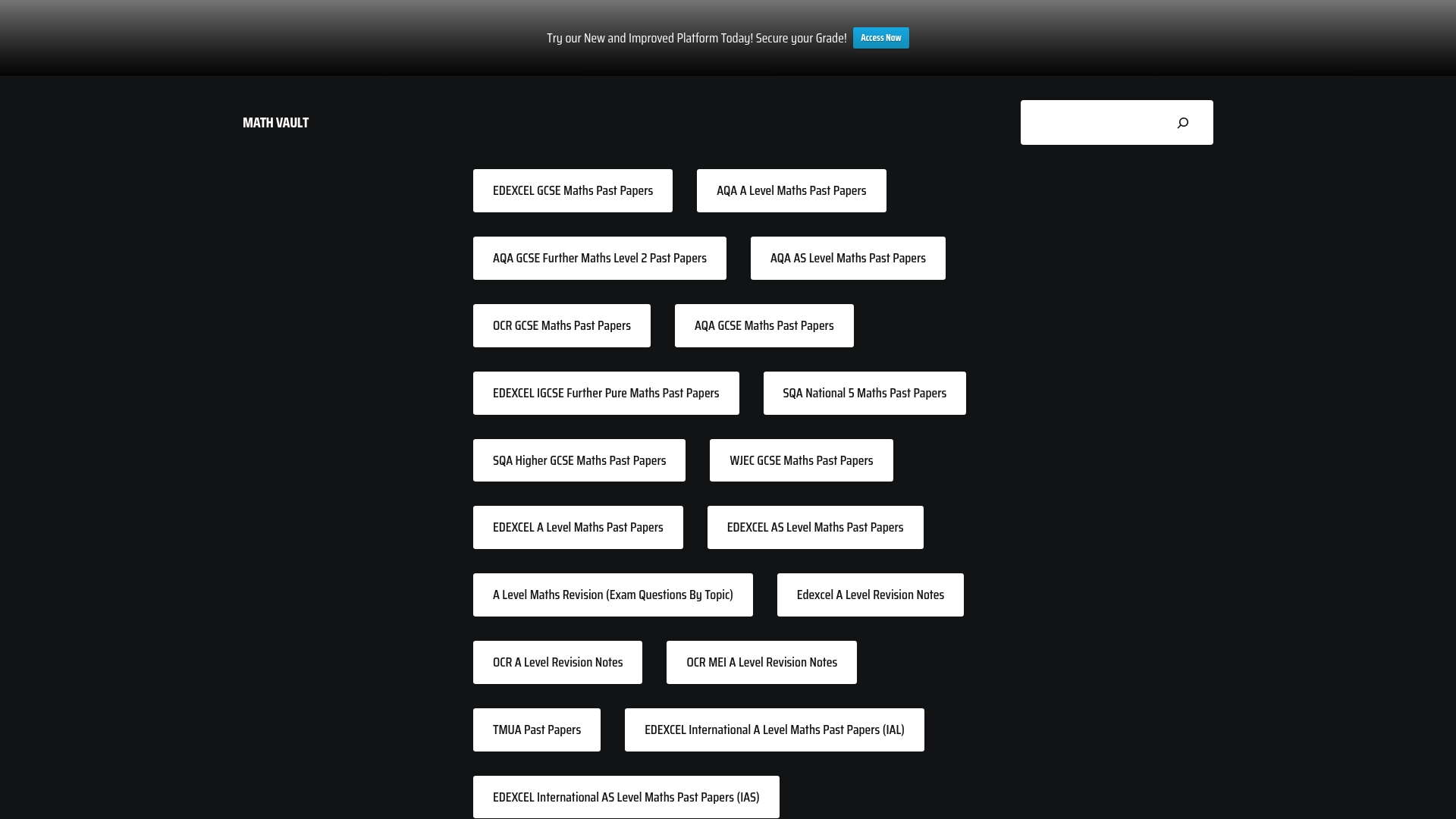
The fastest way to start: go to Mathvault, select your exam board, and download the most recent past paper and its worked solutions. Complete the paper timed, mark it against the worked solutions, and watch the short video walkthrough for any question where your method was wrong. That loop takes under two hours and gives you a precise list of what to fix next.
If you want everything in one place, Mathvault’s downloadable revision packs bundle past papers, mark schemes, and worked solutions by board and year range. WJEC students can access the WJEC GCSE resources directly. For live help, Mathvault runs weekly Q&A sessions where you can bring specific questions from your error log and get them answered in real time. No subscription, no long-term commitment — just the resources you need, when you need them most.
Useful sources and quick links
The resources below are the most authoritative starting points for last-minute GCSE maths revision in the UK.
- Exam-board past papers and mark schemes: download directly from your board’s official website (AQA, Edexcel, OCR, WJEC, CCEA). These are the single most important resource — use the most recent papers first and always mark with the official mark scheme.
- Mathvault (mathvault.io): free board-organised past papers, fully worked step-by-step solutions, short video walkthroughs, and downloadable revision packs. The fastest way to convert a past-paper error into understanding, particularly when you need to see the method explained rather than just the answer.
- BBC Bitesize (bbc.co.uk/bitesize): short topic quizzes and revision videos covering all GCSE maths topics. Best used for quick confidence checks between timed papers, not as a substitute for past-paper practice.
- Corbettmaths (corbettmaths.com): free topic worksheets, 5-a-day quick practice sets, and short videos. Particularly useful for drilling a specific topic after identifying it in your error log.
- MathsMadeEasy and 1stClassMaths: free printable worksheets organised by topic and tier. Useful for targeted practice on foundation or higher topics when you need five to ten focused questions on a single area.
How to pick the right board materials: always check the paper code on your entry confirmation. AQA, Edexcel, OCR, WJEC, and CCEA each have distinct question styles and mark distributions. Using the wrong board’s paper wastes time and can give you a misleading sense of your readiness. Worked solutions shorten the feedback loop because they show you not just the answer but the method and the marks awarded at each step — which is exactly what you need to understand why you lost marks and how to avoid losing them again.
Leave a Reply