
The fastest route to a better grade is board-specific past papers paired with fully worked solutions, not a generic revision guide that covers every board at once. Open Mathvault now, select your exam board, and download a past paper with its worked solution before you do anything else. Most GCSE 9–1 specifications run across three written papers totalling 240 marks (Paper 1 non-calculator; Papers 2 and 3 calculator), so understanding the structure of your specific papers is half the battle before revision even begins.
Start revising in three steps:
- Download a past paper and its worked solution from your exam board’s Mathvault page.
- Check your board’s official formula sheet and note which formulae are not provided.
- Set a timed 90-minute practice session this week to identify your weakest topics.
Table of Contents
- Which GCSE maths revision guides match your exam board?
- What makes a revision guide genuinely worth using?
- Which type of resource should you use, and when?
- How to use revision guides effectively
- Free vs paid resources: which do you actually need?
- Revision plans you can start this week
- How to practise exam technique properly
- Key takeaways
- What actually moves grades in GCSE Maths
- Mathvault: free board-specific revision resources, ready now
- Useful sources
Which GCSE maths revision guides match your exam board?
Matching your materials to your exact exam board is non-negotiable. AQA, Edexcel, OCR, WJEC, and iGCSE each have distinct topic weightings, question styles, and formula sheets. Using a guide written for the wrong board wastes revision time on content that will not appear in your exam.
AQA
- Must-haves: AQA specification checklist, topic packs for Number and Algebra (highest mark weighting), past papers with mark schemes, and formula sheet notes.
- Mathvault carries AQA past papers with fully worked step-by-step solutions and video walkthroughs. Start with the most recent paper available.
- Foundation and Higher tiers are assessed separately; confirm your tier with your teacher before downloading papers.
Edexcel
- Must-haves: Edexcel specification, topic-organised past-paper questions, and worked solutions that show method marks explicitly.
- Mathvault’s topic-organised Edexcel resources demonstrate the depth of worked solutions available across the platform.
- Edexcel’s formula sheet is more limited than some boards, so flashcard preparation for non-provided formulae is especially important here.
OCR
- Must-haves: OCR specification (note that OCR’s paper structure can differ from the standard 240-mark format, so check your specification directly), topic packs, and past papers with mark schemes.
- OCR questions often include multi-step problem-solving; prioritise worked solutions that show full reasoning chains.
WJEC / Eduqas
- Must-haves: WJEC specification, past papers, mark schemes, and video walkthroughs.
- Mathvault’s WJEC landing page is the clearest starting point, with papers organised by year and full worked solutions. The 2022 question paper and 2023 worked solutions are particularly useful for understanding current question styles.
- Video walkthroughs for 2017 and 2019 papers show exactly how method marks are awarded step by step.
iGCSE / SQA
- iGCSE specifications (typically Edexcel or Cambridge) have slightly different topic scopes; always cross-reference your syllabus.
- SQA students in Scotland should check Mathvault’s SQA resources alongside the official SQA past-paper archive.
All Mathvault materials are available as PDFs and video walkthroughs, with downloadable packs for offline study. Foundation and Higher tier papers are kept separate throughout.
Pro Tip: Download the most recent past paper for your board first. Timed practice on a real paper reveals weak topics faster than any topic-by-topic checklist.
What makes a revision guide genuinely worth using?
Not every guide sold as a GCSE maths study aid is worth your time. Before committing to any resource, run it through this checklist.
Core criteria:
- Exam-board alignment: the guide must name your board explicitly and match its current 9–1 specification.
- Complete topic coverage: Number, Algebra, Ratio and Proportion, Geometry and Measure, Statistics, and Probability should all be present.
- Fully worked step-by-step solutions, not just final answers.
- Plenty of exam-style questions, not just explanatory text.
- Clear mark-scheme guidance showing how marks are distributed across method and accuracy marks.
Secondary criteria:
- Updated to reflect the current syllabus (post-2017 reform for most boards).
- Accessibility features: dyslexia-friendly fonts, clear diagram labelling, and sufficient contrast for visual clarity.
- Calculator-friendly worked examples for Papers 2 and 3.
- Video walkthroughs for topics where seeing the method in motion helps.
A revision guide that only shows final answers is actively harmful. If you cannot see where the method marks fall, you cannot learn how to earn them when your own working goes slightly wrong. Worked solutions that show method marks and follow-through are what separate a genuinely useful resource from a glorified answer book.
Which type of resource should you use, and when?
Different resources serve different stages of revision. Using the wrong type at the wrong moment slows progress.
- Revision guides (written topic explanations with examples): use these at the start of a topic to build or refresh understanding. They are not a substitute for practice.
- Workbooks (structured question sets by topic): use these immediately after reading a guide section. Focused topic drilling builds procedural fluency before you mix topics.
- Video walkthroughs: use these when a written explanation is not clicking. Seeing a method worked through in real time often resolves confusion that text cannot.
- Flashcards (formula and key-fact cards): use these throughout revision for spaced retrieval practice. Making your own formula flashcards for formulae not printed on the exam sheet is more effective than using pre-made sets, because the act of creating them encodes the information.
- Past papers: use these from the midpoint of revision onwards. A timed full paper tests whether you can select and apply methods under pressure, which is the actual exam skill.
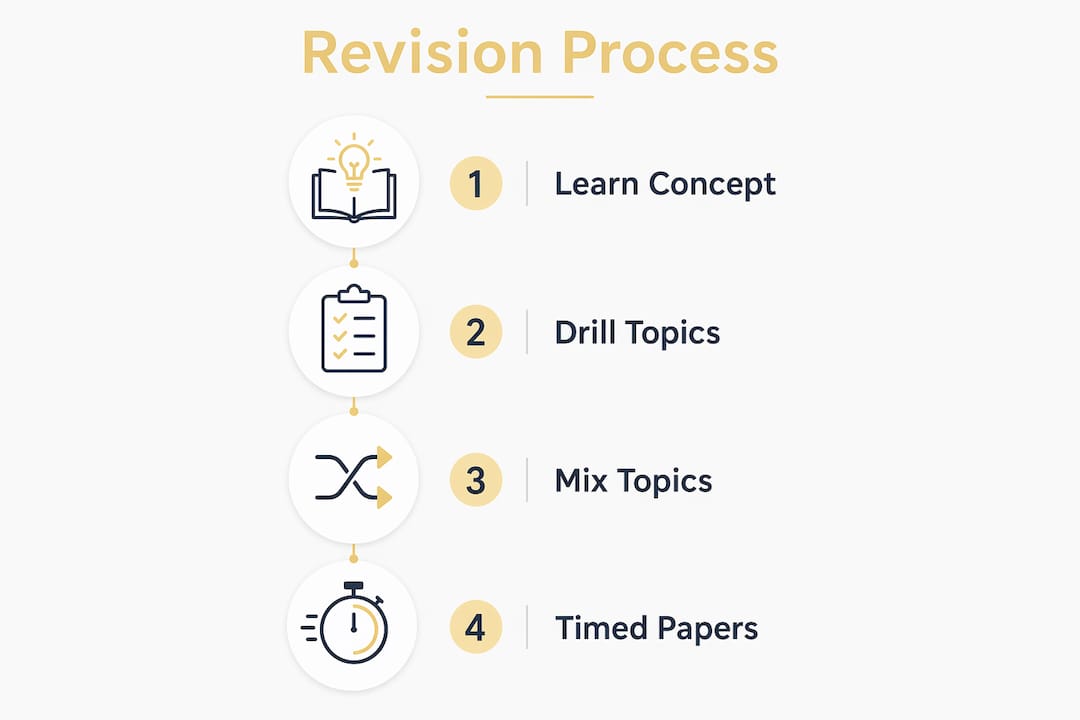
The sequence that works: learn the concept → drill by topic → mix topics across sessions → timed full papers.
Pro Tip: Before making flashcards, download your board’s official formula sheet. Only make cards for formulae that are NOT provided in the exam. This saves time and focuses memory effort where it counts.
How to use revision guides effectively
Passive reading produces very little. The methods below turn any guide or pack into measurable progress.

Build your topic audit first
Rate every specification topic red (not confident), amber (partial), or green (secure). Allocate revision time proportionate to mark weighting: Number and Algebra carry the most marks on most boards, so they deserve the most sessions. This audit becomes your revision roadmap.
Use active recall, not re-reading
Attempt every practice question before reading the worked example. Cover the solution, write your answer, then compare it against the mark scheme. This process, sometimes called “blurting,” forces retrieval rather than recognition. Active practice with past papers produces greater improvement than reviewing notes alone.
Apply spaced repetition and interleaving
Return to a topic two to three days after first studying it, then again a week later. Within each session, mix topics rather than blocking one topic for the entire session. Interleaving topics feels harder initially but strengthens your ability to select the right method when exam questions do not signal the topic for you.
Sample two-week intensive cycle:
- Days 1–3: Red topics only, topic-by-topic drill (workbook questions + mark scheme).
- Days 4–5: Mixed topic session (interleaved questions from two or three red topics).
- Day 6: Timed half-paper (one hour, mark strictly, log errors).
- Days 7–10: Amber topics, same drill-then-mix pattern.
- Day 11: Second timed full paper.
- Days 12–14: Error review, red-topic flashcard sprint, final formula check.
Sample four-week cycle:
- Week 1: Red topics, topic drill, daily 15–20 minute sessions.
- Week 2: Amber topics, begin interleaving with red topics.
- Week 3: Mixed topic sessions, one timed full paper mid-week.
- Week 4: Full papers every other day, error log review, formula consolidation.
Short, frequent sessions of 15–20 minutes daily build retention more reliably than occasional long cramming sessions, so keep individual study blocks tight and consistent.
Free vs paid resources: which do you actually need?
The best starting point is free. Official past papers and mark schemes are published directly by AQA, Edexcel, OCR, WJEC, and SQA at no cost. Mathvault’s worked solutions, video walkthroughs, and topic revision guides are also free to access online.

| Free resources | Paid resources | |
|---|---|---|
| Best for | Past papers, mark schemes, topic guides, video walkthroughs | Organised offline packs, printer-ready booklets, priority live support |
| Limitations | Requires self-organisation; no offline pack structure | Cost; not always necessary if you are disciplined with free materials |
| Examples | Mathvault (free access), BBC Bitesize board-mapped quizzes and videos, White Rose Education topic packs | Mathvault downloadable packs, printed revision guides |
When buying is worth it:
- You want everything for your board in one organised, downloadable PDF pack.
- You prefer to work from printed materials without managing individual downloads.
- You want access to priority live Q&A sessions or teacher commentary on your answers.
- Your school does not provide structured past-paper packs.
When free materials are enough:
- You are organised and can manage individual paper downloads.
- You have reliable internet access for video walkthroughs.
- You are using Mathvault’s free resources alongside official board materials.
Platforms such as Cognito map content by board and topic, offering quizzes and flashcards alongside past papers, which can be useful for daily micro-sessions.
Revision plans you can start this week
Adapt these to your own red/amber/green topic list. The core rule: red topics that carry high marks get the most sessions. Slot one full timed paper per week once you reach the midpoint of your plan.
2-week intensive checklist:
- Days 1–6: Red and amber topic drills, mixed sessions from Day 4.
- Days 7–11: Timed papers every other day, strict error logging.
- Days 12–14: Formula flashcard review, examiner report scan, final topic gaps.
4-week focused checklist:
- Week 1: Topic audit, red-topic drill, daily short sessions.
- Week 2: Amber topics, interleaved sessions, first timed paper.
- Week 3: Mixed papers, error log review, green-topic maintenance.
- Week 4: Full papers, targeted error sessions, formula consolidation.
12-week steady checklist:
- Weeks 1–4: Full specification coverage, one topic per session.
- Weeks 5–8: Topic drill by category, begin interleaving.
- Weeks 9–11: Timed papers weekly, error log, targeted revision.
- Week 12: Final papers, formula sprint, examiner report review.
Sample weekly schedule (adaptable to any plan length):
| Day | Session type | Focus |
|---|---|---|
| Monday | Topic drill | Number (e.g. fractions, percentages) |
| Tuesday | Timed segment (90 min) | Algebra questions from past paper |
| Wednesday | Video walkthrough + questions | Geometry or Statistics weak topic |
| Thursday | Mixed interleaved session | Two topics from different categories |
| Friday | Mark and review | Previous timed session error log |
| Saturday | Timed full paper (90 min) | Full exam conditions |
| Sunday | Formula flashcard review | Non-provided formulae only |
How to practise exam technique properly
Knowing the content is necessary. Converting that knowledge into marks under timed conditions is a separate skill, and it requires deliberate practice.
- Set up exam conditions. Sit at a clear desk, use your actual exam calculator, and set a timer. Practising with the exact calculator you will use on exam day makes the button layout automatic, reducing errors under pressure.
- Work through the paper without stopping. Attempt every question. If you are stuck, write down any relevant formula or method step and move on. Partial working earns method marks.
- Mark strictly against the official mark scheme. Do not award yourself marks for answers that are close but not quite right. Identify every mark you dropped and note whether it was a method error, an arithmetic slip, or a missing unit.
- Log recurring errors. Keep a simple error log: topic, type of mistake, and the correct method. Review this log before every subsequent paper.
- Reattempt missed questions. After marking, return to every question you could not complete and work through it using the mark scheme as a guide. This closes the gap between what you know and what you can execute under pressure.
Using examiner reports effectively:
- Download the examiner report for each past paper you complete (available from your board’s website).
- Look for the topics where the report notes “many candidates failed to…” — these are the pitfalls and examiner traps that appear repeatedly.
- Pay attention to command words: “show that,” “prove,” and “explain” each require a different type of response, and marks are often lost by misreading them.
- Note where the report praises clear working. Examiners award method marks for correct process even when the final answer is wrong, so showing every step is always worth doing.
Key takeaways
Board-specific past papers with fully worked solutions are the single most effective GCSE maths study aid available, and the majority of what you need is free.
| Point | Details |
|---|---|
| Start with your board’s past paper | Download a paper matched to AQA, Edexcel, OCR, WJEC, or iGCSE and attempt it timed before anything else. |
| Use worked solutions that show method marks | Solutions showing full working reveal where marks are earned even when final answers are wrong. |
| Short daily sessions beat long cramming | 15–20 minute daily practice sessions build retention more reliably than occasional long study blocks. |
| Interleave topics from the midpoint | Mixing topics within sessions improves your ability to select the right method in mixed-topic exam papers. |
| Mathvault as your starting point | Mathvault provides free past papers, worked solutions, and video walkthroughs organised by exam board, with downloadable packs available for offline study. |
What actually moves grades in GCSE Maths
The conventional advice to “read your revision guide thoroughly” misses the point almost entirely. Reading is passive. Maths is a performance subject: you improve by doing, not by absorbing. Every student I have seen make a significant grade jump in a short period has done the same thing: they sat down with a past paper, attempted it honestly under timed conditions, marked it strictly, and then worked through every question they dropped. The guide was a reference, not the main event.
What also tends to be underestimated is the value of method marks. Students often feel they have “got a question wrong” when their final answer is incorrect, but a well-structured attempt with clear working can still earn the majority of marks available. This is why worked solutions that show full method steps matter so much. Seeing exactly where marks are awarded changes how you approach questions, particularly the multi-step problems that appear in the higher-mark questions on every board.
Board-specific materials are not a luxury. A student revising from a generic guide risks spending hours on content their board does not assess, or missing question styles their board uses consistently. Starting with Mathvault’s board-specific pages and past papers removes that risk immediately. If you have doubts about a specific topic or question type, Mathvault’s live weekly Q&A sessions are there to give you real-time answers rather than leaving you stuck.
Mathvault: free board-specific revision resources, ready now
Mathvault gives you free access to past papers, fully worked step-by-step solutions, and video walkthroughs organised by exam board, covering AQA, Edexcel, OCR, WJEC, and SQA. There is no subscription required to access the core materials.
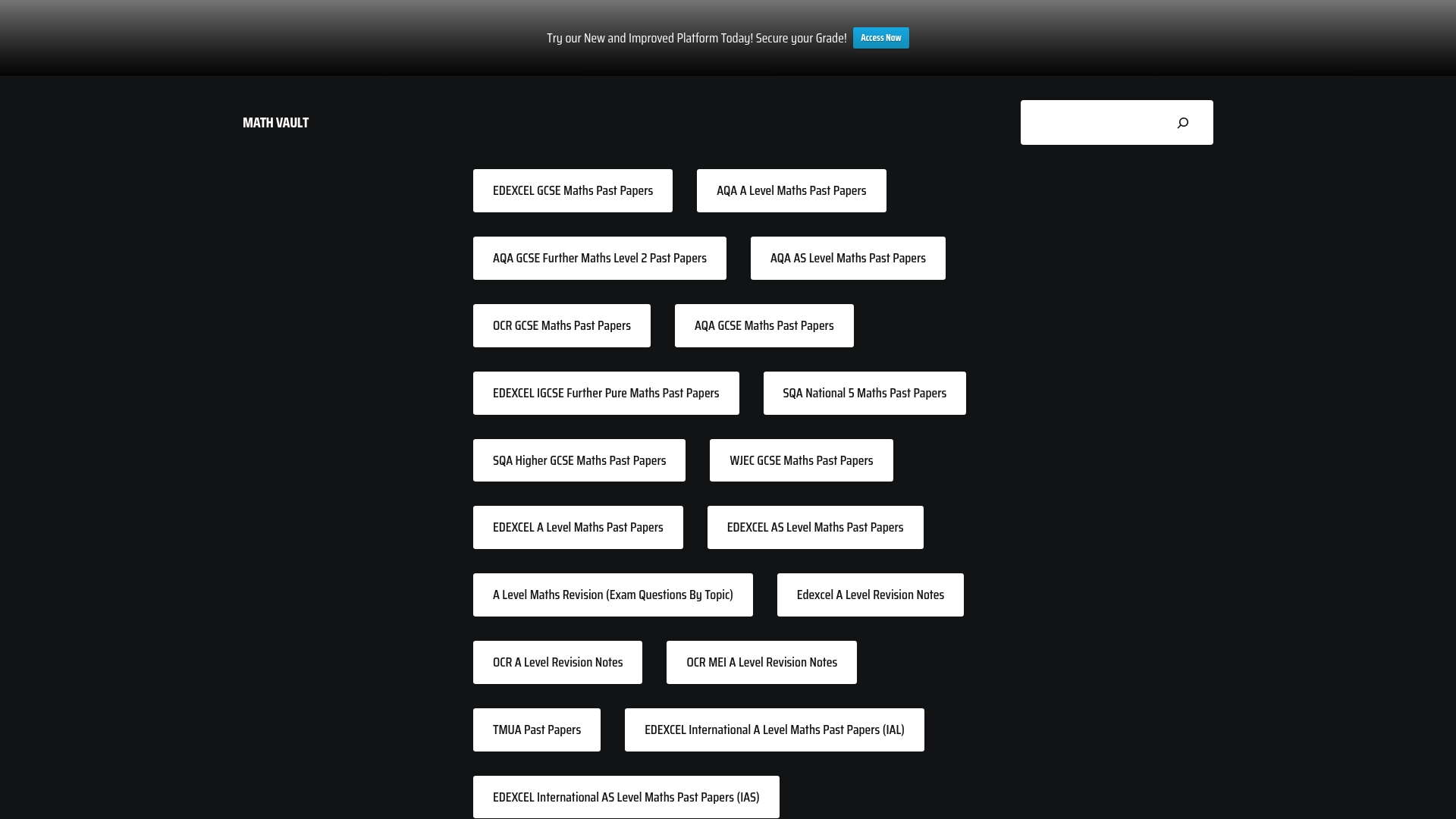
What you get for free: past papers with mark schemes, fully worked solutions showing method and accuracy marks, video walkthroughs, and topic revision guides. What you can purchase: complete downloadable packs per board and year, printer-ready booklets, and priority access to live weekly Q&A sessions where you can put specific questions to a teacher in real time.
WJEC students should head directly to the WJEC resources page for papers organised by year, with worked solutions and video walkthroughs ready to use. For all other boards, the Mathvault home page lists every available resource by board and level.
Start with one past paper, one worked solution, and one timed session. That is enough to identify exactly where to focus next.
Useful sources
Official exam board resources (use these for specifications, past papers, and formula sheets):
- AQA: aqa.org.uk — specification, past papers, mark schemes, and examiner reports.
- Edexcel (Pearson): qualifications.pearson.com — specification, past papers, and formula booklets.
- OCR: ocr.org.uk — specification and past papers; note OCR’s paper structure may differ from the standard format.
- WJEC / Eduqas: wjec.co.uk — specification, past papers, and mark schemes for Wales and England.
- SQA: sqa.org.uk — National 5 and Higher past papers and marking instructions for Scotland.
Trusted revision hubs:
- BBC Bitesize GCSE Maths — board-mapped topic guides, short quizzes, and videos; ideal for daily micro-sessions.
- White Rose Education — concise topic packs used in schools and recommended for home revision.
- Cognito — past papers, quizzes, and flashcards mapped by board and topic.
Mathvault pages referenced in this article:
- Mathvault home — all boards, free resources, and downloadable packs.
- WJEC resources — past papers, worked solutions, and video walkthroughs for WJEC GCSE.
- WJEC 2022 question paper and 2023 worked solutions.
- Mathvault blog — study technique articles and formula sheet guides.
Always cross-check your topic coverage against your official board specification rather than relying on any third-party summary. Specifications are the definitive source of what will and will not appear in your exam.
Leave a Reply